Дослідження використання лікарської рослинної сировини та препаратів на її основі при лікуванні дітей, вагітних та годуючих жінок
DOI:
https://doi.org/10.15587/2519-4852.2026.359138Ключові слова:
лікарські рослини, лікування рослинними засобами, дитячий вік, вагітні, годуючі жінки, потенційні ризикиАнотація
Рослини протягом тисячоліть були основними засобами лікування для людства. Батьки все частіше шукають альтернативні методи лікування, що здаються більш безпечними, для покращення здоров'я своїх дітей, використовуючи засоби на основі рослинної сировини.
Метою дослідження стало отримання обґрунтованої наукової інформації для лікарів та населення про найбільш часто застосовувану лікарську рослинну сировину та фітозасоби для лікування дітей, вагітних жінок та під час годування груддю новонароджених, оцінка можливих ризиків.
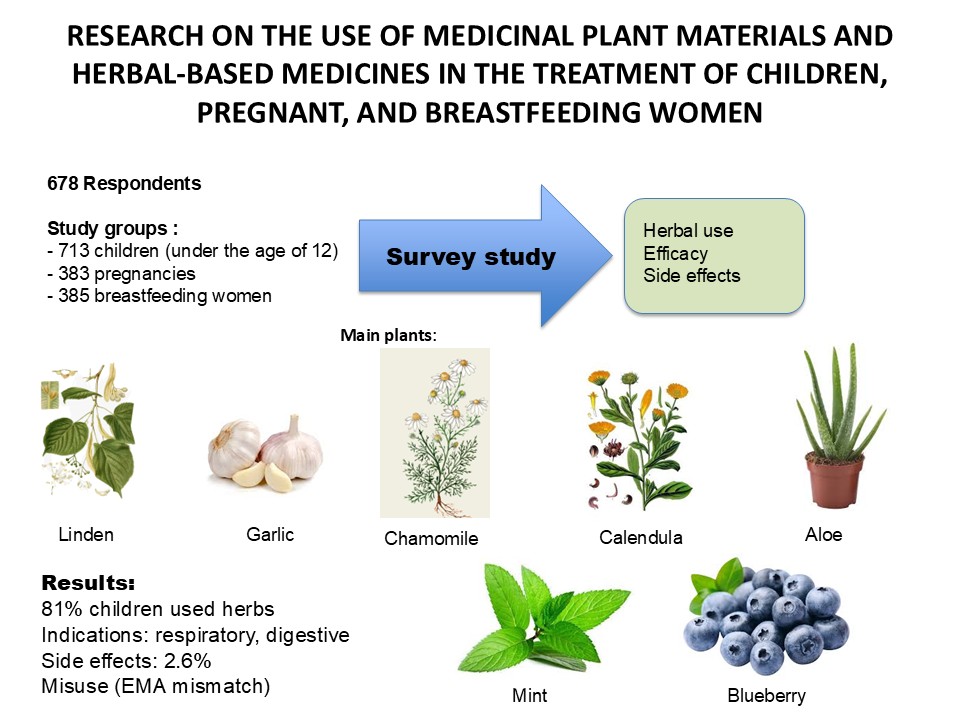
Матеріали і методи. Було зібрано дані щодо 713 дітей віком до 12 років, яких представляли 678 респондентів та 383 (385) жінок. Під час дослідження аналізувалися відомості про використовувані фітозасоби, частоту їх застосування, показання до використання, ефективність лікування, а також можливі побічні ефекти рослинних препаратів. У дослідженні розглядалось використання 7 об’єктів: квіток липи, цибулин часнику, квіток ромашки, квіток календули, листя алое, листя м’яти та плодів чорниці. Аналіз стану вивчення проблеми щодо застосування HMS проведено на основі даних баз PubMed, Embase, Best Evidence, EMA, British Medical Journal.
Результати дослідження. Серед досліджуваного континууму 81% дітей використовували ЛРС або препарати на її основі. Переважними показаннями до застосування були застудні захворювання та розлади травлення. Встановлено, що застосування фітозасобів лише частково відповідало рекомендаціям Європейського агентства з лікарських засобів (EMA). Так, 54% дітей застосовували листя алое для лікування шкірних запалень, що не рекомендовано EMA. Дослідження також виявило використання ЛРС, не рекомендованої EMA, зокрема листя мати-й-мачухи, трави звіробою звичайного та листя гінкго білоба. Побічні ефекти були зафіксовані у 2,6% дітей, найчастіше при використанні цибулин часнику та листя м’яти. Було виявлено використання сировини, яка не рекомендована під час вагітності та лактації, зокрема трави пустирника. Систематизовані дані лягли в основу рекомендацій для лікарів та населення щодо основних критеріїв фітотерапії в педіатрії, вагітних і годуючих жінок.
Висновки. Оскільки ЛРС та препарати на їх основі відіграють важливу роль у лікуванні дітей, а також застосовуються під час вагітності та лактації, і результати дослідження свідчать про використання засобів, не рекомендованих EMA, існує нагальна потреба в інформуванні лікарів та населення щодо правильного застосування фітозасобів та можливих ризиків, пов’язаних із їх використанням
Спонсор дослідження
- European Union in the MSCA4Ukraine project “Design and development of 3D-printed medicines for bioactive materials of Ukrainian and Estonian medicinal plants origin” [ID number 1232466]
Посилання
- Lie, Y. (2024). The Rise of Herbal Medicines: A Global Perspective. Journal of Basic and Clinical Pharmacy, 15 (5), 386.
- Bareetseng, S. (2022). The Worldwide Herbal Market: Trends and Opportunities. Journal of Biomedical Research & Environmental Sciences, 3 (5), 575–584. https://doi.org/10.37871/jbres1482
- Herbal Nutraceuticals Market Size and Share Forecast Outlook 2025 to 2035.. Global Market Analysis Report – 2035. Herbal Nutraceuticals Market. Available at: https://www.futuremarketinsights.com/reports/herbal-nutraceuticals-market
- Leach, M. J., Veziari, Y., Flanagan, C., Schloss, J. (2024). Prevalence of Complementary Medicine Use in Children and Adolescents: A Systematic Review. Journal of Pediatric Health Care, 38 (4), 505–519. https://doi.org/10.1016/j.pedhc.2023.12.010
- Rigillo, G., Blom, J. M. C., Cocchi, A., Martinucci, V., Favaro, F., Baini, G. et al. (2025). Medicinal Plants for Child Mental Health: Clinical Insights, Active Compounds, and Perspectives for Rational Use. Children, 12 (9), 1142. https://doi.org/10.3390/children12091142
- Raal, A., Volmer, D., Sõukand, R., Hratkevitš, S., Kalle, R. (2013). Complementary Treatment of the Common Cold and Flu with Medicinal Plants – Results from Two Samples of Pharmacy Customers in Estonia. PLoS ONE, 8 (3), e58642. https://doi.org/10.1371/journal.pone.0058642
- Sepp, J., Shepeleva, O., Kask, A., Nelis, G., Huttunen, A.-P., Kogermann, K. et al. (2024). Production, marketing and consumption of herbal drugs in Estonia. Journal of Applied Research on Medicinal and Aromatic Plants, 40, 100544. https://doi.org/10.1016/j.jarmap.2024.100544
- Villako, P., Volmer, D., Raal, A. (2012). Factors influencing purchase of and counselling about prescription and OTC medicines at community pharmacies in Tallinn, Estonia. Acta Poloniae Pharmaceutica, 69 (2), 335–340.
- Volmer, D., Raal, A., Kalle, R., Sõukand, R. (2016). The use of Panax ginseng and its analogues among pharmacy customers in estonia: a cross-sectional study. Acta Poloniae Pharmaceutica, 73 (3), 795–802.
- WHO global report on traditional, complementary and integrative medicine 2024 (2025). WHO. Available at: https://www.who.int/publications/i/item/9789240111387
- Hensel, A., Bauer, R., Heinrich, M., Hempel, G., Kelber, O., Kraft, K. et al. (2024). Rationalising Optimal Dosing of Phytotherapeutics For Use In Children: Current Status – Potential Solutions – Actions Needed. Planta Medica, 90 (6), 416–425. https://doi.org/10.1055/a-2294-5259
- Polat, S., Gürol, A.; Akram, M. (Ed.) (2021). Safety of Herbal Medicines in Children. Alternative Medicine – Update. IntechOpen. https://doi.org/10.5772/intechopen.94545
- Du, Y., Wolf, I.-K., Zhuang, W., Bodemann, S., Knöss, W., Knopf, H. (2014). Use of herbal medicinal products among children and adolescents in Germany. BMC Complementary and Alternative Medicine, 14 (1). https://doi.org/10.1186/1472-6882-14-218
- Stierman, B., Mishra, S., Gahche, J. J., Potischman, N., Hales, C. M. (2020). Dietary Supplement Use in Children and Adolescents Aged ≤19 Years — United States, 2017–2018. MMWR. Morbidity and Mortality Weekly Report, 69 (43), 1557–1562. https://doi.org/10.15585/mmwr.mm6943a1
- Petran, M., Dragoș, D., Stoian, I., Vlad, A., Gilca, M. (2024). Current use of medicinal plants for children’s diseases among mothers in Southern Romania. Frontiers in Pharmacology, 15. https://doi.org/10.3389/fphar.2024.1377341
- Mancak Karakuş, M., Tapisiz, A., Mutlu Karakaş, N., Deniz, M., Koca Çalişkan, U. (2023). Use of Herbal Tea/Herbal Preparations for Children with Symptoms of Viral Upper Respiratory Infections. Turkish Journal of Pharmaceutical Sciences, 20 (1), 8–15. https://doi.org/10.4274/tjps.galenos.2022.65475
- Popova, A., Mihaylova, D., Spasov, A. (2021). Plant-based Remedies with Reference to Respiratory Diseases – A Review. The Open Biotechnology Journal, 15 (1), 46–58. https://doi.org/10.2174/1874434602015010046
- Tervisestatistika ja terviseuuringute andmebaas. Available at: https://statistika.tai.ee/pxweb/et/Andmebaas/
- Common Cold in Children. Stanford Medicine Children’s Health. Available at: https://www.stanfordchildrens.org/en/topic/default%3Fid%3Dcommon-cold-in-children-90-P02966
- Long, S. S., Prober, C. G., Fischer, M. (2018). Principles and Practice of Pediatric Infectious Diseases. Elsevier. https://doi.org/10.1016/C2013-0-19020-4
- Illamola, S. M., Amaeze, O. U., Krepkova, L. V., Birnbaum, A. K., Karanam, A., Job, K. M. et al. (2020). Use of Herbal Medicine by Pregnant Women: What Physicians Need to Know. Frontiers in Pharmacology, 10. https://doi.org/10.3389/fphar.2019.01483
- Devi, P., Kumar, P.; Izah, S. C., Ogwu, M. C., Akram, M. (Eds.) (2023). Herbal Medicine and Pregnancy. Herbal Medicine Phytochemistry. Cham: Springer International Publishing, 1–31. https://doi.org/10.1007/978-3-031-21973-3_25-1
- Im, H. B., Hwang, J. H., Choi, D., Choi, S. J., Han, D. (2024). Patient–physician communication on herbal medicine use during pregnancy: a systematic review and meta-analysis. BMJ Global Health, 9 (3), e013412. https://doi.org/10.1136/bmjgh-2023-013412
- Regulatory Situation of Herbal Medicines. A worldwide Review (1998). WHO. Available at: https://www.who.int/publications/i/item/WHO-TRM-98.1
- Sethi, S. S., Bhardwaj, T., Sethi, S. K., Kaur, S., Rimpi, Baldi, A. (2025). Advancing herbal medicine safety: the need for a global pharmacovigilance approach. Naunyn-Schmiedeberg’s Archives of Pharmacology, 398 (10), 13499–13514. https://doi.org/10.1007/s00210-025-04066-2
- Sujithra, M., Puthiyedath, R., Pillai, Z. S. (2025). Drug–herb interactions: a challenge and clinical concern in primary healthcare. Frontiers in Pharmacology, 12. https://doi.org/10.3389/fmed.2025.1657005
- Gupta, A., Kumari, K., Hasan, F., Kumar, V., Kumar, P. (2024). Herb-Drug Interactions: A Critical Exploration in Modern Healthcare Practices. Journal of Medicinal Natural Products. https://doi.org/10.53941/jmnp.2025.100014
- Jovanović, M., Vučićević, K. (2022). Pediatric pharmacokinetic considerations and implications for drug dosing. Arhiv Za Farmaciju, 72 (3), 340–352. https://doi.org/10.5937/arhfarm72-37605
- Ekor, M. (2014). The growing use of herbal medicines: issues relating to adverse reactions and challenges in monitoring safety. Frontiers in Pharmacology, 4. https://doi.org/10.3389/fphar.2013.00177
- Başaran, N., Paslı, D., Başaran, A. A. (2022). Unpredictable adverse effects of herbal products. Food and Chemical Toxicology, 159, 112762. https://doi.org/10.1016/j.fct.2021.112762
- Sartori, D., Aronson, J. K., Brand, J. S., Gauffin, O., Hedfors Vidlin, S., Norén, G. N., Onakpoya, I. J. (2025). Signals of Adverse Reactions to Herbal Medicines: Evidence and Document Analysis Based on a Scoping Review. Drug Safety, 48 (12), 1339–1352. https://doi.org/10.1007/s40264-025-01580-3
- Di Lorenzo, C., Ceschi, A., Kupferschmidt, H., Lüde, S., De Souza Nascimento, E., Dos Santos, A. et al. (2015). Adverse effects of plant food supplements and botanical preparations: a systematic review with critical evaluation of causality. British Journal of Clinical Pharmacology, 79 (4), 578–592. https://doi.org/10.1111/bcp.12519
- Lombardi, N., Crescioli, G., Bettiol, A., Menniti-Ippolito, F., Maggini, V., Gallo, E. et al. (2019). Safety of complementary and alternative medicine in children: A 16-years retrospective analysis of the Italian Phytovigilance system database. Phytomedicine, 61, 152856. https://doi.org/10.1016/j.phymed.2019.152856
- Committee on Herbal Medicinal Products. European Union herbal monographs: Overview of recommendations for the uses of herbal medicinal products in the paediatric population (2023). EMA. Paediatric uses of herbal medicines. Available at: https://www.ema.europa.eu/en/documents/other/european-union-herbal-monographs-overview-recommendations-uses-herbal-medicinal-products-paediatric-population_en.pdf
- Lowance, M., Franco, J., Wang, E., Milanaik, R. (2025). Navigating nature’s remedies: herbal and botanically derived complementary alternative medicine for children. Current Opinion in Pediatrics, 37 (5), 495–507. https://doi.org/10.1097/mop.0000000000001493
- Barnes, L. A. J., Barclay, L., McCaffery, K., Aslani, P. (2019). Women’s health literacy and the complex decision‐making process to use complementary medicine products in pregnancy and lactation. Health Expectations, 22 (5), 1013–1027. https://doi.org/10.1111/hex.12910
- Italia, S., Wolfenstetter, S. B., Teuner, C. M. (2014). Patterns of Complementary and Alternative Medicine (CAM) use in children: a systematic review. European Journal of Pediatrics, 173 (11), 1413–1428. https://doi.org/10.1007/s00431-014-2300-z
- Chiru, T., Fursenco, C., Ciobanu, N., Dinu, M., Popescu, E., Ancuceanu, R. et al. (2020). Use of medicinal plants in complementary treatment of the common cold and influenza – Perception of pharmacy customers in Moldova and Romania. Journal of Herbal Medicine, 21, 100346. https://doi.org/10.1016/j.hermed.2020.100346
- European Union herbal monograph on Vaccinium myrtillus L., fructus siccus (2015). European Medicines Agency. Available at: https://www.ema.europa.eu/en/documents/herbal-monograph/draft-european-union-herbal-monograph-vaccinium-myrtillus-l-fructus-siccus_en.pdf
- European Union herbal monograph on Vaccinium myrtillus L., fructus recens (2015). European Medicines Agency. Available at: https://www.ema.europa.eu/en/documents/herbal-monograph/final-european-union-herbal-monograph-vaccinium-myrtillus-l-fructus-recens_en.pdf
- Ansary, J., Forbes-Hernández, T. Y., Gil, E., Cianciosi, D., Zhang, J., Elexpuru-Zabaleta, M. et al. (2020). Potential Health Benefit of Garlic Based on Human Intervention Studies: A Brief Overview. Antioxidants, 9 (7), 619. https://doi.org/10.3390/antiox9070619
- European Union herbal monograph on Allium sativum L., bulbus (2016). European Medicines Agency. Available at: https://www.ema.europa.eu/en/documents/herbal-monograph/draft-european-union-herbal-monograph-allium-sativum-l-bulbus_en.pdf
- Sahidur, M. R., Islam, S., Jahurul, M. H. A. (2023). Garlic (Allium sativum) as a natural antidote or a protective agent against diseases and toxicities: A critical review. Food Chemistry Advances, 3, 100353. https://doi.org/10.1016/j.focha.2023.100353
- European Union herbal monograph on Aloe barbadensis Mill. and on Aloe (various species, mainly Aloe ferox Mill. and its hybrids), folii succus siccatus (2016). European Medicines Agency. Available at: https://www.ema.europa.eu/en/documents/herbal-monograph/final-european-union-herbal-monograph-aloe-barbadensis-mill-and-aloe-various-species-mainly-aloe-ferox-mill-and-its-hybrids-folii-succus-siccatus_en.pdf
- Hekmatpou, D., Mehrabi, F., Rahzani, K., Aminiyan, A. (2019). The Effect of Aloe Vera Clinical Trials on Prevention and Healing of Skin Wound: A Systematic Review. Iranian Journal of Medical Sciences, 44 (1), 1–9.
- Kennedy, D. A., Lupattelli, A., Koren, G., Nordeng, H. (2016). Safety classification of herbal medicines used in pregnancy in a multinational study. BMC Complementary and Alternative Medicine, 16 (1). https://doi.org/10.1186/s12906-016-1079-z
- Im, H. B., Ghelman, R., Portella, C. F. S., Hwang, J. H., Choi, D., Kunwor, S. K. et al. (2023). Assessing the safety and use of medicinal herbs during pregnancy: a cross-sectional study in São Paulo, Brazil. Frontiers in Pharmacology, 14. https://doi.org/10.3389/fphar.2023.1268185
- Zheng, T., Yao, D., Chen, W., Hu, H., Ung, C. O. L., Harnett, J. E. (2019). Healthcare providers’ role regarding the safe and appropriate use of herbal products by breastfeeding mothers: A systematic literature review. Complementary Therapies in Clinical Practice, 35, 131–147. https://doi.org/10.1016/j.ctcp.2019.01.011
##submission.downloads##
Опубліковано
Як цитувати
Номер
Розділ
Ліцензія
Авторське право (c) 2026 Ain Raal, Elen Nikker, Tetiana Ilina, Alla Kovalyova, Oleh Koshovyi

Ця робота ліцензується відповідно до Creative Commons Attribution 4.0 International License.
Наше видання використовує положення про авторські права Creative Commons Attribution 4.0 International License для журналів відкритого доступу.
Автори, які публікуються у цьому журналі, погоджуються з наступними умовами:
1. Автори залишають за собою право на авторство своєї роботи та передають журналу право першої публікації цієї роботи на умовах ліцензії Creative Commons Attribution 4.0 International License, котра дозволяє іншим особам вільно розповсюджувати опубліковану роботу з обов'язковим посиланням на авторів оригінальної роботи та першу публікацію роботи у цьому журналі.
2. Автори мають право укладати самостійні додаткові угоди щодо неексклюзивного розповсюдження роботи у тому вигляді, в якому вона була опублікована цим журналом (наприклад, розміщувати роботу в електронному сховищі установи або публікувати у складі монографії), за умови збереження посилання на першу публікацію роботи у цьому журналі.
3. Автори мають право зберігати остаточну прийняту версію статті в інституційному, тематичному або будь-якому іншому репозитарії з метою забезпечення видимості та доступності.