Фармацевтичний крем з екстрактом Carthamuse tinctorius L.: розробка та оцінювання
DOI:
https://doi.org/10.15587/2519-4852.2025.342475Ключові слова:
Carthamus tinctorius L., екстракт сафлору, флавоноїди, β-каротин, ІЧ-спектроскопія, спектрофотометрія, ВЕРХ (високоефективна рідинна хроматографія), фармацевтичний крем, м’яка лікарська форма, розробка складу (формуляції), реологія, мікроскопіяАнотація
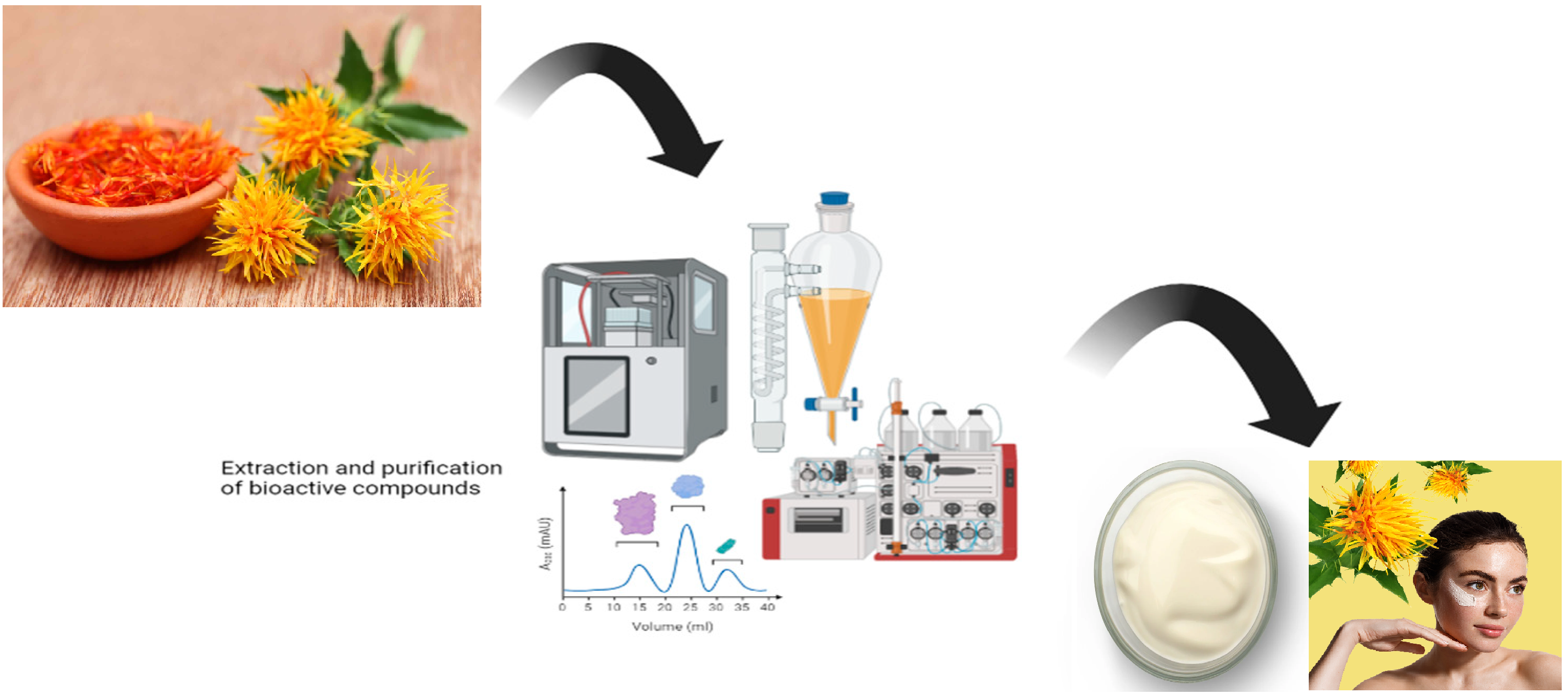
Мета. Метою цього дослідження було розробити та оцінити лікарський засіб у формі крему, що містить рідкий екстракт квіток Carthamus tinctorius L. (сафлору фарбувального).
Дослідження було зосереджене на характеристиці екстракту за допомогою інструментальних аналітичних методів (ІЧ-спектроскопії, спектрофотометрії із використанням рутину як стандарту, ВЕРХ – високоефективної рідинної хроматографії та УФ-спектроскопії для β-каротину), а також на розробці основ кремів із різними гідрофільними, гідрофобними та емульсійними компонентами. Подальша мета дослідження полягала у визначенні показників якості створених зразків, зокрема зовнішнього вигляду, однорідності, термостабільності, колоїдної стабільності та pH, з метою виявлення найбільш стабільних і фармацевтично перспективних композицій.
Методи. Рідкий екстракт квіток Carthamus tinctorius L. використовували як активний фармацевтичний і%D
Посилання
- Sahu, T., Patel, T., Sahu, S., Gidwani, B. (2016). Skin cream as topical drug delivery system: a review. Journal of Pharmaceutical and Biological Sciences, 4 (5), 149. Available at: https://www.researchgate.net/publication/321825248_Skin_Cream_as_Topical_Drug_Delivery_System_A_Review
- Asgarpanah, J., Kazemivash, N. (2013). Phytochemistry, pharmacology and medicinal properties of Carthamus tinctorius L. Chinese Journal of Integrative Medicine, 19 (2), 153–159. https://doi.org/10.1007/s11655-013-1354-5
- Delshad, E., Yousefi, M., Sasannezhad, P., Rakhshandeh, H., Ayati, Z. (2018). Medical uses of Carthamus tinctorius L. (Safflower): a comprehensive review from Traditional Medicine to Modern Medicine. Electronic Physician, 10 (4), 6672–6681. https://doi.org/10.19082/6672
- Lee, J. Y., Chang, E. J., Kim, H. J., Park, J. H., Choi, S. W. (2002). Antioxidative flavonoids from leaves of Carthamus tinctorius. Archives of Pharmacal Research, 25 (3), 313–319. https://doi.org/10.1007/bf02976632
- Ekin, Z. (2005). Resurgence of Safflower (Carthamus tinctorius L.) Utilization: A Global View. Journal of Agronomy, 4 (2), 83–87. https://doi.org/10.3923/ja.2005.83.87
- Emongor, V. (2010). Safflower (Carthamus tinctorius L.) the Underutilized and Neglected Crop: A Review. Asian Journal of Plant Sciences, 9 (6), 299–306. https://doi.org/10.3923/ajps.2010.299.306
- Bakhtiyor kizi, S. I., Shakhsaidovich, S. S., Ravshan kizi, K. A., Gulrano, A., Khalimovna, R. N., Bakhtiyarovna, T. D. (2025). Morphological and size characterization of zinc oxide nanoparticles and evaluation of their cytotoxicity on the MCF-7 cell line. ScienceRise: Pharmaceutical Science, 4 (56), 88–96. https://doi.org/10.15587/2519-4852.2025.338297
- Akhmadova, G., Mirrakhimova, T., Ismoilova, G. (2024). High-quality analysis of dry extract of prickly artichoke raw material (Cynara Scolymus L.) cultivated in Uzbekistan. ScienceRise: Pharmaceutical Science, 4 (50), 60–66. https://doi.org/10.15587/2519-4852.2024.310826
- Olimov, K., Mirrakhimova, T., Akhmadova, G. (2025). Polysaccharide profile, acute toxicity and bile secretion effects of the choleretic herbal preparation “Safroart herbal tea.” ScienceRise: Pharmaceutical Science, 2 (54), 59–68. https://doi.org/10.15587/2519-4852.2025.327605
- Trommer, H., Neubert, R. H. H. (2006). Overcoming the Stratum Corneum: The Modulation of Skin Penetration. Skin Pharmacology and Physiology, 19 (2), 106–121. Portico. https://doi.org/10.1159/000091978
- Pinsky, M. A. (2017). Efficacy and safety of an anti-aging technology for the treatment of facial wrinkles and skin moisturization. The Journal of clinical and aesthetic dermatology, 10 (12), 27–35. Available at: https://www.ncbi.nlm.nih.gov/pmc/articles/PMC5774901/
- Uktamov, B., Rizayeva, N. M., Mirzakamalova, D. S., Sharipova, I. Sh. (2021). Development of the Composition, Technology and Study of the Effectiveness of Drops for Oral Administration "Ascorbicdrop". Journal of Pharmaceutical Research International, 33 (56), 310–316. https://doi.org/10.9734/jpri/2021/v33i56B33957
- Chang, Y., Shi, X., He, F., Wu, T., Jiang, L., Normakhamatov, N. et al. (2022). Valorization of Food Processing Waste to Produce Valuable Polyphenolics. Journal of Agricultural and Food Chemistry, 70 (29), 8855–8870. https://doi.org/10.1021/acs.jafc.2c02655
- El Sohafy, S. M., Nassra, R. A., D’Urso, G., Piacente, S., Sallam, S. M. (2020). Chemical profiling and biological screening with potential anti-inflammatory activity of Callisia fragrans grown in Egypt. Natural Product Research, 35 (23), 5521–5524. https://doi.org/10.1080/14786419.2020.1791113
- Boligon, A. A., Athayde, M. L. (2014). Importance of HPLC in analysis of plant extracts. Austin Chromatography, 1 (3), 2. Available at: https://austinpublishinggroup.com/chromatography/fulltext/chromatography-v1-id1011.php
- Proestos, C., Chorianopoulos, N., Nychas, G.-J. E., Komaitis, M. (2005). RP-HPLC Analysis of the Phenolic Compounds of Plant Extracts. Investigation of Their Antioxidant Capacity and Antimicrobial Activity. Journal of Agricultural and Food Chemistry, 53 (4), 1190–1195. https://doi.org/10.1021/jf040083t
- Engida, A. M., Kasim, N. S., Tsigie, Y. A., Ismadji, S., Huynh, L. H., Ju, Y.-H. (2013). Extraction, identification and quantitative HPLC analysis of flavonoids from sarang semut (Myrmecodia pendan). Industrial Crops and Products, 41, 392–396. https://doi.org/10.1016/j.indcrop.2012.04.043
- Mantzouris, D., Karapanagiotis, I., Panayiotou, C. (2014). Comparison of extraction methods for the analysis of Indigofera tinctoria and Carthamus tinctorius in textiles by high performance liquid chromatography. Microchemical Journal, 115, 78–86. https://doi.org/10.1016/j.microc.2014.02.010
- Johansen, K. T., Wubshet, S. G., Nyberg, N. T., Jaroszewski, J. W. (2011). From Retrospective Assessment to Prospective Decisions in Natural Product Isolation: HPLC-SPE-NMR Analysis of Carthamus oxyacantha. Journal of Natural Products, 74 (11), 2454–2461. https://doi.org/10.1021/np200780m
- Wang, Y., Chen, P., Tang, C., Wang, Y., Li, Y., Zhang, H. (2014). Antinociceptive and anti-inflammatory activities of extract and two isolated flavonoids of Carthamus tinctorius L. Journal of Ethnopharmacology, 151 (2), 944–950. https://doi.org/10.1016/j.jep.2013.12.003
- Meinhardt-Wollweber, M., Suhr, C., Kniggendorf, A.-K., Roth, B. (2018). Absorption and resonance Raman characteristics of β-carotene in water-ethanol mixtures, emulsion and hydrogel. AIP Advances, 8 (5). https://doi.org/10.1063/1.5025788
- Hagos, M., Redi-Abshiro, M., Chandravanshi, B. S., Yaya, E. E. (2022). Development of Analytical Methods for Determination of β-Carotene in Pumpkin (Cucurbita maxima) Flesh, Peel, and Seed Powder Samples. International Journal of Analytical Chemistry, 2022, 1–11. https://doi.org/10.1155/2022/9363692
##submission.downloads##
Опубліковано
Як цитувати
Номер
Розділ
Ліцензія
Авторське право (c) 2025 Nilufar Rizaeva, Gulrano Akhmadova, Munozhat Akhmedova, Dilnoza Bakhriddinova, Nozima Aripova, Irodakhon Sharipova, Nigora Azlarova, Umida Anarmetova

Ця робота ліцензується відповідно до Creative Commons Attribution 4.0 International License.
Наше видання використовує положення про авторські права Creative Commons Attribution 4.0 International License для журналів відкритого доступу.
Автори, які публікуються у цьому журналі, погоджуються з наступними умовами:
1. Автори залишають за собою право на авторство своєї роботи та передають журналу право першої публікації цієї роботи на умовах ліцензії Creative Commons Attribution 4.0 International License, котра дозволяє іншим особам вільно розповсюджувати опубліковану роботу з обов'язковим посиланням на авторів оригінальної роботи та першу публікацію роботи у цьому журналі.
2. Автори мають право укладати самостійні додаткові угоди щодо неексклюзивного розповсюдження роботи у тому вигляді, в якому вона була опублікована цим журналом (наприклад, розміщувати роботу в електронному сховищі установи або публікувати у складі монографії), за умови збереження посилання на першу публікацію роботи у цьому журналі.
3. Автори мають право зберігати остаточну прийняту версію статті в інституційному, тематичному або будь-якому іншому репозитарії з метою забезпечення видимості та доступності.