Леткі сполуки дистилятів та гексанових екстрактів квіток садового жасмину вінцевого та жасмину лікарського
DOI:
https://doi.org/10.15587/2519-4852.2024.318497Ключові слова:
Philadelphus coronarius, Jasminum officinale, ефірна олія, компонентний складАнотація
Jasminum L. родини Oleaceae – рід рослин, які культивуються заради ароматичних квіток, що є джерелом ефірної олії (EO). У країнах з помірним кліматом внаслідок подібного аромату квіток жасмином, або псевдожасмином, часто називають Philadelphus coronarius L. родини Hydrangeáceae або Philadelphaceae.
Мета. Метою дослідження було порівняння компонентного складу летких сполук гідродистилятів та гексанових екстрактів з квіток Philadelphus coronarius L. та Jasminum officinale L.
Матеріали і методи. Методом ГХ-МС було проаналізовано гідродистиляти, отримані з сухих квіток J. officinale та з сухих та свіжих квіток P. coronarius, а також гексанові екстракти з аналогічної сировини.
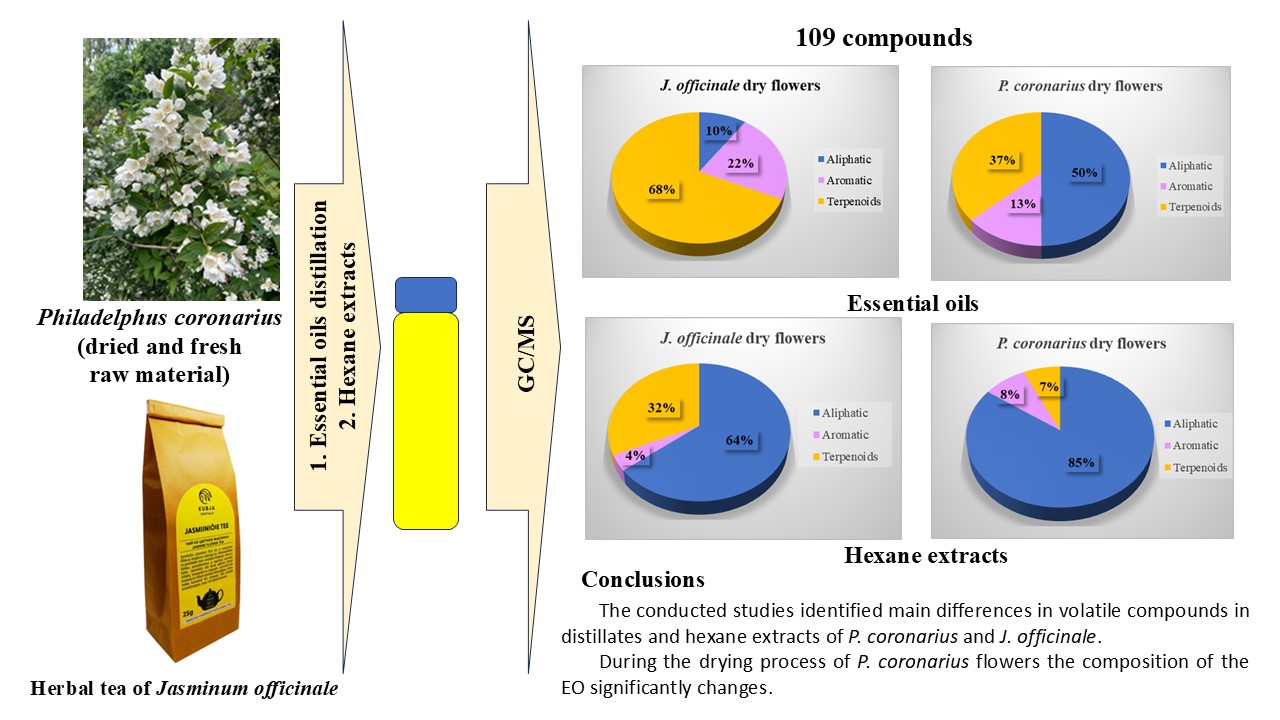
Результати і обговорення. Ідентифіковано 109 сполук. Встановлено, що в EO J. officinale, отриманої методом гідродистиляції, вміст терпеноїдів складає 90,31 %, у гексановому екстракті цієї ж сировини вміст терпеноїдів становить лише 36,24 %. У EO P. coronarius, отриманої методом гідродистиляції сухих квіток, вміст терпеноїдів складає 50,04 %, а із свіжих квіток – 45,13 %. У гексановому екстракті із сухих квіток P. coronarius вміст терпеноїдів складає лише 14,63 %, у той час як у екстракті із свіжих квіток – 52,55 %. У EO J. officinale, отриманої методом гідродистиляції, домінуючими компонентами є (E)-geranyl linalool (12,86 %), linalool (10,72 %), (Z)-3-hexen-1-ol benzoate (7,82 %), α-farnesene (7,72 %), D-limonene (6,43 %), methyl anthranilate (5,9 %), (Z)-9-tricosene (4,15 %). У EO, отриманої методом гідродистиляції із сухих квіток P. coronarius, домінуючими компонентами є: (1R)-(-)-myrtenal (12,73 %), myrtanal (11,09 %), pentadecanal (9,42 %), tricosane (8,33 %), (Z)-jasmone (7,09 %). У EO, отриманої методом гідродистиляції із свіжих квіток P. coronarius, домінуючими компонентами є: nerolidol (19,42 %), ethyl palmitate (19,13 %), methyl 2-methylpalmitate (16,44 %), myrtanal (9,91 %), pentadecanal (5,28 %), (Z)-jasmone (2,72 %).
Висновки. Проведені дослідження виявили основні відмінності летких сполук у дистилятах і гексанових екстрактах P. coronarius і J. officinale. Всього в об’єктах ідентифіковано 109 сполук та встановлено домінуючі компоненти. У процесі сушіння квіток P. coronarius склад ЕО істотно змінюється. Лише гексанові екстракти з висушених квіток J. officinale і P. coronarius містили тритерпеноїд сквален у значних кількостях (13,96 % і 6,72 %). Спільними для гексанових екстрактів досліджуваних об’єктів є ароматичні сполуки: спирт бензиловий, 2,4-ди-трет-бутилфенол; аліфатичні сполуки: 2,4-диметил-гептан, октанал, деканаль
Спонсор дослідження
- European Union in the MSCA4Ukraine project “Design and development of 3D-printed medicines for bioactive materials of Ukrainian and Estonian medicinal plants origin” [ID number 1232466].
Посилання
- Harilik ebajasmiin. Wikipedia. Available at: https://et.wikipedia.org/wiki/Harilik_ebajasmiin Last accessed: 10.25.2024
- Ebajasmiin (perekond). Wikipedia. Available at: https://et.wikipedia.org/wiki/Ebajasmiin_(perekond)
- Philadelphus coronarius L. Plants of the World Online. Kew Science. Available at: https://powo.science.kew.org/taxon/urn:lsid:ipni.org:names:792194-1
- Philadelphus coronarius L. World flora online. Available at: https://www.worldfloraonline.org/taxon/wfo-0000465348
- Mucaji, P., Grancai, D., Nagy, M., Czigleová, S., Budĕsínský, M., Ubik, K. (2001). Nonpolar components of the leaves of Philadelphus coronarius L. Ceska a Slovenska farmacie, 50 (6), 274–276.
- Pető, Á., Kósa, D., Haimhoffer, Á., Nemes, D., Fehér, P., Ujhelyi, Z. et al. (2022). Topical Dosage Formulation of Lyophilized Philadelphus coronarius L. Leaf and Flower: Antimicrobial, Antioxidant and Anti-Inflammatory Assessment of the Plant. Molecules, 27 (9), 2652. https://doi.org/10.3390/molecules27092652
- Czigle, S., Mu[cbreve]aji, P., Gran[cbreve]ai, D., Veres, K., Háznagy-Radnai, E., Dobos, Á., Máthé, I., Tóth, L. (2006). Identification of the Components ofPhiladelphus coronariusL. Essential Oil. Journal of Essential Oil Research, 18 (4), 423–426. https://doi.org/10.1080/10412905.2006.9699130
- Klecáková, J., Chobot, V., Jahodár, L., Laakso, I., Víchová, P. (2004). Antiradical activity of petals of Philadelphus coronarius L. Central European Journal of Public Health, 12, 39–40.
- Nagy, M., Grancai, D., Jantova, S., Ruzekova, L. (2000). Antibacterial activity of plant extracts from the families Fabaceae, Oleaceae, Philadelphaceae, Rosaceae and Staphyleaceae. Phytotherapy Research, 14 (8), 601–603. https://doi.org/10.1002/1099-1573(200012)14:8<601::aid-ptr771>3.0.co;2-b
- Dilshara, M. G., Jayasooriya, R. G. P. T., Lee, S., Jeong, J. B., Seo, Y. T., Choi, Y. H. et al. (2013). Water extract of processed Hydrangea macrophylla (Thunb.) Ser. leaf attenuates the expression of pro-inflammatory mediators by suppressing Akt-mediated NF-κB activation. Environmental Toxicology and Pharmacology, 35 (2), 311–319. https://doi.org/10.1016/j.etap.2012.12.012
- Jasminum L. Plants of the World Online. Kew Science. Available at: https://powo.science.kew.org/taxon/urn:lsid:ipni.org:names:328128-2
- Jasminum officinale L. Plants of the World Online. Kew Science. Available at: https://powo.science.kew.org/taxon/urn:lsid:ipni.org:names:609672-1
- BSBI List 2007 (xls). Botanical Society of Britain and Ireland. Archived from the original (xls) on 2015-06-26.; "Jasminum officinale". Germplasm Resources Information Network. Agricultural Research Service, United States Department of Agriculture.
- Makeri, M., Salihu, A.; Nayik, G. A., Ansari, M. J. (Eds.) (2023). Jasmine essential oil: Production, extraction, characterization, and applications. Essential Oils. Academic Press, 147–177. https://doi.org/10.1016/b978-0-323-91740-7.00013-x
- Dinh Phuc, N., Phuong Thy, L. H., Duc Lam, T., Yen, V. H., Thi Ngoc Lan, N. (2019). Extraction of Jasmine Essential Oil By Hydrodistillation method and Applications On Formulation of Natural Facial Cleansers. IOP Conference Series: Materials Science and Engineering, 542 (1), 012057. https://doi.org/10.1088/1757-899x/542/1/012057
- Jasmine Essential Oil Market Research Report (2021). Report ID: Global Forecast To 2028, 249. Available at: https://industrygrowthinsights.com/report/jasmine-essential-oil-market/
- Singh, B., Sharma, R. A. (2020). Secondary Metabolites of Medicinal Plants, 4 Volume Set: Ethnopharmacological Properties, Biological Activity and Production Strategies. Hoboken: John Wiley & Sons, 574–584. https://doi.org/10.1002/9783527825578
- Rattan, R. (2023). Genus Jasminum: Phytochemicals and Pharmacological effects-a Review. International Journal of Research and Analytical Reviews, 10 (2), 787–795.
- Rattan, R. (2023). Secoiridoids from Jasminum Species- A Report. of Emerging Technologies and Innovative Research. Journal of Emerging Technologies and Innovative Research, 10 (6), 104–109. Available at: https://www.researchgate.net/publication/373709272
- Frezza, C., Nicolosi, R. M., Brasili, E., Mura, F., De Vita, D. (2024). Occurrence and Biological Activities of Seco‐Iridoids from Jasminum L. Chemistry & Biodiversity, 21 (4). https://doi.org/10.1002/cbdv.202400254
- Elhawary, S., El-Hefnawy, H., Mokhtar, F. A., Sobeh, M., Mostafa, E., Osman, S., El-Raey, M. (2020). Green Synthesis of Silver Nanoparticles Using Extract of Jasminum officinal L. Leaves and Evaluation of Cytotoxic Activity Towards Bladder (5637) and Breast Cancer (MCF-7) Cell Lines. International journal of nanomedicine, 15, 9771–9781. https://doi.org/10.2147/ijn.s269880
- Lu, Y., Han, Z.-Z., Zhang, C.-G., Ye, Z., Wu, L.-L., Xu, H. (2019). Four new sesquiterpenoids with anti-inflammatory activity from the stems of Jasminum officinale. Fitoterapia, 135, 22–26. https://doi.org/10.1016/j.fitote.2019.03.029
- Dubey, P., Tiwari, A., Gupta, S. K., Watal, G. (2016). Phytochemical and biochemical studies of Jasminum officinale leaves. International Journal of Pharmaceutical Sciences and Research, 7 (6), 2632–2640. https://doi.org/10.13040/ijpsr.0975-8232.7(6).2632-40
- El-Hawary, S. S., EL-Hefnawy, H. M., Osman, S. M., EL-Raey, M. A., Mokhtar Ali, F. A. (2019). Phenolic profiling of differentJasminumspecies cultivated in Egypt and their antioxidant activity. Natural Product Research, 35 (22), 4663–4668. https://doi.org/10.1080/14786419.2019.1700508
- Al-Snafi, A. E. (2018). Pharmacology and Medical Properties of Jasminum officinale – A Review. Indo American Journal of Pharmaceutical Sciences, 5 (4), 2191–2197. http://doi.org/10.5281/zenodo.1214994
- Wei, F., Chen, F., Tan, X. (2015). Gas Chromatographic-Mass Spectrometric Analysis of Essential Oil of Jasminum officinale L var Grandiflorum Flower. Tropical Journal of Pharmaceutical Research, 14 (1), 149–152. https://doi.org/10.4314/tjpr.v14i1.21
- Garg, P., Garg, V. (2023). Bibliometric Analysis of the Genus Jasminum: Global Status, Research and Trends. Journal of Herbal Medicine, 41, 100711. https://doi.org/10.1016/j.hermed.2023.100711
- Kaviani, M., Maghbool, S., Azima, S., Tabaei, M. H. (2014). Comparison of the effect of aromatherapy with Jasminum officinale and Salvia officinale on pain severity and labor outcome in nulliparous women. Iranian journal of nursing and midwifery research, 19 (6), 666–672.
- Mukhlis, H., Nurhayati, N., Wandini, R. (2018). Effectiveness of Jasmine oil (Jasminum officinale) massage on reduction of labor pain among primigravida mothers. Malahayati International Journal of Nursing and Health Science, 1 (2), 47–52. https://doi.org/10.33024/minh.v1i2.1590
- Saxena, S., Uniyal, V., Bhatt, R. P. (2012). Inhibitory effect of essential oils against Trichosporon ovoides causing Piedra Hair Infection. Brazilian Journal of Microbiology, 43 (4), 1347–1354. https://doi.org/10.1590/s1517-83822012000400016
- Al-Khazraji, S. M. (2015). Evaluation of antibacterial activity of Jasminum officinale. IOSR Journal of Pharmacy and Biological Sciences, 10 (1), 121–124.
- Rama, G., Ampati S. (2013). Evaluation of flowers of Jasminum officinale for antibacterial activity. Journal of Advanced Pharmaceutical Sciences, 3 (1), 428–431.
- Balkrishna, A., Rohela, A., Kumar, A., Kumar, A., Arya, V., Thakur, P. et al. (2021). Mechanistic Insight into Antimicrobial and Antioxidant Potential of Jasminum Species: A Herbal Approach for Disease Management. Plants, 10 (6), 1089. https://doi.org/10.3390/plants10061089
- Khan, U. A., Rahman, H., Niaz, Z., Qasim, M., Khan, J., Tayyaba, Rehman, B. (2013). Antibacterial activity of some medicinal plants against selected human pathogenic bacteria. European Journal of Microbiology and Immunology, 3 (4), 272–274. https://doi.org/10.1556/eujmi.3.2013.4.6
- Bera, P., Kotamreddy, J. N. R., Samanta, T., Maiti, S., Mitra, A. (2015). Inter-specific variation in headspace scent volatiles composition of four commercially cultivated jasmine flowers. Natural Product Research, 29 (14), 1328–1335. https://doi.org/10.1080/14786419.2014.1000319
- Issa, M. Y., Mohsen, E., Younis, I. Y., Nofal, E. S., Farag, M. A. (2020). Volatiles distribution in jasmine flowers taxa grown in Egypt and its commercial products as analyzed via solid-phase microextraction (SPME) coupled to chemometrics. Industrial Crops and Products, 144, 112002. https://doi.org/10.1016/j.indcrop.2019.112002
- Lasekan, O., Lasekan, A. (2012). Flavour chemistry of mate and some common herbal teas. Trends in Food Science & Technology, 27 (1), 37–46. https://doi.org/10.1016/j.tifs.2012.05.004
- Henno, O. (1995). Puude ja põõsaste välimääraja. Tallinn, 580.
- Kubja ürditalu. Aastast 1988. Available at: https://kubja.ee/ Last accessed: 10.25.2024
- European Pharmacopoeia. 11th ed. (2022). Strasbourg: Council of Europe.
- Hrytsyk, Y., Koshovyi, O., Lepiku, M., Jakštas, V., Žvikas, V., Matus, T. et al. (2024). Phytochemical and Pharmacological Research in Galenic Remedies of Solidago canadensis L. Herb. Phyton, 93 (9), 2303–2315. https://doi.org/10.32604/phyton.2024.055117
- (Z)-Jasmone. Available at: https://www.thegoodscentscompany.com/data/rw1016891.html
- Wasternack, C., Song, S. (2017). Jasmonates: biosynthesis, metabolism, and signaling by proteins activating and repressing transcription. Journal of Experimental Botany, 68 (6), 1303–1321. https://doi.org/10.1093/jxb/erw443
##submission.downloads##
Опубліковано
Як цитувати
Номер
Розділ
Ліцензія
Авторське право (c) 2024 Raal Ain, Тetiana Ilina, Alla Kovaleva, Oleh Koshovyi

Ця робота ліцензується відповідно до Creative Commons Attribution 4.0 International License.
Наше видання використовує положення про авторські права Creative Commons Attribution 4.0 International License для журналів відкритого доступу.
Автори, які публікуються у цьому журналі, погоджуються з наступними умовами:
1. Автори залишають за собою право на авторство своєї роботи та передають журналу право першої публікації цієї роботи на умовах ліцензії Creative Commons Attribution 4.0 International License, котра дозволяє іншим особам вільно розповсюджувати опубліковану роботу з обов'язковим посиланням на авторів оригінальної роботи та першу публікацію роботи у цьому журналі.
2. Автори мають право укладати самостійні додаткові угоди щодо неексклюзивного розповсюдження роботи у тому вигляді, в якому вона була опублікована цим журналом (наприклад, розміщувати роботу в електронному сховищі установи або публікувати у складі монографії), за умови збереження посилання на першу публікацію роботи у цьому журналі.
3. Автори мають право зберігати остаточну прийняту версію статті в інституційному, тематичному або будь-якому іншому репозитарії з метою забезпечення видимості та доступності.