Дослідження амінокислотного складу альтернативних білків (Helix pomatia, Lissachatina fulica, Helix aspersa) та потенціалу їх використання у здоровій дієті: розробка сучасної рецептури брандаду
DOI:
https://doi.org/10.15587/2706-5448.2025.326896Ключові слова:
європейська кухня, рибні вироби, філе равликів, незамінні амінокислоти, відходи харчових виробництв, ізолят білка макухи насіння гарбуза, їжа майбутньогоАнотація
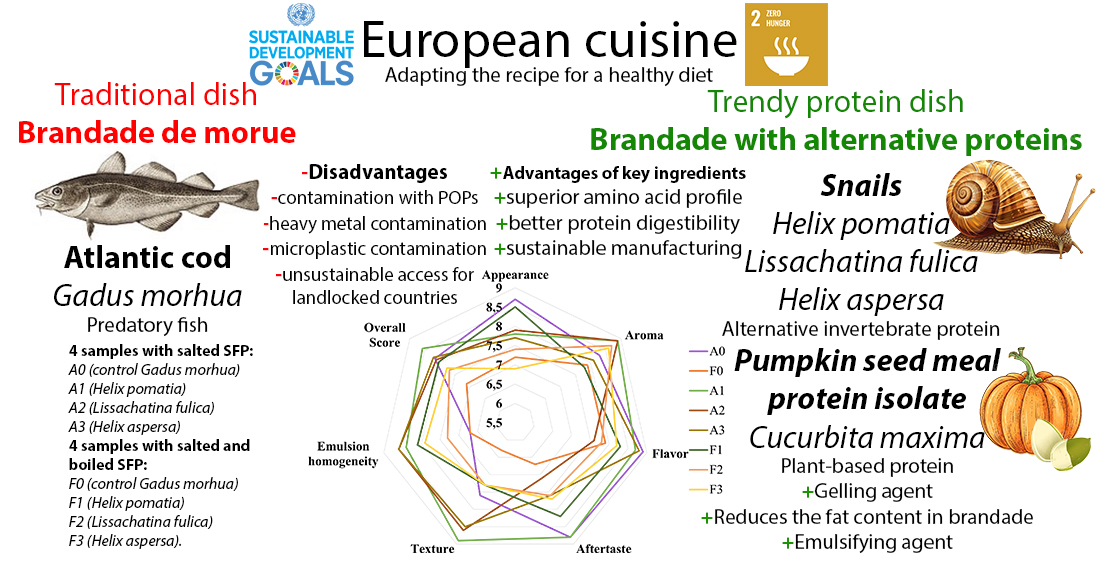
Інтеграція традиційної європейської кухні з альтернативними джерелами білка може зміцнити продовольчу безпеку та забезпечити населення здоровою їжею. Попередні наукові праці вказують на харчовий та екологічний потенціал альтернативних білків. Однак, існує прогалина у дослідженнях щодо їхньої практичної інтеграції в автентичні європейські рецептури з метою покращення харчової цінності, сенсорних характеристик та сприяння здоровому харчуванню. Дане дослідження зосереджене на проблемі вдосконалення брандаду з тріски для здорового харчування. Одним з проблемних місць традиційного брандаду є високий вміст жиру, обмежений вміст білка та використання хижої риби. Це ставить питання щодо його відповідності принципам здорового харчування. Об’єктом дослідження є рецептура та якість брандаду з тріски та його модифікації з альтернативним білком. Розроблено 4 зразки з соленими н/ф: A0 (контроль Gadus morhua), A1 (Helix pomatia), A2 (Lissachatina fulica), A3 (Helix aspersa), та 4 зразки з соленими та вареними н/ф (50 % мас./мас.): F0 (контроль Gadus morhua), F1 (Helix pomatia), F2 (Lissachatina fulica), F3 (Helix aspersa). У дослідних зразках оливкову олію замінили ізолятом білка макухи насіння гарбуза (50 % мас./мас.). Найбільша кількість незамінних амінокислот серед равликів була в Helix pomatia (8,39 г/100 г), але менше контролю на 23,72 %. Найвищу потенційну біологічну цінність мав білок зразка Helix pomatia (87,01 %), що більше контролю на 3,85 %. Суттєво змінюється хімічний склад брандаду. Контроль вирізняється вищим вмістом жиру, A0 має найвищий його показник 29.96 %, що на 14,46 % більше A1. Зразки з равликами мають вищий вміст білка, найбільше якого у A1 35.20 %, що на 15,86 % більше A0. A1 мав найвищу сенсорну оцінку 8,6, перевершивши A0 на 0,4. Показники текстури та однорідності емульсії були кращі у дослідних зразків, завдяки ізоляту білка. Отримані результати підкреслюють значний потенціал використання альтернативних білків для модернізації європейської кухні та створення інноваційних харчових продуктів для здорового харчування.
Посилання
- How to feed the world in 2050. Proceedings of the Expert Meeting on How to Feed the World in 2050 (2009). Rome: Food and Agriculture Organization of the United Nations.
- Yang, F., Ren, L., Sun, J., Gu, C. (2025). A study of the purchase intention of alternative foods. Scientific Reports, 15 (1). https://doi.org/10.1038/s41598-025-90014-2
- Leip, A., Billen, G., Garnier, J., Grizzetti, B., Lassaletta, L., Reis, S. et al. (2015). Impacts of European livestock production: nitrogen, sulphur, phosphorus and greenhouse gas emissions, land-use, water eutrophication and biodiversity. Environmental Research Letters, 10 (11), 115004. https://doi.org/10.1088/1748-9326/10/11/115004
- Lisboa, H. M., Nascimento, A., Arruda, A., Sarinho, A., Lima, J., Batista, L. et al. (2024). Unlocking the Potential of Insect-Based Proteins: Sustainable Solutions for Global Food Security and Nutrition. Foods, 13 (12), 1846. https://doi.org/10.3390/foods13121846
- Golovko, N., Golovko, T., Gelikh, A. (2015). Investigation of amino acid structure of proteins of freshwater bivalve mussels from the genus anodonta of the northern Ukraine. Eastern-European Journal of Enterprise Technologies, 5 (11 (77)), 10–16. https://doi.org/10.15587/1729-4061.2015.51072
- Rygało-Galewska, A., Zglińska, K., Niemiec, T. (2022). Edible Snail Production in Europe. Animals, 12 (20), 2732. https://doi.org/10.3390/ani12202732
- Kougiagka, E., Apostologamvrou, C., Giannouli, P., Hatziioannou, M. (2022). Quality Factors of Commercial Snail Fillets as Affected by Species. Food Technology and Biotechnology, 60 (3), 330–337. https://doi.org/10.17113/ftb.60.03.22.7403
- Zeng, L., Wang, Z., He, Z., Zeng, M., Qin, F., Chen, J. (2022). Physicochemical and gel properties of pumpkin seed protein: a comparative study. International Journal of Food Science & Technology, 58 (3), 1639–1651. https://doi.org/10.1111/ijfs.16124
- Ezzat, S. M., Adel, R., Abdel-Sattar, E. (2022). Pumpkin Bio-Wastes as Source of Functional Ingredients. Mediterranean Fruits Bio-Wastes: Chemistry, functionality and technological applications. Springer, 667–696. https://doi.org/10.1007/978-3-030-84436-3_29
- Gao, D., Helikh, A., Duan, Z., Liu, Y., Shang, F. (2022). Development of pumpkin seed meal biscuits. Eastern-European Journal of Enterprise Technologies, 2 (11 (116)), 36–42. https://doi.org/10.15587/1729-4061.2022.254940
- Liu, Y., Helikh, A., Filon, A., Duan, Z. (2023). Sausage technology for food sustainability: recipe, color, nutrition, structure. Eastern-European Journal of Enterprise Technologies, 4 (11 (124)), 47–58. https://doi.org/10.15587/1729-4061.2023.286323
- Machado, P., McNaughton, S. A., Wingrove, K., Stephens, L. D., Baker, P., Lawrence, M. (2024). A Scoping Review of the Causal Pathways and Biological Mechanisms Linking Nutrition Exposures and Health Outcomes. Current Nutrition Reports, 14 (1). https://doi.org/10.1007/s13668-024-00591-3
- Liu, Z., Hu, X., Lu, S., Xu, B., Bai, C., Ma, T., Song, Y. (2025). Advances in plant-based raw materials for food 3D printing. Journal of Future Foods, 5 (6), 529–541. https://doi.org/10.1016/j.jfutfo.2024.11.001
- Khan, G., Irshad, G., Ijaz, R., Javaid, S., Tahir, N., Mehmood, S. (2025). Emboldening food security for global sustainability yoking artificial intelligence. Discover Food, 5 (1). https://doi.org/10.1007/s44187-025-00273-1
- Wang, Y., Chen, Q., Li, L., Chen, S., Zhao, Y., Li, C. et al. (2023). Transforming the fermented fish landscape: Microbiota enable novel, safe, flavorful, and healthy products for modern consumers. Comprehensive Reviews in Food Science and Food Safety, 22 (5), 3560–3601. https://doi.org/10.1111/1541-4337.13208
- Lee, C.-H., Ahn, J., Son, H.-S. (2024). Ethnic fermented foods of the world: an overview. Journal of Ethnic Foods, 11 (1). https://doi.org/10.1186/s42779-024-00254-2
- Casanova-Martínez, I., Hernández-López, E., Signes-Pastor, A. J., Sendra, E., Carbonell-Barrachina, Á. A., Cano-Lamadrid, M. (2025). Abiotic pollutant concentrations in fish: A comparative review of wild-caught and aquaculture sources. Food Control, 174, 111220. https://doi.org/10.1016/j.foodcont.2025.111220
- Pais-Costa, A. J., Marques, A., Oliveira, H., Gonçalves, A., Camacho, C., Augusto, H. C., Nunes, M. L. (2025). New Perspectives on Canned Fish Quality and Safety on the Road to Sustainability. Foods, 14 (1), 99. https://doi.org/10.3390/foods14010099
- Liu, Y., Helikh, A. O., Filon, A. M., Tang, X.-X., Duan, Z.-H., Ren, A.-Q. (2024). Beetroot (Beta vulgaris L. var. conditiva Alef.) pretreated by freeze-thaw: influence of drying methods on the quality characteristics. CyTA – Journal of Food, 22 (1), 1–12. https://doi.org/10.1080/19476337.2023.2295421
- Visciano, P. (2024). Environmental Contaminants in Fish Products: Food Safety Issues and Remediation Strategies. Foods, 13 (21), 3511. https://doi.org/10.3390/foods13213511
- Gao, D., Helikh, A., Filon, A., Duan, Z., Vasylenko, O. (2022). Effect of pH-shifting treatment on the gel properties of pumpkin seed protein isolate. Journal of Chemistry and Technologies, 30 (2), 198–204. https://doi.org/10.15421/jchemtech.v30i2.241145
- Kjeldahl, J. (1883). Neue Methode zur Bestimmung des Stickstoffs in organischen Körpern. Zeitschrift Für Analytische Chemie, 22 (1), 366–382. https://doi.org/10.1007/bf01338151
- Soxhlet, F. (1879). Die gewichtsanalytische Bestimmung des Milchfettes. Polytechnisches Journal, 232, 461–465.
- Official methods of analysis of AOAC International (2022). AOAC International.
- Poole, C. F. (2023). Instrumental Thin-Layer Chromatography. Elsevier. https://doi.org/10.1016/c2021-0-01004-x
- Protein and amino acid requirements in human nutrition: Report of a joint FAO/WHO/UNU expert consultation (WHO Technical Report Series No. 935) (2007). World Health Organization, Food and Agriculture Organization of the United Nations, & United Nations University.
- Lawless, H. T., Heymann, H. (2010). Sensory evaluation of food: Principles and practices. Springer Science & Business Media. https://doi.org/10.1007/978-1-4419-6488-5
- Reboul, J.-B. (1897). La Cuisinière Provençale. Tacussel.
- Llibre de Sent Soví (1324).
- Grewe, R. (Ed.) (2006). Libre de Sent Soví: receptari de cuina. Editorial Barcino.
- de Nola, R. (1520). Libre del Coch.
##submission.downloads##
Опубліковано
Як цитувати
Номер
Розділ
Ліцензія
Авторське право (c) 2025 Anna Helikh, Andrii Filon

Ця робота ліцензується відповідно до Creative Commons Attribution 4.0 International License.
Закріплення та умови передачі авторських прав (ідентифікація авторства) здійснюється у Ліцензійному договорі. Зокрема, автори залишають за собою право на авторство свого рукопису та передають журналу право першої публікації цієї роботи на умовах ліцензії Creative Commons CC BY. При цьому вони мають право укладати самостійно додаткові угоди, що стосуються неексклюзивного поширення роботи у тому вигляді, в якому вона була опублікована цим журналом, але за умови збереження посилання на першу публікацію статті в цьому журналі.