Study of the amino acid profile of alternative proteins (Helix pomatia, Lissachatina fulica, Helix aspersa) and their potential application in a healthy diet: optimization of a modern brandade recipe
DOI:
https://doi.org/10.15587/2706-5448.2025.326896Keywords:
European cuisine, fish products, snail fillet, essential amino acids, food industry by-products, pumpkin seed meal protein isolate, future foodAbstract
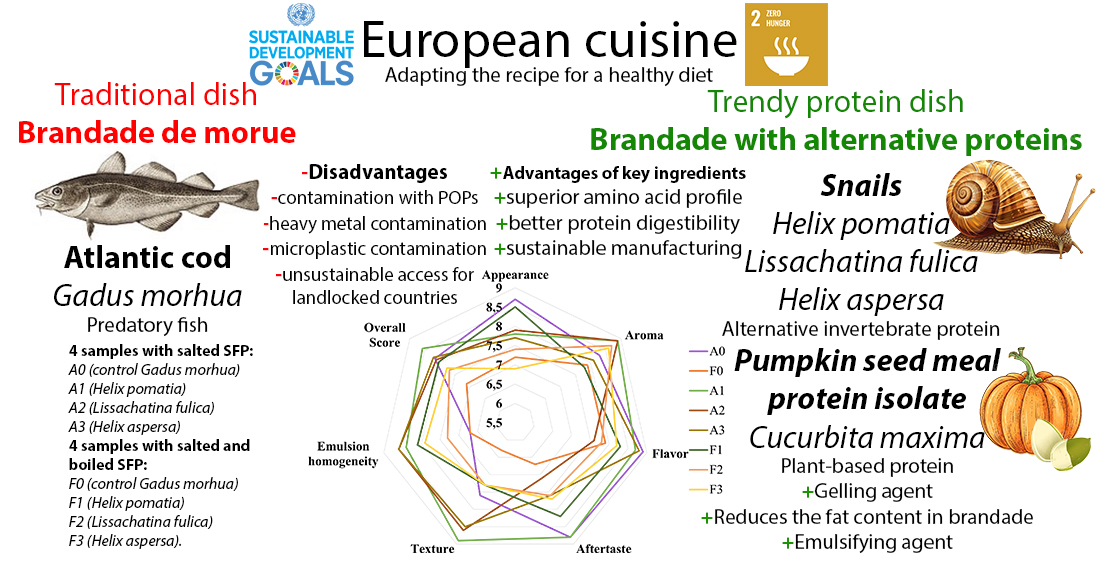
Integrating traditional European cuisine with alternative protein sources can strengthen food security and provide the population with healthy food. Previous scientific works indicate the nutritional and environmental potential of alternative proteins. However, there is a research gap regarding their practical integration into authentic European recipes to improve nutritional value, sensory characteristics, and promote healthy eating. This study focuses on the problem of improving cod brandade for healthy nutrition. One of the problematic aspects of traditional brandade is its high fat content, limited protein content, and the use of predatory fish. This raises questions about its compliance with healthy eating principles. The object of the study is the recipe and quality of cod brandade and its modifications with alternative protein. Four samples were developed using salted semi-finished products: A0 (control Gadus morhua), A1 (Helix pomatia), A2 (Lissachatina fulica), A3 (Helix aspersa), and four samples using salted and cooked semi-finished products (50 % w/w): F0 (control Gadus morhua), F1 (Helix pomatia), F2 (Lissachatina fulica), F3 (Helix aspersa). In the experimental samples, olive oil was replaced with pumpkin seed cake protein isolate (50 % w/w). Among the snails, the highest amount of essential amino acids was found in Helix pomatia (8.39 g/100 g), although this was 23.72 % lower than the control. The protein from the Helix pomatia sample had the highest potential biological value (87.01 %), which was 3.85 % higher than the control. The chemical composition of the brandade changes significantly. The control sample (A0) is distinguished by a higher fat content, having the highest value at 29.96 %, which is 14.46 % more than A1. Samples with snails have a higher protein content, with A1 having the highest at 35.20 %, which is 15.86 % more than A0. Sample A1 achieved the highest sensory score of 8.6, surpassing A0 by 0.4 points. Texture and emulsion homogeneity indicators were better in the experimental samples due to the protein isolate. The obtained results highlight the significant potential of using alternative proteins for modernizing European cuisine and creating innovative food products for healthy nutrition.
References
- How to feed the world in 2050. Proceedings of the Expert Meeting on How to Feed the World in 2050 (2009). Rome: Food and Agriculture Organization of the United Nations.
- Yang, F., Ren, L., Sun, J., Gu, C. (2025). A study of the purchase intention of alternative foods. Scientific Reports, 15 (1). https://doi.org/10.1038/s41598-025-90014-2
- Leip, A., Billen, G., Garnier, J., Grizzetti, B., Lassaletta, L., Reis, S. et al. (2015). Impacts of European livestock production: nitrogen, sulphur, phosphorus and greenhouse gas emissions, land-use, water eutrophication and biodiversity. Environmental Research Letters, 10 (11), 115004. https://doi.org/10.1088/1748-9326/10/11/115004
- Lisboa, H. M., Nascimento, A., Arruda, A., Sarinho, A., Lima, J., Batista, L. et al. (2024). Unlocking the Potential of Insect-Based Proteins: Sustainable Solutions for Global Food Security and Nutrition. Foods, 13 (12), 1846. https://doi.org/10.3390/foods13121846
- Golovko, N., Golovko, T., Gelikh, A. (2015). Investigation of amino acid structure of proteins of freshwater bivalve mussels from the genus anodonta of the northern Ukraine. Eastern-European Journal of Enterprise Technologies, 5 (11 (77)), 10–16. https://doi.org/10.15587/1729-4061.2015.51072
- Rygało-Galewska, A., Zglińska, K., Niemiec, T. (2022). Edible Snail Production in Europe. Animals, 12 (20), 2732. https://doi.org/10.3390/ani12202732
- Kougiagka, E., Apostologamvrou, C., Giannouli, P., Hatziioannou, M. (2022). Quality Factors of Commercial Snail Fillets as Affected by Species. Food Technology and Biotechnology, 60 (3), 330–337. https://doi.org/10.17113/ftb.60.03.22.7403
- Zeng, L., Wang, Z., He, Z., Zeng, M., Qin, F., Chen, J. (2022). Physicochemical and gel properties of pumpkin seed protein: a comparative study. International Journal of Food Science & Technology, 58 (3), 1639–1651. https://doi.org/10.1111/ijfs.16124
- Ezzat, S. M., Adel, R., Abdel-Sattar, E. (2022). Pumpkin Bio-Wastes as Source of Functional Ingredients. Mediterranean Fruits Bio-Wastes: Chemistry, functionality and technological applications. Springer, 667–696. https://doi.org/10.1007/978-3-030-84436-3_29
- Gao, D., Helikh, A., Duan, Z., Liu, Y., Shang, F. (2022). Development of pumpkin seed meal biscuits. Eastern-European Journal of Enterprise Technologies, 2 (11 (116)), 36–42. https://doi.org/10.15587/1729-4061.2022.254940
- Liu, Y., Helikh, A., Filon, A., Duan, Z. (2023). Sausage technology for food sustainability: recipe, color, nutrition, structure. Eastern-European Journal of Enterprise Technologies, 4 (11 (124)), 47–58. https://doi.org/10.15587/1729-4061.2023.286323
- Machado, P., McNaughton, S. A., Wingrove, K., Stephens, L. D., Baker, P., Lawrence, M. (2024). A Scoping Review of the Causal Pathways and Biological Mechanisms Linking Nutrition Exposures and Health Outcomes. Current Nutrition Reports, 14 (1). https://doi.org/10.1007/s13668-024-00591-3
- Liu, Z., Hu, X., Lu, S., Xu, B., Bai, C., Ma, T., Song, Y. (2025). Advances in plant-based raw materials for food 3D printing. Journal of Future Foods, 5 (6), 529–541. https://doi.org/10.1016/j.jfutfo.2024.11.001
- Khan, G., Irshad, G., Ijaz, R., Javaid, S., Tahir, N., Mehmood, S. (2025). Emboldening food security for global sustainability yoking artificial intelligence. Discover Food, 5 (1). https://doi.org/10.1007/s44187-025-00273-1
- Wang, Y., Chen, Q., Li, L., Chen, S., Zhao, Y., Li, C. et al. (2023). Transforming the fermented fish landscape: Microbiota enable novel, safe, flavorful, and healthy products for modern consumers. Comprehensive Reviews in Food Science and Food Safety, 22 (5), 3560–3601. https://doi.org/10.1111/1541-4337.13208
- Lee, C.-H., Ahn, J., Son, H.-S. (2024). Ethnic fermented foods of the world: an overview. Journal of Ethnic Foods, 11 (1). https://doi.org/10.1186/s42779-024-00254-2
- Casanova-Martínez, I., Hernández-López, E., Signes-Pastor, A. J., Sendra, E., Carbonell-Barrachina, Á. A., Cano-Lamadrid, M. (2025). Abiotic pollutant concentrations in fish: A comparative review of wild-caught and aquaculture sources. Food Control, 174, 111220. https://doi.org/10.1016/j.foodcont.2025.111220
- Pais-Costa, A. J., Marques, A., Oliveira, H., Gonçalves, A., Camacho, C., Augusto, H. C., Nunes, M. L. (2025). New Perspectives on Canned Fish Quality and Safety on the Road to Sustainability. Foods, 14 (1), 99. https://doi.org/10.3390/foods14010099
- Liu, Y., Helikh, A. O., Filon, A. M., Tang, X.-X., Duan, Z.-H., Ren, A.-Q. (2024). Beetroot (Beta vulgaris L. var. conditiva Alef.) pretreated by freeze-thaw: influence of drying methods on the quality characteristics. CyTA – Journal of Food, 22 (1), 1–12. https://doi.org/10.1080/19476337.2023.2295421
- Visciano, P. (2024). Environmental Contaminants in Fish Products: Food Safety Issues and Remediation Strategies. Foods, 13 (21), 3511. https://doi.org/10.3390/foods13213511
- Gao, D., Helikh, A., Filon, A., Duan, Z., Vasylenko, O. (2022). Effect of pH-shifting treatment on the gel properties of pumpkin seed protein isolate. Journal of Chemistry and Technologies, 30 (2), 198–204. https://doi.org/10.15421/jchemtech.v30i2.241145
- Kjeldahl, J. (1883). Neue Methode zur Bestimmung des Stickstoffs in organischen Körpern. Zeitschrift Für Analytische Chemie, 22 (1), 366–382. https://doi.org/10.1007/bf01338151
- Soxhlet, F. (1879). Die gewichtsanalytische Bestimmung des Milchfettes. Polytechnisches Journal, 232, 461–465.
- Official methods of analysis of AOAC International (2022). AOAC International.
- Poole, C. F. (2023). Instrumental Thin-Layer Chromatography. Elsevier. https://doi.org/10.1016/c2021-0-01004-x
- Protein and amino acid requirements in human nutrition: Report of a joint FAO/WHO/UNU expert consultation (WHO Technical Report Series No. 935) (2007). World Health Organization, Food and Agriculture Organization of the United Nations, & United Nations University.
- Lawless, H. T., Heymann, H. (2010). Sensory evaluation of food: Principles and practices. Springer Science & Business Media. https://doi.org/10.1007/978-1-4419-6488-5
- Reboul, J.-B. (1897). La Cuisinière Provençale. Tacussel.
- Llibre de Sent Soví (1324).
- Grewe, R. (Ed.) (2006). Libre de Sent Soví: receptari de cuina. Editorial Barcino.
- de Nola, R. (1520). Libre del Coch.
Downloads
Published
How to Cite
Issue
Section
License
Copyright (c) 2025 Anna Helikh, Andrii Filon

This work is licensed under a Creative Commons Attribution 4.0 International License.
The consolidation and conditions for the transfer of copyright (identification of authorship) is carried out in the License Agreement. In particular, the authors reserve the right to the authorship of their manuscript and transfer the first publication of this work to the journal under the terms of the Creative Commons CC BY license. At the same time, they have the right to conclude on their own additional agreements concerning the non-exclusive distribution of the work in the form in which it was published by this journal, but provided that the link to the first publication of the article in this journal is preserved.