Innovative approaches to project financing management in the context of digitalization: micro- and macro-aspects
DOI:
https://doi.org/10.15587/1729-4061.2025.333507Keywords:
project finance management, digitalization, digital currencies, artificial intelligence, open bankingAbstract
This study's object is innovative approaches to project finance management in the context of digitalization. The need for the study relates to solving the issue of insufficient adaptation of conventional approaches to project finance management to the conditions of digitalization, which reduces the efficiency of project decision-making and, as a result, the overall level of competitiveness.
The study proves that conventional approaches to project finance management are being transformed under the influence of digitalization. A comparative characteristic of traditional and innovative approaches to project finance management is given. The advantages and disadvantages of innovative approaches to project finance management associated with the digitalization of this process have been highlighted. The macro- and micro-aspects of innovative approaches to project finance management in the context of digitalization have been characterized.
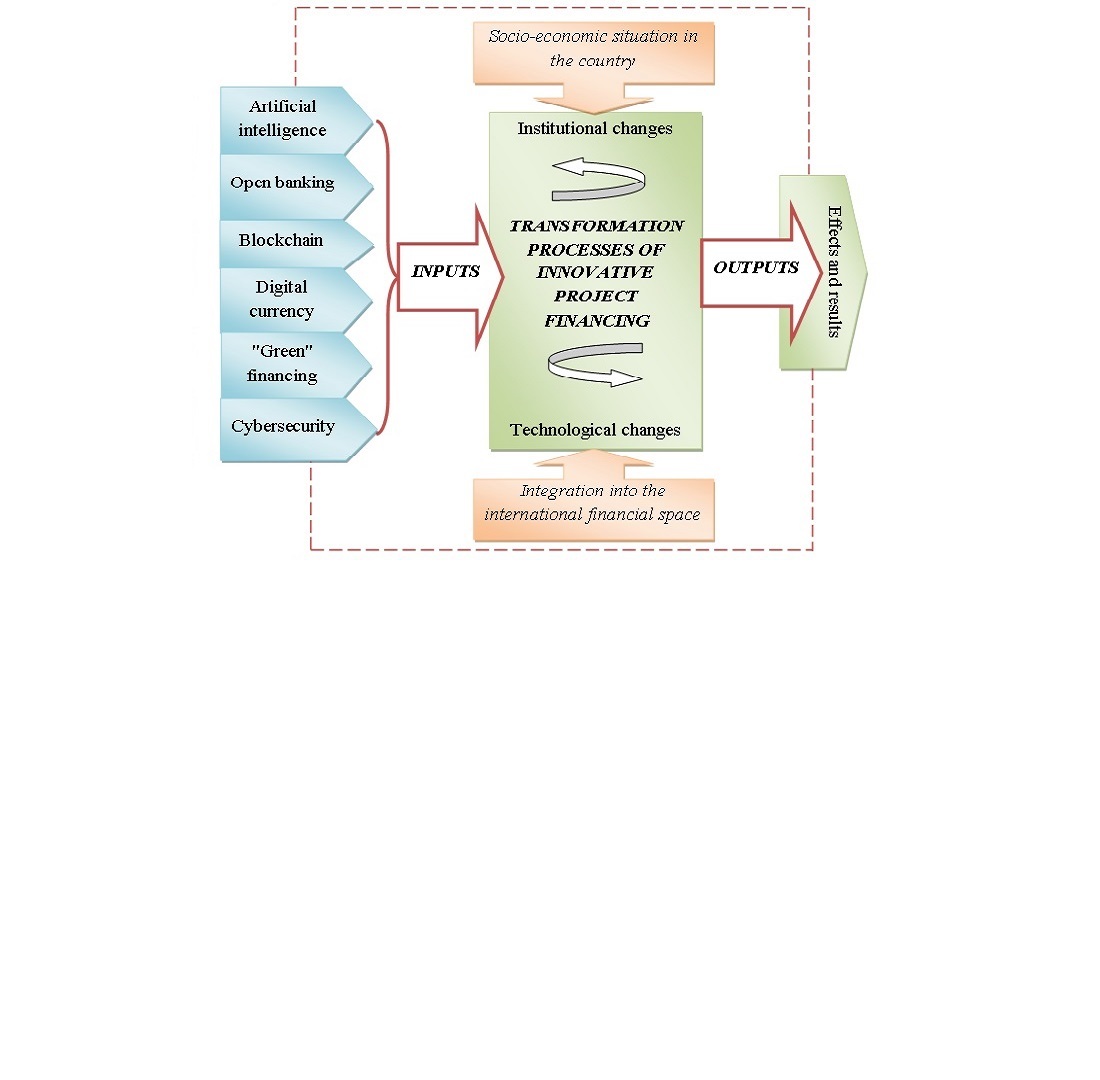
It was established that at the macro level, innovative approaches to project finance management are influenced by global trends in the evolution of the fintech industry. At the micro level, the implementation of innovative approaches to project finance management is associated with the active use of digital technologies. In order to determine the effectiveness of managing the process under study, a system model of innovative project finance in the context of digitalization was built. A forecast for the development of innovative project finance management over 2026–2030 has been prepared according to the basic, optimistic, and pessimistic scenarios.
The practical significance of the results is their use in the development and selection of effective strategies for innovative project finance in the context of digitalization. Quantitative assessment of the research results is meant to improve the conditions for achieving the planned indicators
References
- Liao, K., Liu, H., Liu, F. (2023). Digital transformation and enterprise inefficient investment: Under the view of financing constraints and earnings management. Journal of Digital Economy, 2, 289–302. https://doi.org/10.1016/j.jdec.2023.12.001
- Li, M., Wei, L. (2024). The path of digital transformation driving enterprise growth: The moderating role of financing constraints. International Review of Financial Analysis, 96, 103536. https://doi.org/10.1016/j.irfa.2024.103536
- Tang, X., Ding, S., Gao, X., Zhao, T. (2022). Can digital finance help increase the value of strategic emerging enterprises? Sustainable Cities and Society, 81, 103829. https://doi.org/10.1016/j.scs.2022.103829
- Huo, P., Wang, L. (2022). Digital economy and business investment efficiency: Inhibiting or facilitating? Research in International Business and Finance, 63, 101797. https://doi.org/10.1016/j.ribaf.2022.101797
- Panagariya, A. (2022). Digital revolution, financial infrastructure and entrepreneurship: The case of India. Asia and the Global Economy, 2 (2), 100027. https://doi.org/10.1016/j.aglobe.2022.100027
- Bastyr, S. (2024). Innovative forms of financing and capital structure transformation in the digital age. Proceedings of the 17th International Scientific Conference INPROFORUM, 17, 327–334. https://doi.org/10.32725/978-80-7694-053-6.50
- Amjad, F., Rao, Y., Arif, M., Aftab, R., Baig, S., Rahman, A. ur. (2024). Towards strategic digital transformation: Manufacturing sustainability via crowdfunding, business model innovation, and supportive digital culture. The International Journal of Entrepreneurship and Innovation. https://doi.org/10.1177/14657503241286467
- Stefanelli, V., Ferilli, G. B., Boscia, V. (2022). Exploring the lending business crowdfunding to support SMEs’ financing decisions. Journal of Innovation & Knowledge, 7 (4), 100278. https://doi.org/10.1016/j.jik.2022.100278
- Skare, M., Gavurova, B., Polishchuk, V. (2023). A decision-making support model for financing start-up projects by venture capital funds on a crowdfunding platform. Journal of Business Research, 158, 113719. https://doi.org/10.1016/j.jbusres.2023.113719
- Liu, Q., Li, R., Wang, Y. (2024). Digital finance and capital mobility: Evidence from cross-regional investment of listed companies in China. Pacific-Basin Finance Journal, 87, 102515. https://doi.org/10.1016/j.pacfin.2024.102515
- Li, C., Wang, Y., Zhou, Z., Wang, Z., Mardani, A. (2023). Digital finance and enterprise financing constraints: Structural characteristics and mechanism identification. Journal of Business Research, 165, 114074. https://doi.org/10.1016/j.jbusres.2023.114074
- Xue, L., Dong, J., Zha, Y. (2023). How does digital finance affect firm environmental, social and governance (ESG) performance? — Evidence from Chinese listed firms. Heliyon, 9 (10), e20800. https://doi.org/10.1016/j.heliyon.2023.e20800
- Zhu, X., Wu, H., Deng, Q. (2024). Quantity or quality: Novel insights into the impact of digital finance on innovation. Finance Research Letters, 65, 105603. https://doi.org/10.1016/j.frl.2024.105603
- Hu, J., Huang, L., Li, W., Xu, H. (2025). Financing Mechanisms and Preferences of Technology-Driven Small- and Medium-Sized Enterprises in the Digitalization Context. Systems, 13 (2), 68. https://doi.org/10.3390/systems13020068
- Padgaonkar, C. J., Sarkar, B., Bansal, Е. (2025). Technology Transformations In Infrastructure – A Systematic Review. Communications on Applied Nonlinear Analysis, 32 (2), 264–282. https://doi.org/10.52783/cana.v32.1741
- Bertoni, F., Bonini, S., Capizzi, V., Colombo, M. G., Manigart, S. (2021). Digitization in the Market for Entrepreneurial Finance: Innovative Business Models and New Financing Channels. Entrepreneurship Theory and Practice, 46 (5), 1120–1135. https://doi.org/10.1177/10422587211038480
- Marnewick, C., Marnewick, A. L. (2022). Digitalization of project management: Opportunities in research and practice. Project Leadership and Society, 3, 100061. https://doi.org/10.1016/j.plas.2022.100061
- Pulse of Fintech H2’24. Global analysis of fintech funding (2025). KPMG. Available at: https://assets.kpmg.com/content/dam/kpmg/nz/pdf/2025/02/pulse-of-fintech_h2_2024.pdf
- Kazantsev, D. (2025). Fintech v Ukraini 2025: problemy, trendy, innovatsiyi. Available at: https://mezha.media/articles/chim-zhive-ukrajinskiy-fintech-sektor-300651/
- Kucher, L. (2022). Impact of digitalization on the management of innovative projects. Sj-Economics Scientific Journal, 45 (2), 16–26. https://doi.org/10.58246/sjeconomics.v45i2.273
Downloads
Published
How to Cite
Issue
Section
License
Copyright (c) 2025 Serghiy Radynskyy, Vadym Ratynskiy, Andrii Krupka, Svitlana Shpylyk, Halyna Pohrishchuk, Nataliia Dobizha, Nadiia Zarichna, Vitalii Pysmennyi, Iryna Piniak, Oksana Burlitska

This work is licensed under a Creative Commons Attribution 4.0 International License.
The consolidation and conditions for the transfer of copyright (identification of authorship) is carried out in the License Agreement. In particular, the authors reserve the right to the authorship of their manuscript and transfer the first publication of this work to the journal under the terms of the Creative Commons CC BY license. At the same time, they have the right to conclude on their own additional agreements concerning the non-exclusive distribution of the work in the form in which it was published by this journal, but provided that the link to the first publication of the article in this journal is preserved.
A license agreement is a document in which the author warrants that he/she owns all copyright for the work (manuscript, article, etc.).
The authors, signing the License Agreement with TECHNOLOGY CENTER PC, have all rights to the further use of their work, provided that they link to our edition in which the work was published.
According to the terms of the License Agreement, the Publisher TECHNOLOGY CENTER PC does not take away your copyrights and receives permission from the authors to use and dissemination of the publication through the world's scientific resources (own electronic resources, scientometric databases, repositories, libraries, etc.).
In the absence of a signed License Agreement or in the absence of this agreement of identifiers allowing to identify the identity of the author, the editors have no right to work with the manuscript.
It is important to remember that there is another type of agreement between authors and publishers – when copyright is transferred from the authors to the publisher. In this case, the authors lose ownership of their work and may not use it in any way.








