Design of a ring oscillator for direct conversion of capacitance into frequency in capacitive sensor interfaces
DOI:
https://doi.org/10.15587/1729-4061.2026.350507Keywords:
ring oscillator, complementary metal-oxide-semiconductor structure, micro-electro-mechanical systems, frequency, capacitive sensorAbstract
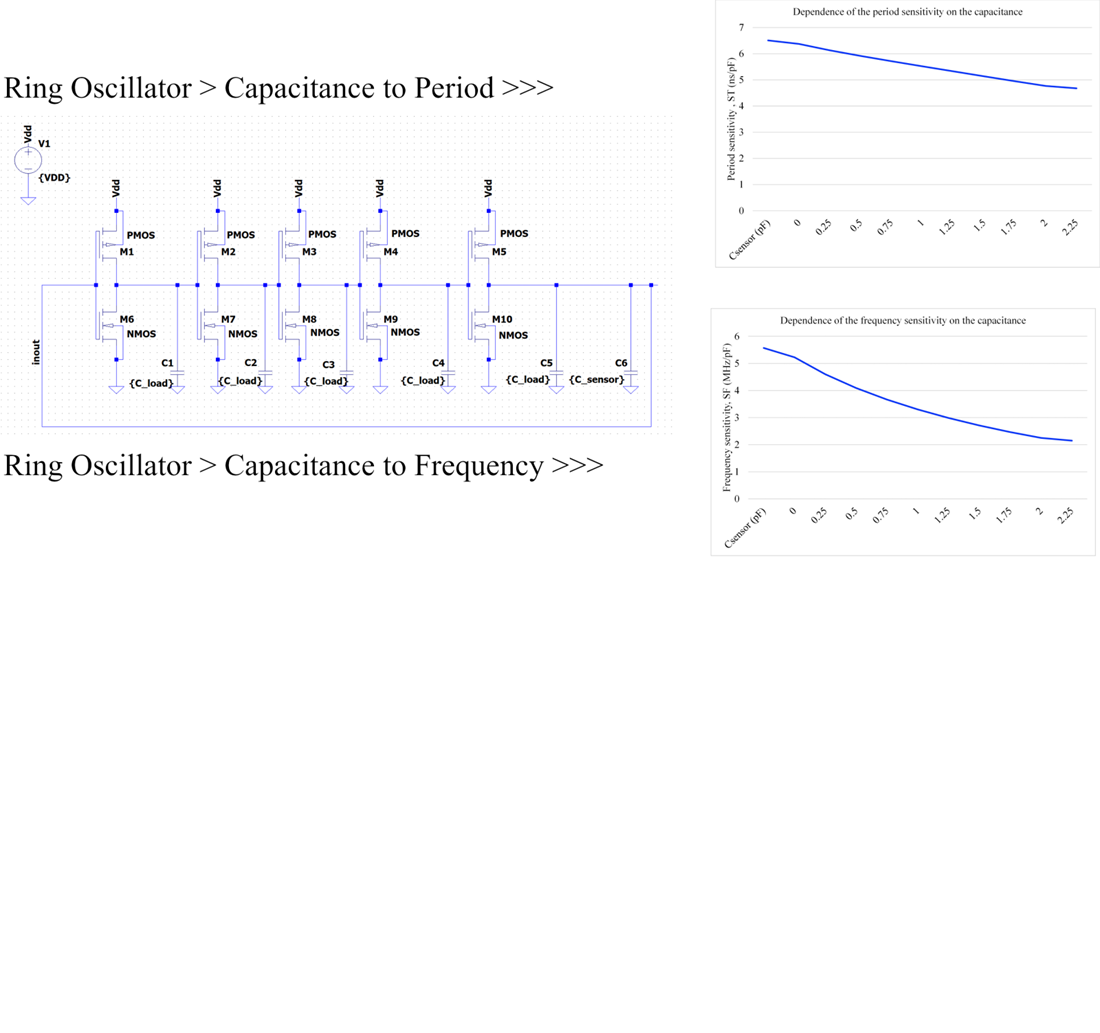
This study examines CMOS ring oscillators that are used as converters of capacitive sensor parameters. The issue with most analytical models is their assumption of symmetric stage loading, making them inaccurate for the topology where a sensor connection to a single node introduces asymmetry. The lack of a validated model for 45-nm technology complicates the design of sensitivity and energy efficiency.
An analytical model for the capacity to frequency converter that accounts for asymmetric loading has been built and verified. The model is based on the physical principle of summing asymmetric stage delays and a linear approximation of inverter delay versus load capacitance.
A parametric analysis was performed in LTspice (sensor capacitance Csensor is from 0 to 2.5 pF) to verify the model. It was determined that the oscillation period has a quasi-linear dependence on capacitance; therefore, the frequency dependence is hyperbolic. The proposed model predicts the frequency with a maximum relative error of no more than 1.55% over the entire simulation range (21.17–29.96 MHz) compared to SPICE data.
Key metrics have been analyzed: the average sensitivity is 3.52 MHz/pF, while the instantaneous sensitivity is non-linear, decreasing from 5.57 MHz/pF to 2.15 MHz/pF. Power consumption increases slightly (151.3–155.7 µW), as the capacitance growth is compensated by the frequency drop. Energy per cycle (Ecycle), conversely, increases almost linearly (5.05–7.35 pJ) with a slope of 0.92 pJ/pF. This closely matches the theoretical value of VDD2 = 1.0 pJ/pF, confirming the dominance of dynamic power consumption.
The proposed model allows engineers to accurately predict and design the capacity-to-frequency characteristics, sensitivity, as well as power consumption of compact integrated sensor interfaces.
References
- Abdullah, M. A., Elamien, M. B., Deen, M. J. (2025). A 0.4 V CMOS Current-Controlled Tunable Ring Oscillator for Low-Power IoT and Biomedical Applications. Electronics, 14 (11), 2209. https://doi.org/10.3390/electronics14112209
- Qiao, Z., Boom, B. A., Annema, A.-J., Wiegerink, R. J., Nauta, B. (2018). On Frequency-Based Interface Circuits for Capacitive MEMS Accelerometers. Micromachines, 9 (10), 488. https://doi.org/10.3390/mi9100488
- Szermer, M., Nazdrowicz, J. (2025). Study on Comb-Drive MEMS Acceleration Sensor Used for Medical Purposes: Monitoring of Balance Disorders. Electronics, 14 (15), 3033. https://doi.org/10.3390/electronics14153033
- Lee, H., Woo, J.-K., Kim, S. (2010). CMOS differential-capacitance-to-frequency converter utilising repetitive charge integration and charge conservation. Electronics Letters, 46 (8), 567–569. https://doi.org/10.1049/el.2010.3416
- Li, L., Lai, X., Wang, Y., Niu, Z. (2023). High-Power-Efficiency Readout Circuit Employing Average Capacitance-to-Voltage Converter for Micro-Electro-Mechanical System Capacitive Accelerometers. Sensors, 23 (20), 8547. https://doi.org/10.3390/s23208547
- Cicalini, M., Piotto, M., Bruschi, P., Dei, M. (2021). Design of a Capacitance-to-Digital Converter Based on Iterative Delay-Chain Discharge in 180 nm CMOS Technology. Sensors, 22 (1), 121. https://doi.org/10.3390/s22010121
- Kotyk, M., Dovgyi, V., Kogut, I., Holota, V. (2018). Schematic-Topological Modeling of the SOI CMOS Ring Oscillators for Sensor Microsystems on Chip. Physics and Chemistry of Solid State, 19 (4), 358–362. https://doi.org/10.15330/pcss.19.4.358-362
- Arya, R., K. Singh, B. (2023). Ring Oscillator for 60 Meter Bandwidth. Computer Systems Science and Engineering, 46 (1), 93–105. https://doi.org/10.32604/csse.2023.029220
- Lee, I., Sylvester, D., Blaauw, D. (2016). A Constant Energy-Per-Cycle Ring Oscillator Over a Wide Frequency Range for Wireless Sensor Nodes. IEEE Journal of Solid-State Circuits, 51 (3), 697–711. https://doi.org/10.1109/jssc.2016.2517133
- Takahashi, S., Huang, Y.-M., Sze, J.-J., Wu, T.-T., Guo, F.-S., Hsu, W.-C. et al. (2017). A 45 nm Stacked CMOS Image Sensor Process Technology for Submicron Pixel. Sensors, 17 (12), 2816. https://doi.org/10.3390/s17122816
- Wang, L. T.-N. (2010). Design and Measurement of Parameter-Specific Ring Oscillators. EECS Department, University of California, Berkeley. Available at: https://www2.eecs.berkeley.edu/Pubs/TechRpts/2010/EECS-2010-159.html
- Novosyadlyj, S., Dzundza, B., Gryga, V., Novosyadlyj, S., Kotyk, M., Mandzyuk, V. (2017). Research into constructive and technological features of epitaxial gallium-arsenide structures formation on silicon substrates. Eastern-European Journal of Enterprise Technologies, 3 (5 (87)), 54–61. https://doi.org/10.15587/1729-4061.2017.104563
- Zhu, Z., Liu, S. (2024). Digitalized analog integrated circuits. Fundamental Research, 4 (6), 1415–1430. https://doi.org/10.1016/j.fmre.2023.01.006
- Gryga, V., Dzundza, B., Dadiak, I., Nykolaichuk, Y. (2018). Research and implementation of hardware algorithms for multiplying binary numbers. 2018 14th International Conference on Advanced Trends in Radioelecrtronics, Telecommunications and Computer Engineering (TCSET), 1277–1281. https://doi.org/10.1109/tcset.2018.8336427
- Aiello, O. (2025). On Standard Cell-Based Design for Dynamic Voltage Comparators and Relaxation Oscillators. Chips, 4 (3), 31. https://doi.org/10.3390/chips4030031
- Chen, L., Li, B., Cheng, C. (2025). Arrayable TDC with Voltage-Controlled Ring Oscillator for dToF Image Sensors. Sensors, 25 (15), 4589. https://doi.org/10.3390/s25154589
- Mohammad, K., Thomson, D. J. (2017). Differential Ring Oscillator Based Capacitance Sensor for Microfluidic Applications. IEEE Transactions on Biomedical Circuits and Systems, 11 (2), 392–399. https://doi.org/10.1109/tbcas.2016.2616346
- Bisdounis, L., Nikolaidis, S., Koufopavlou, O. (1998). Analytical transient response and propagation delay evaluation of the CMOS inverter for short-channel devices. IEEE Journal of Solid-State Circuits, 33 (2), 302–306. https://doi.org/10.1109/4.658636
- Adler, V., Friedman, E. G. (1997). Delay and Power Expressions for a CMOS Inverter Driving a Resistive-Capacitive Load. Analog Design Issues in Digital VLSI Circuits and Systems, 29–39. https://doi.org/10.1007/978-1-4615-6101-9_3
- Kim, S., Agrawal, V. D., Danaher, J. J. (2015). Verification of the Alpha-Power Law by a CMOS Inverter Chain S. Available at: https://www.semanticscholar.org/paper/Verification-of-the-Alpha-Power-Law-by-a-CMOS-Chain-Kim-Agrawal/7fb16b366fb4a953265175d1edbb4d709f9a8526
- Michal, V. (2012). On the low-power design, stability improvement and frequency estimation of the CMOS ring oscillator. Proceedings of 22nd International Conference Radioelektronika 2012. Available at: https://www.researchgate.net/publication/260999799_On_the_Low-power_Design_Stability_Improvement_and_Frequency_Estimation_of_the_CMOS_Ring_Oscillator
- Bulk CMOS Models. Available at: https://mec.umn.edu/ptm
- Razavi, B. (2019). The Ring Oscillator [A Circuit for All Seasons]. IEEE Solid-State Circuits Magazine, 11 (4), 10–81. https://doi.org/10.1109/mssc.2019.2939771
- Ciarpi, G., Monda, D., Mestice, M., Rossi, D., Saponara, S. (2023). Asymmetric 5.5 GHz Three-Stage Voltage-Controlled Ring-Oscillator in 65 nm CMOS Technology. Electronics, 12 (3), 778. https://doi.org/10.3390/electronics12030778
- Sakurai, T., Newton, A. R. (1990). Alpha-power law MOSFET model and its applications to CMOS inverter delay and other formulas. IEEE Journal of Solid-State Circuits, 25 (2), 584–594. https://doi.org/10.1109/4.52187
Downloads
Published
How to Cite
Issue
Section
License
Copyright (c) 2026 Vadym Hula, Vitalii Vintoniak, Volodymyr Hryha

This work is licensed under a Creative Commons Attribution 4.0 International License.
The consolidation and conditions for the transfer of copyright (identification of authorship) is carried out in the License Agreement. In particular, the authors reserve the right to the authorship of their manuscript and transfer the first publication of this work to the journal under the terms of the Creative Commons CC BY license. At the same time, they have the right to conclude on their own additional agreements concerning the non-exclusive distribution of the work in the form in which it was published by this journal, but provided that the link to the first publication of the article in this journal is preserved.
A license agreement is a document in which the author warrants that he/she owns all copyright for the work (manuscript, article, etc.).
The authors, signing the License Agreement with TECHNOLOGY CENTER PC, have all rights to the further use of their work, provided that they link to our edition in which the work was published.
According to the terms of the License Agreement, the Publisher TECHNOLOGY CENTER PC does not take away your copyrights and receives permission from the authors to use and dissemination of the publication through the world's scientific resources (own electronic resources, scientometric databases, repositories, libraries, etc.).
In the absence of a signed License Agreement or in the absence of this agreement of identifiers allowing to identify the identity of the author, the editors have no right to work with the manuscript.
It is important to remember that there is another type of agreement between authors and publishers – when copyright is transferred from the authors to the publisher. In this case, the authors lose ownership of their work and may not use it in any way.








