Devising a method for assessing the residual resource and efficiency of tool utilization based on the analysis of dimensional wear
DOI:
https://doi.org/10.15587/1729-4061.2026.350626Keywords:
average insert resource, efficiency assessment, radial wear, statistical samplingAbstract
This study considers a tool rejection system in mechanical engineering production with a single or small-batch type.
The task addressed is to substantiate assessment of the degree of wear of replaceable carbide inserts that are rejected during single and small-scale production based on the results of current diagnostics. The proposed approach could make it possible to track possible failures or premature rejection and unjustified losses based on a qualitative analysis of actual wear using probabilistic-stochastic methods.
A method for assessing the condition of rejected carbide inserts has been proposed, underlying which is measuring their wear on the back surface, transition to dimensional wear, their statistical processing and grouping by wear level.
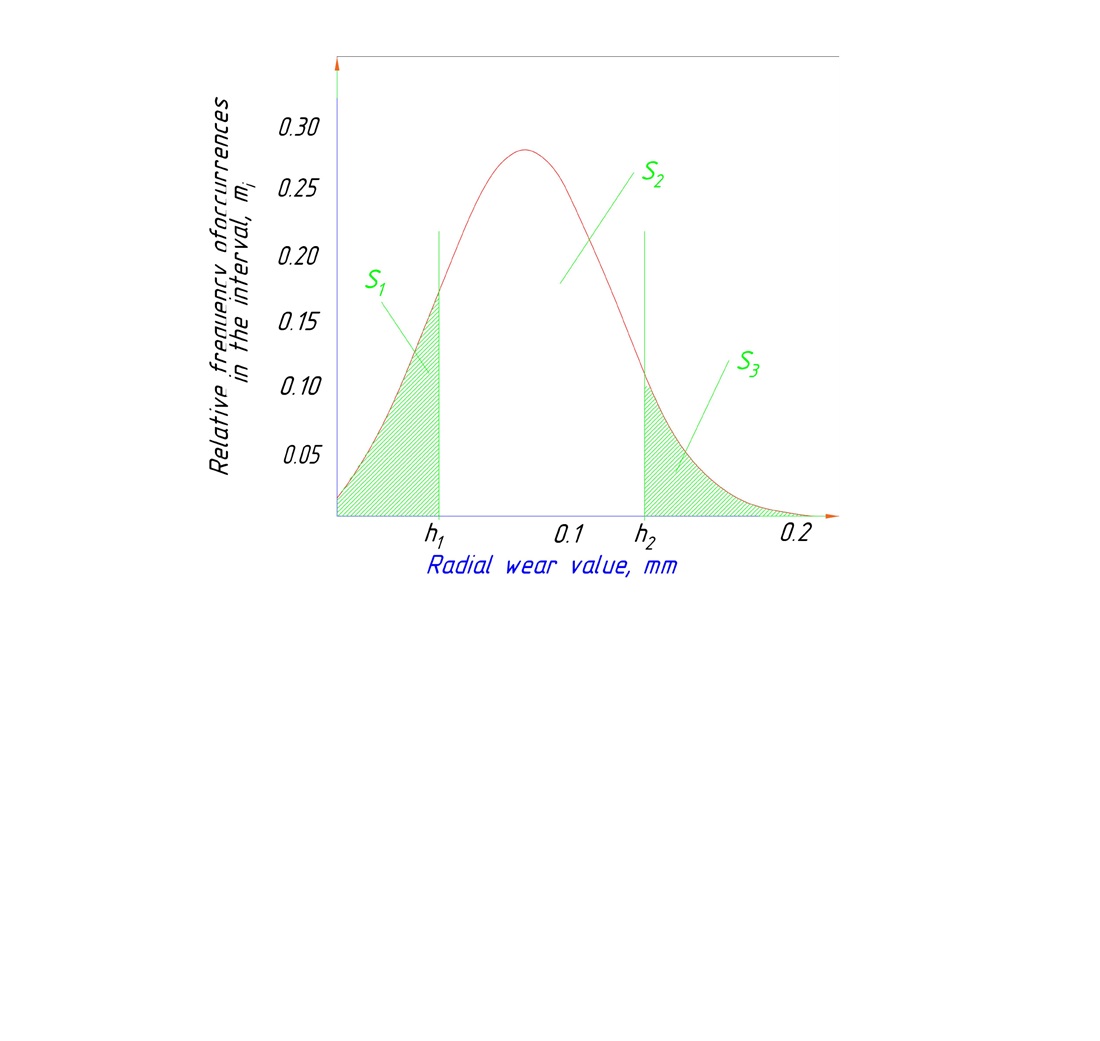
Experimental studies were conducted on carbide inserts used in a milling cutter during roughing of steels under conditions of cyclic shock loads. It was found that the magnitude of dimensional wear obeys the normal distribution law with the following characteristics: mean value mm, dispersion of scattering D(h) = 0.00135 mm2, and mean square deviation σ(h) = 0.0375 mm. Dependences were derived and the percentage composition of rejected inserts was determined: 50.91% of inserts can still be used (with different resources); 1.17% of inserts are excessively worn (which could lead to defects); and 47.91% of inserts are correctly rejected during production.
The proposed methodology could be practically applied without complex measuring equipment and specialized monitoring systems, which makes it suitable for implementation during single and small-scale production. Implementing the method makes it possible to reduce unjustified rejected tools, increase the efficiency of the diagnostic system, and ensure the economy of material resources of an enterprise.
References
- Bohachov, Y., Korobtsov, Y., Shevchenko, V. (2018). Method of increasing the reliability of diagnostics of the state of the cutting tool in the automated processing of parts. Bulletin of Kyiv Polytechnic Institute. Series Instrument Making, 55 (1), 72–76. https://doi.org/10.20535/1970.55(1).2018.135899
- Cantero, J. L., Díaz-Álvarez, J., Miguélez, M. H., Marín, N. C. (2013). Analysis of tool wear patterns in finishing turning of Inconel 718. Wear, 297 (1-2), 885–894. https://doi.org/10.1016/j.wear.2012.11.004
- Güven, S., Gökkaya, H., Sur, G., Motorcu, A. R. (2025). Effects of cutting parameters on tool wear in milling inconel 625 superalloys with a SiAlON ceramic and the prediction of tool life. Ceramics International, 51 (5), 5646–5658. https://doi.org/10.1016/j.ceramint.2024.12.012
- Zhu, K., Zhang, Y. (2019). A generic tool wear model and its application to force modeling and wear monitoring in high speed milling. Mechanical Systems and Signal Processing, 115, 147–161. https://doi.org/10.1016/j.ymssp.2018.05.045
- Buryak, A. V., Buryak, V. G. (2014). Scientific grounds for assessment of work of cutting tools on the analysis of acoustic characteristics of the manufactured and instrumental materials. Problemy trybolohiyi, 4, 23–30. Available at: https://elar.khmnu.edu.ua/items/0a93231b-aa52-46d9-8576-b069437c8328
- Krehel’, R., Krchová, D., Kočiško, M. (2015). Diagnostic Analysis of Cutting Tools using a Temperature Sensor. Key Engineering Materials, 669, 382–390. https://doi.org/10.4028/www.scientific.net/kem.669.382
- Mamurov, E. T. (2022). Problems of control and diagnostics of a cutting tool using a vibroacoustic signal. Middle European Scientific Bulletin, 25, 320–324. Available at: https://archive.org/details/httpscejsr.academicjournal.ioindex.phpjournalarticleview1408/mode/2up?ui=embed&wrapper=false
- Lamraoui, M., Thomas, M., El Badaoui, M. (2014). Cyclostationarity approach for monitoring chatter and tool wear in high speed milling. Mechanical Systems and Signal Processing, 44 (1-2), 177–198. https://doi.org/10.1016/j.ymssp.2013.05.001
- Dayam, S., Desai, K. A. (2024). Smart tool wear state and chatter onset identification system for legacy manual drilling machine operators. The International Journal of Advanced Manufacturing Technology, 136 (2), 675–692. https://doi.org/10.1007/s00170-024-14847-3
- Duro, J. A., Padget, J. A., Bowen, C. R., Kim, H. A., Nassehi, A. (2016). Multi-sensor data fusion framework for CNC machining monitoring. Mechanical Systems and Signal Processing, 66-67, 505–520. https://doi.org/10.1016/j.ymssp.2015.04.019
- Jaen-Cuellar, A. Y., Osornio-Ríos, R. A., Trejo-Hernández, M., Zamudio-Ramírez, I., Díaz-Saldaña, G., Pacheco-Guerrero, J. P., Antonino-Daviu, J. A. (2021). System for Tool-Wear Condition Monitoring in CNC Machines under Variations of Cutting Parameter Based on Fusion Stray Flux-Current Processing. Sensors, 21 (24), 8431. https://doi.org/10.3390/s21248431
- Strutynska, I., Kozbur, H., Sorokivska, O., Dmytrotsa, L., Kozbur, I. (2024). Analysis of business structures regarding the level of digital maturity using data mining methods. The 1st International Workshop on Bioinformatics and Applied Information Technologies 2024, 241–257. Available at: https://ceur-ws.org/Vol-3842/paper15.pdf
- Strutynska, I., Dmytrotsa, L., Kozbur, H., Melnyk, L. (2021). The digital business transformation index determining and monitoring: Development of a national online platform. The 1st International Workshop on Information Technologies: Theoretical and Applied Problems 2021, 327–334. Available at: https://ceur-ws.org/Vol-3039/short33.pdf
- Zhang, C., Zhang, J. (2013). On-line tool wear measurement for ball-end milling cutter based on machine vision. Computers in Industry, 64 (6), 708–719. https://doi.org/10.1016/j.compind.2013.03.010
- Wang, W., Wong, Y. S., Hong, G. S. (2005). Flank wear measurement by successive image analysis. Computers in Industry, 56 (8-9), 816–830. https://doi.org/10.1016/j.compind.2005.05.009
- Chen, H., Cheng, C., Hong, J., Huang, M., Kong, Y., Zheng, X. (2024). An on-machine tool wear area identification method based on image augmentation and advanced segmentation. Journal of Manufacturing Processes, 132, 558–569. https://doi.org/10.1016/j.jmapro.2024.10.085
- Rizal, M., Ghani, J. A., Nuawi, M. Z., Haron, C. H. C. (2013). Online tool wear prediction system in the turning process using an adaptive neuro-fuzzy inference system. Applied Soft Computing, 13 (4), 1960–1968. https://doi.org/10.1016/j.asoc.2012.11.043
- Tobon-Mejia, D. A., Medjaher, K., Zerhouni, N. (2012). CNC machine tool’s wear diagnostic and prognostic by using dynamic Bayesian networks. Mechanical Systems and Signal Processing, 28, 167–182. https://doi.org/10.1016/j.ymssp.2011.10.018
- Sonali S., P., Sujit S., P., Nikhil, P., Abhishek D., P. (2022). Cutting Tool Condition Monitoring using a Deep Learning-based Artificial Neural Network. International Journal of Performability Engineering, 18 (1), 37. https://doi.org/10.23940/ijpe.22.01.p5.3746
- Zaloha, V. O., Zinchenko, R. M. (2012). Study of potential use of an artificial neural network in cutting tools diagnostics system. Visnyk Sumskoho derzhavnoho universytetu. Seriya Tekhnichni nauky, 4, 98–110. Available at: http://essuir.sumdu.edu.ua/handle/123456789/30032
- Tran, M.-Q., Doan, H.-P., Vu, V. Q., Vu, L. T. (2023). Machine learning and IoT-based approach for tool condition monitoring: A review and future prospects. Measurement, 207, 112351. https://doi.org/10.1016/j.measurement.2022.112351
- Kryvyi, P. D., Dzyura, V. O., Tymoshenko, N. M., Krupa, V. V. (2014). Technological Heredity and Accuracy of the Cross-Section Shapes of the Hydro-Cylinder Cylindrical Surfaces. Volume 2: Processing. https://doi.org/10.1115/msec2014-3946
- Karmeliuk, H. I. (2007). Teoriya ymovirnostei ta matematychna statystyka. Kyiv: Tsentr navchalnoi literatury, 576.
- Krupa, V., Tymoshenko, N., Kobelnyk, V., Petrechko, I. (2022). Probability-statistical estimation method of feed influence on the tangential cutting force under turning. Journal of Achievements in Materials and Manufacturing Engineering, 114 (1), 22–31. https://doi.org/10.5604/01.3001.0016.1480
- Krupa, V., Kobelnyk, V., Hahaliuk, A., Dzyura, V., Tymoshenko, N. (2024). Improved Method for Determining the Feed Influence on the Tangential Cutting Force During Re-drilling, Countersinking and Boring Based on the Small Sample Theory. Periodica Polytechnica Mechanical Engineering, 68 (2), 172–180. https://doi.org/10.3311/ppme.29952
- Nouri, M., Fussell, B. K., Ziniti, B. L., Linder, E. (2015). Real-time tool wear monitoring in milling using a cutting condition independent method. International Journal of Machine Tools and Manufacture, 89, 1–13. https://doi.org/10.1016/j.ijmachtools.2014.10.011
- Urenda, J. C., Kosheleva, O., Kreinovich, V. (2022). How to describe measurement errors: A natural generalization of the Central Limit Theorem beyond normal (and other infinitely divisible) distributions. Advanced Mathematical and Computational Tools in Metrology and Testing XII, 418–428. https://doi.org/10.1142/9789811242380_0026
Downloads
Published
How to Cite
Issue
Section
License
Copyright (c) 2026 Volodymyr Krupa, Volodymyr Kobelnyk, Denys Viuk, Andrii Zakharii, Mychailo Bei

This work is licensed under a Creative Commons Attribution 4.0 International License.
The consolidation and conditions for the transfer of copyright (identification of authorship) is carried out in the License Agreement. In particular, the authors reserve the right to the authorship of their manuscript and transfer the first publication of this work to the journal under the terms of the Creative Commons CC BY license. At the same time, they have the right to conclude on their own additional agreements concerning the non-exclusive distribution of the work in the form in which it was published by this journal, but provided that the link to the first publication of the article in this journal is preserved.
A license agreement is a document in which the author warrants that he/she owns all copyright for the work (manuscript, article, etc.).
The authors, signing the License Agreement with TECHNOLOGY CENTER PC, have all rights to the further use of their work, provided that they link to our edition in which the work was published.
According to the terms of the License Agreement, the Publisher TECHNOLOGY CENTER PC does not take away your copyrights and receives permission from the authors to use and dissemination of the publication through the world's scientific resources (own electronic resources, scientometric databases, repositories, libraries, etc.).
In the absence of a signed License Agreement or in the absence of this agreement of identifiers allowing to identify the identity of the author, the editors have no right to work with the manuscript.
It is important to remember that there is another type of agreement between authors and publishers – when copyright is transferred from the authors to the publisher. In this case, the authors lose ownership of their work and may not use it in any way.








