Development of classification algorithm and boosting method for fake news detection: filtration and orientation
DOI:
https://doi.org/10.15587/1729-4061.2026.352117Keywords:
fake news, social media, infodemy, machine learning, automatic detection of misinformationAbstract
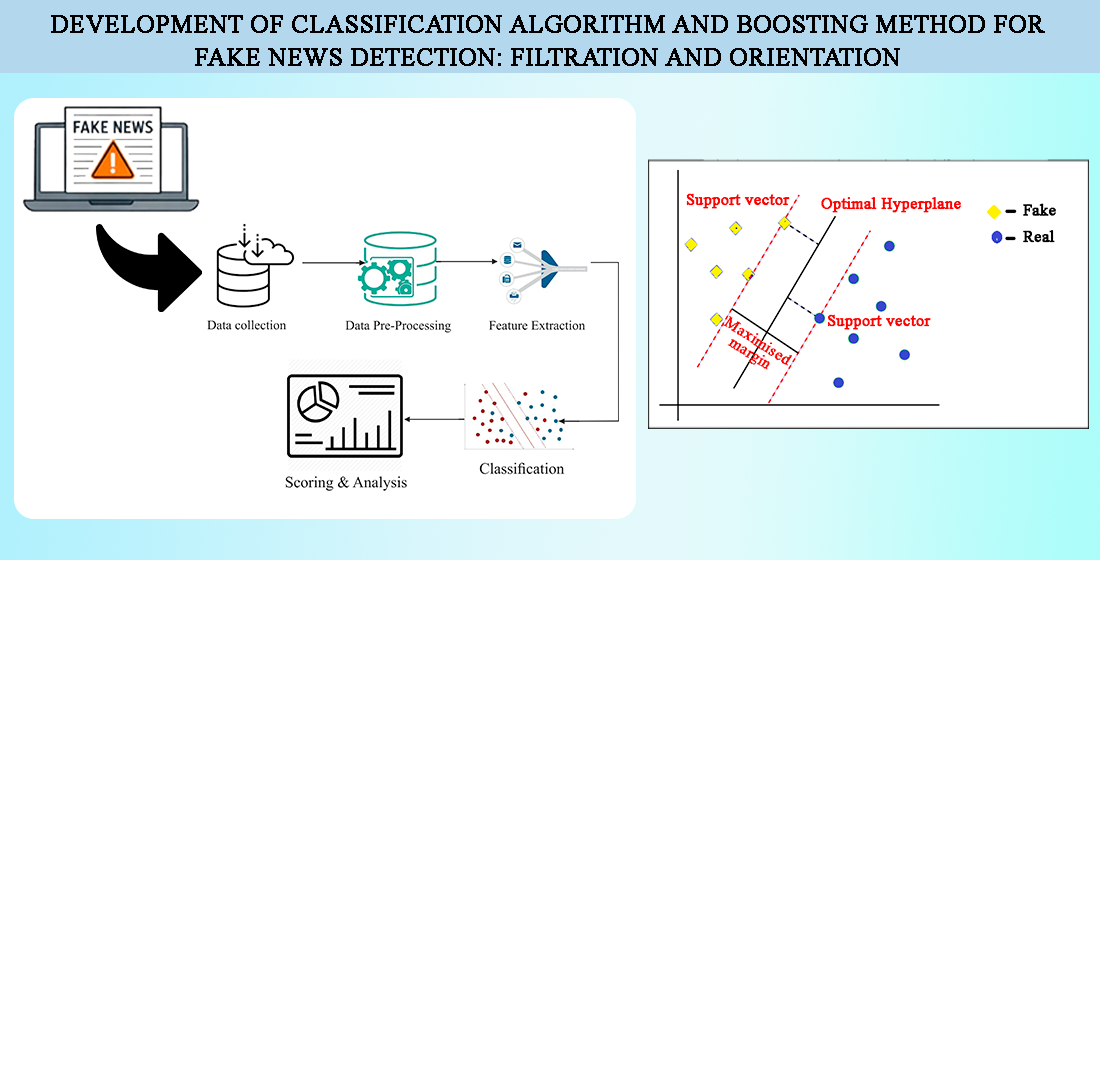
The object of this study is text-based news content distributed through online media and social media platforms, presented as vector objects formed on the basis of unstructured text data and used for subsequent automated analysis. The problem solved in this study is the limited effectiveness, stability, and generalizing ability of traditional machine learning methods in detecting fake news, especially in conditions of heterogeneous datasets, noisy textual characteristics, and dynamically changing linguistic patterns, which negatively affects the quality of classification.
The article proposes a method for improving the efficiency of machine learning based on the combined use of SVM and the AdaBoost algorithm. To form an informative representation of text data, complex preprocessing and feature extraction using the TF-IDF model are used. The experimental verification of the method was performed on four open datasets: ISOT, Kaggle, News Trends and Reuters.
The results show that the proposed SVM ensemble model with AdaBoost is superior to the basic SVM classifier and a number of traditional algorithms. Accuracy increased from 0.8175 for the base model to 0.83 for SVM+AdaBoost, while memorization increased by 4.02%, average memorization accuracy increased by 2.22%, and the F1 index increased by 1.84%, while the stability of the test accuracy decreased only slightly by 0.19%. The improvement is explained by AdaBoost's adaptive enhancement of the contribution of hard-to-classify objects and a reduction in the number of errors with moderate computational complexity.
The developed approach can be effectively applied in automated systems for monitoring news content and social networks in the presence of marked-up text data and limited computing resources
References
- Zhou, X., Zafarani, R. (2020). A Survey of Fake News. ACM Computing Surveys, 53 (5), 1–40. https://doi.org/10.1145/3395046
- Yang, K.-C., Torres-Lugo, C., Menczer, F. (2020). Prevalence of low-credibility information on twitter during the covid-19 outbreak. Workshop: Workshop on Cyber Social Threats (CySoc 2020). https://doi.org/10.36190/2020.16
- Jamieson, K. H., Cappella, J. N. (2008). Echo chamber: Rush Limbaugh and the conservative media establishment. Oxford University Press.
- Holan, A. D. (2016). 2016 Lie of the Year: Fake news. Available at: https://www.politifact.com/article/2016/dec/13/2016-lie-year-fake-news/
- Vosoughi, S., Roy, D., Aral, S. (2018). The spread of true and false news online. Science, 359 (6380), 1146–1151. https://doi.org/10.1126/science.aap9559
- Allcott, H., Gentzkow, M. (2017). Social Media and Fake News in the 2016 Election. Journal of Economic Perspectives, 31 (2), 211–236. https://doi.org/10.1257/jep.31.2.211
- Gundapu, S., Mamidi, R. (2021). Transformer based Automatic COVID-19 Fake News Detection System. arXiv. https://doi.org/10.48550/arXiv.2101.00180
- Koggalahewa, D., Xu, Y., Foo, E. (2022). An unsupervised method for social network spammer detection based on user information interests. Journal of Big Data, 9 (1). https://doi.org/10.1186/s40537-021-00552-5
- Kesarwani, A., Chauhan, S. S., Nair, A. R., Verma, G. (2020). Supervised Machine Learning Algorithms for Fake News Detection. Advances in Communication and Computational Technology, 767–778. https://doi.org/10.1007/978-981-15-5341-7_58
- Thakar, H., Bhatt, B. (2024). Fake news detection: recent trends and challenges. Social Network Analysis and Mining, 14 (1). https://doi.org/10.1007/s13278-024-01344-4
- Ahmad, I., Yousaf, M., Yousaf, S., Ahmad, M. O. (2020). Fake News Detection Using Machine Learning Ensemble Methods. Complexity, 2020, 1–11. https://doi.org/10.1155/2020/8885861
- Gao, Q., Lantz, N. (2022). Using Machine Learning Algorithms to Detect Fake News. Journal of Student Research, 11 (4). https://doi.org/10.47611/jsrhs.v11i4.3446
- Vijjali, R, Potluri, P., Kumar, S., Teki, S (2020). Two Stage Transformer Model for COVID-19 Fake News Detection and Fact Checking. arXiv. https://doi.org/10.48550/arXiv.2011.13253
- Kaur, S., Kumar, P., Kumaraguru, P. (2019). Automating fake news detection system using multi-level voting model. Soft Computing, 24 (12), 9049–9069. https://doi.org/10.1007/s00500-019-04436-y
- Mahabub, A. (2020). A robust technique of fake news detection using Ensemble Voting Classifier and comparison with other classifiers. SN Applied Sciences, 2 (4). https://doi.org/10.1007/s42452-020-2326-y
- Umer, M., Imtiaz, Z., Ullah, S., Mehmood, A., Choi, G. S., On, B.-W. (2020). Fake News Stance Detection Using Deep Learning Architecture (CNN-LSTM). IEEE Access, 8, 156695–156706. https://doi.org/10.1109/access.2020.3019735
- Kaliyar, R. K., Goswami, A., Narang, P., Sinha, S. (2020). FNDNet – A deep convolutional neural network for fake news detection. Cognitive Systems Research, 61, 32–44. https://doi.org/10.1016/j.cogsys.2019.12.005
- Fake News. University of Victoria. Available at: https://libguides.uvic.ca/fakenews
- Ozbay, F. A., Alatas, B. (2020). Fake news detection within online social media using supervised artificial intelligence algorithms. Physica A: Statistical Mechanics and Its Applications, 540, 123174. https://doi.org/10.1016/j.physa.2019.123174
- Sultan, A., Yermoldina, G., Kassym, R., Serikov, T., Bekbosynov, S., Yernazarov, N. et al. (2024). Research and construction of an adaptive drive with increased efficiency based on a balancing friction clutch. Vibroengineering Procedia, 54, 334–340. https://doi.org/10.21595/vp.2024.23971
- Nagima, B., Kumar, P., Suman, N., Serikov, T., Temirbekova, M., Sergazin, G. et al. (2024). Development of an innovative patch antenna design and implementation using ENG materials for health care systems and 5G networks. Eastern-European Journal of Enterprise Technologies, 4 (5 (130)), 26–33. https://doi.org/10.15587/1729-4061.2024.309080
- Yelikbai, K., Kumar, P., Serikov, T., Temirbekova, M., Mussapirova, G., Arai, T. et al. (2025). Improving inteligent reflective surface efficiency using ENG-metamaterials and L-shaped patch antennas in a dynamic radio environment. EUREKA: Physics and Engineering, 4, 99–109. https://doi.org/10.21303/2461-4262.2025.003914
Downloads
Published
How to Cite
Issue
Section
License
Copyright (c) 2026 Zhanna Suimenbayeva, Pramod Kumar Aylapogu, Ruslan Kassym, Arai Tolegenova, Begaidar Sarsekulov, Nurlan Suimenbayev, Yerdaulet Beibit, Akmaral Tlenshiyeva, Ayaulym Kassym, Mussapirova Gulzada

This work is licensed under a Creative Commons Attribution 4.0 International License.
The consolidation and conditions for the transfer of copyright (identification of authorship) is carried out in the License Agreement. In particular, the authors reserve the right to the authorship of their manuscript and transfer the first publication of this work to the journal under the terms of the Creative Commons CC BY license. At the same time, they have the right to conclude on their own additional agreements concerning the non-exclusive distribution of the work in the form in which it was published by this journal, but provided that the link to the first publication of the article in this journal is preserved.
A license agreement is a document in which the author warrants that he/she owns all copyright for the work (manuscript, article, etc.).
The authors, signing the License Agreement with TECHNOLOGY CENTER PC, have all rights to the further use of their work, provided that they link to our edition in which the work was published.
According to the terms of the License Agreement, the Publisher TECHNOLOGY CENTER PC does not take away your copyrights and receives permission from the authors to use and dissemination of the publication through the world's scientific resources (own electronic resources, scientometric databases, repositories, libraries, etc.).
In the absence of a signed License Agreement or in the absence of this agreement of identifiers allowing to identify the identity of the author, the editors have no right to work with the manuscript.
It is important to remember that there is another type of agreement between authors and publishers – when copyright is transferred from the authors to the publisher. In this case, the authors lose ownership of their work and may not use it in any way.








