Unveiling the root cause failure 3-1/2" parted drill in onshore environment
DOI:
https://doi.org/10.15587/1729-4061.2026.352272Keywords:
sulfide stress cracking, hydrogen embrittlement, sulfur content, drill pipe failureAbstract
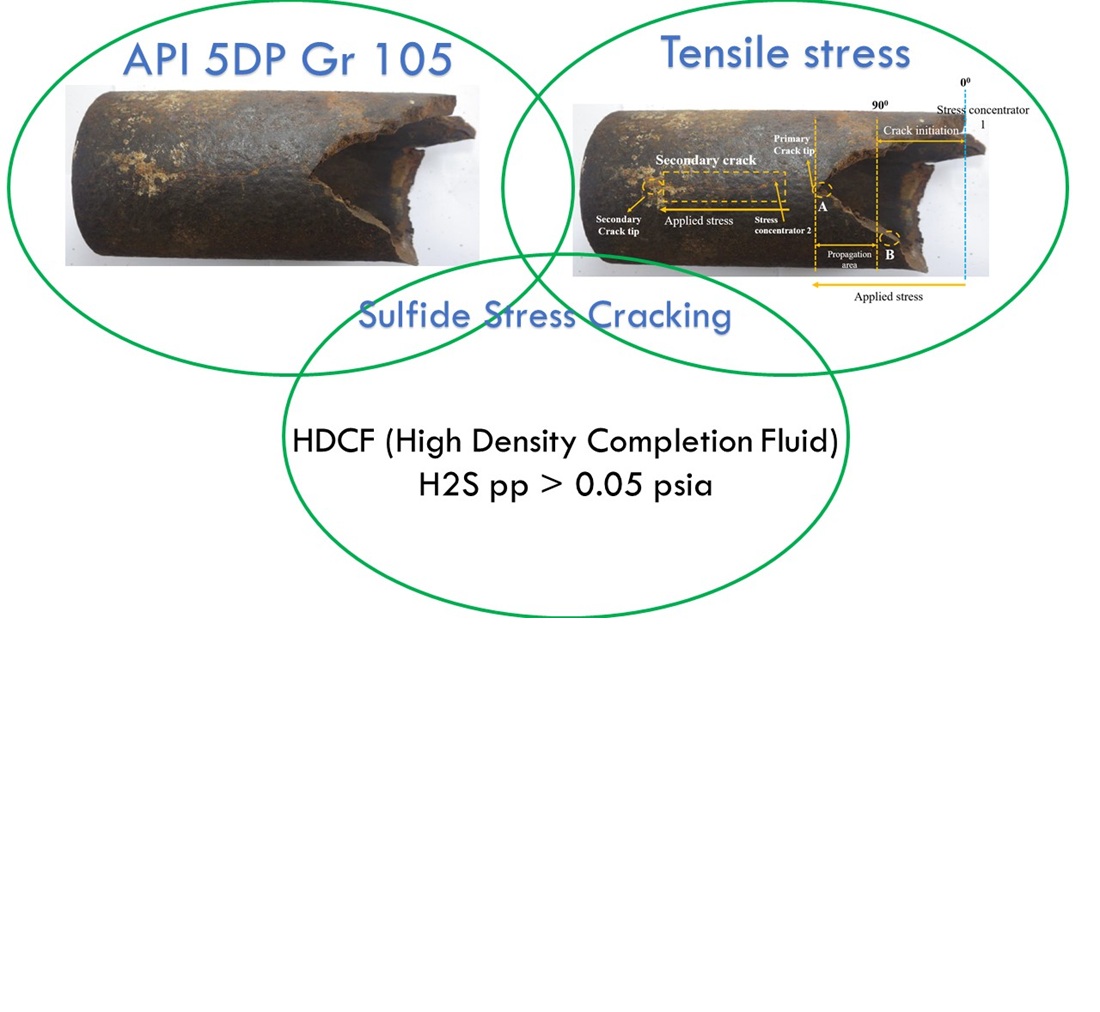
The object of this study is HSS API 5DP Gr 105 which has been used as drill pipe and was found leak during drilling activity, causing a delay in the delivery of drilling products. The interaction among the high partial pressure of H2S, a high-hardness material, and the injection of high-density completion fluid (HDCF) remains poorly understood, leading to sulfide stress cracking. Despite offering substantial benefits, the detected trace amounts of hydrogen and sulfur indicate a localized corrosion, which can lead to unprecedented drilling shutdowns and consequently impose greater operational costs. Recently, the API 5DP 3-1/2’’ drill pipe experienced failure with a significant hardness value of 26 HRC, exceeding the standard specified by NACE MR 0175. The material was in service in rich H2S gas well, where HDCF was injected to maintain hydrostatic pressure and serve as a control fluid. Multiple field and laboratory investigations have been undertaken to identify the root cause of this failure, including visual inspections, macrophotography, chemical composition analysis, completion fluid testing, tensile testing, metallography, and SEM-EDX analysis. The shear-slip and step-like markings on the failed material clearly indicate a brittle nature, correlating with a noticeable tensile strength of 907.80 MPa and an elongation limit of 18.18%. The increase in hardness beyond 22 HRC indicates susceptibility to sulfide stress cracking (SSC) where the hydrogen permeation increases with the increasing H2S partial pressure. These facts align with water chemistry analysis results to show S2– and HS–levels exceeding one ppm. Additionally, metallography reveals intergranular cracking in the tempered martensite, likely initiated at a local stress concentrator before propagating and confirmed by scanning electron microscope (SEM) images
References
- Manzano-Ruiz, J. J., Carballo, J. G. (2024). Multiphase Transport of Hydrocarbons in Pipes. John Wiley & Sons. https://doi.org/10.1002/9781119888543
- Kaban, A. P. S., Soedarsono, J. W., Mayangsari, W., Anwar, M. S., Maksum, A., Ridhova, A., Riastuti, R. (2023). Insight on Corrosion Prevention of C1018 in 1.0 M Hydrochloric Acid Using Liquid Smoke of Rice Husk Ash: Electrochemical, Surface Analysis, and Deep Learning Studies. Coatings, 13 (1), 136. https://doi.org/10.3390/coatings13010136
- Tamalmani, K., Husin, H. (2020). Review on Corrosion Inhibitors for Oil and Gas Corrosion Issues. Applied Sciences, 10 (10), 3389. https://doi.org/10.3390/app10103389
- Luo, S., Liu, M., Shen, Y., Lin, X. (2019). Sulfide Stress Corrosion Cracking Behavior of G105 and S135 High-Strength Drill Pipe Steels in H2S Environment. Journal of Materials Engineering and Performance, 28 (3), 1707–1718. https://doi.org/10.1007/s11665-019-03913-7
- Han, Y., Zhao, X., Bai, Z., Yin, C. (2014). Failure Analysis on Fracture of a S135 Drill Pipe. Procedia Materials Science, 3, 447–453. https://doi.org/10.1016/j.mspro.2014.06.075
- Plessis, G. J., Uttecht, A., Pink, T., Hehn, L., Jellison, M. J., Vinson, B. (2016). An Innovative Pipe Grade to Enhance Reach of Deeper Prospects in Sour Fields. IADC/SPE Asia Pacific Drilling Technology Conference. https://doi.org/10.2118/180612-ms
- Tale, S., Ahmed, R., Elgaddafi, R., Teodoriu, C. (2021). Sulfide Stress Cracking of C-110 Steel in a Sour Environment. Corrosion and Materials Degradation, 2 (3), 376–396. https://doi.org/10.3390/cmd2030020
- Al-Mansour, M., Alfantazi, A. M., El-boujdaini, M. (2009). Sulfide stress cracking resistance of API-X100 high strength low alloy steel. Materials & Design, 30 (10), 4088–4094. https://doi.org/10.1016/j.matdes.2009.05.025
- Vakili, M., Koutník, P., Kohout, J. (2024). Addressing Hydrogen Sulfide Corrosion in Oil and Gas Industries: A Sustainable Perspective. Sustainability, 16 (4), 1661. https://doi.org/10.3390/su16041661
- Taravel-Condat, C., Desamais, N. (2006). Qualification of High Strength Carbon Steel Wires for Use in Specific Annulus Environment of Flexible Pipes Containing CO2 and H2S. Volume 3: Safety and Reliability; Materials Technology; Douglas Faulkner Symposium on Reliability and Ultimate Strength of Marine Structures, 585–591. https://doi.org/10.1115/omae2006-92394
- Ning, J., Li, H., Yoon, Y., Srinivasan, S. (2019). Review of Key Factors Related to Sour Service Material Selection for HPHT Oil & Gas Production Applications. CORROSION 2019, 1–13. https://doi.org/10.5006/c2019-13400
- ISO 15156-1:2009(en). Petroleum and natural gas industries – Materials for use in H2S-containing environments in oil and gas production – Part 1: General principles for selection of cracking-resistant materials.
- Silva, C. A., Varela, L. B., Kolawole, F. O., Tschiptschin, A. P., Panossian, Z. (2020). Multiphase-flow-induced corrosion and cavitation-erosion damages of API 5L X80 and API 5DP grade S steels. Wear, 452-453, 203282. https://doi.org/10.1016/j.wear.2020.203282
- Zheng, Y., Zhang, Y., Sun, B., Zhang, B., Zhang, S., Jin, S. et al. (2024). Corrosion Behavior and Mechanical Performance of Drill Pipe Steel in a CO2/H2S-Drilling-Fluid Environment. Processes, 12 (3), 502. https://doi.org/10.3390/pr12030502
- Yu, Z., Zeng, D., Hu, S., Zhou, X., Lu, W., Luo, J. et al. (2022). The failure patterns and analysis process of drill pipes in oil and gas well: A case study of fracture S135 drill pipe. Engineering Failure Analysis, 138, 106171. https://doi.org/10.1016/j.engfailanal.2022.106171
- Li, X., Lv, W., Li, M., Zhang, K., Xu, Z., Yuan, J. et al. (2024). Sulfide stress corrosion cracking in L360QS pipelines: A comprehensive failure analysis and implications for natural gas transportation safety. International Journal of Pressure Vessels and Piping, 212, 105324. https://doi.org/10.1016/j.ijpvp.2024.105324
- Paul, S. K., Stanford, N., Hilditch, T. (2015). Effect of martensite volume fraction on low cycle fatigue behaviour of dual phase steels: Experimental and microstructural investigation. Materials Science and Engineering: A, 638, 296–304. https://doi.org/10.1016/j.msea.2015.04.059
- Liu, M., Yang, C. D., Cao, G. H., Russell, A. M., Liu, Y. H., Dong, X. M., Zhang, Z. H. (2016). Effect of microstructure and crystallography on sulfide stress cracking in API-5CT-C110 casing steel. Materials Science and Engineering: A, 671, 244–253. https://doi.org/10.1016/j.msea.2016.06.034
- Hazra, M., Rao, A. S., Singh, A. K. (2023). Corrosion Fatigue Failure of Exhaust Valve of a Diesel Generator. Journal of Failure Analysis and Prevention, 23 (4), 1402–1412. https://doi.org/10.1007/s11668-023-01663-2
- Zhou, G. Y., Cao, G. H., Dong, X. M., Zhang, Z. H. (2025). Tailoring the mechanical property and sulfide stress corrosion cracking resistance of rare earth doped casing steel by tempering treatment. Corrosion Science, 245, 112699. https://doi.org/10.1016/j.corsci.2025.112699
- Treseder, R. S., Swanson, T. M. (1968). Factors in Sulfide Corrosion Cracking of High Strength Steels. Corrosion, 24 (2), 31–37. https://doi.org/10.5006/0010-9312-24.2.31
- Westin, E. M., Warchomicka, F. G. (2022). Solidification cracking in duplex stainless steel flux-cored arc welds Part 2 – susceptibility of 22Cr all-weld metals under high restraint. Welding in the World, 66 (12), 2425–2442. https://doi.org/10.1007/s40194-022-01389-z
- Grobner, P. J., Sponseller, D. L., Diesburg, D. E. (1978). Effect of Molybdenum Content on the Sulfide Stress Cracking Resistance of AISI 4130-Type Steel with 0.035% Cb. CORROSION 1978, 1–21. https://doi.org/10.5006/c1978-78040
- Liu, Y.-W., Zhang, J., Lu, X., Liu, M.-R., Wang, Z.-Y. (2020). Effect of Metal Cations on Corrosion Behavior and Surface Structure of Carbon Steel in Chloride Ion Atmosphere. Acta Metallurgica Sinica (English Letters), 33 (9), 1302–1310. https://doi.org/10.1007/s40195-020-01032-0
- Lynch, S. (2012). Hydrogen embrittlement phenomena and mechanisms. Corrosion Reviews, 30 (3-4), 105–123. https://doi.org/10.1515/corrrev-2012-0502
- Shi, X.-B., Yan, W., Wang, W., Zhao, L.-Y., Shan, Y.-Y., Yang, K. (2015). HIC and SSC Behavior of High-Strength Pipeline Steels. Acta Metallurgica Sinica (English Letters), 28 (7), 799–808. https://doi.org/10.1007/s40195-015-0257-1
- Li, J., Zhou, E., Xie, F., Li, Z., Wang, F., Xu, D. (2025). Accelerated stress corrosion cracking of X80 pipeline steel under the combined effects of sulfate-reducing bacteria and hydrostatic pressure. Corrosion Science, 243, 112593. https://doi.org/10.1016/j.corsci.2024.112593
- Chen, J., Qin, Z., Martino, T., Shoesmith, D. W. (2017). Non-uniform film growth and micro/macro-galvanic corrosion of copper in aqueous sulphide solutions containing chloride. Corrosion Science, 114, 72–78. https://doi.org/10.1016/j.corsci.2016.10.024
- Guan, G., Wang, X., Xin, M., Sun, C., Zhang, Q., He, J. (2024). Study on the Bonding Performance of BFRP Bars with Seawater Sand Concrete. Materials, 17 (3), 543. https://doi.org/10.3390/ma17030543
- Jiang, H., Ye, Y., Lai, S.-Y. (2023). Behavior of seawater sea sand concrete-filled plastic-lined steel tube stub columns under axial compression. Structures, 58, 105577. https://doi.org/10.1016/j.istruc.2023.105577
Downloads
Published
How to Cite
Issue
Section
License
Copyright (c) 2026 Sidhi Aribowo, Johny Soedarsono, Sopar Mangarapot Simanullang, Ario Oktora, Warneri Warneri, Rini Riastuti, Agus Kaban

This work is licensed under a Creative Commons Attribution 4.0 International License.
The consolidation and conditions for the transfer of copyright (identification of authorship) is carried out in the License Agreement. In particular, the authors reserve the right to the authorship of their manuscript and transfer the first publication of this work to the journal under the terms of the Creative Commons CC BY license. At the same time, they have the right to conclude on their own additional agreements concerning the non-exclusive distribution of the work in the form in which it was published by this journal, but provided that the link to the first publication of the article in this journal is preserved.
A license agreement is a document in which the author warrants that he/she owns all copyright for the work (manuscript, article, etc.).
The authors, signing the License Agreement with TECHNOLOGY CENTER PC, have all rights to the further use of their work, provided that they link to our edition in which the work was published.
According to the terms of the License Agreement, the Publisher TECHNOLOGY CENTER PC does not take away your copyrights and receives permission from the authors to use and dissemination of the publication through the world's scientific resources (own electronic resources, scientometric databases, repositories, libraries, etc.).
In the absence of a signed License Agreement or in the absence of this agreement of identifiers allowing to identify the identity of the author, the editors have no right to work with the manuscript.
It is important to remember that there is another type of agreement between authors and publishers – when copyright is transferred from the authors to the publisher. In this case, the authors lose ownership of their work and may not use it in any way.








