Determining photovoltaic array configurations with reduced impact of partial shading on energy performance
DOI:
https://doi.org/10.15587/1729-4061.2026.352343Keywords:
photovoltaic array configuration, shading strip movement, global maximum power trajectoryAbstract
This work explores energy processes in the array of photovoltaic panels within an object’s power supply system under dynamic modes of the partial-shading strip movement. The study aims to increase the energy productivity of a photovoltaic panel array in the power supply system at a local facility under partial shading conditions.
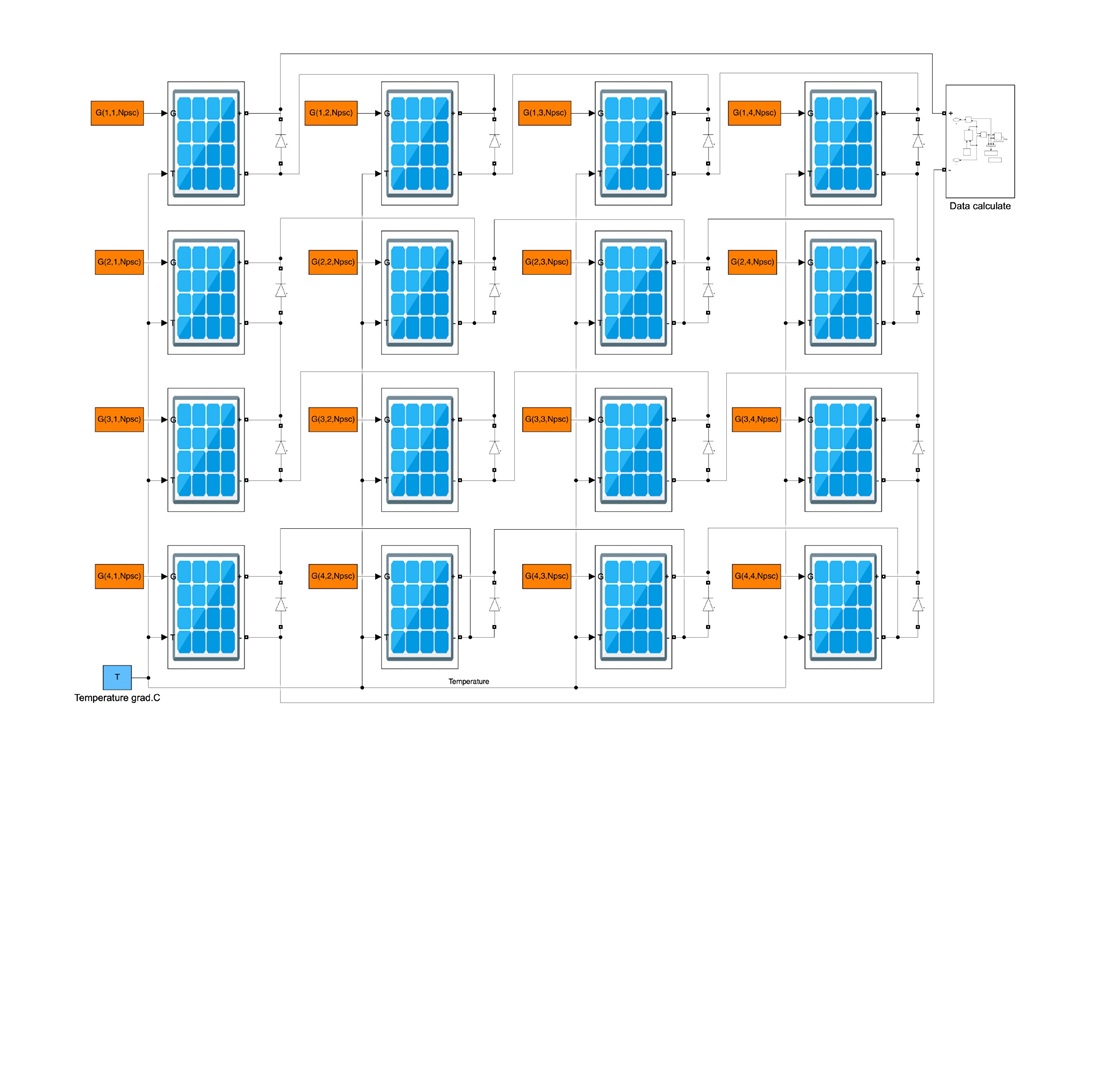
Based on climatic data, the methodology for modelling the movement of a cloud shading strip, taking wind direction into account, has been substantiated. The array model has been improved by introducing a partial-shading strip that moves in specified directions. That has made it possible to assess the influence of strip direction and speed on dynamic modes for selected panel configurations, based on their location and connection topology.
In accordance with the adopted array power, possible configurations with 16 photovoltaic panels, each of 655 W, have been determined. Modeling confirmed the complication of the trajectory of the global maximum power point under the conditions of shading strip movement. This manifests in the multiplicity of local maxima and in the unpredictable trajectory of the global maximum, which depends on the array configuration and the direction of strip movement.
It was established that the strip speed did not affect the performance. According to the simulation results, recommended configurations with minimal shading impact on energy performance were obtained when the strip moved along the prevailing wind direction. It was shown that the generation power along the prevailing directions of the shading strip relative to the average value in all directions of movement is not less than 96%. The trajectory of the global maximum is monotonic, so no special algorithms are needed to track the maximum power. This makes it possible, at a panel power of 655 W, to form array configurations with a total power in the range of 3.93–15.72 kW.
References
- Shao, C., Migan-Dubois, A., Diallo, D. (2023). Performance of PV array configurations under dynamic partial shadings. EPJ Photovoltaics, 14, 21. https://doi.org/10.1051/epjpv/2023012
- Suriya kala, S., Prince winston, D., Pravin, M., Sakthivel, G. (2023). Maximum power enhancement in solar PV modules through modified TCT interconnection method. Sustainable Energy Technologies and Assessments, 60, 103462. https://doi.org/10.1016/j.seta.2023.103462
- Baba, A. O., Liu, G., Chen, X. (2020). Classification and Evaluation Review of Maximum Power Point Tracking Methods. Sustainable Futures, 2, 100020. https://doi.org/10.1016/j.sftr.2020.100020
- Rezk, H., Fathy, A., Abdelaziz, A. Y. (2017). A comparison of different global MPPT techniques based on meta-heuristic algorithms for photovoltaic system subjected to partial shading conditions. Renewable and Sustainable Energy Reviews, 74, 377–386. https://doi.org/10.1016/j.rser.2017.02.051
- Duranay, Z. B., Güldemir, H. (2025). Mitigating Partial Shading Effects in Photovoltaic Systems Using Particle Swarm Optimization-Tuned Sliding Mode Control. Processes, 13 (5), 1463. https://doi.org/10.3390/pr13051463
- Abdulmawjood, K., Alsadi, S., Refaat, S. S., Morsi, W. G. (2022). Characteristic Study of Solar Photovoltaic Array Under Different Partial Shading Conditions. IEEE Access, 10, 6856–6866. https://doi.org/10.1109/access.2022.3142168
- Pareek, S., Ansari, M. F., Khurana, N., Nezami, Md. M., Alharbi, S. S., Alharbi, S. S. et al. (2025). Performance comparison of interconnection schemes for mitigating partial shading losses in solar photovoltaic arrays. Scientific Reports, 15 (1). https://doi.org/10.1038/s41598-025-12984-7
- Siaw, F. L., Thio, T. H. G., Lau, W. H. (2025). Comparative study of solar photovoltaic array configurations under partial shading conditions on portable solar chargers. International Conference on Research Innovations: Trends in Computational Science, 3335, 040006. https://doi.org/10.1063/5.0290086
- Saiprakash, C., Mohapatra, A., Nayak, B., Ghatak, S. R. (2021). Analysis of partial shading effect on energy output of different solar PV array configurations. Materials Today: Proceedings, 39, 1905–1909. https://doi.org/10.1016/j.matpr.2020.08.307
- Ganesan, S., David, P. W., Thangaraj, H., Balachandran, P. K., Selvarajan, S. (2025). Power enhancement of PV arrays in different configurations under different partial shaded condition. Scientific Reports, 15 (1). https://doi.org/10.1038/s41598-025-91508-9
- Devakirubakaran, S., Verma, R., Chokkalingam, B., Mihet-Popa, L. (2023). Performance Evaluation of Static PV Array Configurations for Mitigating Mismatch Losses. IEEE Access, 11, 47725–47749. https://doi.org/10.1109/access.2023.3274684
- Jalil, M. F., Pushpender, Khatoon, S., Hameed, S., Bansal, R. C. (2026). Shade dispersion in partial shading and mismatch loss reduction in PV array with improved odd-even reconfiguration. International Journal of Modelling and Simulation, 1–17. https://doi.org/10.1080/02286203.2025.2611264
- Mishra, V. L., Chauhan, Y. K., Verma, K. S. (2024). Attenuation of shading loss using a novel solar array reconfigured topology under partial shading conditions. Solar Energy, 274, 112552. https://doi.org/10.1016/j.solener.2024.112552
- Cherukuri, S. K., Kumar, B. P., Kaniganti, K. R., Muthubalaji, S., Devadasu, G., Babu, T. S., Alhelou, H. H. (2022). A Novel Array Configuration Technique for Improving the Power Output of the Partial Shaded Photovoltaic System. IEEE Access, 10, 15056–15067. https://doi.org/10.1109/access.2022.3148065
- Satpathy, P. R., Aljafari, B., Thanikanti, S. B., Sharma, R. (2023). An efficient power extraction technique for improved performance and reliability of solar PV arrays during partial shading. Energy, 282, 128992. https://doi.org/10.1016/j.energy.2023.128992
- Koshkarbay, N., Mohammed, K. K., Mekhilef, S., Kuttybay, N., Saymbetov, A., Nurgaliyev, M., Kalassov, N. (2026). High-efficiency hybrid MPPT technique with integrated partial shading detection for photovoltaic systems under varying shading conditions. Renewable Energy, 261, 125244. https://doi.org/10.1016/j.renene.2026.125244
- Akter, K., Motakabeer, S. M. A., Zahirul Alam, A. H. M., Yusoff, S. H. B., Pachauri, R. K., Malik, H., Jadoun, V. K. (2025). A novel MPPT approach for photovoltaic system using Pelican optimization and high-gain DC–DC converter. Scientific Reports, 15 (1). https://doi.org/10.1038/s41598-025-24000-z
- Somesunthrim, K., Charin, C., Ismail, B., Bani Ahmad, A. (2025). Maximum Power Point Tracking With Opposition‐Based Learning–Levy Flight Optimization for a Standalone Photovoltaic System. Journal of Electrical and Computer Engineering, 2025 (1). https://doi.org/10.1155/jece/5001433
- Mahmod Mohammad, A. N., Mohd Radzi, M. A., Azis, N., Shafie, S., Atiqi Mohd Zainuri, M. A. (2020). An Enhanced Adaptive Perturb and Observe Technique for Efficient Maximum Power Point Tracking Under Partial Shading Conditions. Applied Sciences, 10 (11), 3912. https://doi.org/10.3390/app10113912
- Climate and monthly weather forecast Kyiv, Ukraine. Weather Atlas. Available at: https://www.weather-atlas.com/en/ukraine/kiev-climate?utm_source
- Hi-MO X10_Scientist LR7-72HVH 655-670M. Available at: https://static.longi.com/LR_7_72_HVH_655_670_M_30_30_and_15_Scientist_BGV_02_20241118_EN_Draft_9293e45f42.pdf
- Deye. Hybrid Inverter. User Manual. Available at: https://www.deyeinverter.com/deyeinverter/2024/02/03/rand/1391/instructions_sun-5-25k-sg01hp3-eu-am2_240203_en.pdf
Downloads
Published
How to Cite
Issue
Section
License
Copyright (c) 2026 Olexandr Shavolkin, Hennadii Kruhliak, Iryna Shvedchykova, Tetiana Bila, Andrіі Pisotskyi

This work is licensed under a Creative Commons Attribution 4.0 International License.
The consolidation and conditions for the transfer of copyright (identification of authorship) is carried out in the License Agreement. In particular, the authors reserve the right to the authorship of their manuscript and transfer the first publication of this work to the journal under the terms of the Creative Commons CC BY license. At the same time, they have the right to conclude on their own additional agreements concerning the non-exclusive distribution of the work in the form in which it was published by this journal, but provided that the link to the first publication of the article in this journal is preserved.
A license agreement is a document in which the author warrants that he/she owns all copyright for the work (manuscript, article, etc.).
The authors, signing the License Agreement with TECHNOLOGY CENTER PC, have all rights to the further use of their work, provided that they link to our edition in which the work was published.
According to the terms of the License Agreement, the Publisher TECHNOLOGY CENTER PC does not take away your copyrights and receives permission from the authors to use and dissemination of the publication through the world's scientific resources (own electronic resources, scientometric databases, repositories, libraries, etc.).
In the absence of a signed License Agreement or in the absence of this agreement of identifiers allowing to identify the identity of the author, the editors have no right to work with the manuscript.
It is important to remember that there is another type of agreement between authors and publishers – when copyright is transferred from the authors to the publisher. In this case, the authors lose ownership of their work and may not use it in any way.








