Establishing patterns in the formation of a fire-resistant sip panel with hemp insulation
DOI:
https://doi.org/10.15587/1729-4061.2026.352433Keywords:
hemp insulation, reactive coating, lime, SIP panels, fire resistance, coke layerAbstract
This study investigates the process that forms fire-resistant properties of SIP-panels with hemp insulation based on reactive coating and lime. The task addressed is to ensure the stability of SIP-panels and components when treated with coatings to changes in operating conditions. This is important since production from renewable sources for construction is a relevant issue.
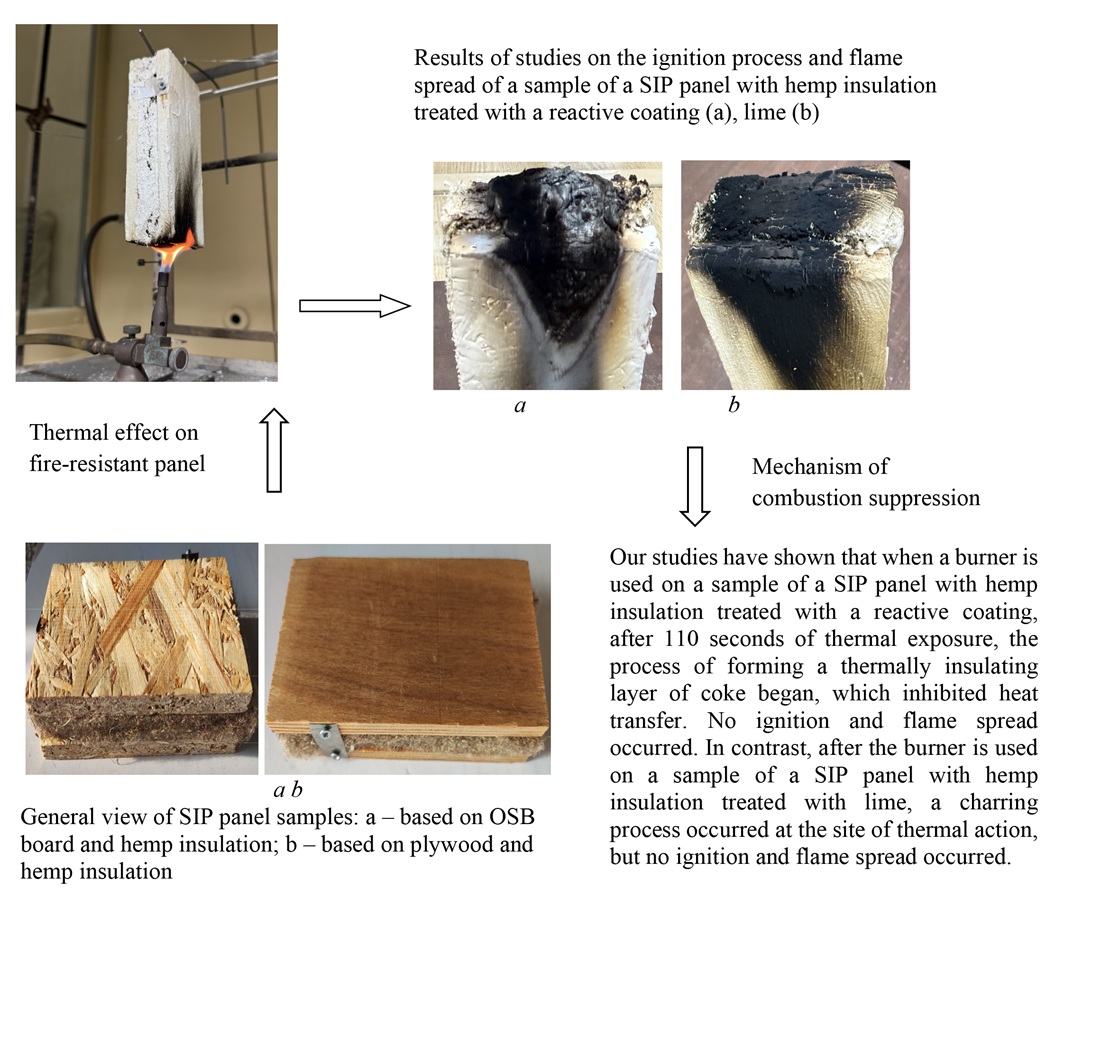
It has been proven that during thermal action on samples of hemp insulation treated with reactive coating and lime, no ignition and flame spread along the surface occurred. A layer of foam coke formed on the surface of the sample treated with reactive coating, which is 22 mm.
The study has shown that when a burner is applied to a sample of SIP-panels with hemp insulation treated with reactive coating, after 110 s of thermal exposure, the process of forming a heat-insulating layer of coke began, which inhibited heat transfer. Instead, after the burner was exposed to a sample of SIP panels with hemp insulation treated with lime, a charring process occurred at the site of thermal action, but ignition and flame spread did not occur.
Based on the results of determining the strength, it was found that treating the surface of hemp insulation with a coating increases the tensile strength by more than 2.5 times. Thus, increasing the amount of reactive coating on the surface of hemp insulation by half increases the tensile strength by 2.3 times. In the case of treating hemp insulation with lime, the tensile strength decreases by 3.4 times while increasing the amount of lime when treating the surface of hemp insulation to 0.38 kg/m2 increases the tensile strength by 5.3 times.
Thus, there is reason to argue about the possibility to design effective and operationally stable biocomposites for construction.
References
- Li, X., Peng, C., Liu, L. (2020). Experimental study of the thermal performance of a building wall with vacuum insulation panels and extruded polystyrene foams. Applied Thermal Engineering, 180, 115801. https://doi.org/10.1016/j.applthermaleng.2020.115801
- Gallina, L., Chaji, S., Manzoli, M., Cravero, F., Gnoffo, C., Gesti, S. et al. (2024). Preparation of hemp‐based biocomposites and their potential industrial application. Polymer Composites, 46 (4), 3791–3802. https://doi.org/10.1002/pc.29206
- Pereira, J. F., Núñez, E., Reyes, A., Mali, S., Lopez-Rubio, A., Fabra, M. J. (2024). On the use of lignocellulosic hemp fibers to produce biodegradable cost-efficient biocomposites. Future Foods, 10, 100507. https://doi.org/10.1016/j.fufo.2024.100507
- Cigasova, J., Stevulova, N., Schwarzova, I., Sicakova, A., Junak, J. (2015). Application of Hemp Hurds in the Preparation of Biocomposites. IOP Conference Series: Materials Science and Engineering, 96, 012023. https://doi.org/10.1088/1757-899x/96/1/012023
- Kausar, A., Ahmad, I. (2023). Hemp Fibres: Essentials, Composites or Nanocomposites and Technical Applications. Nano-Horizons: Journal of Nanosciences and Nanotechnologies, 2. https://doi.org/10.25159/3005-2602/13835
- Dahal, R. K., Acharya, B., Dutta, A. (2023). The Interaction Effect of the Design Parameters on the Water Absorption of the Hemp-Reinforced Biocarbon-Filled Bio-Epoxy Composites. International Journal of Molecular Sciences, 24 (7), 6093. https://doi.org/10.3390/ijms24076093
- Akbarian-Saravi, N., Sowlati, T., Ahmad, H., Hewage, K., Sadiq, R., Milani, A. S. (2025). Life cycle assessment of hemp-based biocomposites production for agricultural emission mitigation strategies: a case study. Biocomposites and the Circular Economy, 261–285. https://doi.org/10.1016/b978-0-443-23718-8.00012-0
- Francucci, G., Manthey, N., Cardona, F., Aravinthan, T. (2013). Processing and characterization of 100% hemp-based biocomposites obtained by vacuum infusion. Journal of Composite Materials, 48 (11), 1323–1335. https://doi.org/10.1177/0021998313485266
- Sassoni, E., Manzi, S., Motori, A., Montecchi, M., Canti, M. (2014). Novel sustainable hemp-based composites for application in the building industry: Physical, thermal and mechanical characterization. Energy and Buildings, 77, 219–226. https://doi.org/10.1016/j.enbuild.2014.03.033
- Morgan, A. B., Toubia, E. (2013). Cone calorimeter and room corner fire testing of balsa wood core/phenolic composite skin sandwich panels. Journal of Fire Sciences, 32 (4), 328–345. https://doi.org/10.1177/0734904113514944
- Yoshioka, H., Tanaka, Y., Tamura, M., Nishio, Y., Tanaike, Y., Ando, T. et al. (2017). Study on intermediate-scale test method for fire safety performance evaluation of sandwich panels. AIJ Journal of Technology and Design, 23 (53), 159–164. https://doi.org/10.3130/aijt.23.159
- de Boer, J. G. G. M., Hofmeyer, H., Maljaars, J., van Herpen, R. A. P. (2019). Two-way coupled CFD fire and thermomechanical FE analyses of a self-supporting sandwich panel façade system. Fire Safety Journal, 105, 154–168. https://doi.org/10.1016/j.firesaf.2019.02.011
- Tsapko, Y., Tsapko, А., Bondarenko, O., Chudovska, V. (2021). Thermophysical characteristics of the formed layer of foam coke when protecting fabric from fire by a formulation based on modified phosphorus-ammonium compounds. Eastern-European Journal of Enterprise Technologies, 3 (10 (111)), 34–41. https://doi.org/10.15587/1729-4061.2021.233479
- Tsapko, Y., Tsapko, А. (2017). Establishment of the mechanism and fireproof efficiency of wood treated with an impregnating solution and coatings. Eastern-European Journal of Enterprise Technologies, 3 (10 (87)), 50–55. https://doi.org/10.15587/1729-4061.2017.102393
- ASTM D5035-11. Standard Test Method for Breaking Force and Elongation of Textile Fabrics (Strip Method). Available at: https://www.mecmesin.com/standard/astm-d5035-11
- Tsapko, Y., Tsapko, A., Likhnyovskyi, R., Bielikova, K., Berdnyk, O., Gavryliuk, A. et al. (2025). Establishing regularities of fire protection of wood by a composite coating with a biopolymer. Eastern-European Journal of Enterprise Technologies, 3 (10 (135)), 16–25. https://doi.org/10.15587/1729-4061.2025.332443
- Tsapko, Y., Tsapko, A., Lomaha, V., Illiuchenko, P., Berdnyk, O., Likhnyovskyi, R. et al. (2025). Establishing patterns in the formation of biocomposites for thermal insulation of building structures. Eastern-European Journal of Enterprise Technologies, 4 (10 (136)), 56–64. https://doi.org/10.15587/1729-4061.2025.337401
- Tsapko, Y., Sukhanevych, M., Bondarenko, O., Tsapko, O., Sarapin, Y. (2023). Investigation of changes in the process of thermal-oxidative destruction of fire-retardant fabric. IX International Conference on Actual Problems of Engineering Mechanics (APEM2022), 2840, 020009. https://doi.org/10.1063/5.0168781
Downloads
Published
How to Cite
Issue
Section
License
Copyright (c) 2026 Yuriy Tsapko, Аleksii Tsapko, Oksana Berdnyk, Ruslan Likhnyovskyi, Kseniia Bielikova, Oksana Slutska, Anna Borysova, Vasyl Lomaha, Olha Uzhehova, Vitalii Chaikovskiy

This work is licensed under a Creative Commons Attribution 4.0 International License.
The consolidation and conditions for the transfer of copyright (identification of authorship) is carried out in the License Agreement. In particular, the authors reserve the right to the authorship of their manuscript and transfer the first publication of this work to the journal under the terms of the Creative Commons CC BY license. At the same time, they have the right to conclude on their own additional agreements concerning the non-exclusive distribution of the work in the form in which it was published by this journal, but provided that the link to the first publication of the article in this journal is preserved.
A license agreement is a document in which the author warrants that he/she owns all copyright for the work (manuscript, article, etc.).
The authors, signing the License Agreement with TECHNOLOGY CENTER PC, have all rights to the further use of their work, provided that they link to our edition in which the work was published.
According to the terms of the License Agreement, the Publisher TECHNOLOGY CENTER PC does not take away your copyrights and receives permission from the authors to use and dissemination of the publication through the world's scientific resources (own electronic resources, scientometric databases, repositories, libraries, etc.).
In the absence of a signed License Agreement or in the absence of this agreement of identifiers allowing to identify the identity of the author, the editors have no right to work with the manuscript.
It is important to remember that there is another type of agreement between authors and publishers – when copyright is transferred from the authors to the publisher. In this case, the authors lose ownership of their work and may not use it in any way.








