Development of a method of automatic control of additional wind propulsion system, propeller and stern as a single structure of ship actuators
DOI:
https://doi.org/10.15587/1729-4061.2026.352588Keywords:
additional wind propulsion systems, energy efficiency, conditional optimization, unified structure of actuatorsAbstract
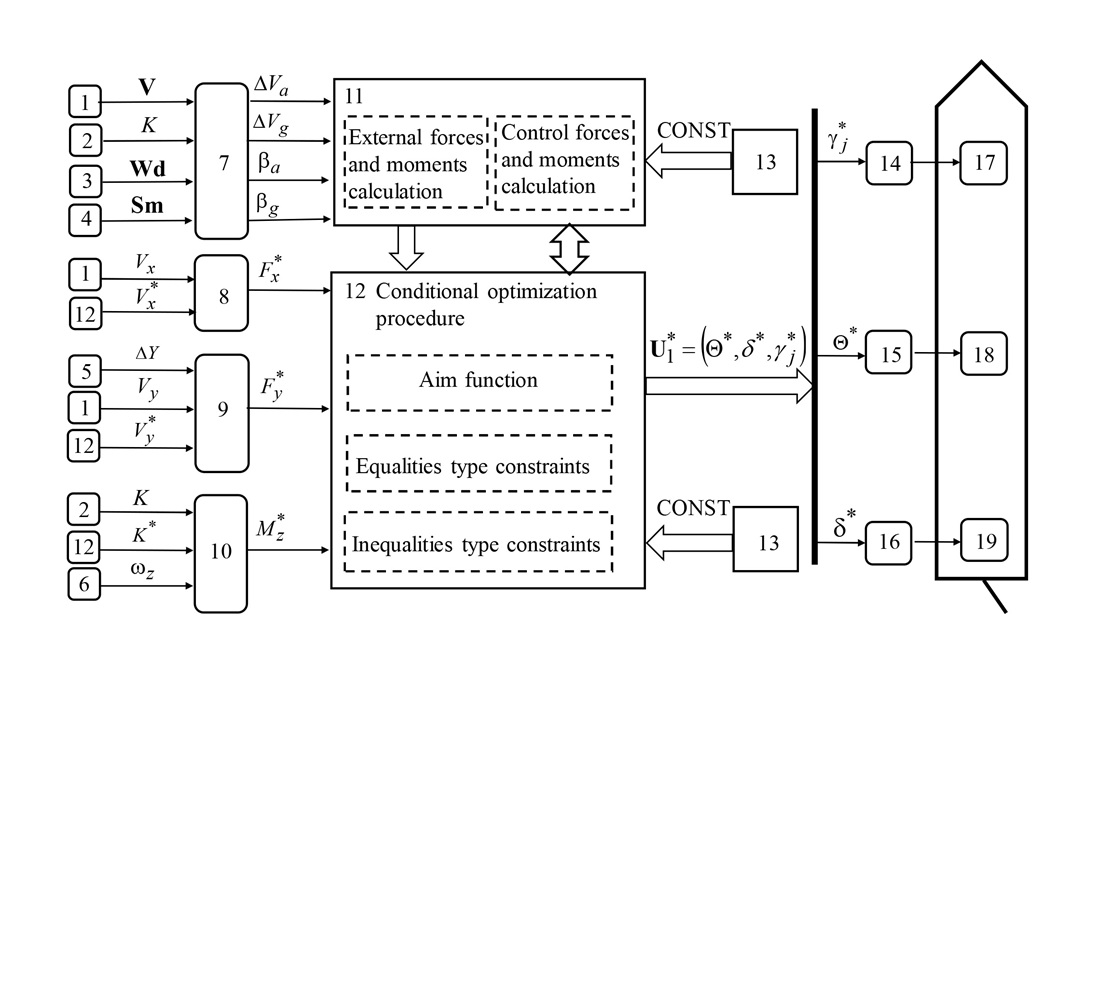
This study investigates processes related to automatic optimal control over additional wind propulsion systems, propeller, and rudder as a single structure of vessel's actuators.
The maritime industry faces significant challenges because of increasingly stringent legislative requirements for reducing emissions of harmful substances into the atmosphere and improving the climate. Among the wide range of technologies and fuel solutions considered in this context, one of the most promising ones are wind propulsion systems, which can significantly reduce fuel consumption by vessels and, as a result, decrease emissions of greenhouse gases and other harmful substances into the atmosphere. In known solutions, each sail of a wind propulsion system is equipped with a system of automatic optimal guidance to the wind, which allows for maximum utilization of wind energy.
This work considers the issues of additional reduction of fuel consumption by a single-propeller conventional vessel with a wind propulsion system when moving along the route, in comparison with known solutions. The results are attributed to the use on-board controller in the vessel movement control system; to the calculation, at each step of the on-board controller, of optimal controls for the wind propulsion system, propeller, and rudder as a single structure of vessel's actuators. Optimal controls are found by solving the problem of conditional optimization of the objective function with constraints on equalities and inequalities type in the on-board controller. This allows for an additional 11% reduction in fuel consumption compared to the prototype and, at the same time, providing the necessary steering forces and torque to maintain a vessel's desired movement along the route. Results can only be achieved if the on-board computer control system has sufficient power
References
- Louda, P., Marasanov, V., Sharko, A., Stepanchikov, D., Sharko, A. (2022). The Theory of Similarity and Analysis of Dimensions for Determining the State of Operation of Structures under Difficult Loading Conditions. Materials, 15 (3), 1191. https://doi.org/10.3390/ma15031191
- Babichev, S., Sharko, O., Sharko, A., Mikhalyov, O. (2019). Soft Filtering of Acoustic Emission Signals Based on the Complex Use of Huang Transform and Wavelet Analysis. Lecture Notes in Computational Intelligence and Decision Making, 3–19. https://doi.org/10.1007/978-3-030-26474-1_1
- Louda, P., Sharko, A., Stepanchikov, D., Sharko, A. (2022). Experimental and Theoretical Study of Plastic Deformation of Epoxy Coatings on Metal Substrates Using the Acoustic Emission Method. Materials, 15 (11), 3791. https://doi.org/10.3390/ma15113791
- Luo, Y., Kong, L., Fang, S., Shu, Y., Niu, T., Chen, G., Liao, R. (2024). Reviews on the power management for shipboard energy storage systems. Sustainable Horizons, 9, 100094. https://doi.org/10.1016/j.horiz.2024.100094
- Zinchenko, S., Kyrychenko, K., Grosheva, O., Nosov, P., Popovych, I., Mamenko, P. (2023). Automatic Reset of Kinetic Energy in Case of Inevitable Collision of Ships. 2023 13th International Conference on Advanced Computer Information Technologies (ACIT), 496–500. https://doi.org/10.1109/acit58437.2023.10275545
- Kobets, V., Zinchenko, S., Tovstokoryi, O., Nosov, P., Popovych, I., Gritsuk, I., Perederyi, V. (2024). Automatic Prevention of the Vessel’s Parametric Rolling on the Wave. Proceedings of the 8th International Conference on Computational Linguistics and Intelligent Systems. Volume II: Modeling, Optimization, and Controlling in Information and Technology Systems Workshop (MOCITSW-CoLInS 2024). https://doi.org/10.31110/colins/2024-2/016
- Zinchenko, S., Tovstokoryi, O., Popovych, I., Nosov, P., Onyshko, D., Kalinichenko, Y. (2025). Reconfiguration of Redundant Structures of Ship Actuators Using Zero Motion Method. 2025 15th International Conference on Advanced Computer Information Technologies (ACIT), 948–953. https://doi.org/10.1109/acit65614.2025.11185810
- Zinchenko, S., Tovstokoryi, O., Kobets, V., Kyrychenko, K. (2025). Intelligent system for reconfiguring the redundant structure of ship actuators without disturbance. Proceedings of the Intelligent Systems Workshop at 9th International Conference on Computational Linguistics and Intelligent Systems (CoLInS-2025). https://doi.org/10.31110/colins/2025-2/009
- Kobets, V., Popovych, I., Zinchenko, S., Nosov, P., Tovstokoryi, O., Kyrychenko, K. (2023). Control of the Pivot Point Position of a Conventional Single-Screw Vessel. Proceedings of the 11-th International Conference "Information Control Systems & Technologies", 130–140. Available at: https://ceur-ws.org/Vol-3513/paper11.pdf
- Laursen, R., Patel, H., Sofiadi, D., Zhu, R., Nelissen, D., Seters, V., Pang, D. (2023). Potential of wind – assisted propulsion for shipping. European Maritime Safety Agency (EMSA). Available at: https://www.emsa.europa.eu/publications/item/5078-potential-of-wind-assisted-propulsion-for-shipping.html
- Berge Olympus. Available at: https://www.bergebulk.com/our-fleet/berge-olympus/
- Wind Challenger. The Wind Assisted Ship Propulsion System. Available at: https://www.mol-service.com/en/services/energy-saving-technologies/wind-challenger
- Li, Z., Wang, K., Liu, Y., Liang, H., Zhang, D., Wang, Z. et al. (2026). Evaluation of energy-saving effects of a wing-typed sail-assisted ship using wind energy density route analysis. Ocean Engineering, 345, 123693. https://doi.org/10.1016/j.oceaneng.2025.123693
- Zhang, S., Wang, X., Zhen, L. (2026). Shipping service design for wind-assisted ships. Transportation Research Part E: Logistics and Transportation Review, 209, 104720. https://doi.org/10.1016/j.tre.2026.104720
- Li, Z., Wang, K., Ruan, Z., Li, D., Liang, H., Ma, R. et al. (2025). A fuel consumption prediction model for wind-assisted ship based on operational data. Transportation Research Part D: Transport and Environment, 149, 105045. https://doi.org/10.1016/j.trd.2025.105045
- Cairns, J., Vezza, M., Green, R., MacVicar, D. (2021). Numerical optimisation of a ship wind-assisted propulsion system using blowing and suction over a range of wind conditions. Ocean Engineering, 240, 109903. https://doi.org/10.1016/j.oceaneng.2021.109903
- Nyanya, M. N., Vu, H. B., Schönborn, A., Ölçer, A. I. (2021). Wind and solar assisted ship propulsion optimisation and its application to a bulk carrier. Sustainable Energy Technologies and Assessments, 47, 101397. https://doi.org/10.1016/j.seta.2021.101397
- Zhu, J., Chen, L., Miao, R. (2025). Optimization of sail-hybrid electric power system for ships considering correlated environmental uncertainties. Applied Energy, 391, 125862. https://doi.org/10.1016/j.apenergy.2025.125862
- Wang, Z., Chen, L., Huang, L., Wang, K., Ma, R., Wang, B. (2025). A novel multivariable coupling optimization method of wind-assisted propulsion system for a large crude carrier. Energy, 322, 135720. https://doi.org/10.1016/j.energy.2025.135720
- Zinchenko, S. M., Tovstokoryy, K. O. (2025). Conditional optimization of vessel controls with wind additional propulsion system. Scientific Bulletin Kherson State Maritime Academy, 2 (31), 30–40. https://doi.org/10.33815/2313-4763.2025.2.31.030-040
Downloads
Published
How to Cite
Issue
Section
License
Copyright (c) 2026 Serhii Zinchenko, Kostyantyn Tovstokoryy, Kostiantyn Tymofeiev, Dmytro Onyshko, Vadym Polishchuk

This work is licensed under a Creative Commons Attribution 4.0 International License.
The consolidation and conditions for the transfer of copyright (identification of authorship) is carried out in the License Agreement. In particular, the authors reserve the right to the authorship of their manuscript and transfer the first publication of this work to the journal under the terms of the Creative Commons CC BY license. At the same time, they have the right to conclude on their own additional agreements concerning the non-exclusive distribution of the work in the form in which it was published by this journal, but provided that the link to the first publication of the article in this journal is preserved.
A license agreement is a document in which the author warrants that he/she owns all copyright for the work (manuscript, article, etc.).
The authors, signing the License Agreement with TECHNOLOGY CENTER PC, have all rights to the further use of their work, provided that they link to our edition in which the work was published.
According to the terms of the License Agreement, the Publisher TECHNOLOGY CENTER PC does not take away your copyrights and receives permission from the authors to use and dissemination of the publication through the world's scientific resources (own electronic resources, scientometric databases, repositories, libraries, etc.).
In the absence of a signed License Agreement or in the absence of this agreement of identifiers allowing to identify the identity of the author, the editors have no right to work with the manuscript.
It is important to remember that there is another type of agreement between authors and publishers – when copyright is transferred from the authors to the publisher. In this case, the authors lose ownership of their work and may not use it in any way.








