Definition a clusterization method to solve the task of early identification of IT product configuration elements
DOI:
https://doi.org/10.15587/1729-4061.2026.352878Keywords:
information system, configuration element, dense-based clustering, DBSCAN algorithm, Chebyshev distanceAbstract
This study investigates the process that controls the IT project configuration.
The task addressed is early identification of configuration items (CIs) within an enterprise management information system (IS). Research in this area is aimed at solving the task of early identification of services when refactoring software systems. Up to now, the application of artificial intelligence methods to define CIs has not been studied in detail.
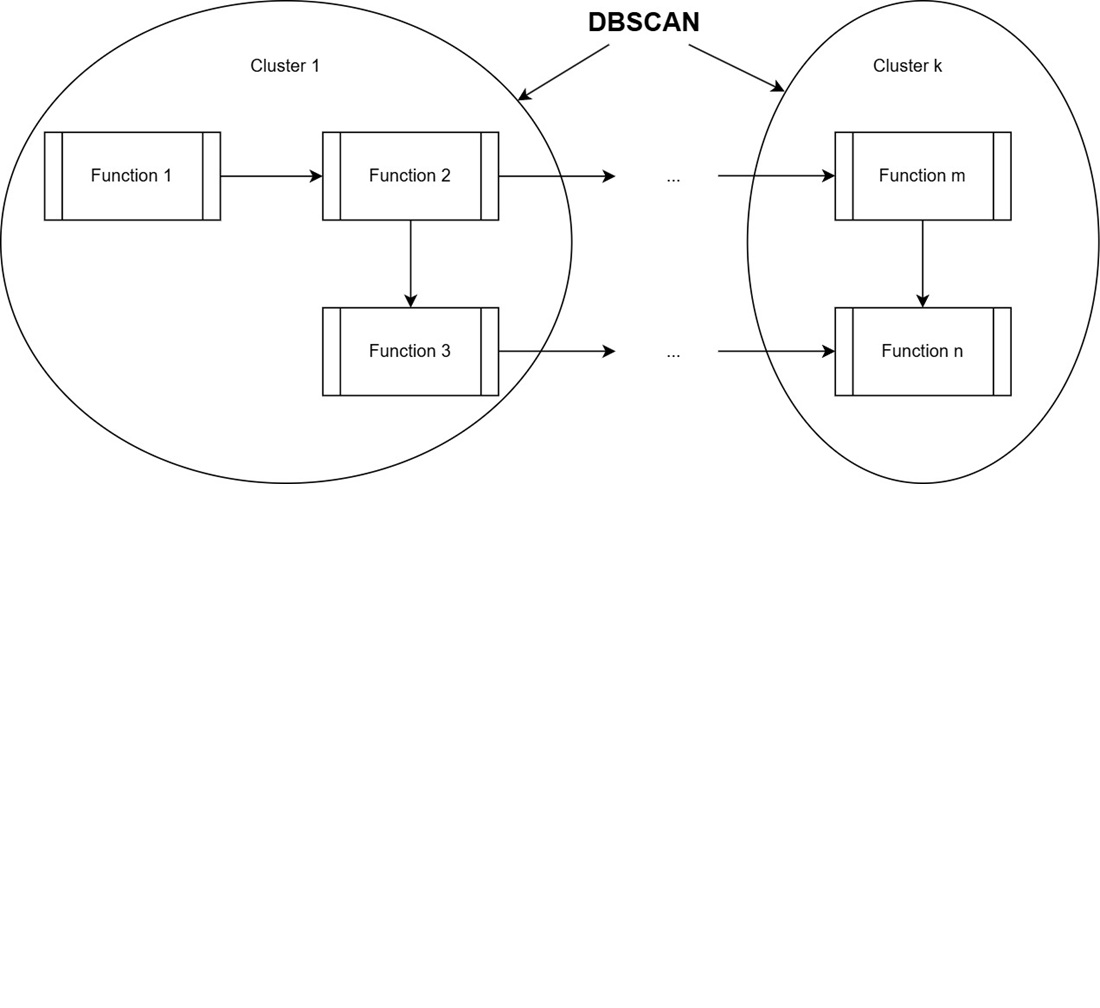
To solve the task of early identification of IS CIs, the density-based clustering algorithm Density-Based Spatial Clustering of Applications with Noise (DBSCAN) was adapted. The adapted DBSCAN was used to early define CIs in the functional task “Formation and maintenance of an individual plan of a scientific and pedagogical employee at a department”. As initial CIs, 10 functions and 12 entities in the database of the task were considered. The result is the sets of clusters that describe monolithic, modular, and service-oriented IS architectures.
A comparative analysis of the use of DBSCAN, Divisive Analysis, Agglomerative Nesting, Chameleon, and k-means methods and algorithms for solving the task of early identification was carried out. The criteria “Cumbersome solution” and “Identification of separated CIs” were used for comparison. The application of DBSCAN made it possible to form a solution from one (monolithic and modular architecture) or two (service-oriented architecture) clusters and to detect separated CIs. These values of the proposed criteria are the best for the selected group of clustering methods and algorithms.
Implementing the results makes it possible to automate a procedure for synthesizing the description of IS architecture. This automation would improve the quality of IS development by identifying a set of architectural entities of this IS for its design. This set is much smaller than the set of elementary IS functions
References
- Quigley, J. M., Robertson, K. L. (2019). Configuration Management. Auerbach Publications. https://doi.org/10.1201/9780429318337
- Bourque, P., Fairley, R. E. (2014). Guide to the Software Engineering Body of Knowledge. Version 3.0. IEEE Computer Society, 335. Available at: https://dl.acm.org/doi/10.5555/2616205
- IEEE/ISO/IEC 15288-2023. ISO/IEC/IEEE International Standard - Systems and software engineering--System life cycle processes. Available at: https://standards.ieee.org/ieee/15288/10424/
- Farayola, O. A., Hassan, A. O., Adaramodu, O. R., Fakeyede, O. G., Oladeinde, M. (2023). Configuration management in the modern era: best practices, innovations, and challenges. Computer Science & IT Research Journal, 4 (2), 140–157. https://doi.org/10.51594/csitrj.v4i2.613
- Reiff-Marganiec, S., Tilly, M. (Eds.) (2012). Handbook of Research on Service-Oriented Systems and Non-Functional Properties. IGI Global Scientific Publishing. https://doi.org/10.4018/978-1-61350-432-1
- Cadavid, H., Andrikopoulos, V., Avgeriou, P., Broekema, P. C. (2022). System and software architecting harmonization practices in ultra-large-scale systems of systems: A confirmatory case study. Information and Software Technology, 150, 106984. https://doi.org/10.1016/j.infsof.2022.106984
- Faitelson, D., Heinrich, R., Tyszberowicz, S. (2017). Supporting Software Architecture Evolution by Functional Decomposition. Proceedings of the 5th International Conference on Model-Driven Engineering and Software Development, 435–442. https://doi.org/10.5220/0006206204350442
- Shahin, R. (2021). Towards Assurance-Driven Architectural Decomposition of Software Systems. Computer Safety, Reliability, and Security. SAFECOMP 2021 Workshops, 187–196. https://doi.org/10.1007/978-3-030-83906-2_15
- Suljkanović, A., Milosavljević, B., Inđić, V., Dejanović, I. (2022). Developing Microservice-Based Applications Using the Silvera Domain-Specific Language. Applied Sciences, 12 (13), 6679. https://doi.org/10.3390/app12136679
- Felfernig, A., Le, V.-M., Popescu, A., Uta, M., Tran, T. N. T., Atas, M. (2021). An Overview of Recommender Systems and Machine Learning in Feature Modeling and Configuration. Proceedings of the 15th International Working Conference on Variability Modelling of Software-Intensive Systems, 1–8. https://doi.org/10.1145/3442391.3442408
- Abolfazli, A., Spiegelberg, J., Palmer, G., Anand, A. (2023). A Deep Reinforcement Learning Approach to Configuration Sampling Problem. 2023 IEEE International Conference on Data Mining (ICDM), 1–10. https://doi.org/10.1109/icdm58522.2023.00009
- Sellami, K., Saied, M. A., Ouni, A. (2022). A Hierarchical DBSCAN Method for Extracting Microservices from Monolithic Applications. The International Conference on Evaluation and Assessment in Software Engineering 2022, 201–210. https://doi.org/10.1145/3530019.3530040
- Krause, A., Zirkelbach, C., Hasselbring, W., Lenga, S., Kroger, D. (2020). Microservice Decomposition via Static and Dynamic Analysis of the Monolith. 2020 IEEE International Conference on Software Architecture Companion (ICSA-C), 9–16. https://doi.org/10.1109/icsa-c50368.2020.00011
- Ievlanov, M., Vasiltcova, N., Neumyvakina, O., Panforova, I. (2022). Development of a method for solving the problem of it product configuration analysis. Eastern-European Journal of Enterprise Technologies, 6 (2 (120)), 6–19. https://doi.org/10.15587/1729-4061.2022.269133
- Santos, J. L., Martins, L. E. G., Molléri, J. S. (2025). Requirements extraction from model-based systems engineering: A systematic literature review. Journal of Systems and Software, 226, 112407. https://doi.org/10.1016/j.jss.2025.112407
- Ashfaq, M., Sadik, A. R., Das, T., Waseem, M., Mäkitalo, N., Mikkonen, T. (2026). Runtime composition in dynamic system of systems: A systematic review of challenges, solutions, tools, and evaluation methods. Journal of Systems and Software, 232, 112661. https://doi.org/10.1016/j.jss.2025.112661
- Han, J., Kamber, M., Pei, J. (2012). Data Mining: Concepts and Techniques. Waltham: Morgan Kaufmann Publishers.
- Schubert, E., Sander, J., Ester, M., Kriegel, H. P., Xu, X. (2017). DBSCAN Revisited, Revisited. ACM Transactions on Database Systems, 42 (3), 1–21. https://doi.org/10.1145/3068335
- Evlanov, М. (2016). Development of the model and method of selecting the description of rational architecture of information system. Eastern-European Journal of Enterprise Technologies, 1 (2 (79)), 4–12. https://doi.org/10.15587/1729-4061.2016.60583
- Vasyltcova, N. V., Panforova, I. Yu. (2022). Research on the use of hierarchical clustering methods when solving the task of IT product configuration analysis. Management Information System and Devises, 178, 37–49. https://doi.org/10.30837/0135-1710.2022.178.037
- Ievlanov, M., Vasiltcova, N., Neumyvakina, O., Panforova, I. (2024). Use of clustering methods to solve the problem of identifying configuration items in IT project. PROJECT MANAGEMENT: INDUSTRY SPECIFICS, 3–38. https://doi.org/10.15587/978-617-8360-03-0.ch1
- Evlanov, M. V., Vasyltsova, N. V., Nykytiuk, V. A. (2011). Formalyzovannoe opysanye uslovyi yntehratsyy IT-servysov v ynformatsyonnuiu systemu upravlenyia predpryiatyem. Visnyk Akademii mytnoi sluzhby Ukrainy. Seriya «Tekhnichni nauky», 2 (46), 87–96. Available at: http://www.irbis-nbuv.gov.ua/cgi-bin/irbis_nbuv/cgiirbis_64.exe?I21DBN=LINK&P21DBN=UJRN&Z21ID=&S21REF=10&S21CNR=20&S21STN=1&S21FMT=ASP_meta&C21COM=S&2_S21P03=FILA=&2_S21STR=vamsutn_2011_2_12
- Ievlanov, M., Vasiltcova, N., Panforova, I., Moroz, B., Martynenko, A., Moroz, D. (2024). Comparison of solutions to the task of IT product configuration items early identification using hierarchical clusterization methods. Eastern-European Journal of Enterprise Technologies, 3 (2 (129)), 20–33. https://doi.org/10.15587/1729-4061.2024.303526
Downloads
Published
How to Cite
Issue
Section
License
Copyright (c) 2026 Adrian Kozhanov, Maksym Ievlanov

This work is licensed under a Creative Commons Attribution 4.0 International License.
The consolidation and conditions for the transfer of copyright (identification of authorship) is carried out in the License Agreement. In particular, the authors reserve the right to the authorship of their manuscript and transfer the first publication of this work to the journal under the terms of the Creative Commons CC BY license. At the same time, they have the right to conclude on their own additional agreements concerning the non-exclusive distribution of the work in the form in which it was published by this journal, but provided that the link to the first publication of the article in this journal is preserved.
A license agreement is a document in which the author warrants that he/she owns all copyright for the work (manuscript, article, etc.).
The authors, signing the License Agreement with TECHNOLOGY CENTER PC, have all rights to the further use of their work, provided that they link to our edition in which the work was published.
According to the terms of the License Agreement, the Publisher TECHNOLOGY CENTER PC does not take away your copyrights and receives permission from the authors to use and dissemination of the publication through the world's scientific resources (own electronic resources, scientometric databases, repositories, libraries, etc.).
In the absence of a signed License Agreement or in the absence of this agreement of identifiers allowing to identify the identity of the author, the editors have no right to work with the manuscript.
It is important to remember that there is another type of agreement between authors and publishers – when copyright is transferred from the authors to the publisher. In this case, the authors lose ownership of their work and may not use it in any way.








