Design of a fire fighter's protective mask with a thin layer of water
DOI:
https://doi.org/10.15587/1729-4061.2026.353021Keywords:
firefighter protective clothing, thermal radiation shielding, viewing porthole, layer of waterAbstract
A firefighter's protective mask with a viewing porthole, in which a thin layer of water is used as an optical filter, has been considered in this study. Such mask's structure is designed to solve the task of protecting the firefighter's face from intense thermal radiation in a fire zone.
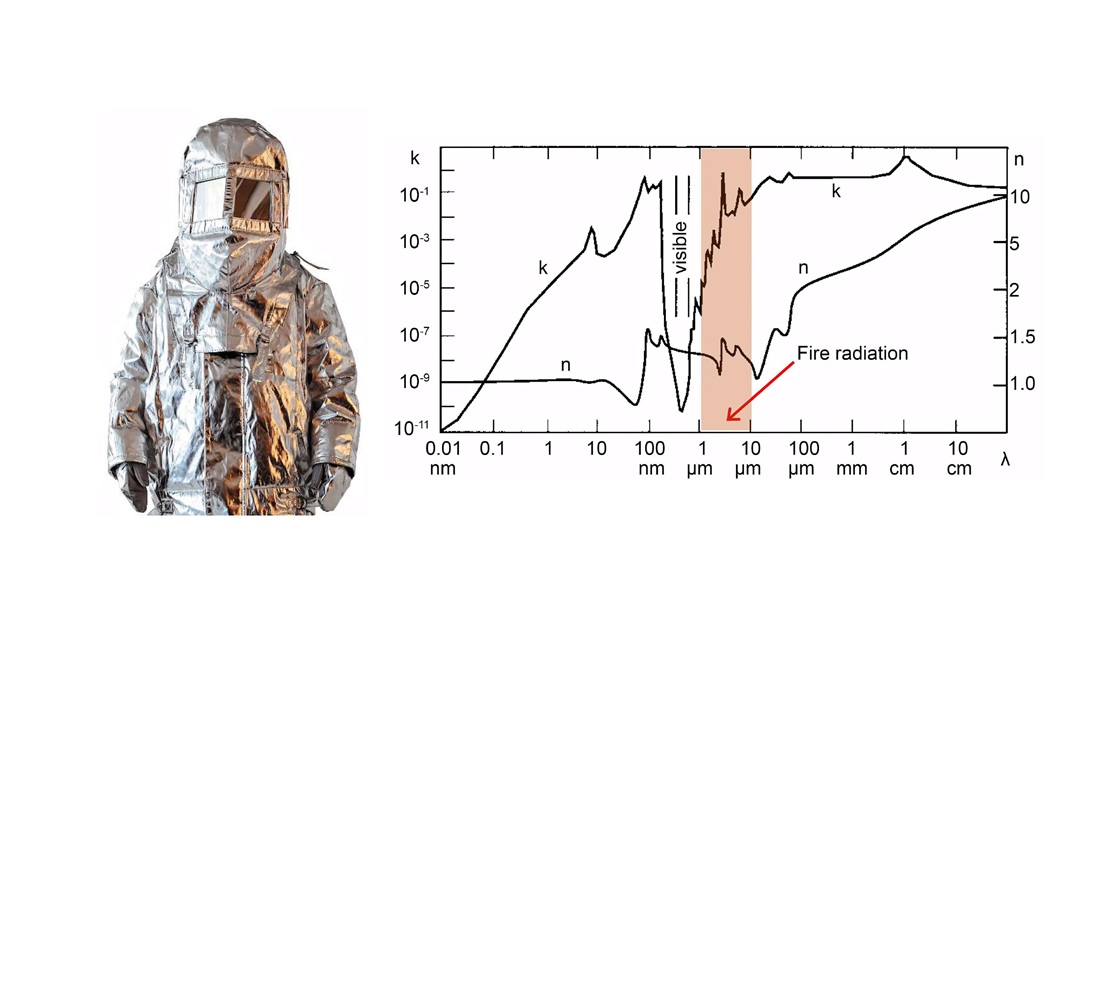
The porthole of the mask is two parallel transparent plates with a gap between them, through which water continuously flows. The porthole exploits the unique optical properties of water, which is transparent in the visible region of the spectrum and opaque in the infrared region, characteristic of fire radiation. In addition to the function of weakening the radiant heat flux, water also performs the function of cooling the protective mask.
This paper reports a theoretical analysis of physical processes, the calculation formulae, as well as the estimated calculations of the design and operational parameters for a protective mask under typical operating conditions in a fire zone. In particular, a methodology was devised for calculating water consumption, changes in its temperature, and attenuation of radiant heat flux under given conditions in a fire zone. For example, for a heat flux intensity of 25 kW/m2, a temperature at the fire site of 1200 K, and a water layer thickness in the porthole of 1 mm, a 15-fold attenuation of the heat flux was established. Under these conditions, the maximum operating time in a fire zone reaches 12 minutes, which is three times higher than the similar parameter for existing samples of heat-resistant suits. These parameters indicate the possibility of significant improvement of protective masks for firefighters.
Subject to experimental confirmation, the results of this work could be practically applied at design institutions engaged in the development of protective fire-fighting equipment.
References
- Chan Kim, S., Lee, K. Y., Hamins, A. (2019). Energy balance in medium-scale methanol, ethanol, and acetone pool fires. Fire Safety Journal, 107, 44–53. https://doi.org/10.1016/j.firesaf.2019.01.004
- Filkov, A. I., Tihay-Felicelli, V., Masoudvaziri, N., Rush, D., Valencia, A., Wang, Y. et al. (2023). A review of thermal exposure and fire spread mechanisms in large outdoor fires and the built environment. Fire Safety Journal, 140, 103871. https://doi.org/10.1016/j.firesaf.2023.103871
- Penney, G., Richardson, S. (2019). Modelling of the Radiant Heat Flux and Rate of Spread of Wildfire within the Urban Environment. Fire, 2 (1), 4. https://doi.org/10.3390/fire2010004
- Wang, W., Tao, G., Zhang, L. (2024). Comparative and analysis study of pool fire radiant heat models under different view factor calculations. Emergency Management Science and Technology, 4 (1). https://doi.org/10.48130/emst-0024-0005
- Zhao, J., Hu, Z., Li, X., Ji, J., Yang, R., Zhang, J., Zhong, Y. (2024). Experimental Study and CFD Modelling of Down-Reaching Flame Behaviors of Tank Fires with Large Ullage Heights. Fire Technology, 60 (5), 3243–3268. https://doi.org/10.1007/s10694-024-01575-z
- Huang, X., Yu, Z., Zhan, Z. (2023). An Experimental Study of Pool Fire Characteristics under the Effects of Cross Winds and Baffles. Fire, 7 (1), 4. https://doi.org/10.3390/fire7010004
- Cavazzuti, M., Tartarini, P. (2024). Pool Fires Within a Large Under-Ventilated Environment: Experimental Analysis and Numerical Simulation Using OpenFOAM. Fire Technology, 60 (3), 1891–1915. https://doi.org/10.1007/s10694-024-01554-4
- Mazumder, S., Roy, S. P. (2023). Modeling Thermal Radiation in Combustion Environments: Progress and Challenges. Energies, 16 (10), 4250. https://doi.org/10.3390/en16104250
- Drean, V., Girardin, B., Guillaume, B., Chiva, R., Colombiano, J., Rengel, B. et al. (2024). Large scale pool fire with a fully engulfed tank - Experimental data and numerical validation of the flame height and flame behaviour around the tank. Journal of Loss Prevention in the Process Industries, 91, 105360. https://doi.org/10.1016/j.jlp.2024.105360
- Liu, C., Yin, Z., Jangi, M., Zhu, X., Liu, Y., Zhang, R. et al. (2025). Experimental study on radiative heat flux from annular pool fires under the cross airflow. Applied Thermal Engineering, 260, 124947. https://doi.org/10.1016/j.applthermaleng.2024.124947
- Raj, P. K. (2006). Spectrum of fires in an LNG facility. Washington. Available at: https://primis.phmsa.dot.gov/rd/FileGet/3133/FINAL_Tech_Report_-_Phase_1.pdf
- Howell, J. R., Mengüç, M. P., Daun, K. J. (2023). Thermal radiation: An introduction. CRC Press. Available at: https://www.routledge.com/Thermal-Radiation-An-Introduction/Howell-Menguc-Daun/p/book/9781032015316
- Modest, M. F., Mazumder, S. (2021). Radiative heat transfer. Academic Press. https://doi.org/10.1016/c2018-0-03206-5
- Rajput, B., Kumar, T., Ray, B., Das, A., Talukdar, P. (2023). Experimental Study of the Effect of Different Air Gap Orientations on Performance of Fire Protective Clothing. Heat Transfer Engineering, 45 (1), 69–80. https://doi.org/10.1080/01457632.2023.2171815
- Kumar, V., Bhanja, D., Acharya, J. (2024). Performance assessment of firefighter protective clothing under different thermal environments: Impact of the variation of thickness in inter-layer airgap and microclimate. International Journal of Thermal Sciences, 205, 109293. https://doi.org/10.1016/j.ijthermalsci.2024.109293
- Acharya, J., Bhanja, D., Misra, R. D. (2023). Prediction of safe zone for firefighters exposed to purely radiant heat source-a numerical analysis. International Journal of Thermal Sciences, 190, 108302. https://doi.org/10.1016/j.ijthermalsci.2023.108302
- Vynogradov, A. (2012). Absorption of the radiant heat flux in the sprayed water jet. Visnyk Natsionalnoho tekhnichnoho universytetu Ukrainy «Kyivskyi politekhnichnyi instytut», seriya Mashynobuduvannia, 65, 145–152. Available at: https://ela.kpi.ua/handle/123456789/3141
- Hale, G. M., Querry, M. R. (1973). Optical Constants of Water in the 200-nm to 200-μm Wavelength Region. Applied Optics, 12 (3), 555. https://doi.org/10.1364/ao.12.000555
- Segelstein, D. (1981). The complex refractive index of water. University of Missouri, Kansas City. Available at: https://mospace.umsystem.edu/server/api/core/bitstreams/b08bebbd-616c-4f75-8f9a-d43ff7185b55/content
- Vynogradov, A. G., Yakhno, O. M. (2015). Raschet parametrov protyvopozharnykh strui raspylennoi vody. Prykladna hidromekhanika, 17 (4), 3–13. Available at: https://nasplib.isofts.kiev.ua/server/api/core/bitstreams/4fa56dfc-2387-48de-ae73-2e52a9d19e81/content
- Vynogradov, A., Yakhno, O. (2016). Equivalent diameter of droplets of sprayed water jets and its dependence on technical parameters. Visnyk Natsionalnoho tekhnichnoho universytetu Ukrainy «Kyivskyi politekhnichnyi instytut», seriya Mashynobuduvannia, 1 (76), 39–45. Available at: https://ela.kpi.ua/handle/123456789/19570
- Vynogradov, A. G. (2019). Calculation of Design Parameters of Fire-Fighting Water Curtains. Mechanics and Advanced Technologies, 87 (3). https://doi.org/10.20535/2521-1943.2019.87.183307
- Bass, M., Van Stryland, E. W., Williams, D. R., Wolfe, W. L. (Eds.) (1995). Handbook of optics, Volume I: Fundamentals, techniques, and design. McGraw-Hill. Available at: https://cdn.preterhuman.net/texts/science_and_technology/physics/Optics/Handbook%20of%20optics%20second%20edition%20Vol%201%20-%20%20-%20Bass%20M.pdf
- Habibi, P. (2025). A review of helmets for personal thermal management. Energy and Buildings, 347, 116270. https://doi.org/10.1016/j.enbuild.2025.116270
- Collin, A., Acem, Z., Suzanne, M., Testa, F., Baulin, G. (2025). Radiative properties of firefighter helmets: Effect of color and soot deposition on thermal performance. Fire Safety Journal, 155, 104405. https://doi.org/10.1016/j.firesaf.2025.104405
Downloads
Published
How to Cite
Issue
Section
License
Copyright (c) 2026 Anatolii Vynogradov, Denis Kolesnikov, Serhiy Stas, Kostiantyn Myhalenko

This work is licensed under a Creative Commons Attribution 4.0 International License.
The consolidation and conditions for the transfer of copyright (identification of authorship) is carried out in the License Agreement. In particular, the authors reserve the right to the authorship of their manuscript and transfer the first publication of this work to the journal under the terms of the Creative Commons CC BY license. At the same time, they have the right to conclude on their own additional agreements concerning the non-exclusive distribution of the work in the form in which it was published by this journal, but provided that the link to the first publication of the article in this journal is preserved.
A license agreement is a document in which the author warrants that he/she owns all copyright for the work (manuscript, article, etc.).
The authors, signing the License Agreement with TECHNOLOGY CENTER PC, have all rights to the further use of their work, provided that they link to our edition in which the work was published.
According to the terms of the License Agreement, the Publisher TECHNOLOGY CENTER PC does not take away your copyrights and receives permission from the authors to use and dissemination of the publication through the world's scientific resources (own electronic resources, scientometric databases, repositories, libraries, etc.).
In the absence of a signed License Agreement or in the absence of this agreement of identifiers allowing to identify the identity of the author, the editors have no right to work with the manuscript.
It is important to remember that there is another type of agreement between authors and publishers – when copyright is transferred from the authors to the publisher. In this case, the authors lose ownership of their work and may not use it in any way.








