Identification of the influence of the rotational motion of a vibropriller basket on melt jets and droplets of mineral fertilizers in a prilling tower
DOI:
https://doi.org/10.15587/1729-4061.2026.353110Keywords:
prilling tower, vibropriller, basket, melt plume, rotational motion, relative velocityAbstract
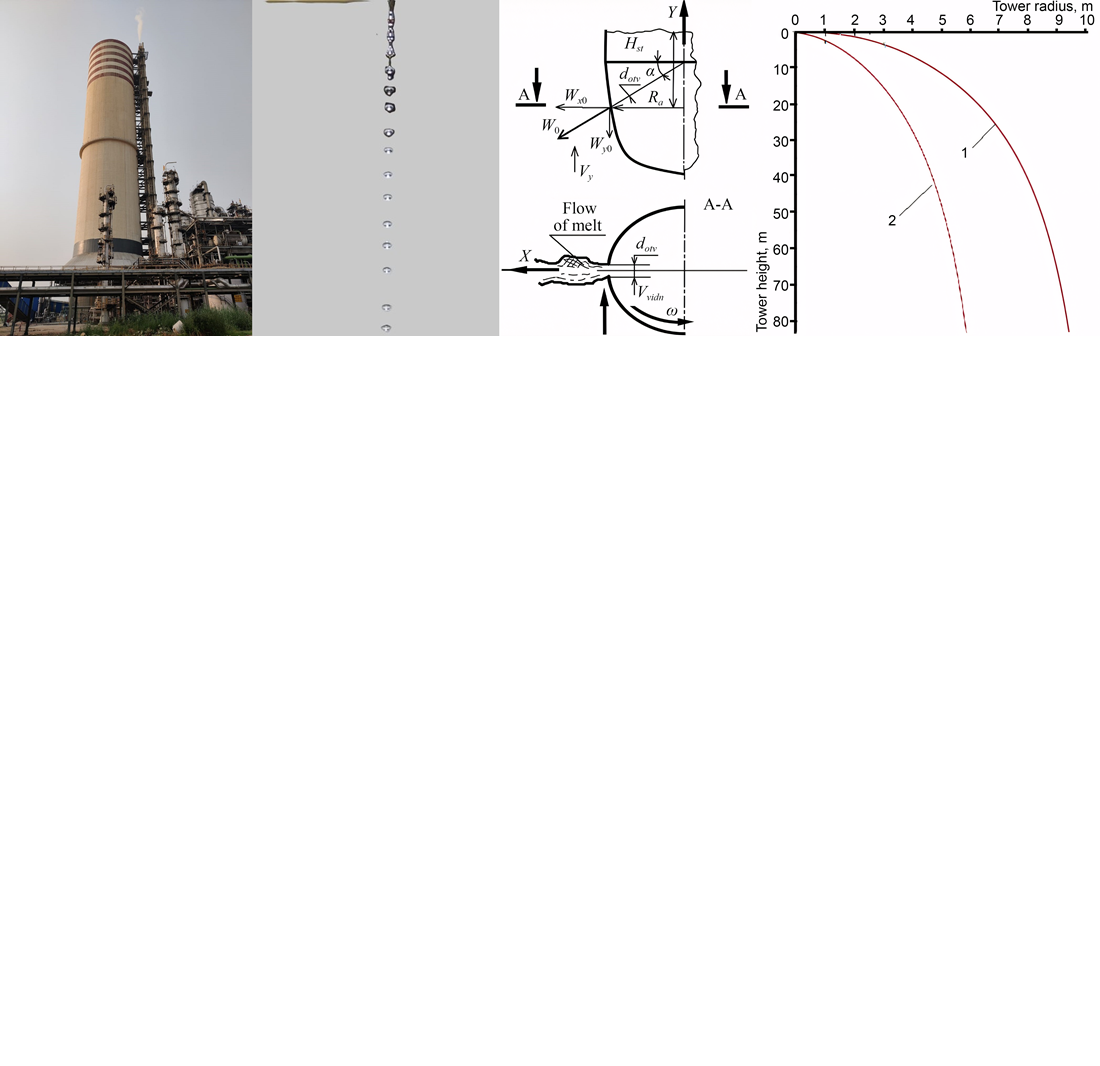
This study investigates the motion of melt jets, droplets, and prills of mineral fertilizers in the working space of a prilling tower. A specific feature of the process is the presence of a rotational velocity component caused by the rotation of the vibropriller basket.
At the design stage of prilling equipment, the influence of basket rotation on the motion of jets, droplets, and prills, as well as their aerodynamic interaction with the air flow. is considered only to a limited extent in most existing models of prilling systems.
A prilling tower with an internal diameter of 24 m, a prill flight height of 80 m, and a melt load of 175 t/h was adopted as the calculation model. The results showed that a basket rotation speed of 180 rpm provides the most effective radial expansion of the melt plume. Droplet trajectories were constructed; the horizontal and vertical velocity components were determined for different vibropriller basket configurations.
The results were obtained by numerically solving a system of differential motion equations considering initial melt outflow conditions, geometric parameters, and basket rotation speed. A quantitative relationship between basket rotation parameters and aerodynamic conditions of particle motion through changes in relative phase velocity was established.
The adopted approach could be applied at the design stage of high capacity prilling equipment to select basket configuration and rotation regimes. The resulting correlations make it possible to predict prill trajectories and prevent adhesion of non-crystallized melt to the internal tower surfaces. Elimination of secondary droplet breakup conditions reduces dust formation and stabilizes the particle size distribution of the product
References
- Yurchenko, O., Sklabinskyi, V., Ochowiak, M., Ostroha, R., Gusak, O. (2022). Rational Choice of a Basket for the Rotational Vibropriller. Journal of Engineering Sciences, 9 (1), F16–F20. https://doi.org/10.21272/jes.2022.9(1).f3
- Skydanenko, M., Sklabinskyi, V., Saleh, S., Barghi, S. (2017). Reduction of Dust Emission by Monodisperse System Technology for Ammonium Nitrate Manufacturing. Processes, 5 (3), 37. https://doi.org/10.3390/pr5030037
- Skydanenko, M., Sklabinskyi, V., Nadhem, A.-K. M., Nichvolodin, K. (2021). Determination of granule (prill) movement modes in the prilling tower for mineral fertilizer production. Technology Audit and Production Reserves, 5 (3 (61)), 6–9. https://doi.org/10.15587/2706-5448.2021.241142
- Saleh, S. N., Barghi, S. (2016). Reduction of fine particle emission from a prilling tower using CFD simulation. Chemical Engineering Research and Design, 109, 171–179. https://doi.org/10.1016/j.cherd.2016.01.017
- Broumand, M., Birouk, M. (2016). Liquid jet in a subsonic gaseous crossflow: Recent progress and remaining challenges. Progress in Energy and Combustion Science, 57, 1–29. https://doi.org/10.1016/j.pecs.2016.08.003
- Rahmanian, N., Naderi, S., Supuk, E., Abbas, R., Hassanpour, A. (2015). Urea Finishing Process: Prilling Versus Granulation. Procedia Engineering, 102, 174–181. https://doi.org/10.1016/j.proeng.2015.01.122
- Gezerman, A. O. (2020). Mathematical modeling for prilling processes in ammonium nitrate production. Engineering Reports, 2 (6). https://doi.org/10.1002/eng2.12173
- Kasmaiee, Si., Tadjfar, M., Kasmaiee, Sa., Ahmadi, G. (2024). Linear stability analysis of surface waves of liquid jet injected in transverse gas flow with different angles. Theoretical and Computational Fluid Dynamics, 38 (1), 107–138. https://doi.org/10.1007/s00162-024-00685-2
- Kong, L., Lan, T., Chen, J., Wang, K., Sun, H. (2020). Breakup Processes and Droplet Characteristics of Liquid Jets Injected into Low-Speed Air Crossflow. Processes, 8 (6), 676. https://doi.org/10.3390/pr8060676
- Guildenbecher, D. R., López-Rivera, C., Sojka, P. E. (2009). Secondary atomization. Experiments in Fluids, 46 (3), 371–402. https://doi.org/10.1007/s00348-008-0593-2
- Jackiw, I. M., Ashgriz, N. (2021). On aerodynamic droplet breakup. Journal of Fluid Mechanics, 913. https://doi.org/10.1017/jfm.2021.7
- Eggers, J., Villermaux, E. (2008). Physics of liquid jets. Reports on Progress in Physics, 71 (3), 036601. https://doi.org/10.1088/0034-4885/71/3/036601
- Jain, M., Prakash, R. S., Tomar, G., Ravikrishna, R. V. (2015). Secondary breakup of a drop at moderate Weber numbers. Proceedings of the Royal Society A: Mathematical, Physical and Engineering Sciences, 471 (2177), 20140930. https://doi.org/10.1098/rspa.2014.0930
- Pourrousta, M., Larimi, M. M., Biglarian, M., Hedayati, P. (2023). Liquid Jet Breakup and Penetration in a Gas Cross-Flow -An Experimental Study. Experimental Techniques, 48 (3), 449–459. https://doi.org/10.1007/s40799-023-00668-8
- Boggavarapu, P., Ramesh, S. P., Avulapati, M. M., RV, R. (2021). Secondary breakup of water and surrogate fuels: Breakup modes and resultant droplet sizes. International Journal of Multiphase Flow, 145, 103816. https://doi.org/10.1016/j.ijmultiphaseflow.2021.103816
- Sklabinskyi, V., Gusak, O., Yurchenko, O., Nichvolodin, K. (2024). Features of placement of several rotating vibrating granulators (OVG) in one granulation tower. Pratsi Tavriyskoho Derzhavnoho Ahrotekhnolohichnoho Universytetu Imeni Dmytra Motornoho, 24 (3), 53–61. https://doi.org/10.32782/2078-0877-2024-24-3-4
- Nemati, H., Shekoohi, S. A. (2020). Particle number balance approach for simulation of a multi-chamber fluidized bed urea granulator; Modeling and validation. Powder Technology, 369, 96–105. https://doi.org/10.1016/j.powtec.2020.05.010
Downloads
Published
How to Cite
Issue
Section
License
Copyright (c) 2026 Vsevolod Sklabinskyi, Andrii Karutskyi

This work is licensed under a Creative Commons Attribution 4.0 International License.
The consolidation and conditions for the transfer of copyright (identification of authorship) is carried out in the License Agreement. In particular, the authors reserve the right to the authorship of their manuscript and transfer the first publication of this work to the journal under the terms of the Creative Commons CC BY license. At the same time, they have the right to conclude on their own additional agreements concerning the non-exclusive distribution of the work in the form in which it was published by this journal, but provided that the link to the first publication of the article in this journal is preserved.
A license agreement is a document in which the author warrants that he/she owns all copyright for the work (manuscript, article, etc.).
The authors, signing the License Agreement with TECHNOLOGY CENTER PC, have all rights to the further use of their work, provided that they link to our edition in which the work was published.
According to the terms of the License Agreement, the Publisher TECHNOLOGY CENTER PC does not take away your copyrights and receives permission from the authors to use and dissemination of the publication through the world's scientific resources (own electronic resources, scientometric databases, repositories, libraries, etc.).
In the absence of a signed License Agreement or in the absence of this agreement of identifiers allowing to identify the identity of the author, the editors have no right to work with the manuscript.
It is important to remember that there is another type of agreement between authors and publishers – when copyright is transferred from the authors to the publisher. In this case, the authors lose ownership of their work and may not use it in any way.








