Formation of informative signals in an optical toxic gas detector
DOI:
https://doi.org/10.15587/1729-4061.2026.353247Keywords:
optical sensor, informative detector signal, conjugated polymers, toxic gases, signal converterAbstract
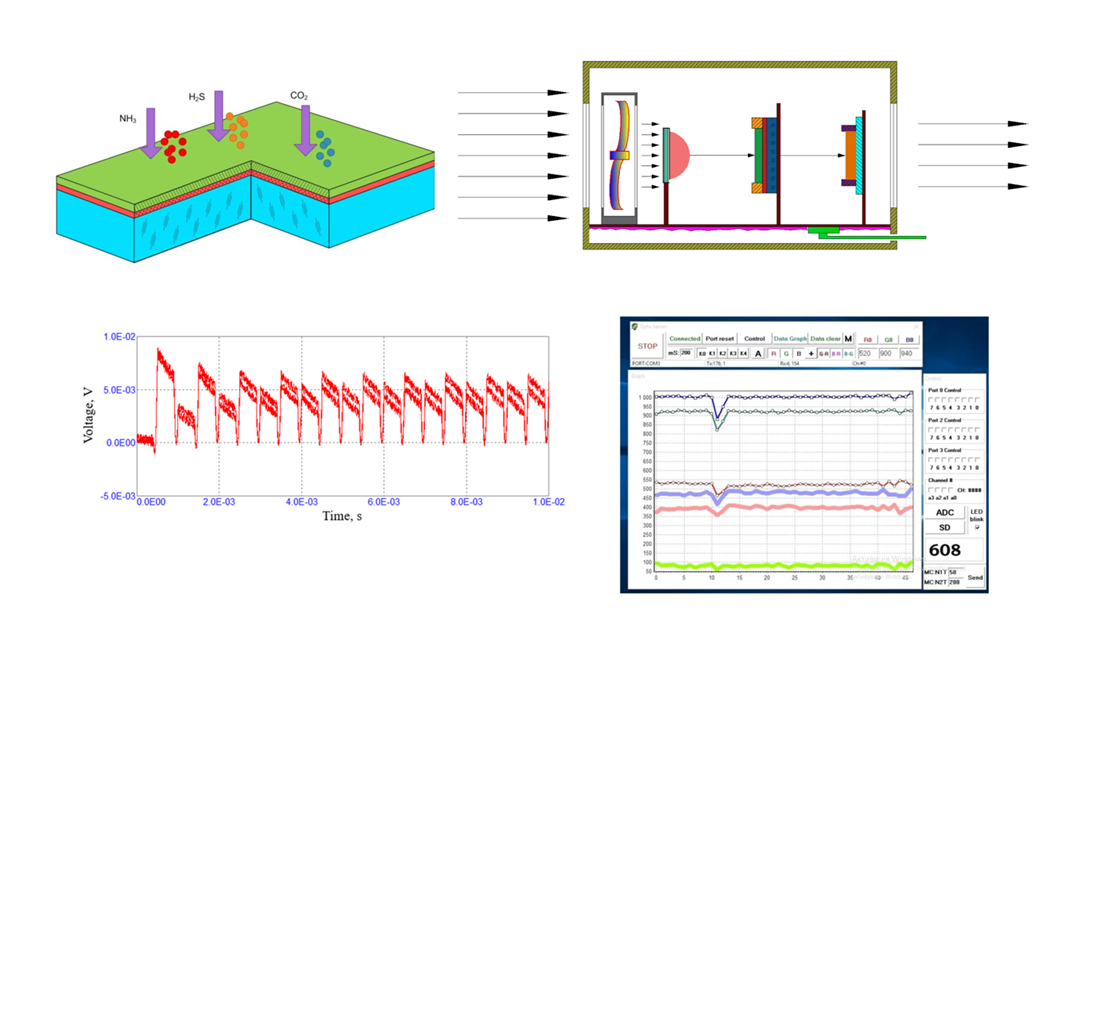
Detection of various gas environments is an important security task, especially in conditions of military operations and in contaminated areas. In this case, optical gas sensors of the colorimetric type are effective, which can promptly signal the presence of toxic substances in "field conditions", do not require complex equipment or energy consumption.
The object of the study is a detector of harmful gases of the colorimetric type. The problem of improving the characteristics of colorimetric sensors by amplifying useful signals and reducing the influence of spurious radiation is being solved.
To solve the problem, a functional and mathematical model of the signal path of a pollutant detector was developed. A method for forming an optical signal of increased sensitivity due to multiple passage and reflection of light fluxes in a colorimetric sensor model was proposed.
A model of an optical gas detector based on a polyaniline sensor element was manufactured. The presence of ammonia vapors was analyzed using gas-stimulated changes in optical absorption at different wavelengths, namely, 470 ± 5, 528 ± 7 and 623 ± 5 nm. The proposed functional scheme of the detector signal path allowed to improve its sensitivity and selectivity, which is explained by the amplification of useful signals and the reduction of9 the influence of parasitic radiation.
The high speed of recovery of the resulting sensor to the initial values (up to 10 s) ensures its reversibility and opens up prospects for effective practical use, in particular, monitoring the state of the environment, the freshness of food products, harmful gas leaks near landfills, chemical storage sites, etc.
References
- Jaaniso, R., Tan, O. K. (Eds.) (2020). Semiconductor Gas Sensors. Woodhead Publishing. https://doi.org/10.1016/c2017-0-00001-0
- Nikolic, M. V., Milovanovic, V., Vasiljevic, Z. Z., Stamenkovic, Z. (2020). Semiconductor Gas Sensors: Materials, Technology, Design, and Application. Sensors, 20 (22), 6694. https://doi.org/10.3390/s20226694
- Farea, M. A., Mohammed, H. Y., Shirsat, S. M., Sayyad, P. W., Ingle, N. N., Al-Gahouari, T. et al. (2021). Hazardous gases sensors based on conducting polymer composites: Review. Chemical Physics Letters, 776, 138703. https://doi.org/10.1016/j.cplett.2021.138703
- Aksimentyeva, O. I., Tsizh, B. R., Horbenko, Yu. Yu., Konopelnyk, O. I., Martynyuk, G. V., Chokhan’, M. I. (2018). Flexible elements of gas sensors based on conjugated polyaminoarenes. Molecular Crystals and Liquid Crystals, 670 (1), 3–10. https://doi.org/10.1080/15421406.2018.1542057
- Hu, C.-W., Yamada, Y., Yoshimura, K. (2017). A new type of gasochromic material: conducting polymers with catalytic nanoparticles. Chemical Communications, 53 (22), 3242–3245. https://doi.org/10.1039/c7cc00077d
- Gardner, J. W. (2004). Review of Conventional Electronic Noses and Their Possible Application to the Detection of Explosives. Electronic Noses & Sensors for the Detection of Explosives, 1–28. https://doi.org/10.1007/1-4020-2319-7_1
- To, K. C., Ben-Jaber, S., Parkin, I. P. (2020). Recent Developments in the Field of Explosive Trace Detection. ACS Nano, 14 (9), 10804–10833. https://doi.org/10.1021/acsnano.0c01579
- Basso, C. R., Filho, M. V. B., Gavioli, V. D., Parra, J. P. R. L. L., Castro, G. R., Pedrosa, V. A. (2025). Recent Advances in Nanomaterials for Enhanced Colorimetric Detection of Viruses and Bacteria. Chemosensors, 13 (3), 112. https://doi.org/10.3390/chemosensors13030112
- Kodir, A., Imawan, C., Permana, I. S., Handayani, W. (2016). Pesticide colorimetric sensor based on silver nanoparticles modified by L-cysteine. 2016 International Seminar on Sensors, Instrumentation, Measurement and Metrology (ISSIMM), 43–47. https://doi.org/10.1109/issimm.2016.7803719
- Pinyorospathum, C., Rattanarat, P., Chailapakul, O., Siangproh, W. (2018). P1OS.3 - Colorimetric sensor for phosphate ions detection using 2- mercaptoethanesulfonate modified silver nanoplates. Proceedings IMCS 2018, 622. https://doi.org/10.5162/imcs2018/p1os.3
- Malik, S., Singh, J., Saini, K., Chaudhary, V., Umar, A., Ibrahim, A. A. et al. (2024). Paper-based sensors: affordable, versatile, and emerging analyte detection platforms. Analytical Methods, 16 (18), 2777–2809. https://doi.org/10.1039/d3ay02258g
- Zhang, Y., Xia, O., Ho, K. H., Liang, Z., Lei, D., Zhang, A. P., Tam, H.-Y. (2019). Sliver-Nanoparticle Enhanced Pva Thin-Film Colorimetric Humidity Sensor. 2019 20th International Conference on Solid-State Sensors, Actuators and Microsystems & Eurosensors XXXIII (TRANSDUCERS & EUROSENSORS XXXIII), 1219–1221. https://doi.org/10.1109/transducers.2019.8808495
- Kroutil, J., Laposa, A., Povolny, V., Klimsa, L., Husak, M. (2023). Gas Sensor with Different Morphology of PANI Layer. Sensors, 23 (3), 1106. https://doi.org/10.3390/s23031106
- Tsizh, B., Aksimentyeva, O. (2020). Ways to improve the parameters of optical gas sensors of ammonia based on polyaniline. Sensors and Actuators A: Physical, 315, 112273. https://doi.org/10.1016/j.sna.2020.112273
- Tsizh, B., Aksimentyeva, O., Horbenko, Y., Holyaka, R. (2022). Combined Polymer Nanostructures for Selective Gas Sensors. 10th jubilee International Conference "Combined Polymer Nanostructures for Selective Gas Sensors". Available at: http://www.iop.kiev.ua/~een/conference/nano2022/assets/files/posters/Poster_Tsizh_2022.pdf
- Wu, Y.-J., Brito, R., Choi, W.-H., Lam, C.-S., Wong, M.-C., Sin, S.-W., Martins, R. P. (2023). IoT Cloud-Edge Reconfigurable Mixed-Signal Smart Meter Platform for Arc Fault Detection. IEEE Internet of Things Journal, 10 (2), 1682–1695. https://doi.org/10.1109/jiot.2022.3210220
- Kim, D., Kim, S., An, J., Kim, S. (2017). A portable colorimetric array reader for toxic gas detection. 2017 ISOCS/IEEE International Symposium on Olfaction and Electronic Nose (ISOEN), 1–3. https://doi.org/10.1109/isoen.2017.7968928
- Chaabane, N., Mahfoudhi, S., Belkadhi, K. (2024). Interpolation-Based IoT Sensors Selection. IEEE Sensors Journal, 24 (21), 36143–36147. https://doi.org/10.1109/jsen.2024.3461833
- Mukhopadhyay, S. C., Tyagi, S. K. S., Suryadevara, N. K., Piuri, V., Scotti, F., Zeadally, S. (2021). Artificial Intelligence-Based Sensors for Next Generation IoT Applications: A Review. IEEE Sensors Journal, 21 (22), 24920–24932. https://doi.org/10.1109/jsen.2021.3055618
Downloads
Published
How to Cite
Issue
Section
License
Copyright (c) 2026 Olena Aksimentyeva, Roman Holyaka, Bohdan Tsizh, Hryhoriy Barylo

This work is licensed under a Creative Commons Attribution 4.0 International License.
The consolidation and conditions for the transfer of copyright (identification of authorship) is carried out in the License Agreement. In particular, the authors reserve the right to the authorship of their manuscript and transfer the first publication of this work to the journal under the terms of the Creative Commons CC BY license. At the same time, they have the right to conclude on their own additional agreements concerning the non-exclusive distribution of the work in the form in which it was published by this journal, but provided that the link to the first publication of the article in this journal is preserved.
A license agreement is a document in which the author warrants that he/she owns all copyright for the work (manuscript, article, etc.).
The authors, signing the License Agreement with TECHNOLOGY CENTER PC, have all rights to the further use of their work, provided that they link to our edition in which the work was published.
According to the terms of the License Agreement, the Publisher TECHNOLOGY CENTER PC does not take away your copyrights and receives permission from the authors to use and dissemination of the publication through the world's scientific resources (own electronic resources, scientometric databases, repositories, libraries, etc.).
In the absence of a signed License Agreement or in the absence of this agreement of identifiers allowing to identify the identity of the author, the editors have no right to work with the manuscript.
It is important to remember that there is another type of agreement between authors and publishers – when copyright is transferred from the authors to the publisher. In this case, the authors lose ownership of their work and may not use it in any way.








