Development of a hybrid information retrieval–knowledge graph model for cross-framework competency alignment
DOI:
https://doi.org/10.15587/1729-4061.2026.358313Keywords:
information retrieval, knowledge graph, competency alignment, CPL, SKKNI, O*NET, ESCO, career readiness indexAbstract
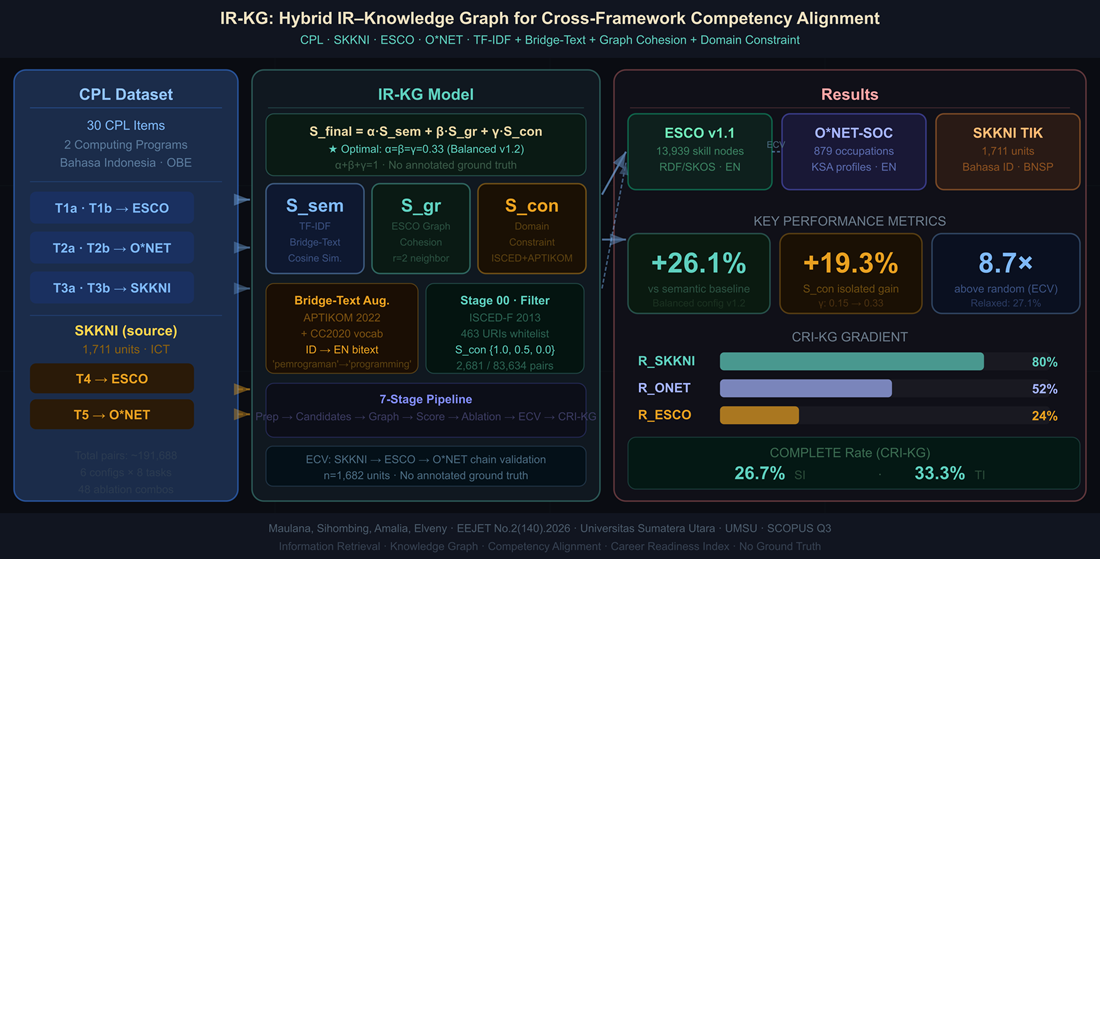
The object of this study is the alignment of Indonesian computing graduate learning outcomes (CPL – Capaian Pembelajaran Lulusan) with three heterogeneous competency frameworks: the European skills, competences, qualifications and occupations (ESCO), the occupational information network (O*NET), and the Standar Kompetensi Kerja Nasional Indonesia (SKKNI). The problem addressed is the absence of a unified pipeline capable of simultaneously mapping CPL across these frameworks while accounting for national qualification hierarchies and cross-lingual constraints. An IR-KG (information retrieval–knowledge graph) model is proposed with a seven-stage pipeline using a hybrid scoring function S_final = α·S_sem + β·S_gr + γ·S_con, integrating TF-IDF (term frequency–inverse document frequency) semantic similarity, ESCO knowledge graph cohesion, and domain constraint scores from ISCED-F 2013 (International Standard Classification of Education: Fields of Education and Training) and APTIKOM 2022 (Asosiasi Pendidikan Tinggi Informatika dan Komputer) classifications. The balanced configuration (α = β = γ = 0.33) achieves a mean selection objective of 0.537, a 26.1% improvement over the semantic baseline. External consistency validation yields a relaxed consistency rate of 27.1% (8.7× above random baseline), confirming valid alignment signal capture. The CRI-KG (Career Readiness index based on knowledge graph) reveals a gradient R_SKKNI >> R_ONET > R_ESCO, exposing persistent gaps in international framework coverage. The pipeline is applicable for curriculum audit, qualification recognition policy, and national-to-international framework integration where labelled training data are unavailable
References
- Acemoglu, D., Restrepo, P. (2019). Automation and New Tasks: How Technology Displaces and Reinstates Labor. Journal of Economic Perspectives, 33 (2), 3–30. https://doi.org/10.1257/jep.33.2.3
- Autor, D. H. (2019). Work of the Past, Work of the Future. AEA Papers and Proceedings, 109, 1–32. https://doi.org/10.1257/pandp.20191110
- The Future of Jobs Report 2023 (2023). Available at: https://www.weforum.org/reports/the-future-of-jobs-report-2023
- OECD Employment Outlook 2021 (2021). In OECD Employment Outlook. OECD Publishing. https://doi.org/10.1787/5a700c4b-en
- European Skills, Competences, Qualifications and Occupations (ESCO). ESCO v1.1. Available at: https://esco.ec.europa.eu/en/about-esco/escopedia/escopedia/esco-v11
- Occupational Listings. O*NET 28.0 Database – occupations updated with job incumbent or occupational expert (OE) data. Available at: https://www.onetcenter.org/listings/28.0/updated.html
- Neutel, S., de Boer, M. H. T. (2021). Towards Automatic Ontology Alignment using BERT. Proceedings of the AAAI 2021 Spring Symposium on Combining Machine Learning and Knowledge Engineering (AAAI-MAKE 2021). Available at: https://ceur-ws.org/Vol-2846/paper28.pdf
- Snijder, L. L., Smit, Q. T. S., De Boer, M. H. T. (2024). Advancing Ontology Alignment in the Labor Market: Combining Large Language Models with Domain Knowledge. Proceedings of the AAAI Symposium Series, 3 (1), 253–262. https://doi.org/10.1609/aaaiss.v3i1.31208
- Panduan Kurikulum Berbasis OBE/KKNI/SKKNI APTIKOM: Program Studi Sarjana Sistem Informasi, ver. 1.1 (2022). Jakarta: APTIKOM. Available at: http://elibrary.almaata.ac.id/3475/1/19%20Jan%202023%20V1.1%20-%2013%20jan%202023%20-%20FORDI%20SI%20-%20BUKU%20KURIKULUM%20BERBASIS%20OBE.pdf
- European Commission: Directorate-General for Employment, Social Affairs and Inclusion (2017). ESCO handbook: European skills, competences, qualifications and occupations. Publications Office. https://doi.org/10.2767/934956
- Manning, C. D., Raghavan, P., Schütze, H. (2008). Introduction to Information Retrieval. Cambridge University Press. https://doi.org/10.1017/cbo9780511809071
- Robertson, S., Zaragoza, H. (2009). The Probabilistic Relevance Framework: BM25 and Beyond. Foundations and Trends® in Information Retrieval, 4 (1-2), 1–174. https://doi.org/10.1561/1500000019
- Fareri, S., Melluso, N., Chiarello, F., Fantoni, G. (2021). SkillNER: Mining and mapping soft skills from any text. Expert Systems with Applications, 184, 115544. https://doi.org/10.1016/j.eswa.2021.115544
- Decorte, J.-J., Van Hautte, J., Demeester, T., Develder, C. (2021). JobBERT: Understanding Job Titles Through Skills. arXiv. https://doi.org/10.48550/arXiv.2109.09605
- Chiarello, F., Fantoni, G., Hogarth, T., Giordano, V., Baltina, L., Spada, I. (2021). Towards ESCO 4.0 – Is the European classification of skills in line with Industry 4.0? A text mining approach. Technological Forecasting and Social Change, 173, 121177. https://doi.org/10.1016/j.techfore.2021.121177
- Euzenat, J., Shvaiko, P. (2013). Ontology Matching. Springer Berlin Heidelberg. https://doi.org/10.1007/978-3-642-38721-0
- Computing Curricula 2020: Paradigms for Global Computing Education (2021). Association for Computing Machinery. https://doi.org/10.1145/3467967
- Chen, J., Jiménez-Ruiz, E., Horrocks, I., Antonyrajah, D., Hadian, A., Lee, J. (2021). Augmenting Ontology Alignment by Semantic Embedding and Distant Supervision. The Semantic Web, 392–408. https://doi.org/10.1007/978-3-030-77385-4_23
- Savickas, M. L. (2005). The Theory and Practice of Career Construction. Career Development and Counseling: Putting Theory and Research to Work. Wiley, 42–70.
- Development and Validation of the NACE Career Readiness Competencies (2022). NACE. Available at: https://www.naceweb.org/uploadedFiles/files/2022/resources/2022-nace-career-readiness-development-and-validation.pdf
- Reimagining our futures together: a new social contract for education (2021). UNESCO. https://doi.org/10.54675/asrb4722
- European skills and jobs survey (ESJS). CEDEFOP. Available at: https://www.cedefop.europa.eu/en/projects/european-skills-and-jobs-survey-esjs#:~:text=The%201st%20ESJS%20collected%20information,facilitated%20numerous%20research%20studies%2C%20including:
- Hevner, A. R., March, S. T., Park, J., Ram, S. (2004). Design Science in Information Systems Research1. MIS Quarterly, 28 (1), 75–106. https://doi.org/10.2307/25148625
Downloads
Published
How to Cite
Issue
Section
License
Copyright (c) 2026 Halim Maulana, Poltak Sihombing, Amalia Amalia, Marischa Elveny

This work is licensed under a Creative Commons Attribution 4.0 International License.
The consolidation and conditions for the transfer of copyright (identification of authorship) is carried out in the License Agreement. In particular, the authors reserve the right to the authorship of their manuscript and transfer the first publication of this work to the journal under the terms of the Creative Commons CC BY license. At the same time, they have the right to conclude on their own additional agreements concerning the non-exclusive distribution of the work in the form in which it was published by this journal, but provided that the link to the first publication of the article in this journal is preserved.
A license agreement is a document in which the author warrants that he/she owns all copyright for the work (manuscript, article, etc.).
The authors, signing the License Agreement with TECHNOLOGY CENTER PC, have all rights to the further use of their work, provided that they link to our edition in which the work was published.
According to the terms of the License Agreement, the Publisher TECHNOLOGY CENTER PC does not take away your copyrights and receives permission from the authors to use and dissemination of the publication through the world's scientific resources (own electronic resources, scientometric databases, repositories, libraries, etc.).
In the absence of a signed License Agreement or in the absence of this agreement of identifiers allowing to identify the identity of the author, the editors have no right to work with the manuscript.
It is important to remember that there is another type of agreement between authors and publishers – when copyright is transferred from the authors to the publisher. In this case, the authors lose ownership of their work and may not use it in any way.








