Analysis of workforce stability factors in pharmacy organizations
DOI:
https://doi.org/10.15587/2519-4852.2025.335443Keywords:
workforce policy, pharmacy organizations, staff turnover, employee satisfaction, surveyAbstract
The aim of this study is to determine the level of need for pharmacists to ensure optimal functioning of pharmacy organizations, as well as to analyze the current state of workforce planning and its impact on the effectiveness of pharmaceutical structures.
Materials and methods. A survey of 121 employees of the pharmacy organization in Almaty city (Kazakhstan) using Likert scale was conducted. Pearson's χ² criterion was used to analyze the data. The methodology was based on adaptation of Job Satisfaction Survey (JSS), “WISN” method, “360° degree” assessment and Australian Bureau of Statistics (ABS) data. The study was approved by the local ethical committee of Al-Farabi Kazakh National University (Protocol No. IRB-A871).
Results. The analysis revealed that staff turnover, workforce replenishment and seasonal shortage of staff are the key problems of retail pharmacy organizations. Significant factors affecting the stability of the workforce composition were identified, and their association with the workplace environment was statistically confirmed.
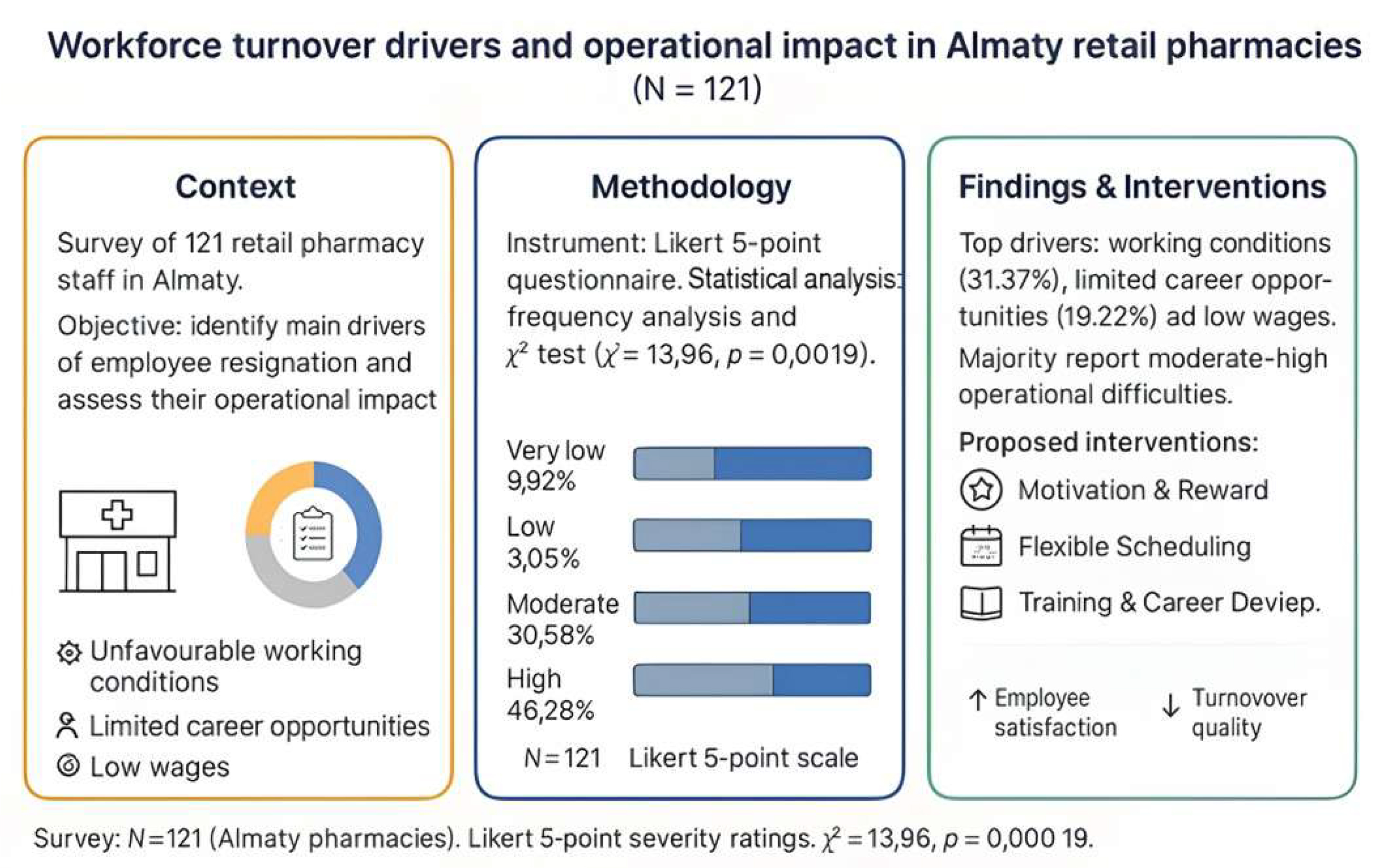
Conclusions. The article examines the factors contributing to staff turnover in retail pharmacy organizations. A structured employee survey was conducted, identifying the primary reasons for resignation, including low wages (18.43%), limited opportunities for career advancement (19.22%), and unfavourable working conditions (31.37%). The findings also indicate that the work environment and management practices significantly influence employee satisfaction. Dynamics highlighted the impact of turnover, workplace conditions, and career prospects on organisational stability. Statistical analysis (χ²=13.96; p=0.00019) confirmed a significant association between the work atmosphere and human resource policies.policies. Optimizing HR strategies is essential to enhanceemployee satisfaction and reduce turnover
References
- Lebovitz, L., Eddington, N. D. (2019). Trends in the Pharmacist Workforce and Pharmacy Education. American Journal of Pharmaceutical Education, 83 (1), 7051. https://doi.org/10.5688/ajpe7051
- Abzaliyeva, A., Kausova, G., Abdraimova, E., Ismagilova, A., Mamyrbekova, S. (2022). Availability of General Practice Workforce and Basic Health Indicators in the Republic of Kazakhstan: 2015-2019. Open Access Macedonian Journal of Medical Sciences, 10 (E), 452–457. https://doi.org/10.3889/oamjms.2022.7880
- Barkizatova, G. B., Shertaeva, K. D., Utegenova, G. I., Kumisbek, T. Kh. (2019). Model of professional competence of pharmacist. Vestnik KazNMU, 2, 222–225. Available at: https://vestnik.kaznmu.edu.kz/10.53065/kaznmu.2019.49.2.pdf
- Rocha, B. G., Silva, A. M. S., Pereira, M. L., Baldoni, A. O., Ayres, L. R., Penm, J. et al. (2022). Perception of pharmacists regarding human resources, training, and development of a national hospital pharmacy: a preliminary report on Basel Statements. Brazilian Journal of Pharmaceutical Sciences, 58. https://doi.org/10.1590/s2175-97902022e19877
- McDermott, I., Willis, S., Hindi, A., Schafheutle, E. (2025). Why are pharmacy technicians leaving? Factors contributing to turnover intention and strategies for retention. Research in Social and Administrative Pharmacy, 21 (2), 94–103. https://doi.org/10.1016/j.sapharm.2024.10.010
- Thin, S. M., Chongmelaxme, B., Watcharadamrongkun, S., Kanjanarach, T., Sorofman, B. A., Kittisopee, T. (2022). A systematic review on pharmacists’ turnover and turnover intention. Research in Social and Administrative Pharmacy, 18 (11), 3884–3894. https://doi.org/10.1016/j.sapharm.2022.05.014
- Lan, Y.-L., Huang, W.-T., Kao, C.-L., Wang, H.-J. (2019). The relationship between organizational climate, job stress, workplace burnout, and retention of pharmacists. Journal of Occupational Health, 62(1). https://doi.org/10.1002/1348-9585.12079
- Carvajal, M. J., Popovici, I., Hardigan, P. C. (2021). Gender and Pharmacists’ Career Satisfaction in the United States. Pharmacy, 9 (4), 173. https://doi.org/10.3390/pharmacy9040173
- Trivellas, P., Kakkos, N., Blanas, N., Santouridis, I. (2015). The Impact of Career Satisfaction on Job Performance in Accounting Firms. The Mediating Effect of General Competencies. Procedia Economics and Finance, 33, 468–476. https://doi.org/10.1016/s2212-5671(15)01730-x
- Meilianti, S., Matuluko, A., Ibrahim, N., Uzman, N., Bates, I. (2022). A global study on job and career satisfaction of early-career pharmacists and pharmaceutical scientists. Exploratory Research in Clinical and Social Pharmacy, 5, 100110. https://doi.org/10.1016/j.rcsop.2022.100110
- Ayele, Y., Hawulte, B., Feto, T., Basker, G. V., Bacha, Y. D. (2020). Job satisfaction among pharmacy professionals working in public hospitals and its associated factors, eastern Ethiopia. Journal of Pharmaceutical Policy and Practice, 13(1). https://doi.org/10.1186/s40545-020-00209-3
- Cox, T. (2017). 80% of employee pharmacists now suffering from workplace stress. Community Pharmacy News, Analysis and CPD. Available at: https://www.chemistanddruggist.co.uk/CD009083/80-of-employee-pharmacists-now-suffering-from-workplace-stress
- Dyrbye, L. N., Shanafelt, T. D., Johnson, P. O., Johnson, L. A., Satele, D., West, C. P. (2019). A cross-sectional study exploring the relationship between burnout, absenteeism, and job performance among American nurses. BMC Nursing, 18 (1). https://doi.org/10.1186/s12912-019-0382-7
- Wong, L. S., Ram, S., Scahill, S. L. (2023). Understanding the Risk Factors and Stressors Impacting Optimal Work Practices in New Zealand Pharmacies: A S.H.E.L.L Model Analysis. Pharmacy, 11 (3), 90. https://doi.org/10.3390/pharmacy11030090
- Joshi, A., Kale, S., Chandel, S., Pal, D. (2015). Likert Scale: Explored and Explained. British Journal of Applied Science & Technology, 7 (4), 396–403. https://doi.org/10.9734/bjast/2015/14975
- Kandasamy, I., Kandasamy, W. B. V., Obbineni, J. M., Smarandache, F. (2019). Indeterminate Likert scale: feedback based on neutrosophy, its distance measures and clustering algorithm. Soft Computing, 24 (10), 7459–7468. https://doi.org/10.1007/s00500-019-04372-x
- Al-Jumaili, A. A., Elhiny, R., Thomas, D., Elbarbry, F., Khdour, M., Sherbeny, F., Hamad, A. (2023). Factors impacting job satisfaction among pharmacists in the Arab world: A qualitative study. Saudi Pharmaceutical Journal, 31 (4), 578–584. https://doi.org/10.1016/j.jsps.2023.02.010
- Spector, P. E. (2022). Job Satisfaction: From Assessment to Intervention. New York: Routledge. https://doi.org/10.4324/9781003250616
- Manalu, P., Sahara, M., Suyono, T., Sianipar, M. R. (2021). Using the Workload Indicators of Staffing Need (WISN) Method for Predicting Pharmacists Human Resources in Hospitals. Jurnal Aisyah : Jurnal Ilmu Kesehatan, 6 (3), 537–542. https://doi.org/10.30604/jika.v6i3.579
- Shelygin, K. V. (2023). Staffing for the health care system of the Arkhangelsk region. Transbaikalian Medical Bulletin, 1, 92–103. https://doi.org/10.52485/19986173_2023_1_92
- Das, B. K., G., R. (2023). Leadership development through 360-degree multi-rater feedback – An experience sharing of need, approach, roll-out, and the impact. Environment and Social Psychology, 9 (2). https://doi.org/10.54517/esp.v9i2.2000
- Awdishu, L., Zheng, A., Gerd Granas, A., Galasso, J., Macauley, K., Butera, C. et al. (2018). 360-Degree Feedback Model to Enhance Interprofessional Learning. MedEdPublish, 7, 154. https://doi.org/10.15694/mep.2018.0000154.1
- Age Standard (version 1.7) (2014). Australian Bureau of Statistics. Available at: https://www.abs.gov.au
- Singhal, R., Rana, R. (2015). Chi-square test and its application in hypothesis testing. Journal of the Practice of Cardiovascular Sciences, 1 (1), 69–71. https://doi.org/10.4103/2395-5414.157577
- Ahmed, S. K. (2024). How to choose a sampling technique and determine sample size for research: A simplified guide for researchers. Oral Oncology Reports, 12, 100662. https://doi.org/10.1016/j.oor.2024.100662
- Gorrie, F., Goodall, K., Rush, R., Ravenscroft, J. (2019). Towards population screening for Cerebral Visual Impairment: Validity of the Five Questions and the CVI Questionnaire. PLOS ONE, 14 (3), e0214290. https://doi.org/10.1371/journal.pone.0214290
- Shariff, A., Rakshith, U. R., Srikanth, M. S. (2021). Development and validation of tool to assess the perception, expectation & satisfaction about the patient care services provided by the community pharmacist. Clinical Epidemiology and Global Health, 12, 100873. https://doi.org/10.1016/j.cegh.2021.100873
- Hoole, C., Hotz, G. (2016). The impact of a total reward system of work engagement. SA Journal of Industrial Psychology, 42 (1). https://doi.org/10.4102/sajip.v42i1.1317
- Bucklin, B. R., Li, A., Rodriguez, M. M., Johnson, D. A., Eagle, L. M. (2022). Pay-for-performance: Behavior-based recommendations from research and practice. Journal of Organizational Behavior Management, 42 (4), 309–335. https://doi.org/10.1080/01608061.2022.2047868
- Freel, S. A., Helm, S. L. T., Hanes, L., Lee-Chavarria, D., Hogentogler, R. E., Brock, A., Fitz-Gerald, M. B. (2023). 114 Stay Interviews: Guiding Meaningful Conversations for Retention of High-Quality CRPs. Journal of Clinical and Translational Science, 7 (s1), 33–34. https://doi.org/10.1017/cts.2023.197
- Rizany, I., Handiyani, H., Pujasari, H., Erwandi, D., Wulandari, C. I. (2024). Self-scheduling for nurse: A concept analysis. Multidisciplinary Reviews, 8 (1), 2025021. https://doi.org/10.31893/multirev.2025021
- Munyon, T. P., LeClaire, C., Pace, L., Boldin, T. (2023). What makes a compressed workweek successful? Organizational Dynamics, 52 (2), 100982. https://doi.org/10.1016/j.orgdyn.2023.100982
- Radu, C. (2023). Fostering a Positive Workplace Culture: Impacts on Performance and Agility. Human Resource Management – An Update. IntechOpen. https://doi.org/10.5772/intechopen.1003259
- Priest, K. L., Kaufman, E. K., Brunton, K., Seibel, M. (2013). Appreciative Inquiry: A Tool for Organizational, Programmatic, and Project-Focused Change. Journal of Leadership Education, 12 (1), 18–33. https://doi.org/10.12806/v12/i1/r2
- Paulus, P. (2023). The Role of Psychological Safety in Team Communication: Implications for Human Resource Practices. Golden Ratio of Mapping Idea and Literature Format, 3 (2), 156–166. https://doi.org/10.52970/grmilf.v3i2.399
- Ho, N. S., Nguyen, L. T. M. (2021). Challenges in the Implementation of Peer-to-peer Recognition. SHS Web of Conferences, 124, 08007. https://doi.org/10.1051/shsconf/202112408007
- Adams, J. M. (2019). The Value of Worker Well-Being. Public Health Reports®, 134 (6), 583–586. https://doi.org/10.1177/0033354919878434
Downloads
Published
How to Cite
Issue
Section
License
Copyright (c) 2025 Aziza Assylbekkyzy Kudaibergen, Assem Serikovna Kalykova, Kairat Saparkhanovich Zhakipbekov, Syrym Beketovich Jiyenbalanov, Kuralay Bakytnurkyzy Bekesheva, Anelya Nurlankyzy Suyunbek, Altynai Salauatkyzy Tulen

This work is licensed under a Creative Commons Attribution 4.0 International License.
Our journal abides by the Creative Commons Attribution 4.0 International License copyright rights and permissions for open access journals.
Authors, who are published in this journal, agree to the following conditions:
1. The authors reserve the right to authorship of the work and pass the first publication right of this work to the journal under the terms of a Creative Commons Attribution 4.0 International License, which allows others to freely distribute the published research with the obligatory reference to the authors of the original work and the first publication of the work in this journal.
2. The authors have the right to conclude separate supplement agreements that relate to non-exclusive work distribution in the form in which it has been published by the journal (for example, to upload the work to the online storage of the journal or publish it as part of a monograph), provided that the reference to the first publication of the work in this journal is included.
3. Authors have the right to store the final accepted version of the article in an institutional, thematic, or any other repository to ensure visibility and accessibility.