Composition, chemotypes and sub-chemotypes of essential oils from Coriandrum vulgare and Carum carvi fruits cultivated in different countries
DOI:
https://doi.org/10.15587/2519-4852.2025.341811Keywords:
Coriandrum sativum, Carum carvi, essential oil, component composition, chemotypes, sub-chemotypesAbstract
Coriandrum sativum L. and Carum carvi L. of the Apiaceae family are among the most cultivated plants, as they have been used for a long time as spices and essential oil (EO) bearing plants.
The aim. The aim from of this work is to examine the composition of EOs from commercial samples of C. sativum originating from 6 countries and C. carvi EOs from 2 countries, to establish the variability of the content of their components and to identify possible chemotypes of this species.
Materials and methods. The EOs were hydrodistilled from the dried fruits of C. carvi and C. sativum, and their chemical composition was determined using GC/MS. Samples were obtained from retail pharmacies in 6 different countries.
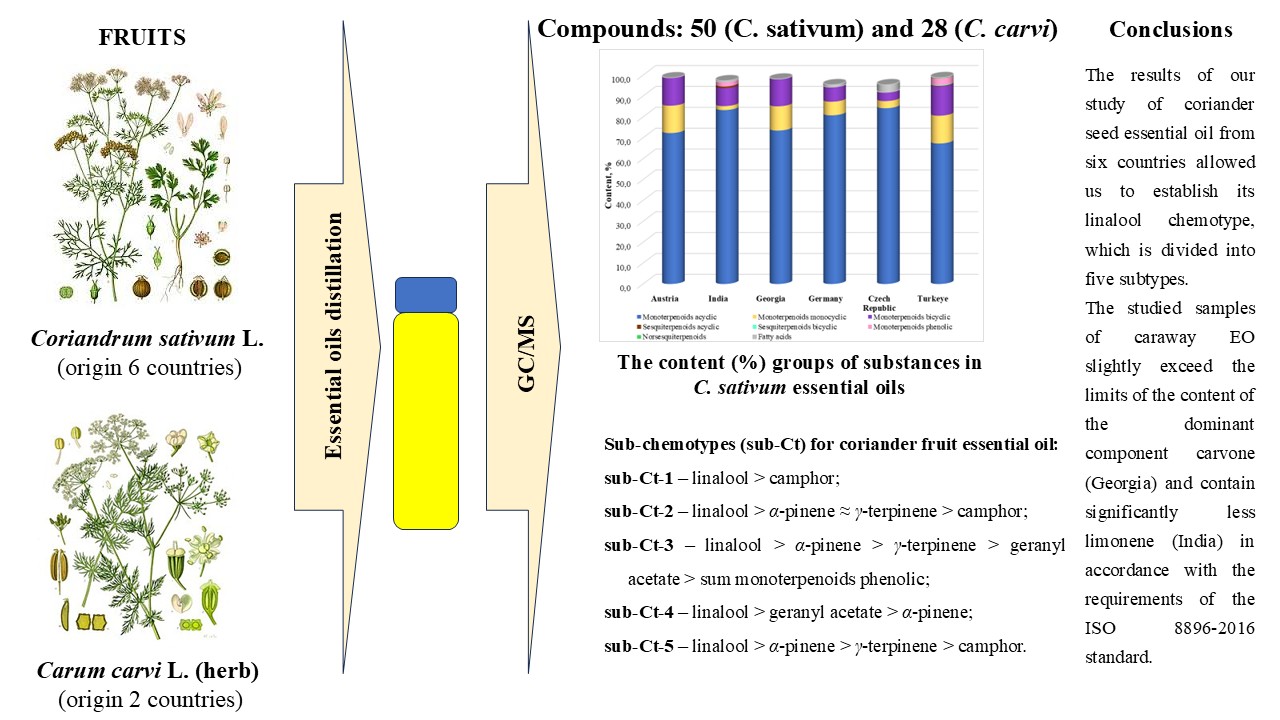
Research results. In the samples of coriander EOs, 50 compounds were detected. The dominant group of compounds is acyclic monoterpenoids, ranging from 67.3% (Turkey) to 84.2% (Czech Republic). The dominant component is linalool (61.6% – 77.9%). According to the content of the dominant major and minor components, it has been established for the first time that the studied samples of linalool-chemotypes can be divided into several sub-chemotypes. It has been noted for the first time that phenolic monoterpenoids were found in samples from subtropical and tropical countries. There is a strong negative correlation between the content of linalool and α-pinene (-0.891); linalool and γ-terpinene (-0.895). In the samples of C. carvi EOs, 28 compounds were detected. Both studied samples of caraway fruits contain the maximum amount of carvone (54.6% – 66.8%), followed by the content of limonene (19.9% – 30.1%). The EO of the caraway studied samples consists almost entirely of monocyclic monoterpenoids.
Conclusions. The results of our study of coriander fruits essential oil from six countries allowed us to establish its linalool chemotype, which is divided into five subtypes depending on the secondary compounds, that is novelty for research on possible chemotypes of coriander fruit essential oil. The studied samples of coriander fruits EO do not fully comply with the requirements of the ISO 3516:1997 standard; the content of linalool (Turkey) is slightly below the lower limit in accordance with the requirements. The studied samples of caraway EO slightly exceed the limits of the content of the dominant component carvone (Georgia) and contain significantly less limonene (India) in accordance with the requirements of the ISO 8896-2016 standard
Supporting Agency
- European Union in the MSCA4Ukraine project “Design and development of 3D-printed medicines for bioactive materials of Ukrainian and Estonian medicinal plants origin” [ID number 1232466]
References
- Prachayasittikul, V., Prachayasittikul, S., Ruchirawat, S., Prachayasittikul, V. (2018). Coriander ( Coriandrum sativum ): A promising functional food toward the well-being. Food Research International, 105, 305–323. https://doi.org/10.1016/j.foodres.2017.11.019
- Global Coriander Production: Top Producing Countries. iSpice You. Available at: https://www.ispiceyou.com/blogs/news/global-coriander-production-top-producing-countries?srsltid=AfmBOopNQZ2rN3O4LPQf4Xo3eTfcCXUtkb_rQEtBTF5zYGjz5r0gG_9P
- Chaurasia, P. K., Bharati, S. L. (2025). Coriander: A holistic outlook on its chemistry and pharmacology. Food Chemistry, 469, 142444. https://doi.org/10.1016/j.foodchem.2024.142444
- Caraway Seeds Market – By Source (Carum carvi, Carum Bulbocastanum), By Form (Whole Seed, Powder Seed), By Application (Food, Beverages, Cosmetic & Personal Care, Pharmaceuticals), By Distribution Channel (Offline, Online) & Forecast, 2024 – 2032. Caraway Seeds Market Size, Share & Growth Analysis – 2032. Available at: https://www.gminsights.com/industry-analysis/caraway-seeds-market
- Al-Khayri, J. M., Banadka, A., Nandhini, M., Nagella, P., Al-Mssallem, M. Q., Alessa, F. M. (2023). Essential Oil from Coriandrum sativum: A review on Its Phytochemistry and Biological Activity. Molecules, 28 (2), 696. https://doi.org/10.3390/molecules28020696
- Wei, J.-N., Liu, Z.-H., Zhao, Y.-P., Zhao, L.-L., Xue, T.-K., Lan, Q.-K. (2019). Phytochemical and bioactive profile of Coriandrum sativum L. Food Chemistry, 286, 260–267. https://doi.org/10.1016/j.foodchem.2019.01.171
- Shams, M., Esfahan, S. Z., Esfahan, E. Z., Dashtaki, H. N., Dursun, A., Yildirim, E. (2016). Effects of Climatic Factors on the Quantity of Essential Oil and Dry Matter Yield of Coriander (Coriandrum sativum L). Indian Journal of Science and Technology, 9 (6). https://doi.org/10.17485/ijst/2016/v9i6/61301
- Machado, K. da C., Islam, M. T., Ali, E. S., Rouf, R., Uddin, S. J., Dev, S. et al. (2018). A systematic review on the neuroprotective perspectives of beta‐caryophyllene. Phytotherapy Research, 32 (12), 2376–2388. https://doi.org/10.1002/ptr.6199
- European Pharmacopoeia. 11th ed. (2022). Strasbourg: Council of Europe.
- ISO 3516:1997. Oil of coriander fruits (Coriandrum sativum L.) ISO. Available at: https://www.iso.org/standard/8885.html
- Global Coriander Oleoresin Market Size By End-Use Industry (Food & Beverages, Pharmaceuticals), By Type (Conventional, Organic), By Form (Liquid, Powder), By Application (Flavoring Agent, Fragrance Agent), By Distribution Channel (Direct Sales, Retail Sales), By Geographic Scope And Forecast. Coriander Oleoresin Market Size, Assessment, Growth & Forecast 2033. Available at: https://www.verifiedmarketreports.com/product/coriander-oleoresin-market/
- Kassahun, B. M. (2020). Unleashing the Exploitation of Coriander (Coriander sativum L.) for Biological, Industrial and Pharmaceutical Applications. Academic Research Journal of Agricultural Science and Research, 8 (6), 552–564.
- Mahleyuddin, N. N., Moshawih, S., Ming, L. C., Zulkifly, H. H., Kifli, N., Loy, M. J. et al. (2021). Coriandrum sativum L.: A Review on Ethnopharmacology, Phytochemistry, and Cardiovascular Benefits. Molecules, 27 (1), 209. https://doi.org/10.3390/molecules27010209
- Diederichsen, A., Banniza, S., Armstrong-Cho, C., Sander, T.; Novak, J., Blüthner, W.-D. (Eds.) (2020). Coriandrum sativum L. – Coriander. Medicinal, Aromatic and Stimulant Plants. Cham: Springer Nature, 265–281. https://doi.org/10.1007/978-3-030-38792-1_4
- Arcanjo, F. P. N., Arcanjo, C. C., Arcanjo, C. P. C., Santos, P. R., El-Ghorab, A. H., El-Gharabli, M. M. et al. (2020). Current Research in Agricultural and Food Science Vol. 3 (Dr. A. M. M. Al-Naggar, Ed.). Book Publisher International (a part of SCIENCEDOMAIN International). https://doi.org/10.9734/bpi/crafs/v3
- Talebi, S. M., Naser, A., Ghorbanpour, M. (2024). Chemical composition and antimicrobial activity of the essential oils in different populations of Coriandrum sativum L. (coriander) from Iran and Iraq. Food Science & Nutrition, 12(6), 3872–3882. Portico. https://doi.org/10.1002/fsn3.4047
- Goyal, M., Gupta, V. K., Singh, N., Mrinal (2018). Carum Carvi- An Updated Review. Indian Journal of Pharmaceutical and Biological Research, 6 (4), 14–24. https://doi.org/10.30750/ijpbr.6.4.4
- El-Rady, M. F. A., Rasmy, N. M. H., Yasin, N. M., Fahmy, H. A., Amer, A. (2023). Phytochemicals and biological activities of caraway (Carumcarvi L.) essential oil. Egyptian Pharmaceutical Journal, 22 (2), 285–293. https://doi.org/10.4103/epj.epj_154_22
- Aly, A., Maraei, R., Rezk, A., Diab, A. (2022). Phytochemical constitutes and biological activities of essential oil extracted from irradiated caraway seeds (Carum carviL.). International Journal of Radiation Biology, 99 (2), 318–328. https://doi.org/10.1080/09553002.2022.2078004
- Liu, C., Cheng, F., Aisa, H. A., Maiwulanjiang, M. (2023). Comprehensive Study of Components and Antimicrobial Properties of Essential Oil Extracted from Carum carvi L. Seeds. Antibiotics, 12 (3), 591. https://doi.org/10.3390/antibiotics12030591
- Mahboubi, M. (2019). Caraway as Important Medicinal Plants in Management of Diseases. Natural Products and Bioprospecting, 9 (1), 1–11. https://doi.org/10.1007/s13659-018-0190-x
- Al-Snafi, A. (2015). The Chemical Constituents and Pharmacological Effects of Carum carvi – A Review. Indian Journal of Pharmaceutical Science & Research, 5 (2), 72–82.
- Rasooli, I., Allameh, A.; Preedy, V. R. (Ed.) (2016). Caraway (Carum carvi L.) Essential Oils. Essential Oils in Food Preservation, Flavor and Safety. Academic Press, 287–293. https://doi.org/10.1016/b978-0-12-416641-7.00032-8
- Pooja, A., Singh, D. K. (2014). A review on the pharmacological aspects of Carum carvi. Journal of Biology and earth Sciences, 4 (1), M1–M13.
- ISO 8896:2016(E). Essential oil of caraway (Carum carvi L.) ISO. Available at: https://www.iso.org/standard/66253.html
- Sepp, J., Koshovyi, O., Jakštas, V., Žvikas, V., Botsula, I., Kireyev, I. et al. (2024). Phytochemical, Pharmacological, and Molecular Docking Study of Dry Extracts of Matricaria discoidea DC. with Analgesic and Soporific Activities. Biomolecules, 14 (3), 361. https://doi.org/10.3390/biom14030361
- Raal, A., Arak, E., Orav, A. (2012). The content and composition of the essential oil Found inCarum carviL. commercial fruits obtained from different countries. Journal of Essential Oil Research, 24 (1), 53–59. https://doi.org/10.1080/10412905.2012.646016
- Davies, N. W. (1990). Gas chromatographic retention indices of monoterpenes and sesquiterpenes on methyl silicon and Carbowax 20M phases. Journal of Chromatography A, 503, 1–24. https://doi.org/10.1016/s0021-9673(01)81487-4
- Raal, A., Komarov, R., Orav, A., Kapp, K., Grytsyk, A., Koshovyi, O. (2022). Chemical composition of essential oil of common juniper (Juniperus communis L.) branches from Estonia. ScienceRise: Pharmaceutical Science, 6 (40), 66–73. https://doi.org/10.15587/2519-4852.2022.271048
- Raal, A., Arak, E., Orav, A. (2004). Chemical composition of coriander seeds essential oil and their conformity with EP standards. Agraarteadus, 15, 234–239.
- Sepp, J., Koshovyi, O., Jakstas, V., Žvikas, V., Botsula, I., Kireyev, I. et al. (2024). Phytochemical, Technological, and Pharmacological Study on the Galenic Dry Extracts Prepared from German Chamomile (Matricaria chamomilla L.) Flowers. Plants, 13 (3), 350. https://doi.org/10.3390/plants13030350
- Beyzi, E., Karaman, K., Gunes, A., Buyukkilic Beyzi, S. (2017). Change in some biochemical and bioactive properties and essential oil composition of coriander seed (Coriandrum sativum L.) varieties from Turkey. Industrial Crops and Products, 109, 74–78. https://doi.org/10.1016/j.indcrop.2017.08.008
- Saxena, S. N., Rathore, S. S., Saxena, R., Barnwal, P., Sharma, L. K., Singh, B. (2014). Effect of Cryogenic Grinding on Essential Oil Constituents of Coriander (Coriandrum sativumL.) Genotypes. Journal of Essential Oil Bearing Plants, 17 (3), 385–392. https://doi.org/10.1080/0972060x.2014.895197
- Aćimović, M. G., Oljača, S. I., Tešević, V. V., Todosijević, M. M., Djisalov, J. N. (2014). Evaluation of caraway essential oil from different production areas of Serbia. Horticultural Science, 41 (3), 122–130. https://doi.org/10.17221/248/2013-hortsci
- Ghannay, S., Aouadi, K., Kadri, A., Snoussi, M. (2022). GC-MS Profiling, Vibriocidal, Antioxidant, Antibiofilm, and Anti-Quorum Sensing Properties of Carum carvi L. Essential Oil: In Vitro and In Silico Approaches. Plants, 11 (8), 1072. https://doi.org/10.3390/plants11081072
- Hemake, P. J., Pawar, P. R. (2023). A Comprehensive Review on Carum Carvi Linn: Botany, Ethnopharmacology, Phytochemistry and Pharmacology Aspects. International Journal For Multidisciplinary Research, 5 (2). https://doi.org/10.36948/ijfmr.2023.v05i02.1920
Downloads
Published
How to Cite
Issue
Section
License
Copyright (c) 2025 Ain Raal, Тetiana Ilina, Alla Kovalyova, Anne Orav, Yuliia Avidzba, Oleksandr Panasenko, Oleh Koshovyi

This work is licensed under a Creative Commons Attribution 4.0 International License.
Our journal abides by the Creative Commons Attribution 4.0 International License copyright rights and permissions for open access journals.
Authors, who are published in this journal, agree to the following conditions:
1. The authors reserve the right to authorship of the work and pass the first publication right of this work to the journal under the terms of a Creative Commons Attribution 4.0 International License, which allows others to freely distribute the published research with the obligatory reference to the authors of the original work and the first publication of the work in this journal.
2. The authors have the right to conclude separate supplement agreements that relate to non-exclusive work distribution in the form in which it has been published by the journal (for example, to upload the work to the online storage of the journal or publish it as part of a monograph), provided that the reference to the first publication of the work in this journal is included.
3. Authors have the right to store the final accepted version of the article in an institutional, thematic, or any other repository to ensure visibility and accessibility.


