Склад, хемотипи та субхемотипи ефірних олій з плодів коріандру звичайного та кмину звичайного, що культивуються в різних країнах
DOI:
https://doi.org/10.15587/2519-4852.2025.341811Ключові слова:
Coriandrum sativum, Carum carvi, ефірна олія, компонентний склад, хемотипи, субхемотипиАнотація
Coriandrum sativum L. та Carum carvi L. родини Apiaceae є одними з найбільш культивованих рослин, оскільки вони здавна використовуються як спеції та ефіроолійні (ЕО) рослини.
Мета. Метою цієї роботи є вивчення складу ЕО з комерційних зразків C. sativum, що походять з 6 країн, та ЕО C. carvi з 2 країн, встановлення мінливості вмісту їхніх компонентів та визначення можливих хемотипів цих видів.
Матеріали та методи. ЕО з висушених плодів C. carvi та C. sativum були отримані методом гідродистиляції, їх компонентний склад був визначений за допомогою ГХ/МС. Зразки сировини були отримані з роздрібних аптек у 6 різних країнах.
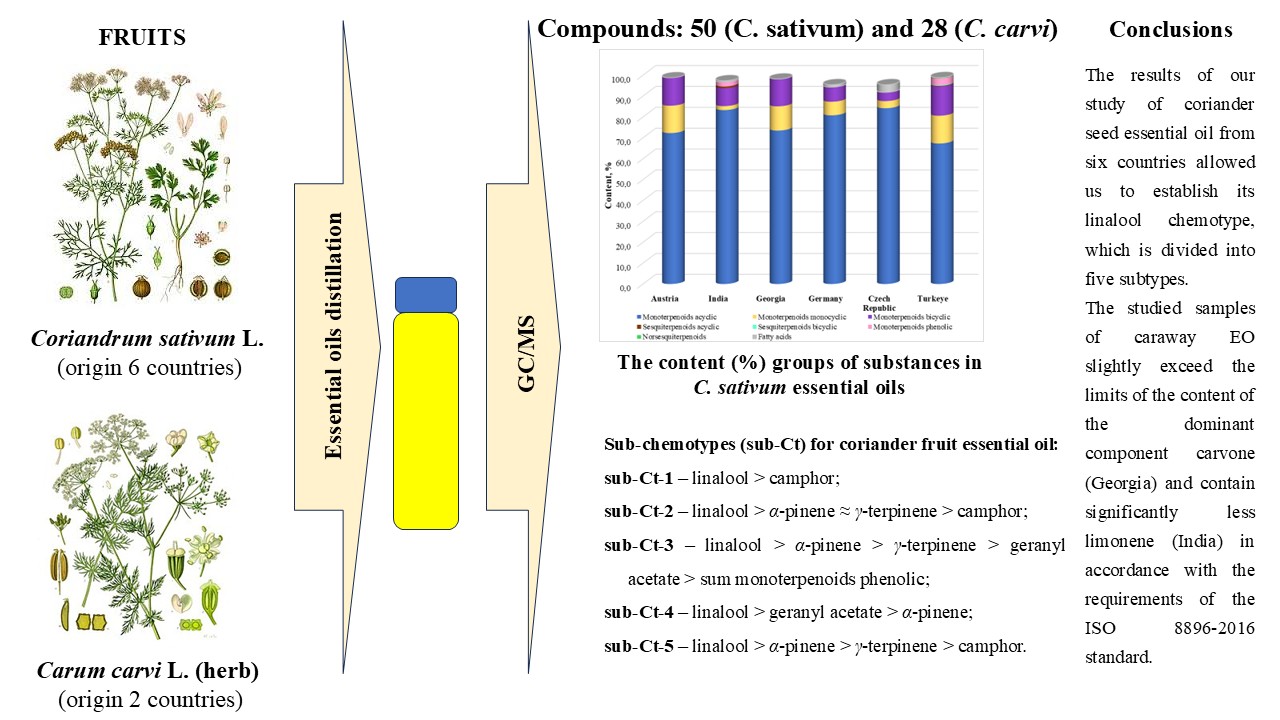
Результати дослідження. У зразках ЕО коріандру було виявлено 50 сполук. Домінуючою групою сполук є ациклічні монотерпеноїди, їх кількість коливається від 67,3% (Туреччина) до 84,2% (Чеська Республіка). Домінуючим компонентом є ліналоол (61,6% – 77,9%). За вмістом домінуючих основних та другорядних компонентів вперше встановлено, що досліджувані зразки хемотипу ліналоолу можна розділити на кілька підхемотипів. Вперше встановлено, що фенольні монотерпеноїди у складі ефірної олії плодів коріандру характерні для зразків із субтропічних та тропічних країн. Спостерігається сильна негативна кореляція між вмістом ліналоолу та α-пінену (-0,891); ліналоолу та γ-терпінену (-0,895). У зразках плодів C. carvi було виявлено 28 сполук. Обидва досліджені зразки плодів кмину містять максимальну кількість карвону (54,6% – 66,8%), дещо нижчий вміст лімонену (19,9% – 30,1%). ЕО досліджених зразків кмину майже повністю складається з моноциклічних монотерпеноїдів.
Висновки. Результати дослідження ефірної олії плодів коріандру з шести країн дозволили встановити її ліналооловий хемотип, який поділяється на п'ять підтипів залежно від вторинних сполук, що є новим для дослідження можливих хемотипів ефірної олії плодів коріандру. Досліджувані зразки ЕО плодів коріандру не повністю відповідали вимогам стандарту ISO 3516:1997; вміст ліналоолу (Туреччина) дещо нижчий за нижню межу вимог. Досліджувані зразки ефірної олії кмину дещо перевищують межі вмісту домінуючого компонента карвону (Грузія) та містять значно менше лімонену (Індія) відповідно до вимог стандарту ISO 8896-2016
Спонсор дослідження
- European Union in the MSCA4Ukraine project “Design and development of 3D-printed medicines for bioactive materials of Ukrainian and Estonian medicinal plants origin” [ID number 1232466]
Посилання
- Prachayasittikul, V., Prachayasittikul, S., Ruchirawat, S., Prachayasittikul, V. (2018). Coriander ( Coriandrum sativum ): A promising functional food toward the well-being. Food Research International, 105, 305–323. https://doi.org/10.1016/j.foodres.2017.11.019
- Global Coriander Production: Top Producing Countries. iSpice You. Available at: https://www.ispiceyou.com/blogs/news/global-coriander-production-top-producing-countries?srsltid=AfmBOopNQZ2rN3O4LPQf4Xo3eTfcCXUtkb_rQEtBTF5zYGjz5r0gG_9P
- Chaurasia, P. K., Bharati, S. L. (2025). Coriander: A holistic outlook on its chemistry and pharmacology. Food Chemistry, 469, 142444. https://doi.org/10.1016/j.foodchem.2024.142444
- Caraway Seeds Market – By Source (Carum carvi, Carum Bulbocastanum), By Form (Whole Seed, Powder Seed), By Application (Food, Beverages, Cosmetic & Personal Care, Pharmaceuticals), By Distribution Channel (Offline, Online) & Forecast, 2024 – 2032. Caraway Seeds Market Size, Share & Growth Analysis – 2032. Available at: https://www.gminsights.com/industry-analysis/caraway-seeds-market
- Al-Khayri, J. M., Banadka, A., Nandhini, M., Nagella, P., Al-Mssallem, M. Q., Alessa, F. M. (2023). Essential Oil from Coriandrum sativum: A review on Its Phytochemistry and Biological Activity. Molecules, 28 (2), 696. https://doi.org/10.3390/molecules28020696
- Wei, J.-N., Liu, Z.-H., Zhao, Y.-P., Zhao, L.-L., Xue, T.-K., Lan, Q.-K. (2019). Phytochemical and bioactive profile of Coriandrum sativum L. Food Chemistry, 286, 260–267. https://doi.org/10.1016/j.foodchem.2019.01.171
- Shams, M., Esfahan, S. Z., Esfahan, E. Z., Dashtaki, H. N., Dursun, A., Yildirim, E. (2016). Effects of Climatic Factors on the Quantity of Essential Oil and Dry Matter Yield of Coriander (Coriandrum sativum L). Indian Journal of Science and Technology, 9 (6). https://doi.org/10.17485/ijst/2016/v9i6/61301
- Machado, K. da C., Islam, M. T., Ali, E. S., Rouf, R., Uddin, S. J., Dev, S. et al. (2018). A systematic review on the neuroprotective perspectives of beta‐caryophyllene. Phytotherapy Research, 32 (12), 2376–2388. https://doi.org/10.1002/ptr.6199
- European Pharmacopoeia. 11th ed. (2022). Strasbourg: Council of Europe.
- ISO 3516:1997. Oil of coriander fruits (Coriandrum sativum L.) ISO. Available at: https://www.iso.org/standard/8885.html
- Global Coriander Oleoresin Market Size By End-Use Industry (Food & Beverages, Pharmaceuticals), By Type (Conventional, Organic), By Form (Liquid, Powder), By Application (Flavoring Agent, Fragrance Agent), By Distribution Channel (Direct Sales, Retail Sales), By Geographic Scope And Forecast. Coriander Oleoresin Market Size, Assessment, Growth & Forecast 2033. Available at: https://www.verifiedmarketreports.com/product/coriander-oleoresin-market/
- Kassahun, B. M. (2020). Unleashing the Exploitation of Coriander (Coriander sativum L.) for Biological, Industrial and Pharmaceutical Applications. Academic Research Journal of Agricultural Science and Research, 8 (6), 552–564.
- Mahleyuddin, N. N., Moshawih, S., Ming, L. C., Zulkifly, H. H., Kifli, N., Loy, M. J. et al. (2021). Coriandrum sativum L.: A Review on Ethnopharmacology, Phytochemistry, and Cardiovascular Benefits. Molecules, 27 (1), 209. https://doi.org/10.3390/molecules27010209
- Diederichsen, A., Banniza, S., Armstrong-Cho, C., Sander, T.; Novak, J., Blüthner, W.-D. (Eds.) (2020). Coriandrum sativum L. – Coriander. Medicinal, Aromatic and Stimulant Plants. Cham: Springer Nature, 265–281. https://doi.org/10.1007/978-3-030-38792-1_4
- Arcanjo, F. P. N., Arcanjo, C. C., Arcanjo, C. P. C., Santos, P. R., El-Ghorab, A. H., El-Gharabli, M. M. et al. (2020). Current Research in Agricultural and Food Science Vol. 3 (Dr. A. M. M. Al-Naggar, Ed.). Book Publisher International (a part of SCIENCEDOMAIN International). https://doi.org/10.9734/bpi/crafs/v3
- Talebi, S. M., Naser, A., Ghorbanpour, M. (2024). Chemical composition and antimicrobial activity of the essential oils in different populations of Coriandrum sativum L. (coriander) from Iran and Iraq. Food Science & Nutrition, 12(6), 3872–3882. Portico. https://doi.org/10.1002/fsn3.4047
- Goyal, M., Gupta, V. K., Singh, N., Mrinal (2018). Carum Carvi- An Updated Review. Indian Journal of Pharmaceutical and Biological Research, 6 (4), 14–24. https://doi.org/10.30750/ijpbr.6.4.4
- El-Rady, M. F. A., Rasmy, N. M. H., Yasin, N. M., Fahmy, H. A., Amer, A. (2023). Phytochemicals and biological activities of caraway (Carumcarvi L.) essential oil. Egyptian Pharmaceutical Journal, 22 (2), 285–293. https://doi.org/10.4103/epj.epj_154_22
- Aly, A., Maraei, R., Rezk, A., Diab, A. (2022). Phytochemical constitutes and biological activities of essential oil extracted from irradiated caraway seeds (Carum carviL.). International Journal of Radiation Biology, 99 (2), 318–328. https://doi.org/10.1080/09553002.2022.2078004
- Liu, C., Cheng, F., Aisa, H. A., Maiwulanjiang, M. (2023). Comprehensive Study of Components and Antimicrobial Properties of Essential Oil Extracted from Carum carvi L. Seeds. Antibiotics, 12 (3), 591. https://doi.org/10.3390/antibiotics12030591
- Mahboubi, M. (2019). Caraway as Important Medicinal Plants in Management of Diseases. Natural Products and Bioprospecting, 9 (1), 1–11. https://doi.org/10.1007/s13659-018-0190-x
- Al-Snafi, A. (2015). The Chemical Constituents and Pharmacological Effects of Carum carvi – A Review. Indian Journal of Pharmaceutical Science & Research, 5 (2), 72–82.
- Rasooli, I., Allameh, A.; Preedy, V. R. (Ed.) (2016). Caraway (Carum carvi L.) Essential Oils. Essential Oils in Food Preservation, Flavor and Safety. Academic Press, 287–293. https://doi.org/10.1016/b978-0-12-416641-7.00032-8
- Pooja, A., Singh, D. K. (2014). A review on the pharmacological aspects of Carum carvi. Journal of Biology and earth Sciences, 4 (1), M1–M13.
- ISO 8896:2016(E). Essential oil of caraway (Carum carvi L.) ISO. Available at: https://www.iso.org/standard/66253.html
- Sepp, J., Koshovyi, O., Jakštas, V., Žvikas, V., Botsula, I., Kireyev, I. et al. (2024). Phytochemical, Pharmacological, and Molecular Docking Study of Dry Extracts of Matricaria discoidea DC. with Analgesic and Soporific Activities. Biomolecules, 14 (3), 361. https://doi.org/10.3390/biom14030361
- Raal, A., Arak, E., Orav, A. (2012). The content and composition of the essential oil Found inCarum carviL. commercial fruits obtained from different countries. Journal of Essential Oil Research, 24 (1), 53–59. https://doi.org/10.1080/10412905.2012.646016
- Davies, N. W. (1990). Gas chromatographic retention indices of monoterpenes and sesquiterpenes on methyl silicon and Carbowax 20M phases. Journal of Chromatography A, 503, 1–24. https://doi.org/10.1016/s0021-9673(01)81487-4
- Raal, A., Komarov, R., Orav, A., Kapp, K., Grytsyk, A., Koshovyi, O. (2022). Chemical composition of essential oil of common juniper (Juniperus communis L.) branches from Estonia. ScienceRise: Pharmaceutical Science, 6 (40), 66–73. https://doi.org/10.15587/2519-4852.2022.271048
- Raal, A., Arak, E., Orav, A. (2004). Chemical composition of coriander seeds essential oil and their conformity with EP standards. Agraarteadus, 15, 234–239.
- Sepp, J., Koshovyi, O., Jakstas, V., Žvikas, V., Botsula, I., Kireyev, I. et al. (2024). Phytochemical, Technological, and Pharmacological Study on the Galenic Dry Extracts Prepared from German Chamomile (Matricaria chamomilla L.) Flowers. Plants, 13 (3), 350. https://doi.org/10.3390/plants13030350
- Beyzi, E., Karaman, K., Gunes, A., Buyukkilic Beyzi, S. (2017). Change in some biochemical and bioactive properties and essential oil composition of coriander seed (Coriandrum sativum L.) varieties from Turkey. Industrial Crops and Products, 109, 74–78. https://doi.org/10.1016/j.indcrop.2017.08.008
- Saxena, S. N., Rathore, S. S., Saxena, R., Barnwal, P., Sharma, L. K., Singh, B. (2014). Effect of Cryogenic Grinding on Essential Oil Constituents of Coriander (Coriandrum sativumL.) Genotypes. Journal of Essential Oil Bearing Plants, 17 (3), 385–392. https://doi.org/10.1080/0972060x.2014.895197
- Aćimović, M. G., Oljača, S. I., Tešević, V. V., Todosijević, M. M., Djisalov, J. N. (2014). Evaluation of caraway essential oil from different production areas of Serbia. Horticultural Science, 41 (3), 122–130. https://doi.org/10.17221/248/2013-hortsci
- Ghannay, S., Aouadi, K., Kadri, A., Snoussi, M. (2022). GC-MS Profiling, Vibriocidal, Antioxidant, Antibiofilm, and Anti-Quorum Sensing Properties of Carum carvi L. Essential Oil: In Vitro and In Silico Approaches. Plants, 11 (8), 1072. https://doi.org/10.3390/plants11081072
- Hemake, P. J., Pawar, P. R. (2023). A Comprehensive Review on Carum Carvi Linn: Botany, Ethnopharmacology, Phytochemistry and Pharmacology Aspects. International Journal For Multidisciplinary Research, 5 (2). https://doi.org/10.36948/ijfmr.2023.v05i02.1920
##submission.downloads##
Опубліковано
Як цитувати
Номер
Розділ
Ліцензія
Авторське право (c) 2025 Ain Raal, Тetiana Ilina, Alla Kovalyova, Anne Orav, Yuliia Avidzba, Oleksandr Panasenko, Oleh Koshovyi

Ця робота ліцензується відповідно до Creative Commons Attribution 4.0 International License.
Наше видання використовує положення про авторські права Creative Commons Attribution 4.0 International License для журналів відкритого доступу.
Автори, які публікуються у цьому журналі, погоджуються з наступними умовами:
1. Автори залишають за собою право на авторство своєї роботи та передають журналу право першої публікації цієї роботи на умовах ліцензії Creative Commons Attribution 4.0 International License, котра дозволяє іншим особам вільно розповсюджувати опубліковану роботу з обов'язковим посиланням на авторів оригінальної роботи та першу публікацію роботи у цьому журналі.
2. Автори мають право укладати самостійні додаткові угоди щодо неексклюзивного розповсюдження роботи у тому вигляді, в якому вона була опублікована цим журналом (наприклад, розміщувати роботу в електронному сховищі установи або публікувати у складі монографії), за умови збереження посилання на першу публікацію роботи у цьому журналі.
3. Автори мають право зберігати остаточну прийняту версію статті в інституційному, тематичному або будь-якому іншому репозитарії з метою забезпечення видимості та доступності.