Synthesis and antibacterial activity of nitrogen-doped carbon dots
DOI:
https://doi.org/10.15587/2519-4852.2026.345892Keywords:
antibacterial, bactericides, carbon dots, S. aureus, E. coliAbstract
The aim of our work is to synthesize N-CD and to evaluate its antibacterial activity against Gram-positive and Gram-negative bacteria.
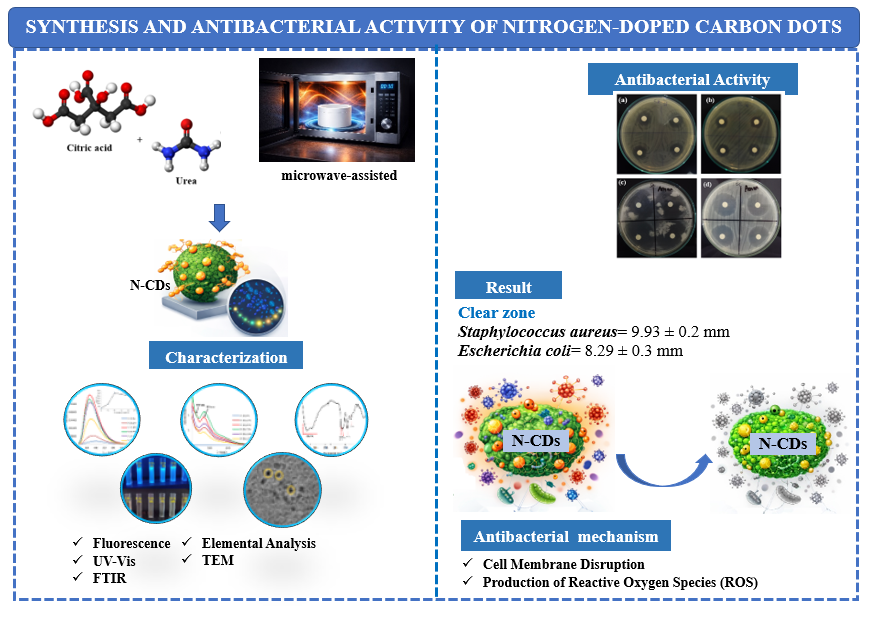
Material and Methods. N-CDs were synthesized from citric acid and urea using a bottom-up approach using microwave-assisted treatment. The nitrogen doping in the CDs structure was studied on an FTIR (Shimadzu IR Prestige-21). The optical properties of N-CDs were detected using fluorescence spectroscopy (Shimadzu RF-6000) and UV-Vis absorption spectroscopy (Shimadzu 1800). The size of N-CDs nanoparticles was confirmed on a TEM (JEOL-JEM 1400). Elemental analysis was performed on an ELEMENTAR vario EL cube. The antibacterial activity of N-CDs was investigated using the agar disk diffusion and dilution method against S.aureus and E.coli bacteria.
Results. The structure and characteristics of N-CDs were confirmed through several stages. The size of N-CDs based on TEM images ranged from 2.4 to 2.6 nm with a fairly uniform size distribution. The success of nitrogen doping was confirmed through fluorescence spectra, UV-vis absoption spectra, FTIR spectra and elemental analysis. The antibacterial activity tests showed that N-CDs were able to inhibit the growth of Gram-positive bacteria (S. aureus, clear zone=9.93±0.2 mm, MIC=50 µg/mL, IC50=272 µg/mL) and Gram-negative bacteria (E. coli, clear zone=8.29±0.3 mm, MIC=50 µg/mL, IC50=339 µg/mL) which makes it a broad-spectrum antibacterial candidate.
Conclusions: N-CD was successfully synthesized and exhibited broad bacterial inhibitory activity. However, its inhibitory performance against Gram-positive bacteria was much better, as seen from the clear zone diameter and IC50 values
Supporting Agencies
- Indonesia Endowment Fund for Education (LPDP)
- Center for Higher Education Funding (BPPT)
- Indonesia Education Scholarship (BPI)
- Ministry of Education, Research and Technology of the Republic of Indonesia
- STIKES Guna Bangsa Yogyakarta
References
- Bindiya, E. S., Ramesh, M. D., Arya, B., Bhat, S. G. (2024). Identification of pigmented extremophilic bacteria from mangrove soil with antibiofilm activity on food pathogens. The Microbe, 4, 100136. https://doi.org/10.1016/j.microb.2024.100136
- Kami, W., Ideguchi, S., Miyagi, K., Tasato, D., Higa, F., Nakamura, H. et al. (2025). Bacterial pneumonia co-infection in adult inpatients with coronavirus disease 2019 during the Omicron variants epidemic in Okinawa, Japan: risk factors and clinical outcomes. Respiratory Investigation, 63 (6), 1087–1092. https://doi.org/10.1016/j.resinv.2025.08.006
- Kapesa, C., Mumbula, E. M., Kwenda, H. C. (2025). Prevalence of gram-negative bacterial causes of urinary tract infection and their antimicrobial susceptibility profile at the university teaching hospitals in Lusaka, Zambia. Scientific African, 27, e02558. https://doi.org/10.1016/j.sciaf.2025.e02558
- Mohammed, S. J., Sidiq, M. K., Najmuldeen, H. H., Kayani, K. F., Kader, D. A., Aziz, S. B. (2024). A comprehensive review on nitrogen-doped carbon dots for antibacterial applications. Journal of Environmental Chemical Engineering, 12 (6), 114444. https://doi.org/10.1016/j.jece.2024.114444
- Yang, L., Mao, L., Du, S., Wang, Z., Fu, W., Yao, C. et al. (2025). Highly sensitive and fast response/recovery ammonia sensor based on PANI/LIG at room temperature. Sensors and Actuators B: Chemical, 437, 137710. https://doi.org/10.1016/j.snb.2025.137710
- Cui, F., Xi, L., Wang, D., Ren, L., Tan, X., Li, X. et al. (2023). Advanced in carbon dot-based hydrogels for antibacterial, detection and adsorption. Coordination Chemistry Reviews, 497, 215457. https://doi.org/10.1016/j.ccr.2023.215457
- Zare, I., Zahed Nasab, S., Rahi, A., Ghaee, A., Koohkhezri, M., Ramezani Farani, M. et al. (2025). Antimicrobial carbon materials-based quantum dots: From synthesis strategies to antibacterial properties for diagnostic and therapeutic applications in wound healing. Coordination Chemistry Reviews, 522, 216211. https://doi.org/10.1016/j.ccr.2024.216211
- Hussen, N. H., Hasan, A. H., FaqiKhedr, Y. M., Bogoyavlenskiy, A., Bhat, A. R., Jamalis, J. (2024). Carbon Dot Based Carbon Nanoparticles as Potent Antimicrobial, Antiviral, and Anticancer Agents. ACS Omega, 9 (9), 9849–9864. https://doi.org/10.1021/acsomega.3c05537
- Hua, J., Hua, P., Qin, K. (2023). Highly fluorescent N, F co-doped carbon dots with tunable light emission for multicolor bio-labeling and antibacterial applications. Journal of Hazardous Materials, 459, 132331. https://doi.org/10.1016/j.jhazmat.2023.132331
- Suner, S. S., Sahiner, M., Ayyala, R. S., Bhethanabotla, V. R., Sahiner, N. (2021). Versatile Fluorescent Carbon Dots from Citric Acid and Cysteine with Antimicrobial, Anti-biofilm, Antioxidant, and AChE Enzyme Inhibition Capabilities. Journal of Fluorescence, 31 (6), 1705–1717. https://doi.org/10.1007/s10895-021-02798-x
- Raut, J., Patra, D., Mandal, S. M., Mandal, S., Sahoo, P. (2023). Targeted antibacterial potency against multidrug resistance pathogen enhanced with N, S co-doped carbon quantum dots selectively recognizes rifampicin. Journal of Photochemistry and Photobiology A: Chemistry, 442, 114761. https://doi.org/10.1016/j.jphotochem.2023.114761
- Khan, B., Wang, H., Wang, Y., Latif, F., Chen, P., Han, M. et al. (2025). Natural-product-derived carbon dots to combat Candida albicans infections without drug resistance by multifaceted antifungal mechanisms. Chemical Engineering Journal, 523, 168622. https://doi.org/10.1016/j.cej.2025.168622
- Balouiri, M., Sadiki, M., Ibnsouda, S. K. (2016). Methods for in vitro evaluating antimicrobial activity: A review. Journal of Pharmaceutical Analysis, 6 (2), 71–79. https://doi.org/10.1016/j.jpha.2015.11.005
- Zhao, X., Wang, H., Liu, Q., Chen, X. (2024). Nitrogen, sulfur-doped carbon quantum dots with large Stokes shift for real-time monitoring of pH in living cells. Talanta, 269, 125479. https://doi.org/10.1016/j.talanta.2023.125479
- Munusamy, S., Mandlimath, T. R., Swetha, P., Al-Sehemi, A. G., Pannipara, M., Koppala, S. et al. (2023). Nitrogen-doped carbon dots: Recent developments in its fluorescent sensor applications. Environmental Research, 231, 116046. https://doi.org/10.1016/j.envres.2023.116046
- Prado, M. B., Truong, N. T., Wanekaya, A. K. (2023). Improving the quantum yield of nitrogen-doped carbon dots by varying dopant ratios and pH. Sensors and Actuators Reports, 6, 100165. https://doi.org/10.1016/j.snr.2023.100165
- Nguyen, M. H., Le, A. T., Pham, V. D., Pham, H. M., Do, H. T., Le, D. T. et al. (2024). A Comprehensive Study on the Antibacterial Activities of Carbon Quantum Dots Derived from Orange Juice against Escherichia coli. Applied Sciences, 14 (6), 2509. https://doi.org/10.3390/app14062509
- Ozyurt, D., Kobaisi, M. A., Hocking, R. K., Fox, B. (2023). Properties, synthesis, and applications of carbon dots: A review. Carbon Trends, 12, 100276. https://doi.org/10.1016/j.cartre.2023.100276
- Michenzi, C., Espro, C., Bressi, V., Celesti, C., Vetica, F., Salvitti, C., Chiarotto, I. (2023). Electrochemical bottom-up synthesis of biomass-derived carbon dots for promoting Knoevenagel condensation. Molecular Catalysis, 544, 113182. https://doi.org/10.1016/j.mcat.2023.113182
- Dehvari, K., Chiu, S.-H., Lin, J.-S., Girma, W. M., Ling, Y.-C., Chang, J.-Y. (2020). Heteroatom doped carbon dots with nanoenzyme like properties as theranostic platforms for free radical scavenging, imaging, and chemotherapy. Acta Biomaterialia, 114, 343–357. https://doi.org/10.1016/j.actbio.2020.07.022
- Arif, S., Hassan, M., Rasheed, S., Ahmad, N., Fatima, B., Musharraf, S. G., Hussain, D. (2026). Microfluidic paper-based fluorescent sensing device using citric acid derived carbon dots-tungsten sulfide spheres for on-site detection of secnidazole. Biosensors and Bioelectronics, 291, 118025. https://doi.org/10.1016/j.bios.2025.118025
- Zhang, Y., Gui, C., Cui, X., Zhang, Q., Zheng, X., Sun, X. et al. (2025). Solvent extraction-assisted pyrolysis synthesis of N doped citric acid-based carbon dots for ciprofloxacin detection and anti-counterfeiting applications. Materials Today Communications, 45, 112392. https://doi.org/10.1016/j.mtcomm.2025.112392
- Thinthasit, A., Muryadi, E. I., Jaya, S., Nugroho, D., Chanthai, S., Benchawattananon, R. (2024). Enhanced antibacterial testing and latent fingerprint detection using dichlorofluorescein-doped carbon dots. Journal of Saudi Chemical Society, 28 (6), 101952. https://doi.org/10.1016/j.jscs.2024.101952
- Sahiner, M., Ari, B., Ram, M. K., Sahiner, N. (2022). Nitrogen Doped Carbon-Dot Embedded Poly(lactic acid-co-glycolic acid) Composite Films for Potential Use in Food Packing Industry and Wound Dressing. Journal of Composites Science, 6 (9), 260. https://doi.org/10.3390/jcs6090260
- Hao, X., Huang, L., Zhao, C., Chen, S., Lin, W., Lin, Y. et al. (2021). Antibacterial activity of positively charged carbon quantum dots without detectable resistance for wound healing with mixed bacteria infection. Materials Science and Engineering: C, 123, 111971. https://doi.org/10.1016/j.msec.2021.111971
- Wang, H., Wang, Q., Wang, Q., Dong, W., Liu, Y., Hu, Q. et al. (2023). Metal-free nitrogen-doped carbon nanodots as an artificial nanozyme for enhanced antibacterial activity. Journal of Cleaner Production, 411, 137337. https://doi.org/10.1016/j.jclepro.2023.137337
- Wang, Z., Sheng, L., Yang, X., Sun, J., Ye, Y., Geng, S. et al. (2023). Natural biomass-derived carbon dots as potent antimicrobial agents against multidrug-resistant bacteria and their biofilms. Sustainable Materials and Technologies, 36, e00584. https://doi.org/10.1016/j.susmat.2023.e00584
- Zhang, M., Ye, J., Zhang, J., Tian, Z., Gan, L., Wang, Q. et al. (2025). Porphyrinized carbon quantum dots: A novel antibacterial nanomaterial for visualized and broad-spectrum treatment of drug-resistant infected wounds. Chemical Engineering Journal, 522, 166981. https://doi.org/10.1016/j.cej.2025.166981
- Lu, F., Song, Y., Huang, H., Liu, Y., Fu, Y., Huang, J. et al. (2017). Fluorescent carbon dots with tunable negative charges for bio-imaging in bacterial viability assessment. Carbon, 120, 95–102. https://doi.org/10.1016/j.carbon.2017.05.039
- Wang, S., Wang, D., Wang, G., Zhang, M., Sun, Y., Ding, J. (2025). Antibacterial carbon dots. Materials Today Bio, 30, 101383. https://doi.org/10.1016/j.mtbio.2024.101383
Downloads
Published
How to Cite
Issue
Section
License
Copyright (c) 2026 Bambang Purwono, Wiwit Sepvianti, Suherman Suherman

This work is licensed under a Creative Commons Attribution 4.0 International License.
Our journal abides by the Creative Commons Attribution 4.0 International License copyright rights and permissions for open access journals.
Authors, who are published in this journal, agree to the following conditions:
1. The authors reserve the right to authorship of the work and pass the first publication right of this work to the journal under the terms of a Creative Commons Attribution 4.0 International License, which allows others to freely distribute the published research with the obligatory reference to the authors of the original work and the first publication of the work in this journal.
2. The authors have the right to conclude separate supplement agreements that relate to non-exclusive work distribution in the form in which it has been published by the journal (for example, to upload the work to the online storage of the journal or publish it as part of a monograph), provided that the reference to the first publication of the work in this journal is included.
3. Authors have the right to store the final accepted version of the article in an institutional, thematic, or any other repository to ensure visibility and accessibility.