Синтез і антибактеріальна активність азот-допованих вуглецевих точок
DOI:
https://doi.org/10.15587/2519-4852.2026.345892Ключові слова:
антибактеріальні, бактерициди, вуглецеві точки, S. aureus, E. coliАнотація
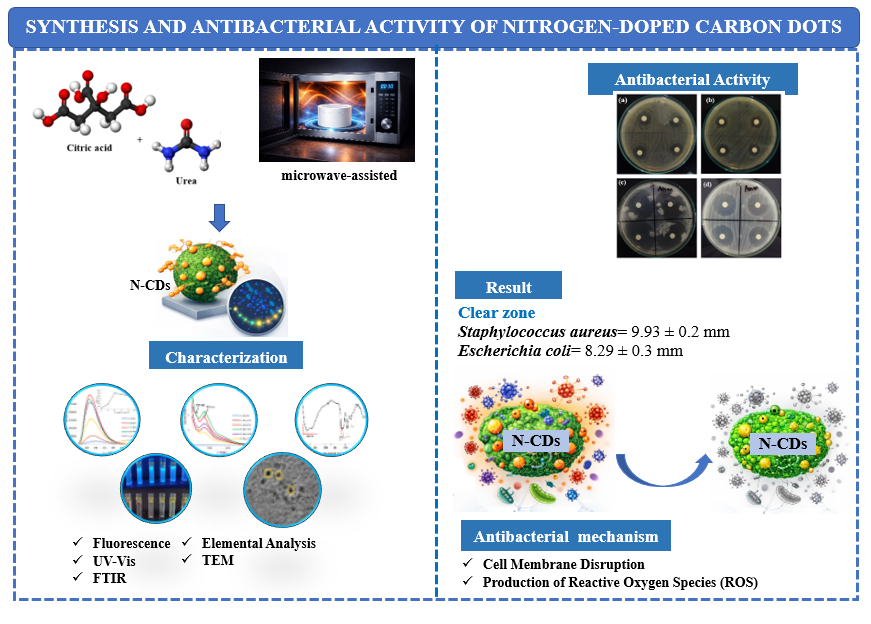
Метою нашої роботи є синтез N-CD та оцінка їхньої антибактеріальної активності щодо грампозитивних і грамнегативних бактерій.
Матеріали та методи. N-CDs були синтезовані з лимонної кислоти та сечовини з використанням підходу «знизу вгору» за допомогою мікрохвильової обробки. Допування азотом у структурі CDs досліджували за допомогою FTIR (Shimadzu IR Prestige-21). Оптичні властивості N-CDs визначали методом флуоресцентної спектроскопії (Shimadzu RF-6000) та УФ-видимої абсорбційної спектроскопії (Shimadzu 1800). Розмір наночастинок N-CDs підтверджували за допомогою TEM (JEOL JEM 1400). Елементний аналіз проводили на ELEMENTAR vario EL cube. Антибактеріальну активність N-CDs досліджували методом дифузії в агарі з дисками та методом розведень щодо бактерій S. aureus і E. coli.
Результати. Структуру та характеристики N-CDs було підтверджено на кількох етапах. Розмір N-CDs за даними TEM-зображень становив від 2,4 до 2,6 нм із досить рівномірним розподілом за розміром. Успішність допування азотом була підтверджена флуоресцентними спектрами, УФ-видимими спектрами поглинання, FTIR-спектрами та елементним аналізом. Тести на антибактеріальну активність показали, що N-CDs здатні пригнічувати ріст грампозитивних бактерій (S. aureus, зона затримки росту = 9,93±0,2 мм, MIC = 50 мкг/мл, IC50 = 272 мкг/мл) та грамнегативних бактерій (E. coli, зона затримки росту = 8,29±0,3 мм, MIC = 50 мкг/мл, IC50 = 339 мкг/мл), що робить їх кандидатом антибактеріального засобу широкого спектра дії.
Висновки: N-CD було успішно синтезовано, і вони продемонстрували широку інгібуючу активність щодо бактерій. Однак їхня інгібуюча ефективність щодо грампозитивних бактерій була значно кращою, що видно з діаметра зони затримки росту та значень IC50
Спонсори дослідження
- Indonesia Endowment Fund for Education (LPDP)
- Center for Higher Education Funding (BPPT)
- Indonesia Education Scholarship (BPI)
- Ministry of Education, Research and Technology of the Republic of Indonesia
- STIKES Guna Bangsa Yogyakarta
Посилання
- Bindiya, E. S., Ramesh, M. D., Arya, B., Bhat, S. G. (2024). Identification of pigmented extremophilic bacteria from mangrove soil with antibiofilm activity on food pathogens. The Microbe, 4, 100136. https://doi.org/10.1016/j.microb.2024.100136
- Kami, W., Ideguchi, S., Miyagi, K., Tasato, D., Higa, F., Nakamura, H. et al. (2025). Bacterial pneumonia co-infection in adult inpatients with coronavirus disease 2019 during the Omicron variants epidemic in Okinawa, Japan: risk factors and clinical outcomes. Respiratory Investigation, 63 (6), 1087–1092. https://doi.org/10.1016/j.resinv.2025.08.006
- Kapesa, C., Mumbula, E. M., Kwenda, H. C. (2025). Prevalence of gram-negative bacterial causes of urinary tract infection and their antimicrobial susceptibility profile at the university teaching hospitals in Lusaka, Zambia. Scientific African, 27, e02558. https://doi.org/10.1016/j.sciaf.2025.e02558
- Mohammed, S. J., Sidiq, M. K., Najmuldeen, H. H., Kayani, K. F., Kader, D. A., Aziz, S. B. (2024). A comprehensive review on nitrogen-doped carbon dots for antibacterial applications. Journal of Environmental Chemical Engineering, 12 (6), 114444. https://doi.org/10.1016/j.jece.2024.114444
- Yang, L., Mao, L., Du, S., Wang, Z., Fu, W., Yao, C. et al. (2025). Highly sensitive and fast response/recovery ammonia sensor based on PANI/LIG at room temperature. Sensors and Actuators B: Chemical, 437, 137710. https://doi.org/10.1016/j.snb.2025.137710
- Cui, F., Xi, L., Wang, D., Ren, L., Tan, X., Li, X. et al. (2023). Advanced in carbon dot-based hydrogels for antibacterial, detection and adsorption. Coordination Chemistry Reviews, 497, 215457. https://doi.org/10.1016/j.ccr.2023.215457
- Zare, I., Zahed Nasab, S., Rahi, A., Ghaee, A., Koohkhezri, M., Ramezani Farani, M. et al. (2025). Antimicrobial carbon materials-based quantum dots: From synthesis strategies to antibacterial properties for diagnostic and therapeutic applications in wound healing. Coordination Chemistry Reviews, 522, 216211. https://doi.org/10.1016/j.ccr.2024.216211
- Hussen, N. H., Hasan, A. H., FaqiKhedr, Y. M., Bogoyavlenskiy, A., Bhat, A. R., Jamalis, J. (2024). Carbon Dot Based Carbon Nanoparticles as Potent Antimicrobial, Antiviral, and Anticancer Agents. ACS Omega, 9 (9), 9849–9864. https://doi.org/10.1021/acsomega.3c05537
- Hua, J., Hua, P., Qin, K. (2023). Highly fluorescent N, F co-doped carbon dots with tunable light emission for multicolor bio-labeling and antibacterial applications. Journal of Hazardous Materials, 459, 132331. https://doi.org/10.1016/j.jhazmat.2023.132331
- Suner, S. S., Sahiner, M., Ayyala, R. S., Bhethanabotla, V. R., Sahiner, N. (2021). Versatile Fluorescent Carbon Dots from Citric Acid and Cysteine with Antimicrobial, Anti-biofilm, Antioxidant, and AChE Enzyme Inhibition Capabilities. Journal of Fluorescence, 31 (6), 1705–1717. https://doi.org/10.1007/s10895-021-02798-x
- Raut, J., Patra, D., Mandal, S. M., Mandal, S., Sahoo, P. (2023). Targeted antibacterial potency against multidrug resistance pathogen enhanced with N, S co-doped carbon quantum dots selectively recognizes rifampicin. Journal of Photochemistry and Photobiology A: Chemistry, 442, 114761. https://doi.org/10.1016/j.jphotochem.2023.114761
- Khan, B., Wang, H., Wang, Y., Latif, F., Chen, P., Han, M. et al. (2025). Natural-product-derived carbon dots to combat Candida albicans infections without drug resistance by multifaceted antifungal mechanisms. Chemical Engineering Journal, 523, 168622. https://doi.org/10.1016/j.cej.2025.168622
- Balouiri, M., Sadiki, M., Ibnsouda, S. K. (2016). Methods for in vitro evaluating antimicrobial activity: A review. Journal of Pharmaceutical Analysis, 6 (2), 71–79. https://doi.org/10.1016/j.jpha.2015.11.005
- Zhao, X., Wang, H., Liu, Q., Chen, X. (2024). Nitrogen, sulfur-doped carbon quantum dots with large Stokes shift for real-time monitoring of pH in living cells. Talanta, 269, 125479. https://doi.org/10.1016/j.talanta.2023.125479
- Munusamy, S., Mandlimath, T. R., Swetha, P., Al-Sehemi, A. G., Pannipara, M., Koppala, S. et al. (2023). Nitrogen-doped carbon dots: Recent developments in its fluorescent sensor applications. Environmental Research, 231, 116046. https://doi.org/10.1016/j.envres.2023.116046
- Prado, M. B., Truong, N. T., Wanekaya, A. K. (2023). Improving the quantum yield of nitrogen-doped carbon dots by varying dopant ratios and pH. Sensors and Actuators Reports, 6, 100165. https://doi.org/10.1016/j.snr.2023.100165
- Nguyen, M. H., Le, A. T., Pham, V. D., Pham, H. M., Do, H. T., Le, D. T. et al. (2024). A Comprehensive Study on the Antibacterial Activities of Carbon Quantum Dots Derived from Orange Juice against Escherichia coli. Applied Sciences, 14 (6), 2509. https://doi.org/10.3390/app14062509
- Ozyurt, D., Kobaisi, M. A., Hocking, R. K., Fox, B. (2023). Properties, synthesis, and applications of carbon dots: A review. Carbon Trends, 12, 100276. https://doi.org/10.1016/j.cartre.2023.100276
- Michenzi, C., Espro, C., Bressi, V., Celesti, C., Vetica, F., Salvitti, C., Chiarotto, I. (2023). Electrochemical bottom-up synthesis of biomass-derived carbon dots for promoting Knoevenagel condensation. Molecular Catalysis, 544, 113182. https://doi.org/10.1016/j.mcat.2023.113182
- Dehvari, K., Chiu, S.-H., Lin, J.-S., Girma, W. M., Ling, Y.-C., Chang, J.-Y. (2020). Heteroatom doped carbon dots with nanoenzyme like properties as theranostic platforms for free radical scavenging, imaging, and chemotherapy. Acta Biomaterialia, 114, 343–357. https://doi.org/10.1016/j.actbio.2020.07.022
- Arif, S., Hassan, M., Rasheed, S., Ahmad, N., Fatima, B., Musharraf, S. G., Hussain, D. (2026). Microfluidic paper-based fluorescent sensing device using citric acid derived carbon dots-tungsten sulfide spheres for on-site detection of secnidazole. Biosensors and Bioelectronics, 291, 118025. https://doi.org/10.1016/j.bios.2025.118025
- Zhang, Y., Gui, C., Cui, X., Zhang, Q., Zheng, X., Sun, X. et al. (2025). Solvent extraction-assisted pyrolysis synthesis of N doped citric acid-based carbon dots for ciprofloxacin detection and anti-counterfeiting applications. Materials Today Communications, 45, 112392. https://doi.org/10.1016/j.mtcomm.2025.112392
- Thinthasit, A., Muryadi, E. I., Jaya, S., Nugroho, D., Chanthai, S., Benchawattananon, R. (2024). Enhanced antibacterial testing and latent fingerprint detection using dichlorofluorescein-doped carbon dots. Journal of Saudi Chemical Society, 28 (6), 101952. https://doi.org/10.1016/j.jscs.2024.101952
- Sahiner, M., Ari, B., Ram, M. K., Sahiner, N. (2022). Nitrogen Doped Carbon-Dot Embedded Poly(lactic acid-co-glycolic acid) Composite Films for Potential Use in Food Packing Industry and Wound Dressing. Journal of Composites Science, 6 (9), 260. https://doi.org/10.3390/jcs6090260
- Hao, X., Huang, L., Zhao, C., Chen, S., Lin, W., Lin, Y. et al. (2021). Antibacterial activity of positively charged carbon quantum dots without detectable resistance for wound healing with mixed bacteria infection. Materials Science and Engineering: C, 123, 111971. https://doi.org/10.1016/j.msec.2021.111971
- Wang, H., Wang, Q., Wang, Q., Dong, W., Liu, Y., Hu, Q. et al. (2023). Metal-free nitrogen-doped carbon nanodots as an artificial nanozyme for enhanced antibacterial activity. Journal of Cleaner Production, 411, 137337. https://doi.org/10.1016/j.jclepro.2023.137337
- Wang, Z., Sheng, L., Yang, X., Sun, J., Ye, Y., Geng, S. et al. (2023). Natural biomass-derived carbon dots as potent antimicrobial agents against multidrug-resistant bacteria and their biofilms. Sustainable Materials and Technologies, 36, e00584. https://doi.org/10.1016/j.susmat.2023.e00584
- Zhang, M., Ye, J., Zhang, J., Tian, Z., Gan, L., Wang, Q. et al. (2025). Porphyrinized carbon quantum dots: A novel antibacterial nanomaterial for visualized and broad-spectrum treatment of drug-resistant infected wounds. Chemical Engineering Journal, 522, 166981. https://doi.org/10.1016/j.cej.2025.166981
- Lu, F., Song, Y., Huang, H., Liu, Y., Fu, Y., Huang, J. et al. (2017). Fluorescent carbon dots with tunable negative charges for bio-imaging in bacterial viability assessment. Carbon, 120, 95–102. https://doi.org/10.1016/j.carbon.2017.05.039
- Wang, S., Wang, D., Wang, G., Zhang, M., Sun, Y., Ding, J. (2025). Antibacterial carbon dots. Materials Today Bio, 30, 101383. https://doi.org/10.1016/j.mtbio.2024.101383
##submission.downloads##
Опубліковано
Як цитувати
Номер
Розділ
Ліцензія
Авторське право (c) 2026 Bambang Purwono, Wiwit Sepvianti, Suherman Suherman

Ця робота ліцензується відповідно до Creative Commons Attribution 4.0 International License.
Наше видання використовує положення про авторські права Creative Commons Attribution 4.0 International License для журналів відкритого доступу.
Автори, які публікуються у цьому журналі, погоджуються з наступними умовами:
1. Автори залишають за собою право на авторство своєї роботи та передають журналу право першої публікації цієї роботи на умовах ліцензії Creative Commons Attribution 4.0 International License, котра дозволяє іншим особам вільно розповсюджувати опубліковану роботу з обов'язковим посиланням на авторів оригінальної роботи та першу публікацію роботи у цьому журналі.
2. Автори мають право укладати самостійні додаткові угоди щодо неексклюзивного розповсюдження роботи у тому вигляді, в якому вона була опублікована цим журналом (наприклад, розміщувати роботу в електронному сховищі установи або публікувати у складі монографії), за умови збереження посилання на першу публікацію роботи у цьому журналі.
3. Автори мають право зберігати остаточну прийняту версію статті в інституційному, тематичному або будь-якому іншому репозитарії з метою забезпечення видимості та доступності.