Дослідження компонентного складу летких фракцій рослин роду Анемона
DOI:
https://doi.org/10.15587/2519-4852.2025.323994Ключові слова:
Anemone nemorosa L., Anemone ranunculoides L., Ranunculaceae, ефірна олія, трава, кореневища, компонентний склад, ГХ/МСАнотація
Рослини роду Анемона родини Жовтецеві – це багаторічні трав’янисті рослини. Рід включає більше 200 видів, з яких на території України зростає 5. Незважаючи на доволі широке поширення і доступність сировини, рослини цього роду залишаються недостатньо вивченими.
Мета. Метою роботи було порівняльне дослідження компонентного складу летких речовини сировини A. nemorosa L. та A. ranunculoides L., заготовлених в Україні.
Матеріали та методи. Гідродистиляти отримані з висушеної трави та кореневищ A. nemorosa L. та висушеної трави A. ranunculoides L. досліджували методом ГХ/МС.
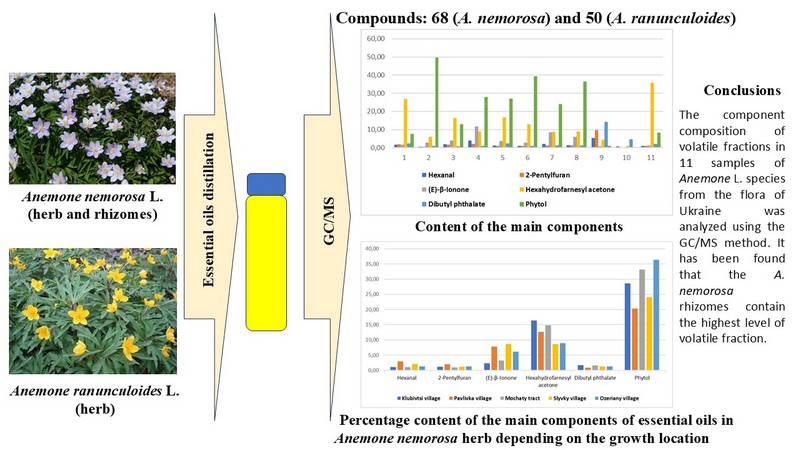
Результати. У результаті досліджень у сировині анемони дібровної та анемони жовтецевої ідентифіковано 68 та 50 сполук відповідно. Основними класами органічних сполук у складі летких фракцій досліджуваних зразків є: альдегіди (30.9 – 42.4 %), монотерпеноїди (6.1 – 15.5 %), органічні кислоти (4.2 – 15.8 %), аліфатичні та ароматичні вуглеводні (0 – 8.7 %), сесквітерпеноїди (7.9 – 18.9 %), дитерпеноїди (1.9 – 6.1 %), естери (1.8 – 4.4 %), ароматичні сполуки (4.4 – 7.9 %), спирти (4.4 – 9.1 %) та кетони (4.4 – 9.1 %). Виявлені такі основні компоненти летких фракцій анемони дібровної: гексагідрофарнезилацетон, дибутилфталат, фітол, гексанал, 2-пентилфуран, (Е)-β-Іонон. Основними сполуками летких фракцій трави анемони жовтецевої є: гексагідрофарнезилацетон, п-гексадеканова кислота, фітол, фталева кислота, пеларгоналальдегід.
Висновки. Методом ГХ/МС досліджено компонентний склад ефірних олій 11 зразків сировини видів роду Anemone L. флори України. Встановлено, що найвищий рівень ефірної олії містять кореневища анемони дібровної. Аналіз компонентного складу летких фракцій сировини видів роду Анемона вказує на перспективність продовження досліджень даного виду рослин
Спонсор дослідження
- This work was supported by the European Union in the MSCA4Ukraine project “Design and development of 3D-printed medicines for bioactive materials of Ukrainian and Estonian medicinal plants origin” [ID number 1232466]. Views and opinions expressed are, however, those of the author(s) only and do not necessarily reflect those of the European Union. Neither the European Union nor the MSCA4Ukraine Consortium as a whole nor any individual member institutions of the MSCA4Ukraine Consortium can be held responsible for them.
Посилання
- The WFO Plant List. Available at: https://wfoplantlist.org/
- POWO. Plants of the World Online. Kew Science. Available at: https://powo.science.kew.org/
- Klokov, M. V., Visylina, O. D., (Eds.) (1953). Flora URSR. Tom V. Kyiv: Vydavnytstvo Akademii nauk Ukrainskoi RSR, 527.
- Ziman, S. M., Kadota, Y., Bulakh, O. V. (2013). Comparative-morphological approaches to the taxonomy of the genus Anemone L. (Ranunculaceae). Ukrainian Botanical Journal, 70 (2), 152–157. https://doi.org/10.15407/ukrbotj70.02.152
- Hao, D.-C., Gu, X., Xiao, P. (2017). Anemone medicinal plants: ethnopharmacology, phytochemistry and biology. Acta Pharmaceutica Sinica B, 7 (2), 146–158. https://doi.org/10.1016/j.apsb.2016.12.001
- Hrodzinskyi, A. M. (Ed.) (1991). Likarski roslyny: Entsyklopedychnyi dovidnyk. Kyiv: Holov. red. URE, 544.
- Du, K., Zeng, M.-N., Wang, Y.-Z., Liu, Y.-F., Feng, W.-S. (2023). Two new β-carboline alkaloids from the roots of Anemone altaica. Journal of Natural Medicines, 77 (2), 397–402. https://doi.org/10.1007/s11418-023-01679-w
- Silva, T., De Andrade, P., Paiva-Martins, F., Valentão, P., Pereira, D. (2017). In Vitro Anti-Inflammatory and Cytotoxic Effects of Aqueous Extracts from the Edible Sea Anemones Anemonia sulcata and Actinia equina. International Journal of Molecular Sciences, 18 (3), 653. https://doi.org/10.3390/ijms18030653
- Shaker, K. H., Göhl, M., Müller, T., Seifert, K. (2015). Indole Alkaloids from the Sea Anemone Heteractis aurora and Homarine from Octopus cyanea. Chemistry & Biodiversity, 12 (11), 1746–1755. https://doi.org/10.1002/cbdv.201400406
- Khropot, O., Konechnyi, Y., Polish, N., Konechna, R., Bazavluk, Y., Kornіychuk, O., Novikov, V. (2019). The Study of the Composition of Chloroform Fraction of Anemone nemorosa L. French-Ukrainian Journal of Chemistry, 7 (2), 153–159. https://doi.org/10.17721/fujcv7i2p153-159
- Anemone nemorosa CH. Schwabe India. Available at: https://www.schwabeindia.com/product/anemone-nemorosa/
- Tinctures Anemone. Pine`s Herbals. Available at: https://pinesherbals.com/tinctures/anemone-1
- Medicaments Homeopathie. Anemone nemorosa Tubes granules. Mon coin Sante. Available at: https://moncoinsante.com/mcs/fr/a-b/9840-anemone-nemorosa-tubes-granules.html
- Anemone Nemorosa Homeopathy 2 Dram Pellets 6C, 30C, 200C, 1M, 10M. Homeomart Blog. Available at: https://homeomart.net/?s=anemone&orderby=relevance&order=DESC
- Lukianchuk, A., Khropot, O., Konechnyi, Y., Konechna, R., Novikov, V. (2017). Wood anemone. Anemone Nemorosa L. Analytical review. ScienceRise: Pharmaceutical Science, 3 (7), 34–38. https://doi.org/10.15587/2519-4852.2017.104438
- European Pharmacopoeia. 11th ed. (2022). Strasbourg: Council of Europe.
- Vlasova, I., Gontova, T., Grytsyk, L., Zhumashova, G., Sayakova, G., Boshkayeva, A. et al. (2022). Determination of standardization parameters of Oxycoccus macrocarpus (Ait.) Pursh and Oxycoccus palustris Pers. Leaves. ScienceRise: Pharmaceutical Science, 3 (37), 48–57. https://doi.org/10.15587/2519-4852.2022.260352
- Raal, A., Ilina, T., Kovalyova, A., Koshovyi, O. (2024). Volatile compounds in distillates and hexane extracts from the flowers of Philadelphus coronarius and Jasminum officinale. ScienceRise: Pharmaceutical Science, 6 (52), 37–46. https://doi.org/10.15587/2519-4852.2024.318497
- Hrytsyk, Y., Koshovyi, O., Lepiku, M., Jakštas, V., Žvikas, V., Matus, T. et al. (2024). Phytochemical and Pharmacological Research in Galenic Remedies of Solidago canadensis L. Herb. Phyton, 93 (9), 2303–2315. https://doi.org/10.32604/phyton.2024.055117
- Raal, A., Komarov, R., Orav, A., Kapp, K., Grytsyk, A., Koshovyi, O. (2022). Chemical composition of essential oil of common juniper (Juniperus communis L.) branches from Estonia. ScienceRise: Pharmaceutical Science, 6 (40), 66–73. https://doi.org/10.15587/2519-4852.2022.271048
- Raal, A., Ilina, Т., Kovaleva, A., Orav, A., Karileet, M., Džaniašvili, M. et al. (2024). Variation in the composition of the essential oil of commercial Artemisia absinthium L. herb samples from different countries. ScienceRise: Pharmaceutical Science, 2 (48), 19–28. https://doi.org/10.15587/2519-4852.2024.302232
- Dubel, N., Grytsyk, A., Grytsyk, L., Koshovyi, O., Kovaleva, A. (2022). Research in components of essential oils from flowers and leaves of the genus Alchemilla L. species. ScienceRise: Pharmaceutical Science, 3 (37), 34–39. https://doi.org/10.15587/2519-4852.2022.259059
- Filipowicz, N., Kamiński, M., Kurlenda, J., Asztemborska, M., Ochocka, J. R. (2003). Antibacterial and antifungal activity of juniper berry oil and its selected components. Phytotherapy Research, 17 (3), 227–231. https://doi.org/10.1002/ptr.1110
- Balogun, O. S., Ajayi, O. S., Adeleke, A. J. (2017). Hexahydrofarnesyl Acetone-Rich Extractives from Hildegardia barteri. Journal of Herbs, Spices & Medicinal Plants, 23 (4), 393–400. https://doi.org/10.1080/10496475.2017.1350614
- Avoseh, O. N., Mtunzi, F. M., Ogunwande, I. A., Ascrizzi, R., Guido, F. (2021). Albizia lebbeck and Albizia zygia volatile oils exhibit anti-nociceptive and anti-inflammatory properties in pain models. Journal of Ethnopharmacology, 268, 113676. https://doi.org/10.1016/j.jep.2020.113676
- Jiangseubchatveera, N., Liawruangrath, B., Liawruangrath, S., Teerawutgulrag, A., Santiarworn, D., Korth, J., Pyne, S. G. (2015). The Chemical Constituents and the Cytotoxicity, Antioxidant and Antibacterial Activities of the Essential Oil ofGraptophyllum pictum(L.) Griff. Journal of Essential Oil Bearing Plants, 18 (1), 11–17. https://doi.org/10.1080/0972060x.2014.935036
- Islam, Md. T., de Alencar, M. V. O. B., da Conceição Machado, K., da Conceição Machado, K., de Carvalho Melo-Cavalcante, A. A., de Sousa, D. P., de Freitas, R. M. (2015). Phytol in a pharma-medico-stance. Chemico-Biological Interactions, 240, 60–73. https://doi.org/10.1016/j.cbi.2015.07.010
- Giordani, R., Hadef, Y., Kaloustian, J. (2008). Compositions and antifungal activities of essential oils of some Algerian aromatic plants. Fitoterapia, 79 (3), 199–203. https://doi.org/10.1016/j.fitote.2007.11.004
- Ansari, M., Emami, S. (2016). β-Ionone and its analogs as promising anticancer agents. European Journal of Medicinal Chemistry, 123, 141–154. https://doi.org/10.1016/j.ejmech.2016.07.037
- Nassan, F. L., Korevaar, T. I. M., Coull, B. A., Skakkebæk, N. E., Krawetz, S. A., Estill, M. et al. (2019). Dibutyl-phthalate exposure from mesalamine medications and serum thyroid hormones in men. International Journal of Hygiene and Environmental Health, 222 (1), 101–110. https://doi.org/10.1016/j.ijheh.2018.08.008
- Türkez, H., Çelik, K., Toğar, B. (2013). Effects of copaene, a tricyclic sesquiterpene, on human lymphocytes cells in vitro. Cytotechnology, 66 (4), 597–603. https://doi.org/10.1007/s10616-013-9611-1
- Aparna, V., Dileep, K. V., Mandal, P. K., Karthe, P., Sadasivan, C., Haridas, M. (2012). Anti‐Inflammatory Property of n‐Hexadecanoic Acid: Structural Evidence and Kinetic Assessment. Chemical Biology & Drug Design, 80 (3), 434–439. https://doi.org/10.1111/j.1747-0285.2012.01418.x
- Siswadi, S., Saragih, G. S. (2021). Phytochemical analysis of bioactive compounds in ethanolic extract of Sterculia quadrifida R.Br. International conference on life sciences and technology (ICoLiST 2020), 2353, 030098. https://doi.org/10.1063/5.0053057
- Kiazolu, J. B., Intisar, A., Zhang, L., Wang, Y., Zhang, R., Wu, Z., Zhang, W. (2016). Phytochemical screening and chemical variability in volatile oils of aerial parts of Morinda morindoides. Natural Product Research, 30 (19), 2249–2252. https://doi.org/10.1080/14786419.2016.1154058
- Radulović, N. S., Miljković, V. M., Mladenović, M. Z., Nikolić, G. S. (2017). Essential Oils of Morus alba and M. nigra Leaves: Effect of Drying on the Chemical Composition. Natural Product Communications, 12 (1), 115–118. https://doi.org/10.1177/1934578x1701200133
- Tao, C., Wu, J., Liu, Y., Liu, M., Yang, R., Lv, Z. (2017). Antimicrobial activities of bamboo (Phyllostachys heterocycla cv. Pubescens) leaf essential oil and its major components. European Food Research and Technology, 244 (5), 881–891. https://doi.org/10.1007/s00217-017-3006-z
##submission.downloads##
Опубліковано
Як цитувати
Номер
Розділ
Ліцензія
Авторське право (c) 2025 Liliia Tuzin, Andriy Grytsyk, Thanh Tung Nguyen, Ain Raal, Oleh Koshovyi

Ця робота ліцензується відповідно до Creative Commons Attribution 4.0 International License.
Наше видання використовує положення про авторські права Creative Commons Attribution 4.0 International License для журналів відкритого доступу.
Автори, які публікуються у цьому журналі, погоджуються з наступними умовами:
1. Автори залишають за собою право на авторство своєї роботи та передають журналу право першої публікації цієї роботи на умовах ліцензії Creative Commons Attribution 4.0 International License, котра дозволяє іншим особам вільно розповсюджувати опубліковану роботу з обов'язковим посиланням на авторів оригінальної роботи та першу публікацію роботи у цьому журналі.
2. Автори мають право укладати самостійні додаткові угоди щодо неексклюзивного розповсюдження роботи у тому вигляді, в якому вона була опублікована цим журналом (наприклад, розміщувати роботу в електронному сховищі установи або публікувати у складі монографії), за умови збереження посилання на першу публікацію роботи у цьому журналі.
3. Автори мають право зберігати остаточну прийняту версію статті в інституційному, тематичному або будь-якому іншому репозитарії з метою забезпечення видимості та доступності.