Дослідження впливу мікроструктури сумісних агрегатів неіонної пар і цетостеарилового спирту на реологічні властивості гідрофільних кремових основ та вивільнення діючих речовин в дослідах in vitro
DOI:
https://doi.org/10.15587/2519-4852.2026.358977Ключові слова:
кремова основа, уявна в’язкість, агрегат, адсорбційний шар, поверхнево-активна речовина, цетостеариловий спирт, спіновий зонд, спектр ЕПР, вивільненняАнотація
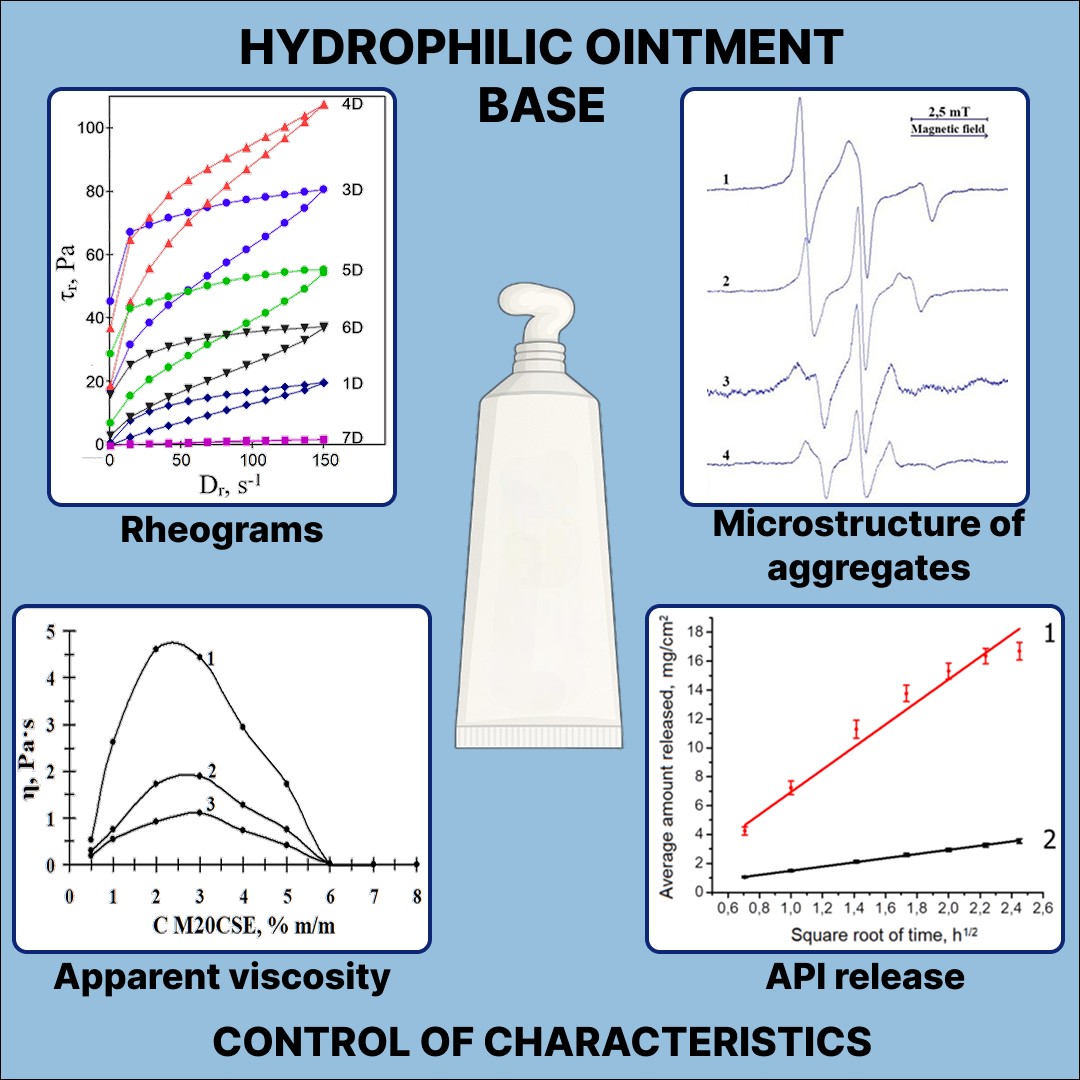
Мета. Дослідити вплив мікроструктури сумісних агрегатів та адсорбційних шарів неіонної поверхнево-активної речовини (ПАР) і цетостеарилового спирту (CSA) на реологічні властивості гідрофільних кремових основ та вивільнення деяких діючих речовин в дослідах in vitro.
Матеріали та методи. Досліджували кремові основи з дисперсійним середовищем вода – пропіленгліколь (9 : 1). У складі основ варіювали масове співвідношення між ПАР і CSA. Реологічні властивості основ досліджували методом ротаційної віскозиметрії, а мікроструктуру агрегатів методом спінових зондів з застосуванням 4-х зондів на основі жирних кислот. Визначали вивільнення діючих речовин з основ і розчинів в дослідах in vitro; вміст діючих речовин в діалізаті визначали методом рідинної хроматографії.
Результати. Уявна в’язкість основ є максимальною при певних співвідношеннях ПАР і CSA, при яких утворюються коагуляційні структури. Структура сумісних агрегатів ПАР і CSA залежить від їх співвідношення. При більшій питомій частці CSA в агрегатах/адсорбційних шарах відбувається латеральне розділення фаз на межі з дисперсійним середовищем; утворюються тверді домени CSA та рідкі домени ПАР. Сумісні агрегати ПАР і CSA мають несферичну форму. Домени неіонної ПАР забезпечують гідратацію агрегатів. Ці фактори сприяють утворенню коагуляційних структур при певному вмісті ПАР і CSA. При збільшенні питомої частки ПАР виникає тенденція до однорідного розподілу ПАР і CSA в агрегатах, що супроводжується зменшенням уявної в’язкості дисперсних систем і переходом від кремів до рідин. При зменшенні питомої частки ПАР зменшується гідратація агрегатів/адсорбційних шарів, що також призводить до зменшення уявної в’язкості основ. З основи, де утворилася коагуляційна структура, суттєво уповільнюється вивільнення офлоксацину або декспантенолу.
Висновки. Реологічні властивості гідрофільних кремових основ залежать від мікроструктури сумісних агрегатів або адсорбційних шарів, утворених неіонною ПАР і CSA, і їх можна регулювати за рахунок зміни масових співвідношень між цими емульгаторами. З кремових основ, де утворилася коагуляційна структура, суттєво уповільнюється вивільнення діючих речовин
Спонсор дослідження
- National Academy of Sciences of Ukraine within the framework of the project «Study of dispersed systems with liquid dispersion medium as the primary matrices for medicinal products» (0125U000740)
Посилання
- The European Pharmacopoeia (2022). European Directorate for the Quality of Medicines & HealthCare of the Council of Europe. Strasbourg: Council of Europe, 6106. Available at: http://pheur.edqm.eu/subhome/11-8
- Derzhavna Farmakopeia Ukrainy. Vol. 2 (2024). Kharkiv: Derzhavne pidpryiemstvo «Ukrainskyi naukovyi farmakopeinyi tsentr yakosti likarskykh zasobiv», 424.
- Costa, C., Medronho, B., Filipe, A., Mira, I., Lindman, B., Edlund, H., Norgren, M. (2019). Emulsion Formation and Stabilization by Biomolecules: The Leading Role of Cellulose. Polymers, 11 (10), 1570. https://doi.org/10.3390/polym11101570
- Langevin, D. (2023). Recent Advances on Emulsion and Foam Stability. Langmuir, 39 (11), 3821–3828. https://doi.org/10.1021/acs.langmuir.2c03423
- Lyapunova, A. M., Bezugla, O. P., Lyapunov, O. M. (2017). The study of o/w emulsions using the rotating viscometer method and the method of spin probes. News of Pharmacy, 4 (92), 29–34. https://doi.org/10.24959/nphj.17.2190
- Dekker, R. I., Velandia, S. F., Kibbelaar, H. V. M., Morcy, A., Sadtler, V., Roques-Carmes, T. et al. (2023). Is there a difference between surfactant-stabilised and Pickering emulsions? Soft Matter, 19 (10), 1941–1951. https://doi.org/10.1039/d2sm01375d
- Karishma, S., Rajvanshi, K., Kumar, H., Basavaraj, M. G., Mani, E. (2023). Oil-in-Water Emulsions Stabilized by Hydrophilic Homopolymers. Langmuir, 39 (38), 13430–13440. https://doi.org/10.1021/acs.langmuir.3c00798
- Ataeian, P., Aroyan, L., Parwez, W., Tam, K. C. (2022). Emulsions undergoing phase transition: Effect of emulsifier type and concentration. Journal of Colloid and Interface Science, 617, 214–223. https://doi.org/10.1016/j.jcis.2022.02.140
- Zheng, R., Tian, J., Binks, B. P., Cui, Z., Xia, W., Jiang, J. (2022). Oil-in-Water emulsions stabilized by alumina nanoparticles with organic electrolytes: Fate of particles. Journal of Colloid and Interface Science, 627, 749–760. https://doi.org/10.1016/j.jcis.2022.07.085
- Badruddoza, A. Z. M., Yeoh, T., Shah, J. C., Walsh, T. (2023). Assessing and Predicting Physical Stability of Emulsion-Based Topical Semisolid Products: A Review. Journal of Pharmaceutical Sciences, 112 (7), 1772–1793. https://doi.org/10.1016/j.xphs.2023.03.014
- Binks, B. P. (Ed.) (1998). Modern aspects of Emulsion Science. Royal Society of Chemistry, 442. https://doi.org/10.1039/9781847551474
- Myers, D. (2006). Surfactant Science and Technology. John Wiley & Sons, Inc. https://doi.org/10.1002/047174607X
- Farn, R. J. (Ed.) (2006). Chemistry and Technology of Surfactants. Blackwell Publishing Ltd, 315. https://doi.org/10.1002/9780470988596
- Cai, Z., Wei, Y., Shi, A., Zhong, J., Rao, P., Wang, Q., Zhang, H. (2023). Correlation between interfacial layer properties and physical stability of food emulsions: current trends, challenges, strategies, and further perspectives. Advances in Colloid and Interface Science, 313, 102863. https://doi.org/10.1016/j.cis.2023.102863
- Li, P., Huang, H., Fang, Y., Wang, Y., No, D. S., Bhatnagar, R. S., Abbaspourrad, A. (2023). Interfacial engineering of clear emulsions: Surfactant hydrophobicity and the hidden role of chain structure. Colloids and Surfaces A: Physicochemical and Engineering Aspects, 676, 132242. https://doi.org/10.1016/j.colsurfa.2023.132242
- Botti, T. C., Hutin, A., Quintella, E., Carvalho, M. S. (2022). Effect of interfacial rheology on drop coalescence in water–oil emulsion. Soft Matter, 18(7), 1423–1434. https://doi.org/10.1039/d1sm01382c
- Leister, N., Götz, V., Jan Bachmann, S., Nachtigall, S., Hosseinpour, S., Peukert, W., Karbstein, H. (2023). A comprehensive methodology to study double emulsion stability. Journal of Colloid and Interface Science, 630, 534–548. https://doi.org/10.1016/j.jcis.2022.10.119
- Han, D., Mao, J., Zhao, J., Zhang, H., Wang, D., Cao, H. et al. (2022). Dissipative particle dynamics simulation and experimental analysis of effects of Gemini surfactants with different spacer lengths on stability of emulsion systems. Colloids and Surfaces A: Physicochemical and Engineering Aspects, 655, 130205. https://doi.org/10.1016/j.colsurfa.2022.130205
- McClements, D. J., Jafari, S. M. (2018). Improving emulsion formation, stability and performance using mixed emulsifiers: A review. Advances in Colloid and Interface Science, 251, 55–79. https://doi.org/10.1016/j.cis.2017.12.001
- Hong, I. K., Kim, S. I., Lee, S. B. (2018). Effects of HLB value on oil-in-water emulsions: Droplet size, rheological behavior, zeta-potential, and creaming index. Journal of Industrial and Engineering Chemistry, 67, 123–131. https://doi.org/10.1016/j.jiec.2018.06.022
- Alam, S., Algahtani, M. S., Ahmad, M. Z., Ahmad, J. (2020). Investigation Utilizing the HLB Concept for the Development of Moisturizing Cream and Lotion: In-Vitro Characterization and Stability Evaluation. Cosmetics, 7 (2), 43. https://doi.org/10.3390/cosmetics7020043
- Wang, Q., Zhang, H., Han, Y., Cui, Y., Han, X. (2023). Study on the relationships between the oil HLB value and emulsion stabilization. RSC Advances, 13 (35), 24692–24698. https://doi.org/10.1039/d3ra04592g
- Colafemmina, G., Palazzo, G., Mateos, H., Amin, S., Fameau, A.-L., Olsson, U., Gentile, L. (2020). The cooling process effect on the bilayer phase state of the CTAC/cetearyl alcohol/water surfactant gel. Colloids and Surfaces A: Physicochemical and Engineering Aspects, 597, 124821. https://doi.org/10.1016/j.colsurfa.2020.124821
- Tran, H. H., Nguyen, T. H., Tran, T. T., Vu, H. D., Nguyen, H. M. T. (2021). Structures, Electronic Properties, and Interactions of Cetyl Alcohol with Cetomacrogol and Water: Insights from Quantum Chemical Calculations and Experimental Investigations. ACS Omega, 6 (32), 20975–20983. https://doi.org/10.1021/acsomega.1c02439
- Berliner, L. J., Reuben, J. (Ed.) (1989). Spin Labeling: Theory and Applications. New York: Plenum Press, 670. https://doi.org/10.1007/978-1-4613-0743-3
- Bezuglaya, E., Lyapunov, N., Chebanov, V., Liapunov, O. (2022). Study of the formation of micelles and their structure by the spin probe method. ScienceRise: Pharmaceutical Science, 4 (38), 4–18. https://doi.org/10.15587/2519-4852.2022.263054
- Liapunov, M. O., Ivanov, L. V., Bezugla, O. P., Zhdanov, R. I., Tsymbal, L. V. (1992). Doslidzhennia ahrehativ poverkhnevo-aktyvnykh rechovyn (PAR) metodom spinovykh zondiv. Farmatsevtychnyi zhurnal, 5-6, 40–45.
- Buckingham, R. (Ed.) (2020). Martindale: The Complete Drug Reference, 40th Ed. London: Pharmaceutical Press, 4852.
- Derzhavnyi reiestr likarskykh zasobiv Ukrainy. Available at: http://www.drlz.kiev.ua/
- Sheskey, P. J., Hancock, B. C., Moss, G. P., Goldfarb, D. J. (Eds.) (2020). Handbook of Pharmaceutical Excipients. London: Pharm. Press, 1296.
- Liapunova, A. M., Krasnopyorova, А. P., Bezuglа, О. P., Liapunov, O. M., Yukhnо, G. D., Pukhova, T. М. (2024). Polythermal studies of the water – propylene glycol systems by densitometry, viscometry and spin probes method. Functional Materials, 31 (4), 609–618. https://doi.org/10.15407/fm31.04.609
- Ilić, T., Pantelić, I., Savić, S. (2021). The Implications of Regulatory Framework for Topical Semisolid Drug Products: From Critical Quality and Performance Attributes towards Establishing Bioequivalence. Pharmaceutics, 13 (5), 710. https://doi.org/10.3390/pharmaceutics13050710
- Tiffner, K. I., Kanfer, I., Augustin, T., Raml, R., Raney, S. G., Sinner, F. (2018). A comprehensive approach to qualify and validate the essential parameters of an in vitro release test (IVRT) method for acyclovir cream, 5%. International Journal of Pharmaceutics, 535 (1-2), 217–227. https://doi.org/10.1016/j.ijpharm.2017.09.049
- Lyapunov, N., Bezugla, O., Liapunova, A., Zinchenko, I., Liapunov, O., Lysokobylka, O., Dzhoraieva, S. (2025). Study of some properties of hydrophilic ointment bases depending on their composition. ScienceRise: Pharmaceutical Science, 5 (57), 4–19. https://doi.org/10.15587/2519-4852.2025.339597
- Bezuglaya, E., Liapunova, A., Zinchenko, I., Lyapunov, N. (2023). Study of factors affecting the in vitro release of dexpanthenol from solutions and topical semi-solid preparations. ScienceRise: Pharmaceutical Science, 3 (43), 4–15. https://doi.org/10.15587/2519-4852.2023.279283
##submission.downloads##
Опубліковано
Як цитувати
Номер
Розділ
Ліцензія
Авторське право (c) 2026 Nikolay Lyapunov, Оlena Bezugla, Oleksii Liapunov, Anna Liapunova, Igor Zinchenko, Yurij Stolper

Ця робота ліцензується відповідно до Creative Commons Attribution 4.0 International License.
Наше видання використовує положення про авторські права Creative Commons Attribution 4.0 International License для журналів відкритого доступу.
Автори, які публікуються у цьому журналі, погоджуються з наступними умовами:
1. Автори залишають за собою право на авторство своєї роботи та передають журналу право першої публікації цієї роботи на умовах ліцензії Creative Commons Attribution 4.0 International License, котра дозволяє іншим особам вільно розповсюджувати опубліковану роботу з обов'язковим посиланням на авторів оригінальної роботи та першу публікацію роботи у цьому журналі.
2. Автори мають право укладати самостійні додаткові угоди щодо неексклюзивного розповсюдження роботи у тому вигляді, в якому вона була опублікована цим журналом (наприклад, розміщувати роботу в електронному сховищі установи або публікувати у складі монографії), за умови збереження посилання на першу публікацію роботи у цьому журналі.
3. Автори мають право зберігати остаточну прийняту версію статті в інституційному, тематичному або будь-якому іншому репозитарії з метою забезпечення видимості та доступності.