Defining the patterns of a jet takeoff system operation in an aerial vehicle with nozzles of a special shape, powered by a gas-hydraulic accumulator
DOI:
https://doi.org/10.15587/1729-4061.2026.349295Keywords:
aircraft, gas-hydraulic accumulator, liquid jet nozzle, vertical takeoff, computational fluid dynamics, energy characteristicsAbstract
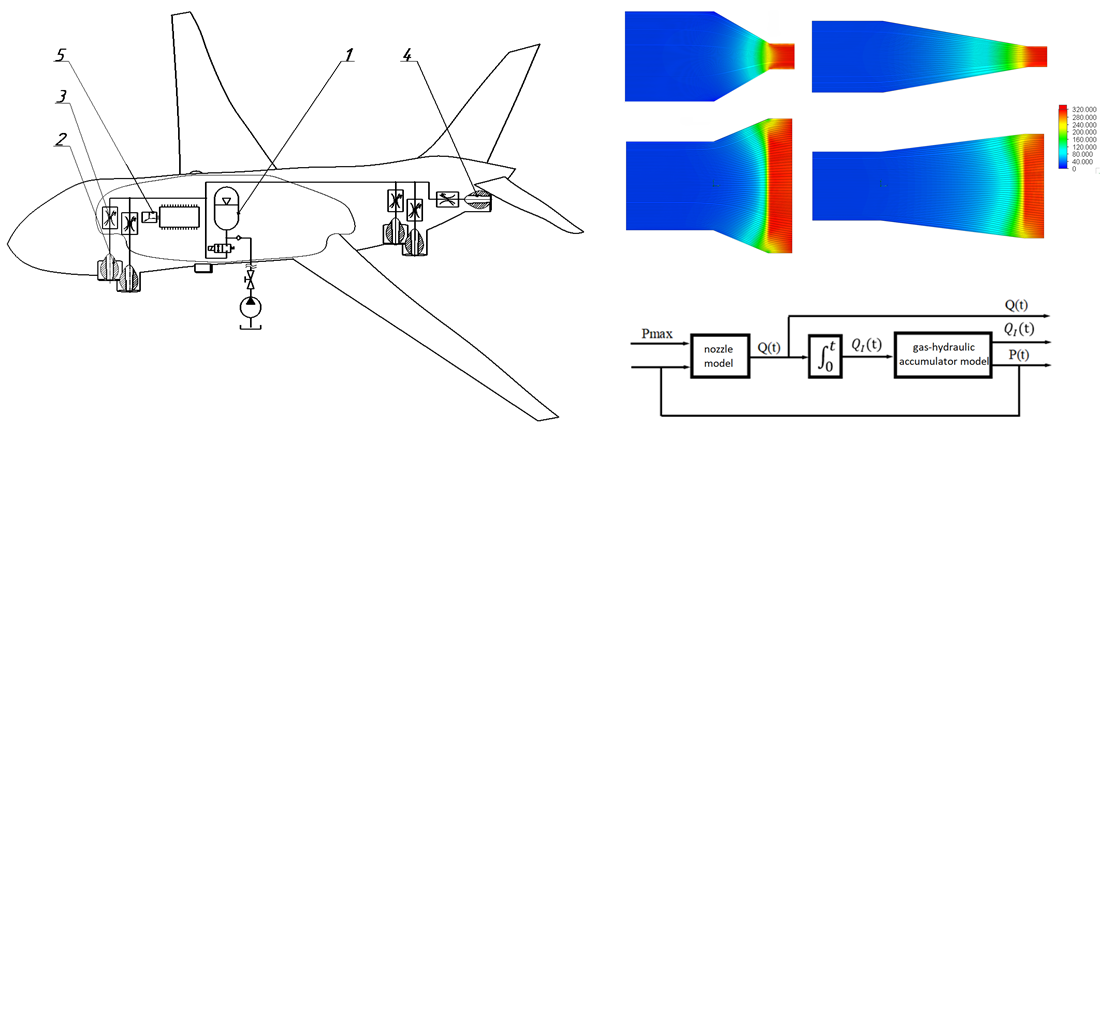
This paper investigates working processes in a liquid nozzle system powered by a gas-hydraulic accumulator used for aircraft takeoff. The study is aimed at finding regularities in the operation of a hydraulic system, which includes a gas-hydraulic accumulator and nozzles with a variable cross-sectional shape that operate at variable pressure. These regularities determine the kinematic parameters of an aircraft that is propelled by a liquid nozzle system.
Numerical modeling of the working processes in nozzles of a special shape showed an increase in vortex formation and a more dramatic increase in the velocity in the flow core at the end section of the nozzle. It was established that energy losses for nozzles with a variable cross-sectional shape are 4% greater than for conical nozzles.
The established patterns of the gas-hydraulic accumulator charging and discharging processes have made it possible to determine the optimal ratio between the mass of the liquid and the filled accumulator, equal to 0.23.
It is shown that the maximum amount of energy and liquid is obtained when the nozzles operate at a variable pressure that falls below the initial charging pressure. Based on the nozzle thrust, dependences of the takeoff height, speed, and acceleration of the aircraft on its mass were determined. It was found that at a ratio of aircraft mass to the mass of the gas-hydraulic accumulator of 2.0, the nozzle system provides only horizontal acceleration to the breakaway speed, and when the ratio is less than 0.2, vertical lift and horizontal acceleration to the breakaway speed are achieved.
The results could be used to assess the maximum capabilities of a takeoff system when applying water as the working fluid.
References
- Muliadi, J. (2018). An empirical method for the catapult performance assessment of the BPPT-developed UAVs. Journal of Physics: Conference Series, 1130, 012033. https://doi.org/10.1088/1742-6596/1130/1/012033
- Franky, Z. (2012). Pat. No. US2013068895A1. Device and System for Propelling a Passenger. declareted: 10.10.2012; published: 21.03.2013. Available at: https://worldwide.espacenet.com/patent/search?q=pn%3DUS2013068895A1
- Sutton, G. P., Seifert, H. S. (1950). Rocket Propulsion Elements. Physics Today, 3 (2), 31–32. https://doi.org/10.1063/1.3066790
- de Iaco Veris, A. (2020). Fundamental Concepts on Liquid-Propellant Rocket Engines. Fundamental Concepts of Liquid-Propellant Rocket Engines, 1–61. https://doi.org/10.1007/978-3-030-54704-2_1
- Salenko, O. F., Strutynskyi, V. B., Zahirniak, M. V. (2005). Efektyvne hidrorizannia. Kremenchuk: KDPU, 488.
- Zhang, Z., Yi, B., Tan, Z. (2021). Numerical Simulation of Flow Field in the Laval Nozzle Based on Euler Equation. Journal of Physics: Conference Series, 2012 (1), 012089. https://doi.org/10.1088/1742-6596/2012/1/012089
- Huang, F., Mi, J., Li, D., Wang, R. (2020). Impinging Performance of High-Pressure Water Jets Emitting from Different Nozzle Orifice Shapes. Geofluids, 2020, 1–14. https://doi.org/10.1155/2020/8831544
- Leon-Quiroga, J., Newell, B., Krishnamurthy, M., Gonzalez-Mancera, A., Garcia-Bravo, J. (2020). Energy Efficiency Comparison of Hydraulic Accumulators and Ultracapacitors. Energies, 13 (7), 1632. https://doi.org/10.3390/en13071632
- Qin, Z., Liu, K., Zhao, X. (2023). A smooth control allocation method for a distributed electric propulsion VTOL aircraft test platform. IET Control Theory & Applications, 17 (7), 925–942. https://doi.org/10.1049/cth2.12427
- Fedorets, O. O., Salenko, O. I. (Eds.) (2009). Hidravlika, hidro- ta pnevmopryvody. Kyiv: Znannia, 502.
- Fedorets, V. O., Pedchenko, M. N., Strutynskyi, V. B. et al. (1995). Hidropryvody ta hidropnevmoavtomatyka. Kyiv: Vyshcha shkola, 463.
- Chen, X., Pan, H., Chen, L. (2025). Effect of Nozzle Geometry on Erosion Characteristics in Abrasive Water Jet: Experimental and Numerical Analysis. Lubricants, 13 (3), 132. https://doi.org/10.3390/lubricants13030132
- Bladder Accumulators. AS and ASP type. Available at: https://www.epeitaliana.it/en/product/as-and-asp-type/
Downloads
Published
How to Cite
Issue
Section
License
Copyright (c) 2026 Serhii Strutinskiy, Dmytro Kostiuk, Igor Gryshko, Andrii Zilinskyi

This work is licensed under a Creative Commons Attribution 4.0 International License.
The consolidation and conditions for the transfer of copyright (identification of authorship) is carried out in the License Agreement. In particular, the authors reserve the right to the authorship of their manuscript and transfer the first publication of this work to the journal under the terms of the Creative Commons CC BY license. At the same time, they have the right to conclude on their own additional agreements concerning the non-exclusive distribution of the work in the form in which it was published by this journal, but provided that the link to the first publication of the article in this journal is preserved.
A license agreement is a document in which the author warrants that he/she owns all copyright for the work (manuscript, article, etc.).
The authors, signing the License Agreement with TECHNOLOGY CENTER PC, have all rights to the further use of their work, provided that they link to our edition in which the work was published.
According to the terms of the License Agreement, the Publisher TECHNOLOGY CENTER PC does not take away your copyrights and receives permission from the authors to use and dissemination of the publication through the world's scientific resources (own electronic resources, scientometric databases, repositories, libraries, etc.).
In the absence of a signed License Agreement or in the absence of this agreement of identifiers allowing to identify the identity of the author, the editors have no right to work with the manuscript.
It is important to remember that there is another type of agreement between authors and publishers – when copyright is transferred from the authors to the publisher. In this case, the authors lose ownership of their work and may not use it in any way.








