Evaluation of the factors influencing the extraction and composition of biologically active substances from secondary raw materials
DOI:
https://doi.org/10.15587/1729-4061.2026.349976Keywords:
extract, hydromodule, phenolic compounds, pomace, stem, peel, wood, water-alcohol, CO2-extract, seedless extract, wine-alcoholAbstract
The object of this study is the technology for producing bioactive compound-rich extracts and high-quality wines. Although several studies have been conducted in winemaking on resource-saving technologies, the factors affecting the amount and extraction of bioactive compounds obtained from residues have not been evaluated.
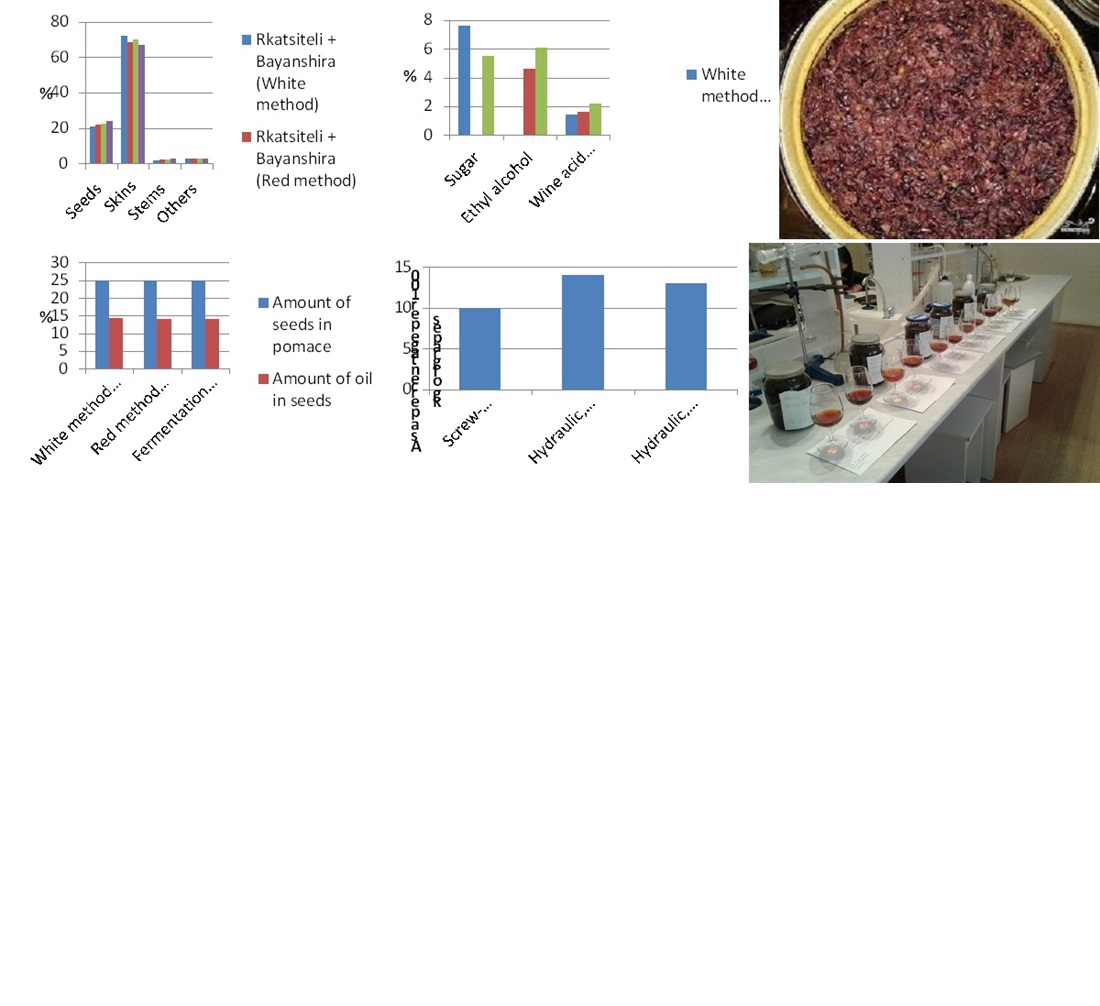
The content of phenolic compounds in sweet pomace obtained from red grape varieties was higher compared to other variants (19.8 g/kg); however, in acidic pomace from the same varieties, this value was significantly lower, at 11.2 g/kg. The Merlot and Madrasa grape varieties were found to contain higher amounts of bioactive compounds and antioxidants.
The extraction of compounds from the peel, seeds, and whole pomace was carried out at 60°C with a 1:3 solid-to-solvent ratio. For the peel, 95% ethanol and 0.5% tartaric acid were used as the solvent; for the seeds, water with 2% tartaric acid; and for the whole pomace, a 30% water–alcohol mixture (wine–alcohol or juice–alcohol) was applied.
The extracts obtained from the peel, seeds, and whole pomace contained vitamin C (0.98–6.6 mg/g), dietary fiber (1.81–3.00 mg/sm3), phenolic compounds (1.04–2.70 mg/sm3), and antioxidant activity (1265.3–2550.3 µmol Trolox equivalents/dm3).
Investigating the factors affecting the extraction of bioactive compounds from secondary raw materials, selecting appropriate technological methods and regimes that ensure high extract yield and antioxidant properties, and rationalizing the composition and quality of the extracts depending on the preparation method and the ingredients provide a solution to the problem. The results offer a practical solution through the production of bioactive compound-rich extracts that can improve the quality of juices and wines
References
- Zuffi, V., Puliga, F., Mercatante, D., Rodriguez-Estrada, M. T., Sanchez-Cortes, S., Zambonelli, A., Francioso, O. (2025). Conversion of grape pomace into fungal biomass: a study of Pleurotus cultivation for a sustainable agro-residue management. Chemical and Biological Technologies in Agriculture, 12 (1). https://doi.org/10.1186/s40538-025-00739-5
- Ponsetto, P., Magrini, C., Sasal, E. M., Valle, C., Mazzoli, R., Grillo, G. et al. (2025). Antioxidants and prebiotics from enological wastes: recycling polyphenols and pectin to obtain nutraceuticals. Food Production, Processing and Nutrition, 7 (1). https://doi.org/10.1186/s43014-025-00333-0
- Abreu, T., Luís, C., Câmara, J. S., Teixeira, J., Perestrelo, R. (2025). Unveiling potential functional applications of grape pomace extracts based on their phenolic profiling, bioactivities, and circular bioeconomy. Biomass Conversion and Biorefinery, 15 (24), 31491–31506. https://doi.org/10.1007/s13399-025-06578-6
- Wang, C., You, Y., Huang, W., Zhan, J. (2024). The high-value and sustainable utilization of grape pomace: A review. Food Chemistry: X, 24, 101845. https://doi.org/10.1016/j.fochx.2024.101845
- Almanza-Oliveros, A., Bautista-Hernández, I., Castro-López, C., Aguilar-Zárate, P., Meza-Carranco, Z., Rojas, R. et al. (2024). Grape Pomace – Advances in Its Bioactivity, Health Benefits, and Food Applications. Foods, 13 (4), 580. https://doi.org/10.3390/foods13040580
- Machado, T. O. X., Portugal, I., Kodel, H. de A. C., Droppa-Almeida, D., Dos Santos Lima, M., Fathi, F. et al. (2024). Therapeutic potential of grape pomace extracts: A review of scientific evidence. Food Bioscience, 60, 104210. https://doi.org/10.1016/j.fbio.2024.104210
- Radulescu, C., Olteanu, R. L., Buruleanu, C. L., (Tudorache), M. N., Dulama, I. D., Stirbescu, R. M. et al. (2024). Polyphenolic Screening and the Antioxidant Activity of Grape Pomace Extracts of Romanian White and Red Grape Varieties. Antioxidants, 13 (9), 1133. https://doi.org/10.3390/antiox13091133
- Carpentieri, S., Ferrari, G., Pataro, G. (2023). Pulsed electric fields-assisted extraction of valuable compounds from red grape pomace: Process optimization using response surface methodology. Frontiers in Nutrition, 10. https://doi.org/10.3389/fnut.2023.1158019
- Ferri, M., Lima, V., Zappi, A., Fernando, A., Melucci, D., Tassoni, A. (2023). Phytochemicals Recovery from Grape Pomace: Extraction Improvement and Chemometric Study. Foods, 12 (5), 959. https://doi.org/10.3390/foods12050959
- Akbulut, M., Çoklar, H., Bulut, A. N., Hosseini, S. R. (2024). Evaluation of black grape pomace, a fruit juice by‐product, in shalgam juice production: Effect on phenolic compounds, anthocyanins, resveratrol, tannin, and in vitro antioxidant activity. Food Science & Nutrition, 12 (6), 4372–4384. https://doi.org/10.1002/fsn3.4104
- Karastergiou, A., Gancel, A.-L., Jourdes, M., Teissedre, P.-L. (2025). Transforming winemaking waste: grape pomace as a sustainable source of bioactive compounds. OENO One, 59 (2). https://doi.org/10.20870/oeno-one.2025.59.2.9202
- Lopes, J. da C., Madureira, J., Margaça, F. M. A., Cabo Verde, S. (2025). Grape Pomace: A Review of Its Bioactive Phenolic Compounds, Health Benefits, and Applications. Molecules, 30 (2), 362. https://doi.org/10.3390/molecules30020362
- Telini, B. de P., Villa, L. C., Vainstein, M. H., Lopes, F. C. (2025). From Vineyard to Brewery: A Review of Grape Pomace Characterization and Its Potential Use to Produce Low-Alcohol Beverages. Fermentation, 11 (2), 57. https://doi.org/10.3390/fermentation11020057
- Shi, N., Li, H.-Q., Lu, H.-C., Tian, M.-B., Han, X., He, F., Wang, J. (2023). Adjusting the pomace ratio during red wine fermentation: Effects of adding white grape pomace and juice runoff on wine flavoromics and sensory qualities. Food Chemistry: X, 20, 100939. https://doi.org/10.1016/j.fochx.2023.100939
- Muñoz-Bernal, Ó. A., Vazquez-Flores, A. A., de la Rosa, L. A., Rodrigo-García, J., Martínez-Ruiz, N. R., Alvarez-Parrilla, E. (2023). Enriched Red Wine: Phenolic Profile, Sensory Evaluation and In Vitro Bioaccessibility of Phenolic Compounds. Foods, 12 (6), 1194. https://doi.org/10.3390/foods12061194
- Piñeiro, Z., Gutiérrez-Escobar, R., Aliaño-González, M. J., Fernández-Marín, M. I., Jiménez-Hierro, M. J., Cretazzo, E., Rodríguez-Torres, I. C. (2025). Impact of Foliar Application of Winemaking By-Product Extracts in Tempranillo Grapes Grown Under Warm Climate: First Results. Beverages, 11 (3), 60. https://doi.org/10.3390/beverages11030060
- Fataliyev, H., Gadimova, N., Huseynova, S., Isgandarova, S., Heydarov, E., Mammadova, S. (2024). Enrichment of functional drinks using grape pomace extracts, analysis of physicochemical indicators. Eastern-European Journal of Enterprise Technologies, 3 (11 (129)), 37–45. https://doi.org/10.15587/1729-4061.2024.307039
- Mammadova, S. M., Fataliyev, H. K., Gadimova, N. S., Aliyeva, G. R., Tagiyev, A. T., Baloglanova, K. V. (2020). Production of functional products using grape processing residuals. Food Science and Technology, 40 (suppl 2), 422–428. https://doi.org/10.1590/fst.30419
- Gadimova, N., Fataliyev, H., Allahverdiyeva, Z., Musayev, T., Akhundova, N., Babashli, A. (2022). Obtaining and investigation of the chemical composition of powdered malt and polymalt extracts for application in the production of non-alcoholic functional beverages. Eastern-European Journal of Enterprise Technologies, 5 (11 (119)), 66–74. https://doi.org/10.15587/1729-4061.2022.265762
- Delić, K., Milinčić, D. D., Pešić, M. B., Steva Lević, S., Nedović, V. A., Gancel, A.-L. et al. (2024). Grape, wine and pomace anthocyanins: winemaking biochemical transformations, application and potential benefits. OENO One, 58 (4). https://doi.org/10.20870/oeno-one.2024.58.4.8039
- Carpentieri, S., Ferrari, G., Pataro, G. (2022). Optimization of Pulsed Electric Fields-Assisted Extraction of Phenolic Compounds From White Grape Pomace Using Response Surface Methodology. Frontiers in Sustainable Food Systems, 6. https://doi.org/10.3389/fsufs.2022.854968
- Wiedemair, V., Zlöbl, D., Bach, K. (2023). Application of a Designed Mixed Model Approach for Antioxidant Extraction from Pomace. Food Analytical Methods, 16 (8), 1347–1357. https://doi.org/10.1007/s12161-023-02507-3
- Fataliyev, H. K. (2012). Winemaking practicum. Baku: Elm, 327. Available at: https://anl.az/el/Kitab/2013/Azf-272480.pdf
- Fataliyev, H. K. (2011). Wine technology. Baku: Elm, 586. Available at: https://anl.az/el/264414.pdf
- Sheskin, D. J. (2020). Handbook of Parametric and Nonparametric Statistical Procedures. Chapman and Hall/CRC. https://doi.org/10.1201/9780429186196
- Gadimova, N., Fataliyev, H., Heydarov, E., Lezgiyev, Y., Isgandarova, S. (2023). Development of a model and optimization of the interaction of factors in the grain malting process and its application in the production of functional beverages. Eastern-European Journal of Enterprise Technologies, 5 (11 (125)), 43–56. https://doi.org/10.15587/1729-4061.2023.289421
- Fataliyev, H., Aghazade, Y., Mikayilov, V., Heydarov, E., Gadimova, N., Imanova, K., Fataliyeva, S. (2025). Identifying the influence of various factors on the composition of juices and wines obtained from the autonomous Bayan Shirey grape variety. Eastern-European Journal of Enterprise Technologies, 3 (11 (135)), 89–102. https://doi.org/10.15587/1729-4061.2025.332592
- Fataliyev, H., Lezgiyev, Y., Aghazade, Y., Gadimova, N., Heydarov, E., Ismailov, M. (2024). Identifying the influence of various technological techniques on the indicators of the composition of bunches and wine samples of the madras grape variety. Eastern-European Journal of Enterprise Technologies, 6 (11 (132)), 50–62. https://doi.org/10.15587/1729-4061.2024.318532
Downloads
Published
How to Cite
Issue
Section
License
Copyright (c) 2026 Hasil Fataliyev, Shafiga Huseynova, Natavan Gadimova, Mehman Ismayilov, Elnur Heydarov, Asaf Rushanov

This work is licensed under a Creative Commons Attribution 4.0 International License.
The consolidation and conditions for the transfer of copyright (identification of authorship) is carried out in the License Agreement. In particular, the authors reserve the right to the authorship of their manuscript and transfer the first publication of this work to the journal under the terms of the Creative Commons CC BY license. At the same time, they have the right to conclude on their own additional agreements concerning the non-exclusive distribution of the work in the form in which it was published by this journal, but provided that the link to the first publication of the article in this journal is preserved.
A license agreement is a document in which the author warrants that he/she owns all copyright for the work (manuscript, article, etc.).
The authors, signing the License Agreement with TECHNOLOGY CENTER PC, have all rights to the further use of their work, provided that they link to our edition in which the work was published.
According to the terms of the License Agreement, the Publisher TECHNOLOGY CENTER PC does not take away your copyrights and receives permission from the authors to use and dissemination of the publication through the world's scientific resources (own electronic resources, scientometric databases, repositories, libraries, etc.).
In the absence of a signed License Agreement or in the absence of this agreement of identifiers allowing to identify the identity of the author, the editors have no right to work with the manuscript.
It is important to remember that there is another type of agreement between authors and publishers – when copyright is transferred from the authors to the publisher. In this case, the authors lose ownership of their work and may not use it in any way.








