Resilience of composite environmental safety indices under wartime conditions: sensitivity to methodology and the impact of statistical distortions
DOI:
https://doi.org/10.15587/1729-4061.2026.351699Keywords:
environmental safety, environmental risk indices, environmental indicators, military conflict zonesAbstract
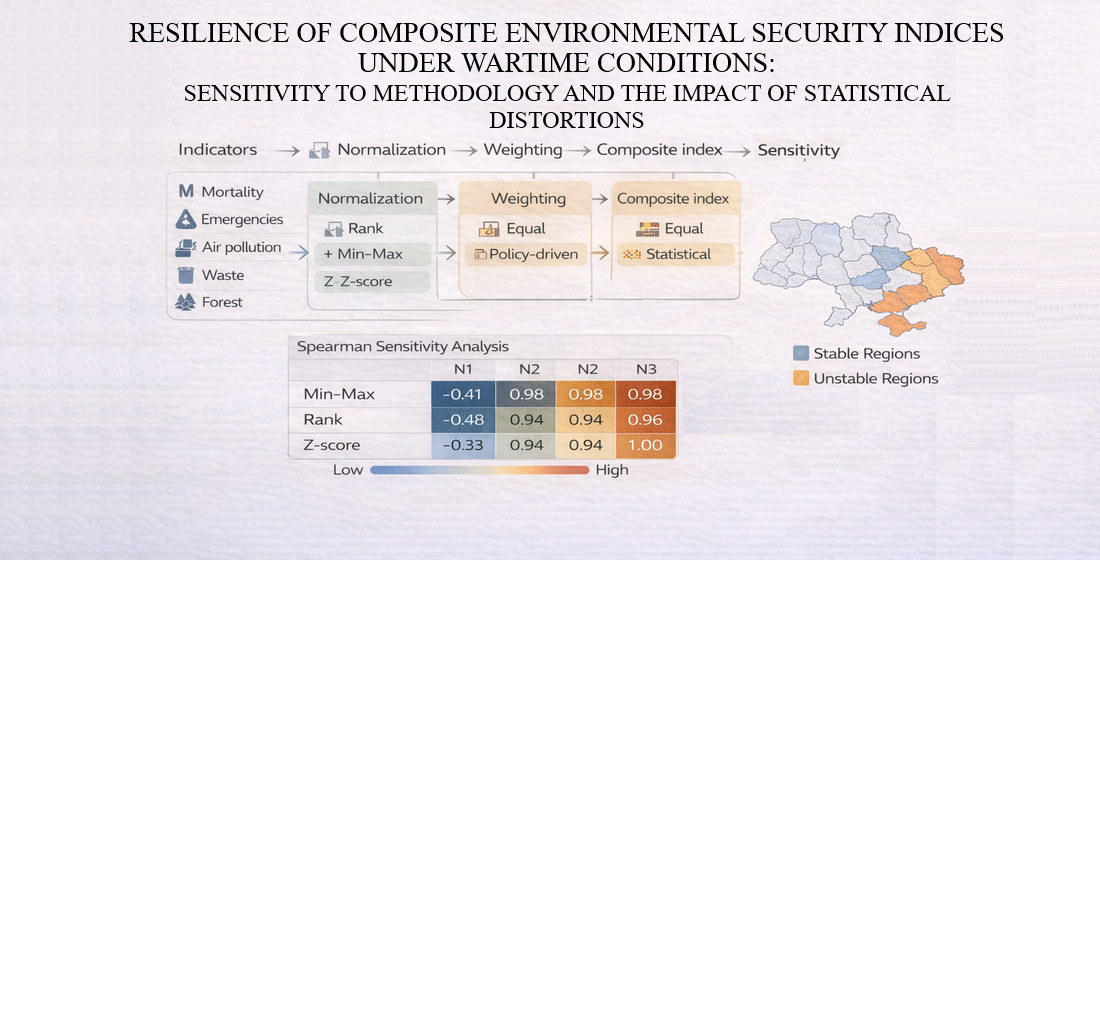
This study investigates the process of building a stable methodological basis for assessing environmental risks in regions. The possibilities of using integrated indicators of environmental risks have been considered, which are a useful tool for summarizing complex information. However, their interpretation should be especially cautious during periods of social upheaval. The combination of a quantitative index with a qualitative analysis is necessary for a complete and adequate assessment of environmental safety for such periods.
This work analyzes the methodological robustness of composite indices of environmental safety of regions under war-time conditions using Ukraine as an example. The influence of the choice of normalization methods, weighting schemes, and processing of missing data on the results of integrated ranking was studied. It is shown that under crisis conditions the semantics of key social-ecological indicators undergoes qualitative changes, as a result of which conventional interpretations of their dynamics become incorrect.
A comparative analysis of combinations of normalization and weighting of indicators for calculating the integrated index of environmental safety of regions in Ukraine over 2021–2022 was conducted. It was found that the rank approach in combination with equilibrium weighting is methodologically unstable under crisis conditions and leads to inversions in regional ranking. An algorithm for calculating the index has been proposed, which involves checking the stability of regional indicators for the completeness and reliability of statistical data, which increases the adequacy of environmental risk assessment during the conflict period. This is particularly important for Ukraine but is also relevant for other countries experiencing or recovering from conflict.
The findings make it possible to increase the readiness of an environmental monitoring system for emergencies, as well as contribute to the construction of a robust methodological base for assessing environmental risks.
References
- Nardo, M., Saisana, M., Saltelli, A., Tarantola, S., Hoffmann, A., Giovannini, E. (2008). Handbook on Constructing Composite Indicators: Methodology and User Guide. OECD publishing. Available at: https://publications.jrc.ec.europa.eu/repository/handle/JRC47008
- Saisana, M., Saltelli, A. (2010). The Multidimensional Poverty Assessment Tool (MPAT): Robustness issues and Critical assessment. Publications Office of the European Union. https://dx.doi.org/10.2788/82008
- Singh, R. K., Murty, H. R., Gupta, S. K., Dikshit, A. K. (2012). An overview of sustainability assessment methodologies. Ecological Indicators, 15 (1), 281–299. https://doi.org/10.1016/j.ecolind.2011.01.007
- Greco, S., Ishizaka, A., Tasiou, M., Torrisi, G. (2018). On the Methodological Framework of Composite Indices: A Review of the Issues of Weighting, Aggregation, and Robustness. Social Indicators Research, 141 (1), 61–94. https://doi.org/10.1007/s11205-017-1832-9
- Paruolo, P., Saisana, M., Saltelli, A. (2012). Ratings and Rankings: Voodoo or Science? Journal of the Royal Statistical Society Series A: Statistics in Society, 176 (3), 609–634. https://doi.org/10.1111/j.1467-985x.2012.01059.x
- Alqararah, K. (2023). Assessing the robustness of composite indicators: the case of the Global Innovation Index. Journal of Innovation and Entrepreneurship, 12 (1). https://doi.org/10.1186/s13731-023-00332-w
- Becker, W., Saisana, M., Paruolo, P., Vandecasteele, I. (2017). Weights and importance in composite indicators: Closing the gap. Ecological Indicators, 80, 12–22. https://doi.org/10.1016/j.ecolind.2017.03.056
- Zhou, P., Ang, B. W., Poh, K. L. (2007). A mathematical programming approach to constructing composite indicators. Ecological Economics, 62 (2), 291–297. https://doi.org/10.1016/j.ecolecon.2006.12.020
- Munda, G., Nardo, M. (2009). Noncompensatory/nonlinear composite indicators for ranking countries: a defensible setting. Applied Economics, 41 (12), 1513–1523. https://doi.org/10.1080/00036840601019364
- Wehbe, C., Baroud, H. (2024). Limitations and considerations of using composite indicators to measure vulnerability to natural hazards. Scientific Reports, 14 (1). https://doi.org/10.1038/s41598-024-68060-z
- Srebotnjak, T., Carr, G., de Sherbinin, A., Rickwood, C. (2012). A global Water Quality Index and hot-deck imputation of missing data. Ecological Indicators, 17, 108–119. https://doi.org/10.1016/j.ecolind.2011.04.023
- Stevens, S. M., Joy, M. K., Abrahamse, W., Milfont, T. L., Petherick, L. M. (2023). Composite environmental indices – a case of rickety rankings. PeerJ, 11, e16325. https://doi.org/10.7717/peerj.16325
- Ghobarah, H. A., Huth, P., Russett, B. (2003). Civil Wars Kill and Maim People – Long After the Shooting Stops. American Political Science Review, 97 (02). https://doi.org/10.1017/s0003055403000613
- Kachynskyi, A. (2001). Ekolohichna bezpeka Ukrainy: systemnyi analiz perspektyv pokrashchennia. Kyiv: NISD, 312.
- Gan, X., Fernandez, I. C., Guo, J., Wilson, M., Zhao, Y., Zhou, B., Wu, J. (2017). When to use what: Methods for weighting and aggregating sustainability indicators. Ecological Indicators, 81, 491–502. https://doi.org/10.1016/j.ecolind.2017.05.068
- Krampe, F., Kreutz, J., Ide, T. (2025). “Armed conflict causes long-lasting environmental harms.” Environment and Security. https://doi.org/10.1177/27538796251323739
- Cutter, S. L., Boruff, B. J., Shirley, W. L. (2003). Social Vulnerability to Environmental Hazards*. Social Science Quarterly, 84 (2), 242–261. https://doi.org/10.1111/1540-6237.8402002
- Nardo, M., Saisana, M., Saltelli, A., Tarantola, S. (2025). Tools for Composite Indicators Building. EUR 21682 EN. Available at: https://publications.jrc.ec.europa.eu/repository/handle/JRC31473
- State Statistics Servise of Ukraine. Available at: https://ukrstat.gov.ua/
- Böhringer, C., Jochem, P. E. P. (2007). Measuring the immeasurable – A survey of sustainability indices. Ecological Economics, 63 (1), 1–8. https://doi.org/10.1016/j.ecolecon.2007.03.008
- Dodatok 2. Tendentsiyi sotsialno-ekonomichnoho rozvytku v umovakh povnomasshtabnoho viyskovoho vtorhnennia Rosiyskoi Federatsiyi v Ukrainu. Available at: https://dn.gov.ua/storage/app/sites/1/uploaded-files/dodatok-2-do-strategii-tendentsii-sotsialno-ekonomichnogo-rozvitku.docx
- Conflict and Environment Observatory. Available at: https://ceobs.org/ukraine-conflict-environmental-briefing-industry/
- The State Emergency Service of Ukraine. Available at: https://dsns.gov.ua
- State Forest Resources Agency of Ukraine. Available at: https://forest.gov.ua/
- Moretti, A., Arias-Salazar, A. (2025). Computing multidimensional composite indicators for small areas in presence of missing variables: a data integration approach. Journal of the Royal Statistical Society Series C: Applied Statistics, 75 (1), 21–42. https://doi.org/10.1093/jrsssc/qlaf032
- Xavier, A., Fragoso, R., Freitas, M. de B. C. (2025). Building sustainability composite indicators using a multi-criteria approach. European Journal of Operational Research, 326 (2), 326–342. https://doi.org/10.1016/j.ejor.2025.04.024
- D’Adamo, I., Di Leo, S., Gastaldi, M., Paris, A. (2025). Evaluating sustainability in Europe with composite indicators. Discover Sustainability, 6 (1). https://doi.org/10.1007/s43621-025-02129-1
- Blancas, F. J., Contreras, I. (2024). Global SDG composite indicator: A new methodological proposal that combines compensatory and non‐compensatory aggregations. Sustainable Development, 33 (1), 158–176. https://doi.org/10.1002/sd.3109
Downloads
Published
How to Cite
Issue
Section
License
Copyright (c) 2026 Yevhenii Bulhakov, Viacheslav Hnatiuk, Tetyana Shabliy

This work is licensed under a Creative Commons Attribution 4.0 International License.
The consolidation and conditions for the transfer of copyright (identification of authorship) is carried out in the License Agreement. In particular, the authors reserve the right to the authorship of their manuscript and transfer the first publication of this work to the journal under the terms of the Creative Commons CC BY license. At the same time, they have the right to conclude on their own additional agreements concerning the non-exclusive distribution of the work in the form in which it was published by this journal, but provided that the link to the first publication of the article in this journal is preserved.
A license agreement is a document in which the author warrants that he/she owns all copyright for the work (manuscript, article, etc.).
The authors, signing the License Agreement with TECHNOLOGY CENTER PC, have all rights to the further use of their work, provided that they link to our edition in which the work was published.
According to the terms of the License Agreement, the Publisher TECHNOLOGY CENTER PC does not take away your copyrights and receives permission from the authors to use and dissemination of the publication through the world's scientific resources (own electronic resources, scientometric databases, repositories, libraries, etc.).
In the absence of a signed License Agreement or in the absence of this agreement of identifiers allowing to identify the identity of the author, the editors have no right to work with the manuscript.
It is important to remember that there is another type of agreement between authors and publishers – when copyright is transferred from the authors to the publisher. In this case, the authors lose ownership of their work and may not use it in any way.








