Improvement of object control based on internet of things technology under variable delays in the control network
DOI:
https://doi.org/10.15587/1729-4061.2026.352195Keywords:
Internet of Things, PID-regulators, control, controllers, negative feedback, non-stationary objects, time delay, space systemsAbstract
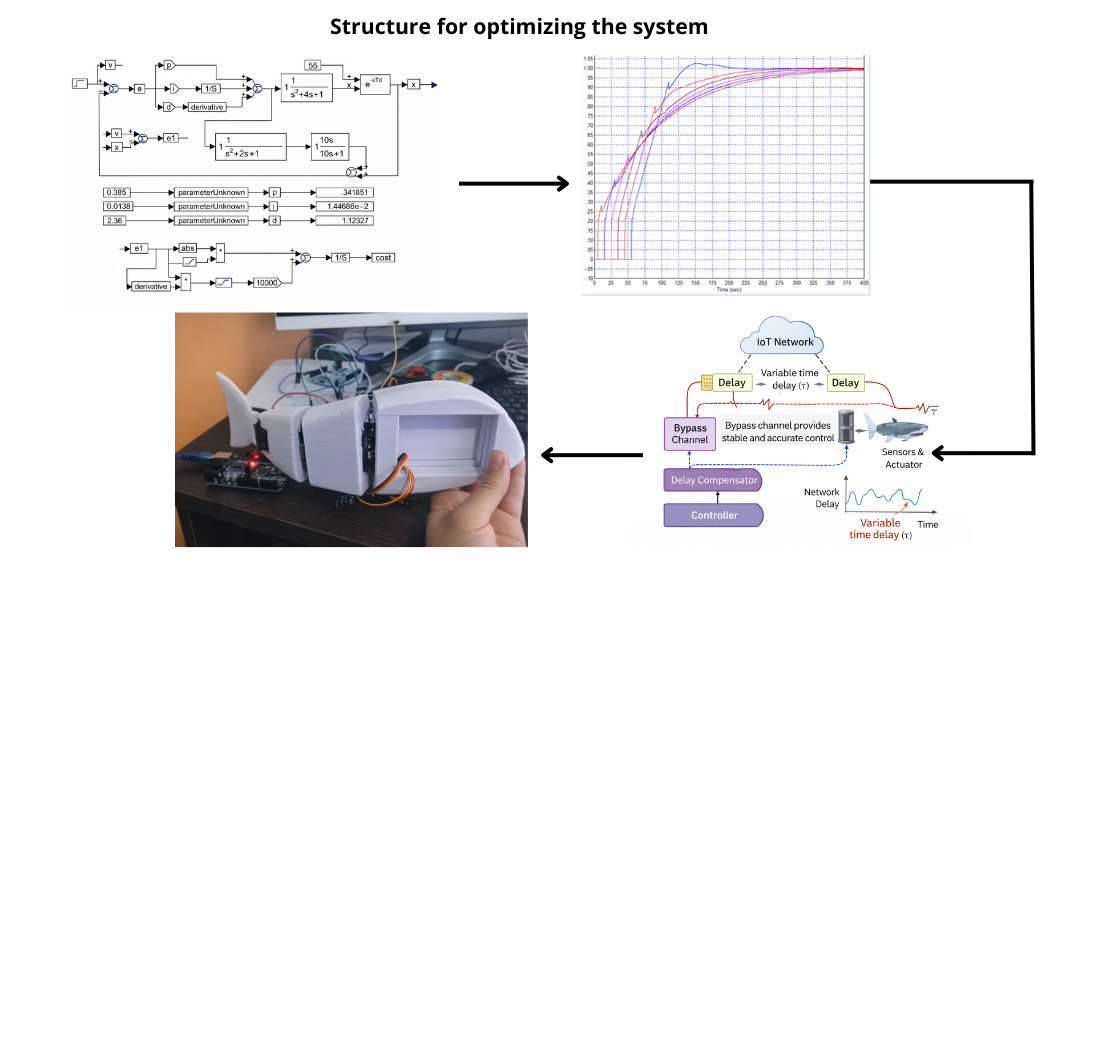
The study focuses on distributed control systems managing objects affected by varying and unpredictable delays, both in terrestrial and space applications. It examines how these delays impact the stability and accuracy of remote control systems, especially in environments with variable transmission times. The main issue addressed is instability caused by variable delays in IoT-based control systems, which affect both terrestrial systems (such as smart homes and industrial automation) and space missions (such as controlling space objects from Earth). The challenge is ensuring stable and accurate control despite unpredictable delays in communication channels.
A new control system design is proposed, incorporating a unique controller structure with a bypass channel to ensure stability under variable delays. The system was validated through mathematical modeling, showing a maximum overshoot of 3% in the PID configuration and near elimination of overshoot with the bypass channel. It outperforms traditional methods like the Smith predictor, which fails when delays deviate by as little as 1–3%. The proposed system ensures stable and accurate control in both terrestrial IoT applications, effectively handling unpredictable delays and maintaining performance in real-time environments
References
- Atzori, L., Iera, A., Morabito, G. (2010). The Internet of Things: A survey. Computer Networks, 54 (15), 2787–2805. https://doi.org/10.1016/j.comnet.2010.05.010
- Friess, P., Vermesan, O. (2022). Internet of Things Applications - From Research and Innovation to Market Deployment. River Publishers. https://doi.org/10.1201/9781003338628
- Hespanha, J. P., Naghshtabrizi, P., Xu, Y. (2007). A Survey of Recent Results in Networked Control Systems. Proceedings of the IEEE, 95 (1), 138–162. https://doi.org/10.1109/jproc.2006.887288
- Zhang, X.-M., Han, Q.-L., Ge, X., Ding, D., Ding, L., Yue, D., Peng, C. (2020). Networked control systems: a survey of trends and techniques. IEEE/CAA Journal of Automatica Sinica, 7 (1), 1–17. https://doi.org/10.1109/jas.2019.1911651
- Szymanski, T. H. (2017). Security and Privacy for a Green Internet of Things. IT Professional, 19 (5), 34–41. https://doi.org/10.1109/mitp.2017.3680952
- Dai, S.-L., Lin, H., Ge, S. S. (2010). Scheduling-and-Control Codesign for a Collection of Networked Control Systems With Uncertain Delays. IEEE Transactions on Control Systems Technology, 18 (1), 66–78. https://doi.org/10.1109/tcst.2008.2010459
- Zhmud, V., Sablina, G., Dimitrov, L., Trubin, V. (2016). The use of bypass channel for feedback control of oscillatory object well-known as difficult one for control. 2016 International Siberian Conference on Control and Communications (SIBCON), 1–6. https://doi.org/10.1109/sibcon.2016.7491767
- Tutkyshbayeva, S., Zakirova, A. (2024). Analysing IoT Digital Education: Fostering Students’ Understanding and Digital Literacy. International Journal of Engineering Pedagogy (IJEP), 14 (4), 4–23. https://doi.org/10.3991/ijep.v14i4.45489
- Choi, J.-Y., Krstic, M. (2015). Compensation of time-varying input delay for discrete-time nonlinear systems. International Journal of Robust and Nonlinear Control, 26 (8), 1755–1776. https://doi.org/10.1002/rnc.3382
- Bahill, A. (1983). A simple adaptive Smith-predictor for controlling time-delay systems: A tutorial. IEEE Control Systems Magazine, 3 (2), 16–22. https://doi.org/10.1109/mcs.1983.1104748
- Tavakoli, S. (2024). Analytical design of modified Smith predictor for second-order stable time delay plants incorporating a zero. Franklin Open, 8, 100140. https://doi.org/10.1016/j.fraope.2024.100140
- Zong, Y., Dai, X., Wei, Z., Zou, M., Guo, W., Gao, Z. (2023). Robust Time Synchronization for Industrial Internet of Things by H ∞ Output Feedback Control. IEEE Internet of Things Journal, 10 (3), 2021–2030. https://doi.org/10.1109/jiot.2022.3144199
- Zhmud, V., Hardt, W., Stukach, O., Dimitrov, L., Nosek, J. (2019). The Parameter Optimization of the PID and PIDD Controller for a Discrete Object. 2019 Dynamics of Systems, Mechanisms and Machines (Dynamics), 1–6. https://doi.org/10.1109/dynamics47113.2019.8944718
- Mishra, P., Patjoshi, R. K., Yadav, A. K. (2023). A Delay Compensation Approach for IoT-Enabled Networks with Different Control Strategies. 2023 Fifth International Conference on Electrical, Computer and Communication Technologies (ICECCT), 1–5. https://doi.org/10.1109/icecct56650.2023.10179610
- Sembayev, T., Nurbekova, Z., Tazabekova, P., Baigusheva, K., Naimanova, D. (2024). Enhancing educational resources through augmented reality-based assessment materials: a comprehensive study. Proceedings of the International Conference on Computer Systems and Technologies 2024, 213–220. https://doi.org/10.1145/3674912.3674927
Downloads
Published
How to Cite
Issue
Section
License
Copyright (c) 2026 Shyryn Tutkyshbayeva, Alma Zakirova, Bakyt Nurbekov, Nurzhamal Kashkimbayeva

This work is licensed under a Creative Commons Attribution 4.0 International License.
The consolidation and conditions for the transfer of copyright (identification of authorship) is carried out in the License Agreement. In particular, the authors reserve the right to the authorship of their manuscript and transfer the first publication of this work to the journal under the terms of the Creative Commons CC BY license. At the same time, they have the right to conclude on their own additional agreements concerning the non-exclusive distribution of the work in the form in which it was published by this journal, but provided that the link to the first publication of the article in this journal is preserved.
A license agreement is a document in which the author warrants that he/she owns all copyright for the work (manuscript, article, etc.).
The authors, signing the License Agreement with TECHNOLOGY CENTER PC, have all rights to the further use of their work, provided that they link to our edition in which the work was published.
According to the terms of the License Agreement, the Publisher TECHNOLOGY CENTER PC does not take away your copyrights and receives permission from the authors to use and dissemination of the publication through the world's scientific resources (own electronic resources, scientometric databases, repositories, libraries, etc.).
In the absence of a signed License Agreement or in the absence of this agreement of identifiers allowing to identify the identity of the author, the editors have no right to work with the manuscript.
It is important to remember that there is another type of agreement between authors and publishers – when copyright is transferred from the authors to the publisher. In this case, the authors lose ownership of their work and may not use it in any way.








