Determining the effect of transformable air ducts and a heat-reflecting screen inside them on the thermal-humidity condition of the corner element considering significant seasonal temperature gradients
DOI:
https://doi.org/10.15587/1729-4061.2026.352434Keywords:
energy efficiency, wall structures, heat transfer, numerical modeling, temperature gradientsAbstract
This study investigates a corner element in a multi-story building with varying numbers of stories. The task addressed relates to the vulnerability of building corner elements to temperature fluctuations.
The energy efficiency of corner elements in external wall structures of buildings with vertical air ducts and a heat-reflecting screen was numerically evaluated under conditions of significant seasonal temperature gradients and varying numbers of stories.
The thermal and humidity conditions of corner zones in building envelopes, characterized by spatial heat transfer and increased thermal vulnerability, were analyzed. Numerical modeling was performed using the finite element method in the ANSYS programming environment, using coupled heat and moisture transfer calculations under various climatic scenarios. The influence of corner zone geometry and building height on temperature distribution and the risk of condensation in the outer envelope was analyzed.
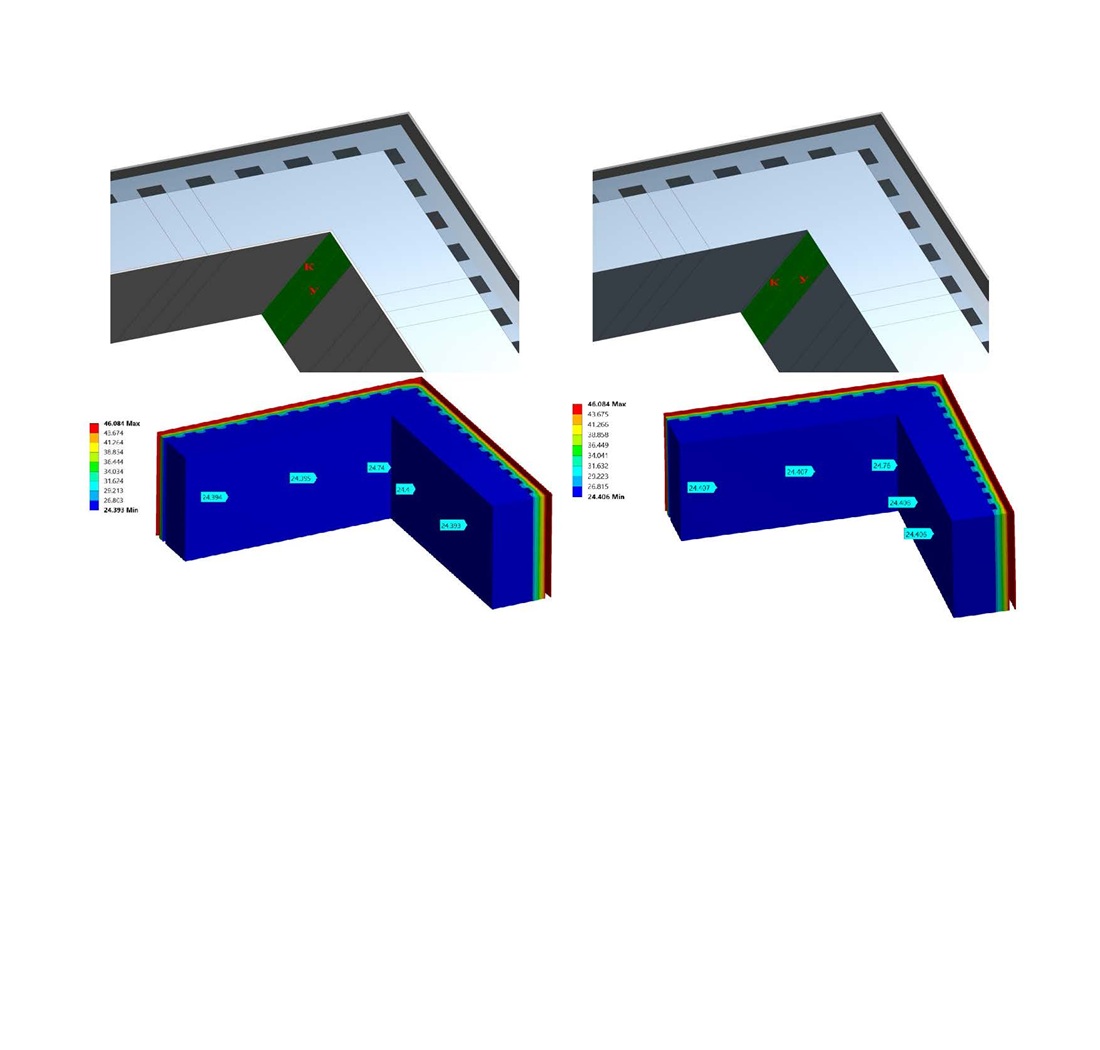
The study results showed that in winter, pronounced non-uniformity of the temperature field occurs in corner zones due to the thermal bridge effect. Moreover, the relative temperature reduction in the corner zone, compared to straight wall sections, ranges from 7% to 12%. During transitional and summer periods, temperature gradients are significantly reduced, and the influence of building height is insignificant. Analysis of the humidity regime revealed the possibility of short-term condensation without conditions for long-term moisture accumulation.
The results could be used in the design of energy-efficient adaptive external wall structures for buildings in regions with pronounced seasonal temperature fluctuations
References
- Pajek, L., Košir, M. (2021). Exploring Climate-Change Impacts on Energy Efficiency and Overheating Vulnerability of Bioclimatic Residential Buildings under Central European Climate. Sustainability, 13 (12), 6791. https://doi.org/10.3390/su13126791
- Piggot-Navarrete, J., Blanchet, P., Cabral, M. R., Cogulet, A. (2025). Impact of climate change on the energy demand of buildings utilizing wooden prefabricated envelopes in cold weather. Energy and Buildings, 338, 115714. https://doi.org/10.1016/j.enbuild.2025.115714
- Al-Shatnawi, Z., Hachem-Vermette, C., Lacasse, M., Ziaeemehr, B. (2024). Advances in Cold-Climate-Responsive Building Envelope Design: A Comprehensive Review. Buildings, 14 (11), 3486. https://doi.org/10.3390/buildings14113486
- Wang, Y., Tian, Y., Zhao, Z., Wang, D., Liu, Y., Liu, J. (2021). Effect of moisture transfer on heat transfer through exterior corners of cooled buildings in hot and humid areas. Journal of Building Engineering, 43, 103160. https://doi.org/10.1016/j.jobe.2021.103160
- Evola, G., Gagliano, A. (2024). Experimental and Numerical Assessment of the Thermal Bridging Effect in a Reinforced Concrete Corner Pillar. Buildings, 14 (2), 378. https://doi.org/10.3390/buildings14020378
- Paz-Pérez, J. A., López-Guerrero, R. E., Carpio, M. (2025). Evaluating the impact of thermal bridges on the thermal performance of concrete and mass timber buildings: Case study in Chile. Case Studies in Thermal Engineering, 74, 107014. https://doi.org/10.1016/j.csite.2025.107014
- Zhangabay, N., Tagybayev, A., Baidilla, I., Sapargaliyeva, B., Shakeshev, B., Baibolov, K. et al. (2023). Multilayer External Enclosing Wall Structures with Air Gaps or Channels. Journal of Composites Science, 7 (5), 195. https://doi.org/10.3390/jcs7050195
- dos Santos Pizzatto, S. M., Pizzatto, F., Raupp-Pereira, F., Arcaro, S., Angioletto, E., Klegues Montedo, O. R. (2025). Ventilated facade system: A review. Boletín de La Sociedad Española de Cerámica y Vidrio, 64 (3), 100443. https://doi.org/10.1016/j.bsecv.2025.100443
- Borodulin, V. Yu., Nizovtsev, M. I. (2021). Modeling heat and moisture transfer of building facades thermally insulated by the panels with ventilated channels. Journal of Building Engineering, 40, 102391. https://doi.org/10.1016/j.jobe.2021.102391
- Nizovtsev, M. I., Letushko, V. N., Yu. Borodulin, V., Sterlyagov, A. N. (2020). Experimental studies of the thermo and humidity state of a new building facade insulation system based on panels with ventilated channels. Energy and Buildings, 206, 109607. https://doi.org/10.1016/j.enbuild.2019.109607
- Zhangabay, N., Bonopera, M., Baidilla, I., Utelbayeva, A., Tursunkululy, T. (2023). Research of Heat Tolerance and Moisture Conditions of New Worked-Out Face Structures with Complete Gap Spacings. Buildings, 13 (11), 2853. https://doi.org/10.3390/buildings13112853
- Zhangabay, N., Baidilla, I., Tagybayev, A., Sultan, B. (2023). Analysis of Thermal Resistance of Developed Energy-Saving External Enclosing Structures with Air Gaps and Horizontal Channels. Buildings, 13 (2), 356. https://doi.org/10.3390/buildings13020356
- Zhangabay, N., Oner, A., Ibraimova, U., Ibrahim, M. N. M., Tursunkululy, T., Utelbayeva, A. (2026). Assessment and Numerical Modeling of the Thermophysical Efficiency of Newly Developed Adaptive Building Envelopes Under Variable Climatic Impacts. Buildings, 16 (2), 366. https://doi.org/10.3390/buildings16020366
- Asan, H. (2006). Numerical computation of time lags and decrement factors for different building materials. Building and Environment, 41 (5), 615–620. https://doi.org/10.1016/j.buildenv.2005.02.020
- Dombaycı, Ö. A., Gölcü, M., Pancar, Y. (2006). Optimization of insulation thickness for external walls using different energy-sources. Applied Energy, 83 (9), 921–928. https://doi.org/10.1016/j.apenergy.2005.10.006
- Çomaklı, K., Yüksel, B. (2004). Environmental impact of thermal insulation thickness in buildings. Applied Thermal Engineering, 24 (5-6), 933–940. https://doi.org/10.1016/j.applthermaleng.2003.10.020
- Vasileva, I. L., Nemova, D. V., Vatin, N. I., Fediuk, R. S., Karelina, M. I. (2022). Climate-Adaptive Façades with an Air Chamber. Buildings, 12 (3), 366. https://doi.org/10.3390/buildings12030366
- Cuce, P. M., Cuce, E. (2025). Ventilated Facades for Low-Carbon Buildings: A Review. Processes, 13 (7), 2275. https://doi.org/10.3390/pr13072275
- Lin, Z., Song, Y., Chu, Y. (2022). An experimental study of the summer and winter thermal performance of an opaque ventilated facade in cold zone of China. Building and Environment, 218, 109108. https://doi.org/10.1016/j.buildenv.2022.109108
- Milardi, M. (2023). Adaptive Building Technologies for Building Envelopes Under Climate Change Conditions. Technological Imagination in the Green and Digital Transition, 695–702. https://doi.org/10.1007/978-3-031-29515-7_62
- Grillo, E., Sansotta, S. (2021). Experimentation of a new adaptive model for envelope system. Possible and preferable scenarios of a sustainable future, 5, 166–177. https://doi.org/10.19229/978-88-5509-232-6/5102021
- Tagybayev, A., Zhangabay, N., Suleimenov, U., Avramov, K., Uspenskyi, B., Umbitaliyev, A. (2023). Revealing patterns of thermophysical parameters in the designed energy-saving structures for external fencing with air channels. Eastern-European Journal of Enterprise Technologies, 4 (8 (124)), 32–43. https://doi.org/10.15587/1729-4061.2023.286078
- Tao, S., Yu, N., Jiang, F., Su, X., Zhao, K. (2023). Correlations for forced convective heat transfer coefficients at the windward building façade with vertical louvers. Building and Environment, 242, 110611. https://doi.org/10.1016/j.buildenv.2023.110611
- Tao, S., Yu, N., Ai, Z., Zhao, K., Jiang, F. (2023). Investigation of convective heat transfer at the facade with balconies for a multi-story building. Journal of Building Engineering, 63, 105420. https://doi.org/10.1016/j.jobe.2022.105420
- Vox, G., Blanco, I., Convertino, F., Schettini, E. (2022). Heat transfer reduction in building envelope with green façade system: A year-round balance in Mediterranean climate conditions. Energy and Buildings, 274, 112439. https://doi.org/10.1016/j.enbuild.2022.112439
- Zhang, Y., Zhang, L., Meng, Q. (2022). Dynamic heat transfer model of vertical green façades and its co-simulation with a building energy modelling program in hot-summer/warm-winter zones. Journal of Building Engineering, 58, 105008. https://doi.org/10.1016/j.jobe.2022.105008
- Ismaiel, M., Chen, Y., Cruz-Noguez, C., Hagel, M. (2021). Thermal resistance of masonry walls: a literature review on influence factors, evaluation, and improvement. Journal of Building Physics, 45 (4), 528–567. https://doi.org/10.1177/17442591211009549
- Lv, L. W. (2014). Thermal Analysis Module of ANSYS. Advanced Materials Research, 1030-1032, 653–656. https://doi.org/10.4028/www.scientific.net/amr.1030-1032.653
- Anicode, S. V. K., Madenci, E. (2021). Three-dimensional moisture diffusion simulation with time dependent saturated concentration in ANSYS through native thermal and spring elements. Microelectronics Reliability, 123, 114167. https://doi.org/10.1016/j.microrel.2021.114167
- Theodosiou, T., Tsikaloudaki, K., Bikas, D., Aravantinos, D., Kontoleon, K. (2014). Assessing the use of simplified and analytical methods for approaching thermal bridges with regard to their impact on the thermal performance of the building envelope. Conference: World Sustainable Building Conference WSB14. Barcelona. Available at: https://www.researchgate.net/publication/275329693_Assessing_the_use_of_simplified_and_analytical_methods_for_approaching_thermal_bridges_with_regard_to_their_impact_on_the_thermal_performance_of_the_building_envelope
- Arends, T., Ruijten, P., Pel, L. (2020). Moisture-induced bending of an oak board exposed to bilateral humidity fluctuations. Journal of Building Engineering, 27, 100957. https://doi.org/10.1016/j.jobe.2019.100957
- Costanzo, V., Evola, G., Marletta, L. (2016). Energy savings in buildings or UHI mitigation? Comparison between green roofs and cool roofs. Energy and Buildings, 114, 247–255. https://doi.org/10.1016/j.enbuild.2015.04.053
- Zhangabay, N., Oner, A., Rakhimov, M., Tursunkululy, T., Abdikerova, U. (2025). Thermal Performance Evaluation of a Retrofitted Building with Adaptive Composite Energy-Saving Facade Systems. Energies, 18 (6), 1402. https://doi.org/10.3390/en18061402
- Zhangabay, N., Tursunkululy, T., Ibraimova, U., Abdikerova, U. (2024). Energy-Efficient Adaptive Dynamic Building Facades: A Review of Their Energy Efficiency and Operating Loads. Applied Sciences, 14 (23), 10979. https://doi.org/10.3390/app142310979
Downloads
Published
How to Cite
Issue
Section
License
Copyright (c) 2026 Nurlan Zhangabay, Ulzhan Ibraimova, Timur Tursunkululy, Bolat Duissenbekov, Bagdaulet Urmashev, Akmaral Utelbayeva, Shugyla Shayakmet

This work is licensed under a Creative Commons Attribution 4.0 International License.
The consolidation and conditions for the transfer of copyright (identification of authorship) is carried out in the License Agreement. In particular, the authors reserve the right to the authorship of their manuscript and transfer the first publication of this work to the journal under the terms of the Creative Commons CC BY license. At the same time, they have the right to conclude on their own additional agreements concerning the non-exclusive distribution of the work in the form in which it was published by this journal, but provided that the link to the first publication of the article in this journal is preserved.
A license agreement is a document in which the author warrants that he/she owns all copyright for the work (manuscript, article, etc.).
The authors, signing the License Agreement with TECHNOLOGY CENTER PC, have all rights to the further use of their work, provided that they link to our edition in which the work was published.
According to the terms of the License Agreement, the Publisher TECHNOLOGY CENTER PC does not take away your copyrights and receives permission from the authors to use and dissemination of the publication through the world's scientific resources (own electronic resources, scientometric databases, repositories, libraries, etc.).
In the absence of a signed License Agreement or in the absence of this agreement of identifiers allowing to identify the identity of the author, the editors have no right to work with the manuscript.
It is important to remember that there is another type of agreement between authors and publishers – when copyright is transferred from the authors to the publisher. In this case, the authors lose ownership of their work and may not use it in any way.








