Визначення впливу трансформованих повітряних каналів та тепловідбивного екрана в них на тепловологісний стан кутового елемента в умовах значних сезонних температурних градієнтів
DOI:
https://doi.org/10.15587/1729-4061.2026.352434Ключові слова:
енергоефективність, стінові конструкції, теплопередача, чисельне моделювання, температурні градієнтиАнотація
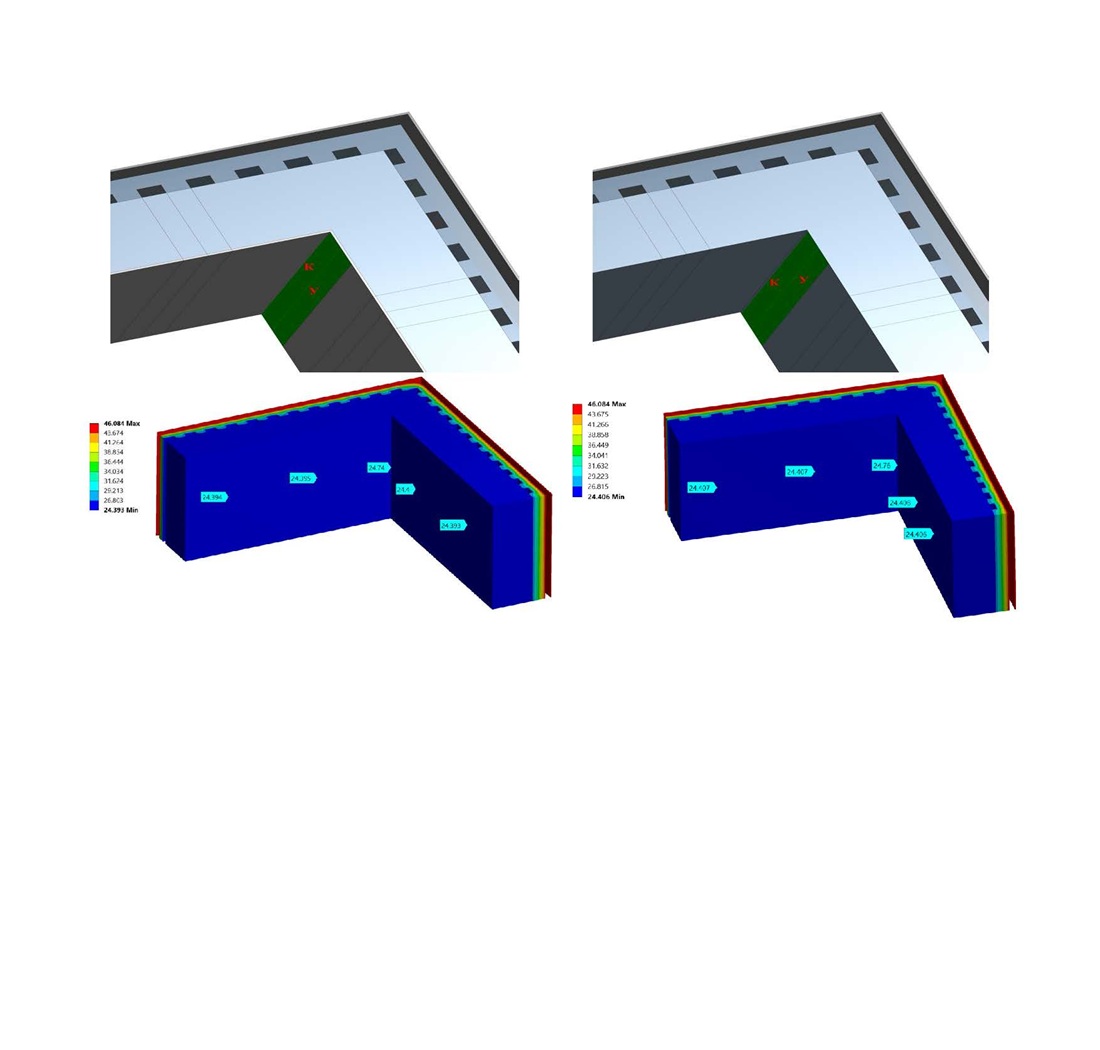
Об’єктом дослідження є кутовий елемент багатоповерхової будівлі за умови різної поверховості. Проблема, що розв’язувалася в роботі, пов’язана з уразливістю кутових елементів будівель в умовах температурних перепадів. Виконано чисельну оцінку енергоефективності кутового елемента зовнішніх стінових конструкцій будівель із вертикальними повітряними каналами та тепловідбивним екраном в умовах значних сезонних температурних градієнтів і різної поверховості.
Проведено аналіз теплового та вологісного режимів кутових зон зовнішніх огороджувальних конструкцій будівель, що характеризуються просторовим характером теплопередачі та підвищеною тепловою уразливістю. Чисельне моделювання виконано методом скінченних елементів у програмному середовищі ANSYS із використанням спряженого розрахунку теплопереносу та вологопереносу при розгляді різних кліматичних сценаріїв навколишнього середовища. Проаналізовано вплив геометрії кутової зони та висоти будівлі на розподіл температур і ризик утворення конденсату в зовнішньому огородженні.
Результати дослідження показали, що в зимовий період у кутових зонах формується виражена неоднорідність температурного поля, зумовлена ефектом теплового моста. Водночас відносне зниження температури в кутовій зоні порівняно з прямолінійними ділянками стіни становить від 7% до 12%. У перехідні та літні періоди температурні градієнти суттєво зменшуються, а вплив висоти будівлі є незначним. Аналіз вологісного режиму виявив можливість короткочасного утворення конденсату без умов для довготривалого накопичення вологи.
Отримані результати можуть бути використані під час проєктування енергоефективних адаптивних зовнішніх стінових конструкцій будівель у регіонах із вираженими сезонними температурними коливаннями.
Посилання
- Pajek, L., Košir, M. (2021). Exploring Climate-Change Impacts on Energy Efficiency and Overheating Vulnerability of Bioclimatic Residential Buildings under Central European Climate. Sustainability, 13 (12), 6791. https://doi.org/10.3390/su13126791
- Piggot-Navarrete, J., Blanchet, P., Cabral, M. R., Cogulet, A. (2025). Impact of climate change on the energy demand of buildings utilizing wooden prefabricated envelopes in cold weather. Energy and Buildings, 338, 115714. https://doi.org/10.1016/j.enbuild.2025.115714
- Al-Shatnawi, Z., Hachem-Vermette, C., Lacasse, M., Ziaeemehr, B. (2024). Advances in Cold-Climate-Responsive Building Envelope Design: A Comprehensive Review. Buildings, 14 (11), 3486. https://doi.org/10.3390/buildings14113486
- Wang, Y., Tian, Y., Zhao, Z., Wang, D., Liu, Y., Liu, J. (2021). Effect of moisture transfer on heat transfer through exterior corners of cooled buildings in hot and humid areas. Journal of Building Engineering, 43, 103160. https://doi.org/10.1016/j.jobe.2021.103160
- Evola, G., Gagliano, A. (2024). Experimental and Numerical Assessment of the Thermal Bridging Effect in a Reinforced Concrete Corner Pillar. Buildings, 14 (2), 378. https://doi.org/10.3390/buildings14020378
- Paz-Pérez, J. A., López-Guerrero, R. E., Carpio, M. (2025). Evaluating the impact of thermal bridges on the thermal performance of concrete and mass timber buildings: Case study in Chile. Case Studies in Thermal Engineering, 74, 107014. https://doi.org/10.1016/j.csite.2025.107014
- Zhangabay, N., Tagybayev, A., Baidilla, I., Sapargaliyeva, B., Shakeshev, B., Baibolov, K. et al. (2023). Multilayer External Enclosing Wall Structures with Air Gaps or Channels. Journal of Composites Science, 7 (5), 195. https://doi.org/10.3390/jcs7050195
- dos Santos Pizzatto, S. M., Pizzatto, F., Raupp-Pereira, F., Arcaro, S., Angioletto, E., Klegues Montedo, O. R. (2025). Ventilated facade system: A review. Boletín de La Sociedad Española de Cerámica y Vidrio, 64 (3), 100443. https://doi.org/10.1016/j.bsecv.2025.100443
- Borodulin, V. Yu., Nizovtsev, M. I. (2021). Modeling heat and moisture transfer of building facades thermally insulated by the panels with ventilated channels. Journal of Building Engineering, 40, 102391. https://doi.org/10.1016/j.jobe.2021.102391
- Nizovtsev, M. I., Letushko, V. N., Yu. Borodulin, V., Sterlyagov, A. N. (2020). Experimental studies of the thermo and humidity state of a new building facade insulation system based on panels with ventilated channels. Energy and Buildings, 206, 109607. https://doi.org/10.1016/j.enbuild.2019.109607
- Zhangabay, N., Bonopera, M., Baidilla, I., Utelbayeva, A., Tursunkululy, T. (2023). Research of Heat Tolerance and Moisture Conditions of New Worked-Out Face Structures with Complete Gap Spacings. Buildings, 13 (11), 2853. https://doi.org/10.3390/buildings13112853
- Zhangabay, N., Baidilla, I., Tagybayev, A., Sultan, B. (2023). Analysis of Thermal Resistance of Developed Energy-Saving External Enclosing Structures with Air Gaps and Horizontal Channels. Buildings, 13 (2), 356. https://doi.org/10.3390/buildings13020356
- Zhangabay, N., Oner, A., Ibraimova, U., Ibrahim, M. N. M., Tursunkululy, T., Utelbayeva, A. (2026). Assessment and Numerical Modeling of the Thermophysical Efficiency of Newly Developed Adaptive Building Envelopes Under Variable Climatic Impacts. Buildings, 16 (2), 366. https://doi.org/10.3390/buildings16020366
- Asan, H. (2006). Numerical computation of time lags and decrement factors for different building materials. Building and Environment, 41 (5), 615–620. https://doi.org/10.1016/j.buildenv.2005.02.020
- Dombaycı, Ö. A., Gölcü, M., Pancar, Y. (2006). Optimization of insulation thickness for external walls using different energy-sources. Applied Energy, 83 (9), 921–928. https://doi.org/10.1016/j.apenergy.2005.10.006
- Çomaklı, K., Yüksel, B. (2004). Environmental impact of thermal insulation thickness in buildings. Applied Thermal Engineering, 24 (5-6), 933–940. https://doi.org/10.1016/j.applthermaleng.2003.10.020
- Vasileva, I. L., Nemova, D. V., Vatin, N. I., Fediuk, R. S., Karelina, M. I. (2022). Climate-Adaptive Façades with an Air Chamber. Buildings, 12 (3), 366. https://doi.org/10.3390/buildings12030366
- Cuce, P. M., Cuce, E. (2025). Ventilated Facades for Low-Carbon Buildings: A Review. Processes, 13 (7), 2275. https://doi.org/10.3390/pr13072275
- Lin, Z., Song, Y., Chu, Y. (2022). An experimental study of the summer and winter thermal performance of an opaque ventilated facade in cold zone of China. Building and Environment, 218, 109108. https://doi.org/10.1016/j.buildenv.2022.109108
- Milardi, M. (2023). Adaptive Building Technologies for Building Envelopes Under Climate Change Conditions. Technological Imagination in the Green and Digital Transition, 695–702. https://doi.org/10.1007/978-3-031-29515-7_62
- Grillo, E., Sansotta, S. (2021). Experimentation of a new adaptive model for envelope system. Possible and preferable scenarios of a sustainable future, 5, 166–177. https://doi.org/10.19229/978-88-5509-232-6/5102021
- Tagybayev, A., Zhangabay, N., Suleimenov, U., Avramov, K., Uspenskyi, B., Umbitaliyev, A. (2023). Revealing patterns of thermophysical parameters in the designed energy-saving structures for external fencing with air channels. Eastern-European Journal of Enterprise Technologies, 4 (8 (124)), 32–43. https://doi.org/10.15587/1729-4061.2023.286078
- Tao, S., Yu, N., Jiang, F., Su, X., Zhao, K. (2023). Correlations for forced convective heat transfer coefficients at the windward building façade with vertical louvers. Building and Environment, 242, 110611. https://doi.org/10.1016/j.buildenv.2023.110611
- Tao, S., Yu, N., Ai, Z., Zhao, K., Jiang, F. (2023). Investigation of convective heat transfer at the facade with balconies for a multi-story building. Journal of Building Engineering, 63, 105420. https://doi.org/10.1016/j.jobe.2022.105420
- Vox, G., Blanco, I., Convertino, F., Schettini, E. (2022). Heat transfer reduction in building envelope with green façade system: A year-round balance in Mediterranean climate conditions. Energy and Buildings, 274, 112439. https://doi.org/10.1016/j.enbuild.2022.112439
- Zhang, Y., Zhang, L., Meng, Q. (2022). Dynamic heat transfer model of vertical green façades and its co-simulation with a building energy modelling program in hot-summer/warm-winter zones. Journal of Building Engineering, 58, 105008. https://doi.org/10.1016/j.jobe.2022.105008
- Ismaiel, M., Chen, Y., Cruz-Noguez, C., Hagel, M. (2021). Thermal resistance of masonry walls: a literature review on influence factors, evaluation, and improvement. Journal of Building Physics, 45 (4), 528–567. https://doi.org/10.1177/17442591211009549
- Lv, L. W. (2014). Thermal Analysis Module of ANSYS. Advanced Materials Research, 1030-1032, 653–656. https://doi.org/10.4028/www.scientific.net/amr.1030-1032.653
- Anicode, S. V. K., Madenci, E. (2021). Three-dimensional moisture diffusion simulation with time dependent saturated concentration in ANSYS through native thermal and spring elements. Microelectronics Reliability, 123, 114167. https://doi.org/10.1016/j.microrel.2021.114167
- Theodosiou, T., Tsikaloudaki, K., Bikas, D., Aravantinos, D., Kontoleon, K. (2014). Assessing the use of simplified and analytical methods for approaching thermal bridges with regard to their impact on the thermal performance of the building envelope. Conference: World Sustainable Building Conference WSB14. Barcelona. Available at: https://www.researchgate.net/publication/275329693_Assessing_the_use_of_simplified_and_analytical_methods_for_approaching_thermal_bridges_with_regard_to_their_impact_on_the_thermal_performance_of_the_building_envelope
- Arends, T., Ruijten, P., Pel, L. (2020). Moisture-induced bending of an oak board exposed to bilateral humidity fluctuations. Journal of Building Engineering, 27, 100957. https://doi.org/10.1016/j.jobe.2019.100957
- Costanzo, V., Evola, G., Marletta, L. (2016). Energy savings in buildings or UHI mitigation? Comparison between green roofs and cool roofs. Energy and Buildings, 114, 247–255. https://doi.org/10.1016/j.enbuild.2015.04.053
- Zhangabay, N., Oner, A., Rakhimov, M., Tursunkululy, T., Abdikerova, U. (2025). Thermal Performance Evaluation of a Retrofitted Building with Adaptive Composite Energy-Saving Facade Systems. Energies, 18 (6), 1402. https://doi.org/10.3390/en18061402
- Zhangabay, N., Tursunkululy, T., Ibraimova, U., Abdikerova, U. (2024). Energy-Efficient Adaptive Dynamic Building Facades: A Review of Their Energy Efficiency and Operating Loads. Applied Sciences, 14 (23), 10979. https://doi.org/10.3390/app142310979
##submission.downloads##
Опубліковано
Як цитувати
Номер
Розділ
Ліцензія
Авторське право (c) 2026 Nurlan Zhangabay, Ulzhan Ibraimova, Timur Tursunkululy, Bolat Duissenbekov, Bagdaulet Urmashev, Akmaral Utelbayeva, Shugyla Shayakmet

Ця робота ліцензується відповідно до Creative Commons Attribution 4.0 International License.
Закріплення та умови передачі авторських прав (ідентифікація авторства) здійснюється у Ліцензійному договорі. Зокрема, автори залишають за собою право на авторство свого рукопису та передають журналу право першої публікації цієї роботи на умовах ліцензії Creative Commons CC BY. При цьому вони мають право укладати самостійно додаткові угоди, що стосуються неексклюзивного поширення роботи у тому вигляді, в якому вона була опублікована цим журналом, але за умови збереження посилання на першу публікацію статті в цьому журналі.
Ліцензійний договір – це документ, в якому автор гарантує, що володіє усіма авторськими правами на твір (рукопис, статтю, тощо).
Автори, підписуючи Ліцензійний договір з ПП «ТЕХНОЛОГІЧНИЙ ЦЕНТР», мають усі права на подальше використання свого твору за умови посилання на наше видання, в якому твір опублікований. Відповідно до умов Ліцензійного договору, Видавець ПП «ТЕХНОЛОГІЧНИЙ ЦЕНТР» не забирає ваші авторські права та отримує від авторів дозвіл на використання та розповсюдження публікації через світові наукові ресурси (власні електронні ресурси, наукометричні бази даних, репозитарії, бібліотеки тощо).
За відсутності підписаного Ліцензійного договору або за відсутністю вказаних в цьому договорі ідентифікаторів, що дають змогу ідентифікувати особу автора, редакція не має права працювати з рукописом.
Важливо пам’ятати, що існує і інший тип угоди між авторами та видавцями – коли авторські права передаються від авторів до видавця. В такому разі автори втрачають права власності на свій твір та не можуть його використовувати в будь-який спосіб.