Development of an effective method of microwave treatment of sunflower kernel to increase oil extraction
DOI:
https://doi.org/10.15587/1729-4061.2026.352514Keywords:
sunflower, microwave processing, microwave radiation, mechanical pressing, oil yield, experimental planning, optimizationAbstract
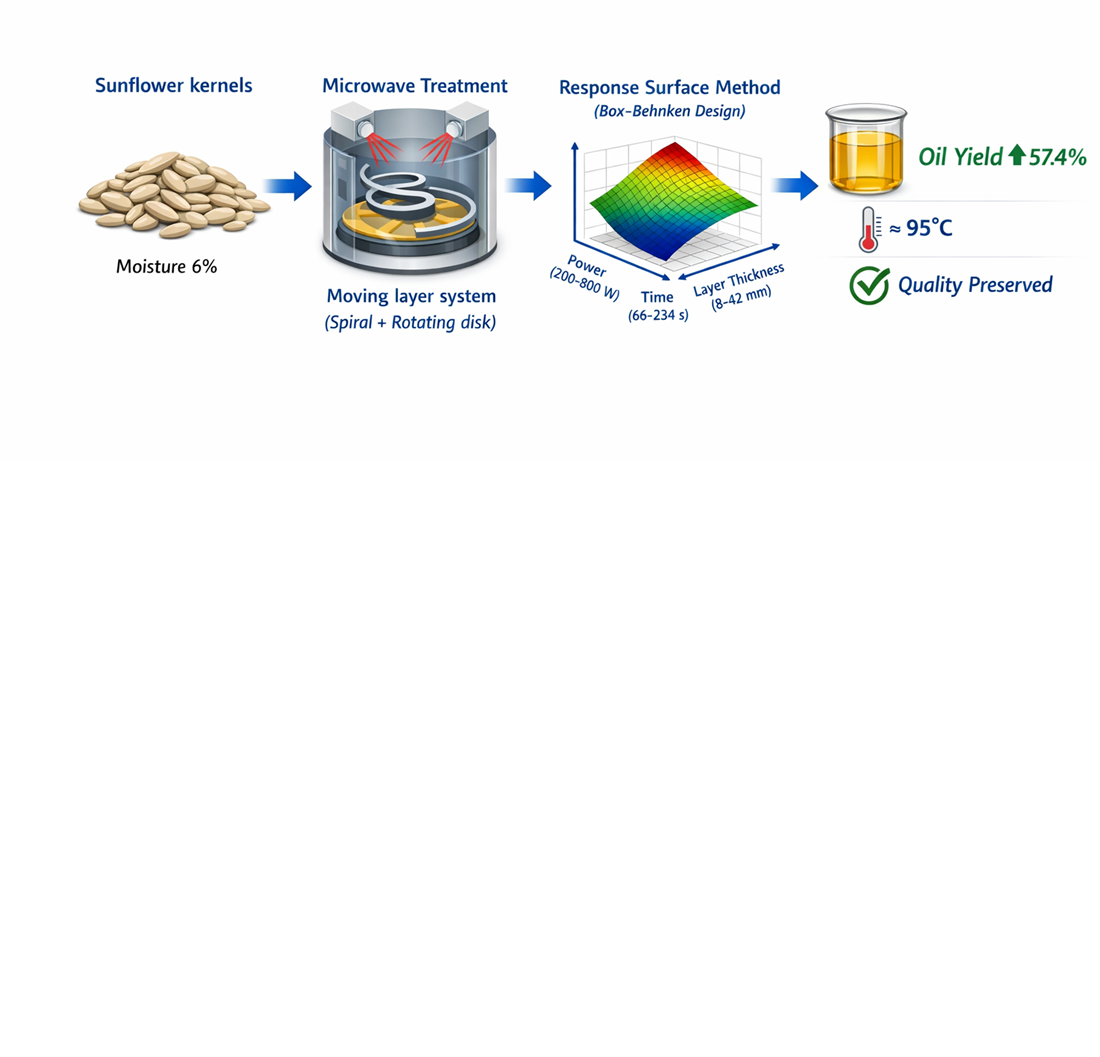
The study focused on microwave processing of sunflower seeds and a unit for its implementation during the preparation stage for mechanical pressing. This unit intensifies the destruction of the kernel's cellular structure, increases oil yield, and maintains its quality within acceptable limits.
The aim was to increase the extraction of high-quality sunflower oil.
The design features of a pilot unit for microwave seed processing and the optimal parameters for microwave seed processing were determined.
It was established that maximum oil extraction without degrading its quality is achieved by using a gentle microwave processing mode, which prevents overheating, changes in the structure and chemical composition of the kernel, and increased oxidation processes. The unit was applied at a power of 500 watts for 150 seconds with a 42 mm layer of peeled sunflower seeds. With these values, the oil yield was approximately 57.4%. Uniform grain distribution within the processed layer was achieved by using a guide spiral and a rotating horizontal disk, which ensures uniform movement and height of the moving layer.
A distinctive feature of the obtained results is the use of a microwave processing unit consisting of a guide spiral, a rotating horizontal disk, and an experimental methodology using second-order rotatable planning to determine the relationship between oil yield and microwave power, duration, and seed layer thickness on the rotating disk surface.
These results can be scaled up for use in industrial vegetable oil production facilities for domestic consumption and increased potential exports
References
- Anjum, F., Anwar, F., Jamil, A., Iqbal, M. (2006). Microwave roasting effects on the physico‐chemical composition and oxidative stability of sunflower seed oil. Journal of the American Oil Chemists’ Society, 83 (9), 777–784. https://doi.org/10.1007/s11746-006-5014-1
- Mohammed, K., Koko, M., Obadi, M., Letsididi, K. S., Cao, P., Liu, Y. (2017). Effects of microwave roasting process and time on chemical composition and oxidative stability of sunflower oil. Journal of Food and Nutrition Research, 5 (9), 659–667. Available at: https://www.researchgate.net/publication/319631620
- Yin, W., Shi, R., Li, K., Wang, X., Wang, A., Zhao, Y., Zhai, Z. (2022). Effect of microwave pretreatment of sunflower kernels on the aroma-active composition, sensory quality, lipid oxidation, tocopherols, heterocyclic amines and polycyclic aromatic hydrocarbons of sunflower oil. LWT, 170, 114077. https://doi.org/10.1016/j.lwt.2022.114077
- Goszkiewicz, A., Kołodziejczyk, E., Ratajczyk, F. (2020). Comparison of microwave and convection method of roasting sunflower seeds and its effect on sensory quality, texture and physicochemical characteristics. Food Structure, 25, 100144. https://doi.org/10.1016/j.foostr.2020.100144
- Mohamed Ahmed, I. A., Özcan, M. M., Uslu, N., Yılmaz, H., Mohammed, B. M., Albakry, Z. (2024). Effect of microwave and oven roasting on chemical composition, bioactive properties, phenolic compounds and fatty acid compositions of sunflower seed and oils. Journal of the American Oil Chemists’ Society, 101 (8), 797–807. https://doi.org/10.1002/aocs.12824
- Wu, L., Xue, W., Shen, X., Hu, W., Zhao, X., Yang, X., Yang, Q. (2025). Effects of microwave-assisted enzymatic treatment on the quality characteristics of sunflower seed oil: A comprehensive investigation based on Lipidomics and volatile flavor compound profiling. Food Chemistry, 491, 145217. https://doi.org/10.1016/j.foodchem.2025.145217
- Azadmard-Damirchi, S., Habibi-Nodeh, F., Hesari, J., Nemati, M., Achachlouei, B. F. (2010). Effect of pretreatment with microwaves on oxidative stability and nutraceuticals content of oil from rapeseed. Food Chemistry, 121 (4), 1211–1215. https://doi.org/10.1016/j.foodchem.2010.02.006
- Wroniak, M., Rękas, A., Siger, A., Janowicz, M. (2016). Microwave pretreatment effects on the changes in seeds microstructure, chemical composition and oxidative stability of rapeseed oil. LWT - Food Science and Technology, 68, 634–641. https://doi.org/10.1016/j.lwt.2016.01.013
- Jiao, J., Li, Z.-G., Gai, Q.-Y., Li, X.-J., Wei, F.-Y., Fu, Y.-J., Ma, W. (2014). Microwave-assisted aqueous enzymatic extraction of oil from pumpkin seeds and evaluation of its physicochemical properties, fatty acid compositions and antioxidant activities. Food Chemistry, 147, 17–24. https://doi.org/10.1016/j.foodchem.2013.09.079
- Fathi-Achachlouei, B., Azadmard-Damirchi, S., Zahedi, Y., Shaddel, R. (2019). Microwave pretreatment as a promising strategy for increment of nutraceutical content and extraction yield of oil from milk thistle seed. Industrial Crops and Products, 128, 527–533. https://doi.org/10.1016/j.indcrop.2018.11.034
- Chen, F., Xu, B., Cui, W., Wang, Y., Wan, F., Cheng, A. (2024). Effects of microwave treatment on vegetable oil quality & biological activities. Trends in Food Science & Technology, 153, 104748. https://doi.org/10.1016/j.tifs.2024.104748
- Kaseke, T., Opara, U. L., Fawole, O. A. (2021). Novel seeds pretreatment techniques: effect on oil quality and antioxidant properties: a review. Journal of Food Science and Technology, 58 (12), 4451–4464. https://doi.org/10.1007/s13197-021-04981-1
- Midhun, J., Stephi, D., Muthamil Selvi, K., Kameshwari, Y., Swatika, S. K., Sunil, C. K. (2023). Effect of emerging pretreatment methods on extraction and quality of edible oils: A review. Food and Humanity, 1, 1511–1522. https://doi.org/10.1016/j.foohum.2023.10.018
- Suleimen, A. M., Askarov, A. D. (2024). Pat. No. 9018 RK. Ustanovka dlya sverhvysokochastotnoy termoobrabotki sypuchih produktov i materialov. published: 19.04.2024, Bul. No. 16.
- Yoshida, H., Hirakawa, Y., Abe, S., Mizushina, Y. (2002). The content of tocopherols and oxidative quality of oils prepared from sunflower (Helianthus annuus L.) seeds roasted in a microwave oven. European Journal of Lipid Science and Technology, 104 (2), 116–122. https://doi.org/10.1002/1438-9312(200202)104:2<116::aid-ejlt116>3.0.co;2-p
- Hu, J., Emile‐Geay, J., Nusbaumer, J., Noone, D. (2018). Impact of Convective Activity on Precipitation δ18O in Isotope‐Enabled General Circulation Models. Journal of Geophysical Research: Atmospheres, 123 (23). https://doi.org/10.1029/2018jd029187
- Zając, M., Kiczorowska, B., Samolińska, W., Kowalczyk-Pecka, D., Andrejko, D., Kiczorowski, P. (2021). Effect of inclusion of micronized camelina, sunflower, and flax seeds in the broiler chicken diet on performance productivity, nutrient utilization, and intestinal microbial populations. Poultry Science, 100 (7), 101118. https://doi.org/10.1016/j.psj.2021.101118
Downloads
Published
How to Cite
Issue
Section
License
Copyright (c) 2026 Akzhol Suleimen, Baurzhan Nurakhmetov, Ardak Askarov, Yevgeniy Medvedkov, Ilyas Nurakhmetov

This work is licensed under a Creative Commons Attribution 4.0 International License.
The consolidation and conditions for the transfer of copyright (identification of authorship) is carried out in the License Agreement. In particular, the authors reserve the right to the authorship of their manuscript and transfer the first publication of this work to the journal under the terms of the Creative Commons CC BY license. At the same time, they have the right to conclude on their own additional agreements concerning the non-exclusive distribution of the work in the form in which it was published by this journal, but provided that the link to the first publication of the article in this journal is preserved.
A license agreement is a document in which the author warrants that he/she owns all copyright for the work (manuscript, article, etc.).
The authors, signing the License Agreement with TECHNOLOGY CENTER PC, have all rights to the further use of their work, provided that they link to our edition in which the work was published.
According to the terms of the License Agreement, the Publisher TECHNOLOGY CENTER PC does not take away your copyrights and receives permission from the authors to use and dissemination of the publication through the world's scientific resources (own electronic resources, scientometric databases, repositories, libraries, etc.).
In the absence of a signed License Agreement or in the absence of this agreement of identifiers allowing to identify the identity of the author, the editors have no right to work with the manuscript.
It is important to remember that there is another type of agreement between authors and publishers – when copyright is transferred from the authors to the publisher. In this case, the authors lose ownership of their work and may not use it in any way.








