Identification of the impact of open banking digital infrastructure on financial inclusion in EU countries in the context of macroeconomic and digital development
DOI:
https://doi.org/10.15587/1729-4061.2026.352586Keywords:
open banking, financial inclusion, banking digitalization, cluster analysis, regression model, digital divideAbstract
The object of the study is the financial inclusion in EU countries in the context of macroeconomic and digital development.
The problem of quantitatively assessing this relationship in a broad cross-country context has been solved.
The following results were obtained:
– a significant cross-country divergence was identified in the level of digitalization of the financial sector, the development of ICT (information and communication technologies) infrastructure, and financial inclusion, which forms fundamentally different starting conditions for the implementation of open banking;
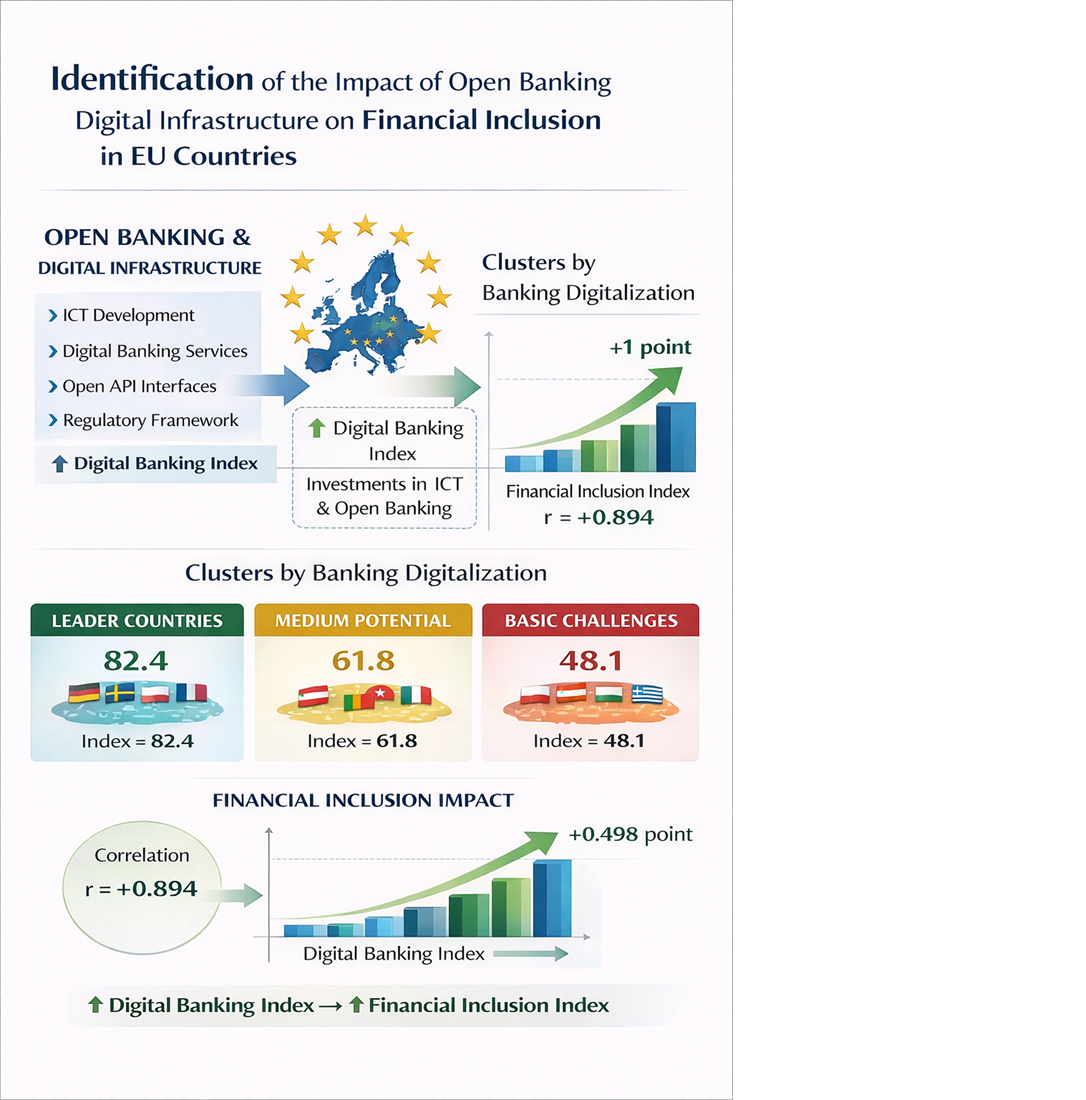
– a strong positive correlation was established between the level of banking digitalization and the composite financial inclusion index (Pearson’s coefficient +0.894);
– an increase in the banking digitalization index by one point leads to an average increase in the composite financial inclusion index by 0.498 points (p < 0.001);
– for “leader” countries, the average banking digitalization index was 82.4; for countries with “medium potential” – 61.8; for countries with “basic challenges” – 48.1.
The obtained results are explained by the fact that technological development of the financial sector creates prerequisites for reducing transaction costs and the emergence of innovative, non-territorially bound services. The specific features of the results lie in proving the differentiated potential of open banking: for “leader” countries, for countries with “medium potential”, for countries with “basic challenges”.
The practical significance of the study lies in providing regulators and financial institutions with quantitatively grounded conclusions for developing differentiated strategies that take into account the level of readiness of the national ecosystem
References
- Directive (EU) 2015/2366 of the European Parliament and of the Council of 25 November 2015 on payment services in the internal market, amending Directives 2002/65/EC, 2009/110/EC and 2013/36/EU and Regulation (EU) No 1093/2010, and repealing Directive 2007/64/EC. Official Journal of the European Union. Available at: https://eur-lex.europa.eu/legal-content/EN/TXT/HTML/?uri=CELEX:32015L2366
- Odorovic, A. (2023). Open Banking: Between Cooperation and Competition. Anali Pravnog Fakulteta u Beogradu, 71 (1), 65–91. https://doi.org/10.51204/anali_pfbu_23102a
- Fitriana, R., Judijanto, L. (2025). Open Banking API implementation: implications for financial services competition and innovation. International Journal of Financial Economics, 2 (6), 659–667. Available at: https://wikep.net/index.php/IJEFE/article/view/134
- Stefanelli, V., Manta, F. (2023). Digital Financial Services and Open Banking Innovation: Are Banks Becoming ‘invisible’? Global Business Review. https://doi.org/10.1177/09721509231151491
- Polasik, M., Kotkowski, R. (2022). The Open Banking Adoption Among Consumers in Europe: The Role of Privacy, Trust, and Digital Financial Inclusion. SSRN Electronic Journal. https://doi.org/10.2139/ssrn.4105648
- Amer Mohammed, A. M. (2025). Open Banking and APIs: Research on how open banking frameworks and APIs are reshaping the financial ecosystem. International Journal of Advances in Engineering and Management, 7 (4), 770–784. https://doi.org/10.35629/5252-0704770784
- Cosma, S., Cosma, S., Pennetta, D. (2023). The Rise of Financial Services Ecosystems: Towards Open Banking Platforms. The Fintech Disruption, 191–213. https://doi.org/10.1007/978-3-031-23069-1_8
- Spulbar, C., Carbune, D. I. M. (2025). How Open Banking and AI drive financial innovation: evidence from the Romanian banking sector. Revista de Științe Politice, 86, 174–187. Available at: https://cis01.central.ucv.ro/revistadestiintepolitice/files/numarul86_2025/15.pdf
- Wolska, A. (2025). From Isolation to Integration: The Role of Open Banking in the Financial Services Evolution. https://doi.org/10.2139/ssrn.5161824
- Alonso, A., Carbó, J. M., Cuadros-Solas, P., Quintanero, J. (2025). The effects of open banking on fintech providers: evidence using microdata from Spain. SSRN Electronic Journal. https://doi.org/10.2139/ssrn.5528599
- Colangelo, G., Khandelwal, P. (2025). The many shades of open banking: A comparative analysis of rationales and models. Internet Policy Review, 14 (1). https://doi.org/10.14763/2025.1.1821
- Tkalenko, S., Liubachivska, R., Onopriienko, Y., Stetsyk, Y., Petukhova, O. (2025). Current trends in banking activities in the eu: assessment of factors impacting profitability. Financial and Credit Activity Problems of Theory and Practice, 2 (61), 11–23. https://doi.org/10.55643/fcaptp.2.61.2025.4677
- Kinslin, D. (2024). Impact of Regulations on Fintech Firms/Banking and Non-Banking Financial Services. Examining Global Regulations During the Rise of Fintech, 371–428. https://doi.org/10.4018/979-8-3693-3803-2.ch015
- Akyildirim, E., Corbet, S., Mukherjee, A., Ryan, M. (2025). Global perspectives on open banking: Regulatory impacts and market response. Journal of International Financial Markets, Institutions and Money, 101, 102159. https://doi.org/10.1016/j.intfin.2025.102159
- Pereira, C. M. (2025). The uncertain path towards open finance: mutual lessons from the United Kingdom and European Union regulatory approaches. A Research Agenda for Financial Law and Regulation, 83–112. https://doi.org/10.4337/9781803929996.00012
- Abbasov, A. A. (2024). An analysis of the impact of digital banking on the future use of Open Banking: a Toda-Yamamoto causality analysis in the context of Azerbaijan. Journal of Baku Engineering University – Economics and Administration, 8 (2), 167–189. Available at: https://ea.beu.edu.az/articles/15
- Dovhan, O. (2025). Analysis of the development of digital innovations in the financial services market in Ukraine in 2010-2024. Economy and Society, 71. https://doi.org/10.32782/2524-0072/2025-71-48
- Henkler, R., Schubart, C. (2025). Open Banking and automated transaction analysis in the digitalization of business banking: design, opportunities, and challenges of a digital credit process. IU Internationale Hochschule. Available at: https://hdl.handle.net/10419/308823
- Commission Staff Working Document Executive Summary Of The Impact Assessment Accompanying the documents Proposal for a Regulation Of The European Parliament And Of The Council on payment services in the internal market and amending Regulation (EU) No 1093/2010 and Proposal for a Directive Of The European Parliament And Of The Council on payment services and electronic money services in the Internal Market amending Directive 98/26/EC and repealing Directives 2015/2366/EU and 2009/110/EC. Available at: https://eur-lex.europa.eu/legal-content/EN/TXT/HTML/?uri=CELEX:52023SC0232
- Report from the Commission to the European Parliament, the Council, the European Central Bank and the European Economic and Social Committee on the review of Directive 2015/2366/EU of the European Parliament and of the Council on payment services in the internal market. Available at: https://eur-lex.europa.eu/legal-content/EN/TXT/HTML/?uri=CELEX:52023DC0365
- Proposal for a Regulation Of The European Parliament And Of The Council on a framework for Financial Data Access and amending Regulations (EU) No 1093/2010, (EU) No 1094/2010, (EU) No 1095/2010 and (EU) 2022/2554 (Text with EEA relevance). Available at: https://eur-lex.europa.eu/legal-content/EN/TXT/HTML/?uri=CELEX:52023PC0360
- Proposal for a Regulation Of The European Parliament And Of The Council on payment services in the internal market and amending Regulation (EU) No 1093/2010 (Text with EEA relevance). Available at: https://eur-lex.europa.eu/legal-content/EN/TXT/HTML/?uri=CELEX:52023PC0367
- Proposal for a Directive Of The European Parliament And Of The Council on payment services and electronic money services in the Internal Market amending Directive 98/26/EC and repealing Directives 2015/2366/EU and 2009/110/EC (Text with EEA relevance). Available at: https://eur-lex.europa.eu/legal-content/EN/TXT/HTML/?uri=CELEX:52023PC0366
Downloads
Published
How to Cite
Issue
Section
License
Copyright (c) 2026 Nurgul Maulina, Amit Dutta, Raushan Gabdualiyeva, Botagoz Duissenbayeva, Nazgul Khamitkhan, Zhanna Tsaurkubule, Karlygash Kamali

This work is licensed under a Creative Commons Attribution 4.0 International License.
The consolidation and conditions for the transfer of copyright (identification of authorship) is carried out in the License Agreement. In particular, the authors reserve the right to the authorship of their manuscript and transfer the first publication of this work to the journal under the terms of the Creative Commons CC BY license. At the same time, they have the right to conclude on their own additional agreements concerning the non-exclusive distribution of the work in the form in which it was published by this journal, but provided that the link to the first publication of the article in this journal is preserved.
A license agreement is a document in which the author warrants that he/she owns all copyright for the work (manuscript, article, etc.).
The authors, signing the License Agreement with TECHNOLOGY CENTER PC, have all rights to the further use of their work, provided that they link to our edition in which the work was published.
According to the terms of the License Agreement, the Publisher TECHNOLOGY CENTER PC does not take away your copyrights and receives permission from the authors to use and dissemination of the publication through the world's scientific resources (own electronic resources, scientometric databases, repositories, libraries, etc.).
In the absence of a signed License Agreement or in the absence of this agreement of identifiers allowing to identify the identity of the author, the editors have no right to work with the manuscript.
It is important to remember that there is another type of agreement between authors and publishers – when copyright is transferred from the authors to the publisher. In this case, the authors lose ownership of their work and may not use it in any way.








