Визначення впливу цифрової інфраструктури відкритого банкінгу на фінансову інклюзію в країнах ЄС у контексті макроекономічного та цифрового розвитку
DOI:
https://doi.org/10.15587/1729-4061.2026.352586Ключові слова:
відкритий банкінг, фінансова інклюзія, банківська діджиталізація, кластерний аналіз, регресійна модель, цифровий розривАнотація
Об'єктом дослідження є фінансова інклюзія в країнах ЄС у контексті макроекономічного та цифрового розвитку.
Вирішено проблему кількісної оцінки цього взаємозв'язку в широкому міжкраїновому контексті.
Отримано такі результати:
– виявлено значну міжкраїнову дивергенцію в рівні цифровізації фінансового сектору, розвитку інфраструктури ІКТ (інформаційно-комунікаційних технологій) та фінансової інклюзії, що формує принципово різні стартові умови для впровадження відкритого банкінгу;
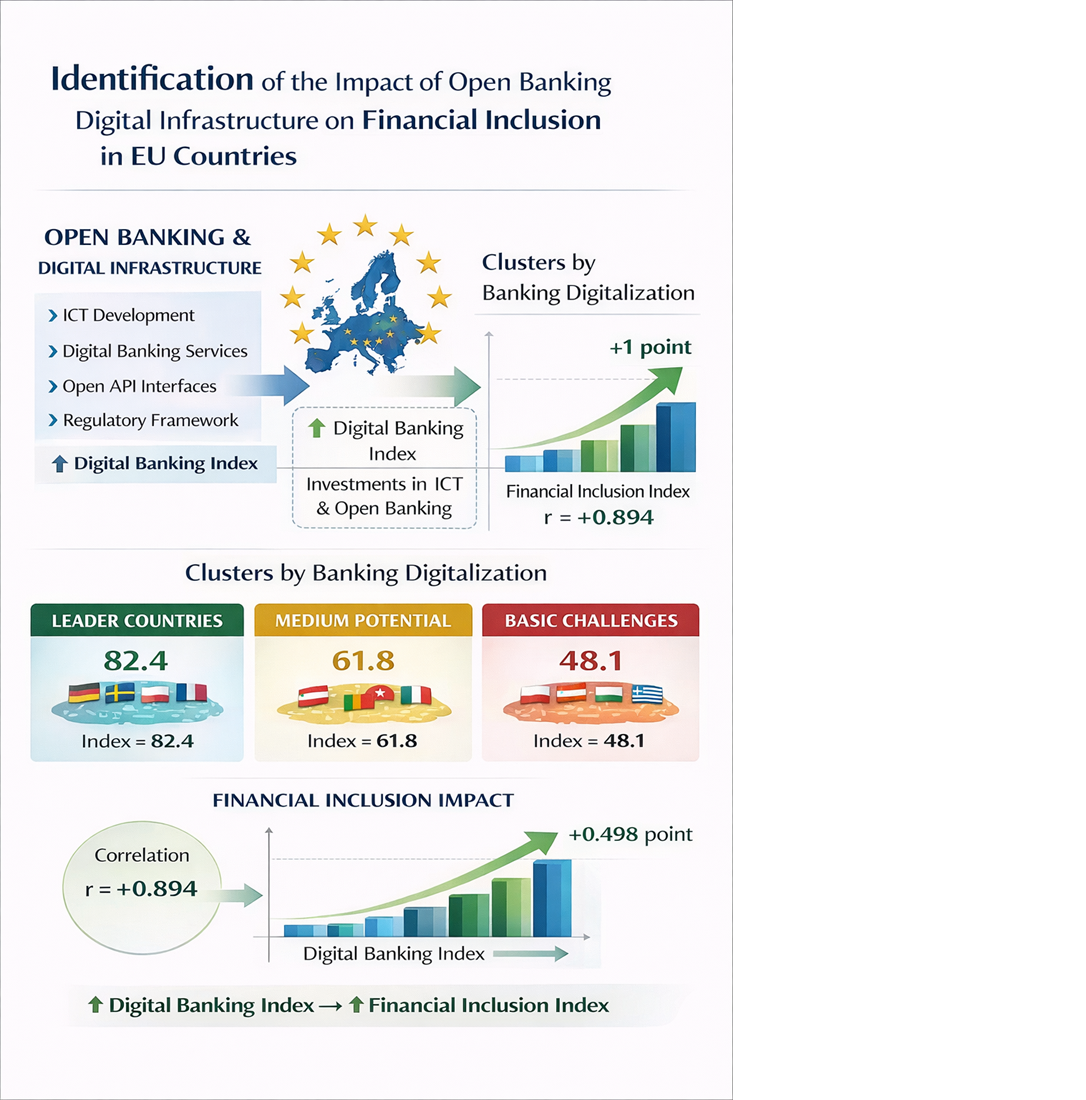
– встановлено сильну позитивну кореляцію між рівнем цифровізації банківської справи та складеним індексом фінансової інклюзії (коефіцієнт Пірсона +0,894);
– збільшення індексу цифровізації банківської справи на один пункт призводить до середнього збільшення складеного індексу фінансової інклюзії на 0,498 пункту (p < 0,001);
– для країн-«лідерів» середній індекс цифровізації банківської справи становив 82,4; для країн із «середнім потенціалом» – 61,8; для країн з «базовими викликами» – 48,1.
Отримані результати пояснюються тим, що технологічний розвиток фінансового сектору створює передумови для зниження транзакційних витрат та появи інноваційних, не територіально прив'язаних послуг. Специфіка результатів полягають у доведенні диференційованого потенціалу відкритого банкінгу: для країн-«лідерів», для країн із «середнім потенціалом», для країн з «базовими викликами».
Практичне значення дослідження полягає в наданні регуляторам та фінансовим установам кількісно обґрунтованих висновків для розробки диференційованих стратегій, що враховують рівень готовності національної екосистеми
Посилання
- Directive (EU) 2015/2366 of the European Parliament and of the Council of 25 November 2015 on payment services in the internal market, amending Directives 2002/65/EC, 2009/110/EC and 2013/36/EU and Regulation (EU) No 1093/2010, and repealing Directive 2007/64/EC. Official Journal of the European Union. Available at: https://eur-lex.europa.eu/legal-content/EN/TXT/HTML/?uri=CELEX:32015L2366
- Odorovic, A. (2023). Open Banking: Between Cooperation and Competition. Anali Pravnog Fakulteta u Beogradu, 71 (1), 65–91. https://doi.org/10.51204/anali_pfbu_23102a
- Fitriana, R., Judijanto, L. (2025). Open Banking API implementation: implications for financial services competition and innovation. International Journal of Financial Economics, 2 (6), 659–667. Available at: https://wikep.net/index.php/IJEFE/article/view/134
- Stefanelli, V., Manta, F. (2023). Digital Financial Services and Open Banking Innovation: Are Banks Becoming ‘invisible’? Global Business Review. https://doi.org/10.1177/09721509231151491
- Polasik, M., Kotkowski, R. (2022). The Open Banking Adoption Among Consumers in Europe: The Role of Privacy, Trust, and Digital Financial Inclusion. SSRN Electronic Journal. https://doi.org/10.2139/ssrn.4105648
- Amer Mohammed, A. M. (2025). Open Banking and APIs: Research on how open banking frameworks and APIs are reshaping the financial ecosystem. International Journal of Advances in Engineering and Management, 7 (4), 770–784. https://doi.org/10.35629/5252-0704770784
- Cosma, S., Cosma, S., Pennetta, D. (2023). The Rise of Financial Services Ecosystems: Towards Open Banking Platforms. The Fintech Disruption, 191–213. https://doi.org/10.1007/978-3-031-23069-1_8
- Spulbar, C., Carbune, D. I. M. (2025). How Open Banking and AI drive financial innovation: evidence from the Romanian banking sector. Revista de Științe Politice, 86, 174–187. Available at: https://cis01.central.ucv.ro/revistadestiintepolitice/files/numarul86_2025/15.pdf
- Wolska, A. (2025). From Isolation to Integration: The Role of Open Banking in the Financial Services Evolution. https://doi.org/10.2139/ssrn.5161824
- Alonso, A., Carbó, J. M., Cuadros-Solas, P., Quintanero, J. (2025). The effects of open banking on fintech providers: evidence using microdata from Spain. SSRN Electronic Journal. https://doi.org/10.2139/ssrn.5528599
- Colangelo, G., Khandelwal, P. (2025). The many shades of open banking: A comparative analysis of rationales and models. Internet Policy Review, 14 (1). https://doi.org/10.14763/2025.1.1821
- Tkalenko, S., Liubachivska, R., Onopriienko, Y., Stetsyk, Y., Petukhova, O. (2025). Current trends in banking activities in the eu: assessment of factors impacting profitability. Financial and Credit Activity Problems of Theory and Practice, 2 (61), 11–23. https://doi.org/10.55643/fcaptp.2.61.2025.4677
- Kinslin, D. (2024). Impact of Regulations on Fintech Firms/Banking and Non-Banking Financial Services. Examining Global Regulations During the Rise of Fintech, 371–428. https://doi.org/10.4018/979-8-3693-3803-2.ch015
- Akyildirim, E., Corbet, S., Mukherjee, A., Ryan, M. (2025). Global perspectives on open banking: Regulatory impacts and market response. Journal of International Financial Markets, Institutions and Money, 101, 102159. https://doi.org/10.1016/j.intfin.2025.102159
- Pereira, C. M. (2025). The uncertain path towards open finance: mutual lessons from the United Kingdom and European Union regulatory approaches. A Research Agenda for Financial Law and Regulation, 83–112. https://doi.org/10.4337/9781803929996.00012
- Abbasov, A. A. (2024). An analysis of the impact of digital banking on the future use of Open Banking: a Toda-Yamamoto causality analysis in the context of Azerbaijan. Journal of Baku Engineering University – Economics and Administration, 8 (2), 167–189. Available at: https://ea.beu.edu.az/articles/15
- Dovhan, O. (2025). Analysis of the development of digital innovations in the financial services market in Ukraine in 2010-2024. Economy and Society, 71. https://doi.org/10.32782/2524-0072/2025-71-48
- Henkler, R., Schubart, C. (2025). Open Banking and automated transaction analysis in the digitalization of business banking: design, opportunities, and challenges of a digital credit process. IU Internationale Hochschule. Available at: https://hdl.handle.net/10419/308823
- Commission Staff Working Document Executive Summary Of The Impact Assessment Accompanying the documents Proposal for a Regulation Of The European Parliament And Of The Council on payment services in the internal market and amending Regulation (EU) No 1093/2010 and Proposal for a Directive Of The European Parliament And Of The Council on payment services and electronic money services in the Internal Market amending Directive 98/26/EC and repealing Directives 2015/2366/EU and 2009/110/EC. Available at: https://eur-lex.europa.eu/legal-content/EN/TXT/HTML/?uri=CELEX:52023SC0232
- Report from the Commission to the European Parliament, the Council, the European Central Bank and the European Economic and Social Committee on the review of Directive 2015/2366/EU of the European Parliament and of the Council on payment services in the internal market. Available at: https://eur-lex.europa.eu/legal-content/EN/TXT/HTML/?uri=CELEX:52023DC0365
- Proposal for a Regulation Of The European Parliament And Of The Council on a framework for Financial Data Access and amending Regulations (EU) No 1093/2010, (EU) No 1094/2010, (EU) No 1095/2010 and (EU) 2022/2554 (Text with EEA relevance). Available at: https://eur-lex.europa.eu/legal-content/EN/TXT/HTML/?uri=CELEX:52023PC0360
- Proposal for a Regulation Of The European Parliament And Of The Council on payment services in the internal market and amending Regulation (EU) No 1093/2010 (Text with EEA relevance). Available at: https://eur-lex.europa.eu/legal-content/EN/TXT/HTML/?uri=CELEX:52023PC0367
- Proposal for a Directive Of The European Parliament And Of The Council on payment services and electronic money services in the Internal Market amending Directive 98/26/EC and repealing Directives 2015/2366/EU and 2009/110/EC (Text with EEA relevance). Available at: https://eur-lex.europa.eu/legal-content/EN/TXT/HTML/?uri=CELEX:52023PC0366
##submission.downloads##
Опубліковано
Як цитувати
Номер
Розділ
Ліцензія
Авторське право (c) 2026 Nurgul Maulina, Amit Dutta, Raushan Gabdualiyeva, Botagoz Duissenbayeva, Nazgul Khamitkhan, Zhanna Tsaurkubule, Karlygash Kamali

Ця робота ліцензується відповідно до Creative Commons Attribution 4.0 International License.
Закріплення та умови передачі авторських прав (ідентифікація авторства) здійснюється у Ліцензійному договорі. Зокрема, автори залишають за собою право на авторство свого рукопису та передають журналу право першої публікації цієї роботи на умовах ліцензії Creative Commons CC BY. При цьому вони мають право укладати самостійно додаткові угоди, що стосуються неексклюзивного поширення роботи у тому вигляді, в якому вона була опублікована цим журналом, але за умови збереження посилання на першу публікацію статті в цьому журналі.
Ліцензійний договір – це документ, в якому автор гарантує, що володіє усіма авторськими правами на твір (рукопис, статтю, тощо).
Автори, підписуючи Ліцензійний договір з ПП «ТЕХНОЛОГІЧНИЙ ЦЕНТР», мають усі права на подальше використання свого твору за умови посилання на наше видання, в якому твір опублікований. Відповідно до умов Ліцензійного договору, Видавець ПП «ТЕХНОЛОГІЧНИЙ ЦЕНТР» не забирає ваші авторські права та отримує від авторів дозвіл на використання та розповсюдження публікації через світові наукові ресурси (власні електронні ресурси, наукометричні бази даних, репозитарії, бібліотеки тощо).
За відсутності підписаного Ліцензійного договору або за відсутністю вказаних в цьому договорі ідентифікаторів, що дають змогу ідентифікувати особу автора, редакція не має права працювати з рукописом.
Важливо пам’ятати, що існує і інший тип угоди між авторами та видавцями – коли авторські права передаються від авторів до видавця. В такому разі автори втрачають права власності на свій твір та не можуть його використовувати в будь-який спосіб.