Creating a polymodel framework for the construction of intelligent decision support systems
DOI:
https://doi.org/10.15587/1729-4061.2026.356307Keywords:
system modeling, data representation, decision-making, multidimensionality of data descriptionAbstract
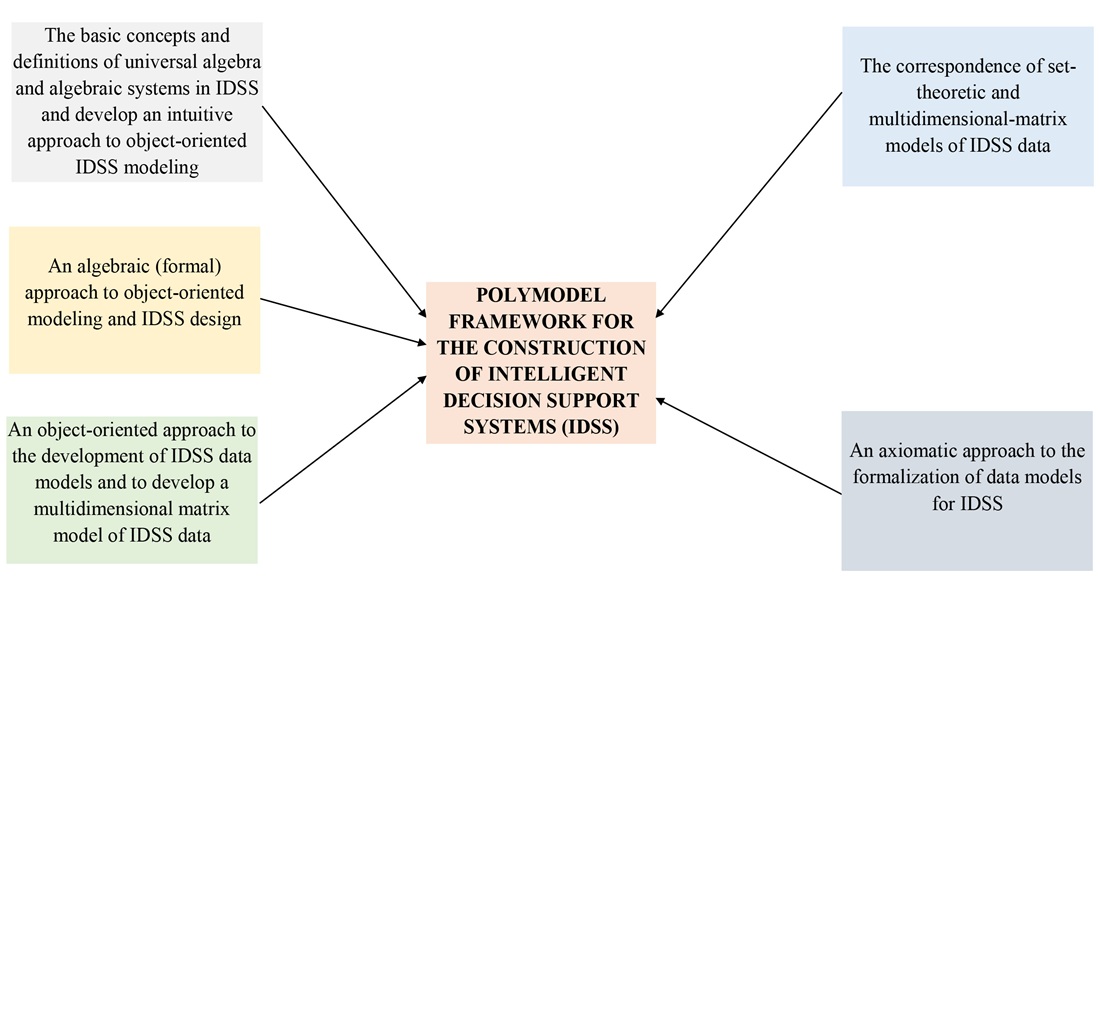
Intelligent decision support systems (IDSS) are the object of the study. The research problem is to improve the accuracy of the mathematical description of the process of processing heterogeneous data in IDSS. The subject of the study is a mathematical description of the processes of processing heterogeneous data in IDSS. The proposed polymodel complex for the construction of IDSS solutions, which allows:
– systemically represent the relationship between IDSS construction models in the course of their calculation and computing tasks;
– simulate the process of functioning of the IDSS, due to the use of an algebraic (formal) approach to object-oriented modeling and design of the IDSS;
– determine the rational tactical and technical indicators of the IDSS for solving specific calculation and computing tasks, due to the multi-level description of the order of construction of the IDSS;
– make the transition from one type of data representation in IDSS to another due to the presence of appropriate mathematical transformations;
– multidimensional to describe the process of processing heterogeneous data in IDSS, due to the use of a multidimensional matrix model of IDSS data;
– approach the solution of computational-calculation tasks in IDSS by using an interconnected set of mathematical models of IDSS construction;
– formalize the process of constructing IDSS, which allows combining IDSSs using different algorithmic and software. The disadvantages of the proposed polymodel complex include the need to adapt the mathematical apparatus to the specific operating conditions of the IDSS.
The proposed polymodel complex should be used for the construction of IDSS to solve general and specialized calculation tasks, as well as to solve the task of integrating various types of IDSS
References
- Kuchuk, N., Shyshatskyi, A., Radchenko, V., Andrusenko, Y., Klivets, S. (2026). Design of a multilevel architecture for optimizing virtual machine migration. Advanced Information Systems, 10 (2), 35–43. https://doi.org/10.20998/2522-9052.2026.2.04
- Dudnyk, V., Sinenko, Y., Matsyk, M., Demchenko, Y., Zhyvotovskyi, R., Repilo, I. et al. (2020). Development of a method for training artificial neural networks for intelligent decision support systems. Eastern-European Journal of Enterprise Technologies, 3 (2 (105)), 37–47. https://doi.org/10.15587/1729-4061.2020.203301
- Sova, O., Shyshatskyi, A., Salnikova, O., Zhuk, O., Trotsko, O., Hrokholskyi, Y. (2021). Development of a method for assessment and forecasting of the radio electronic environment. EUREKA: Physics and Engineering, 4, 30–40. https://doi.org/10.21303/2461-4262.2021.001940
- Pievtsov, H., Turinskyi, O., Zhyvotovskyi, R., Sova, O., Zvieriev, O., Lanetskii, B., Shyshatskyi, A. (2020). Development of an advanced method of finding solutions for neuro-fuzzy expert systems of analysis of the radioelectronic situation. EUREKA: Physics and Engineering, 4, 78–89. https://doi.org/10.21303/2461-4262.2020.001353
- Zuiev, P., Zhyvotovskyi, R., Zvieriev, O., Hatsenko, S., Kuprii, V., Nakonechnyi, O. et al. (2020). Development of complex methodology of processing heterogeneous data in intelligent decision support systems. Eastern-European Journal of Enterprise Technologies, 4 (9 (106)), 14–23. https://doi.org/10.15587/1729-4061.2020.208554
- Li, Z., Xiong, J. (2024). Reactive Power Optimization in Distribution Networks of New Power Systems Based on Multi-Objective Particle Swarm Optimization. Energies, 17 (10), 2316. https://doi.org/10.3390/en17102316
- Lee, B. M. (2025). Efficient Resource Management for Massive MIMO in High-Density Massive IoT Networks. IEEE Transactions on Mobile Computing, 24 (3), 1963–1980. https://doi.org/10.1109/tmc.2024.3486712
- Gasimov, V., Mammadov, J., Islamov, I., Hashimov, E. (2026). Evaluation of alternative solutions for the effective structure of the cyber security system in critical information infrastructures by the hierarchical analysis method. Advanced Information Systems, 10 (2), 87–99. https://doi.org/10.20998/2522-9052.2026.2.10
- Folorunso, O., Mustapha, O. A. (2015). A fuzzy expert system to Trust-Based Access Control in crowdsourcing environments. Applied Computing and Informatics, 11 (2), 116–129. https://doi.org/10.1016/j.aci.2014.07.001
- Mohammad, A. (2020). Development of the concept of electronic government construction in the conditions of synergetic threats. Technology Audit and Production Reserves, 3 (2 (53)), 42–46. https://doi.org/10.15587/2706-5448.2020.207066
- Bodin, L. D., Gordon, L. A., Loeb, M. P., Wang, A. (2018). Cybersecurity insurance and risk-sharing. Journal of Accounting and Public Policy, 37 (6), 527–544. https://doi.org/10.1016/j.jaccpubpol.2018.10.004
- Cormier, A., Ng, C. (2020). Integrating cybersecurity in hazard and risk analyses. Journal of Loss Prevention in the Process Industries, 64, 104044. https://doi.org/10.1016/j.jlp.2020.104044
- Hoffmann, R., Napiórkowski, J., Protasowicki, T., Stanik, J. (2020). Risk based approach in scope of cybersecurity threats and requirements. Procedia Manufacturing, 44, 655–662. https://doi.org/10.1016/j.promfg.2020.02.243
- Perrine, K. A., Levin, M. W., Yahia, C. N., Duell, M., Boyles, S. D. (2019). Implications of traffic signal cybersecurity on potential deliberate traffic disruptions. Transportation Research Part A: Policy and Practice, 120, 58–70. https://doi.org/10.1016/j.tra.2018.12.009
- Isong, A., Stephen, B. U.-A., Asuquo, P., Ihemereze, C., Enang, I. (2026). Machine learning based cloud computing intrusion detection. Advanced Information Systems, 10 (1), 115–125. https://doi.org/10.20998/2522-9052.2026.1.13
- Zarreh, A., Saygin, C., Wan, H., Lee, Y., Bracho, A. (2018). A game theory based cybersecurity assessment model for advanced manufacturing systems. Procedia Manufacturing, 26, 1255–1264. https://doi.org/10.1016/j.promfg.2018.07.162
- Zhuravskyi, Y. (Ed.) (2026). Intelligent decision support systems: methods for optimizing and supporting management decisions. Kharkiv: TECHNOLOGY CENTER PC. https://doi.org/10.15587/978-617-8360-23-8
- Koval, M., Sova, O., Shyshatskyi, A., Artabaiev, Y., Garashchuk, N., Yivzhenko, Y. et al. (2022). Improving the method for increasing the efficiency of decision-making based on bio-inspired algorithms. Eastern-European Journal of Enterprise Technologies, 6 (4 (120)), 6–13. https://doi.org/10.15587/1729-4061.2022.268621
- Shyshatskyi, A. (Ed.) (2024). Information and control systems: modelling and optimizations. Kharkiv: TECHNOLOGY CENTER PC. https://doi.org/10.15587/978-617-8360-04-7
- Voznytsia, A., Sharonova, N., Babenko, V., Ostapchuk, V., Neronov, S., Feoktystov, S. et al. (2025). Development of methods for intelligent assessment of parameters in decision support systems. Eastern-European Journal of Enterprise Technologies, 4 (4 (136)), 73–82. https://doi.org/10.15587/1729-4061.2025.337528
Downloads
Published
How to Cite
Issue
Section
License
Copyright (c) 2026 Nina Kuchuk, Leonid Artushin, Yurii Zhuravskyi, Iraida Stanovska, Oleksii Kononov, Nadiia Protas, Serhii Shostak, Serhii Neronov, Anton Nikitenko, Andrii Veretnov

This work is licensed under a Creative Commons Attribution 4.0 International License.
The consolidation and conditions for the transfer of copyright (identification of authorship) is carried out in the License Agreement. In particular, the authors reserve the right to the authorship of their manuscript and transfer the first publication of this work to the journal under the terms of the Creative Commons CC BY license. At the same time, they have the right to conclude on their own additional agreements concerning the non-exclusive distribution of the work in the form in which it was published by this journal, but provided that the link to the first publication of the article in this journal is preserved.
A license agreement is a document in which the author warrants that he/she owns all copyright for the work (manuscript, article, etc.).
The authors, signing the License Agreement with TECHNOLOGY CENTER PC, have all rights to the further use of their work, provided that they link to our edition in which the work was published.
According to the terms of the License Agreement, the Publisher TECHNOLOGY CENTER PC does not take away your copyrights and receives permission from the authors to use and dissemination of the publication through the world's scientific resources (own electronic resources, scientometric databases, repositories, libraries, etc.).
In the absence of a signed License Agreement or in the absence of this agreement of identifiers allowing to identify the identity of the author, the editors have no right to work with the manuscript.
It is important to remember that there is another type of agreement between authors and publishers – when copyright is transferred from the authors to the publisher. In this case, the authors lose ownership of their work and may not use it in any way.








