Establishing the patterns of change in the fire resistance of tent fabric during treatment with powder paint
DOI:
https://doi.org/10.15587/1729-4061.2026.357600Keywords:
tent fabric, polyester powder paint, intumescent system, fireproof coating, foam cokeAbstract
This study investigates the process that forms a fire-resistant coating based on polyester powder paint on tent fabric. The task addressed is to enable the fire resistance of tent fabric when treated with a coating based on polyester powder paint. This is important as the production of fire-resistant materials for construction is a relevant task.
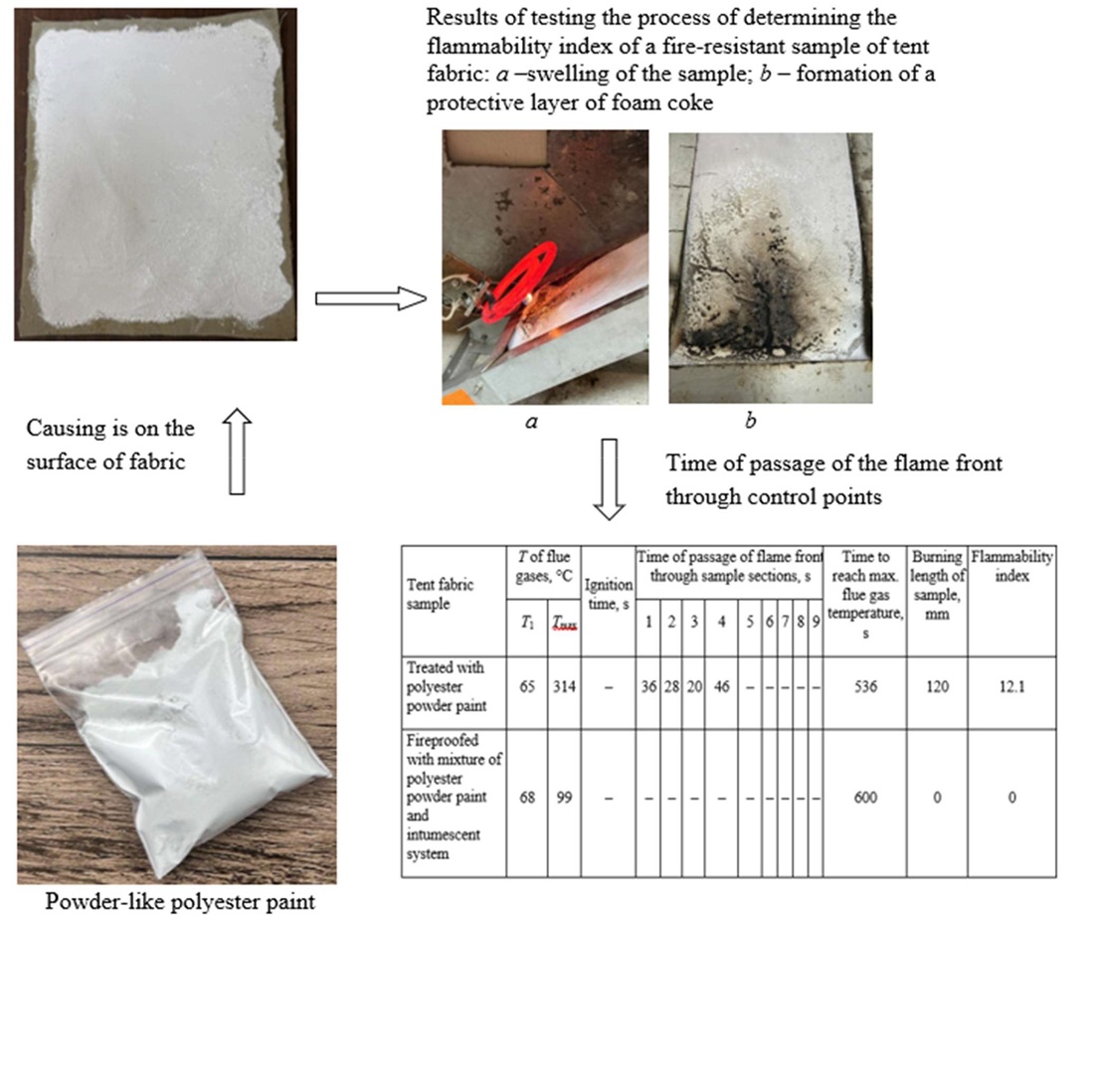
It has been proven that under the influence of a burner flame on a sample of tent fabric treated with a powder coating based on polyester paint, a heat-insulating layer of foam coke of about 4 mm was formed on the surface within 15 s. However, the absence of foam coke was found in some places. A layer of foam coke with a length of more than 50 mm and a width of 20 ÷ 30 formed on the surface of a sample of tent fabric treated with a mixture of polyester powder paint and an intumescent system, while the height of the swelling exceeds 10 mm. This refers the tent fabric to flame-retardant materials as no burning or smoldering was recorded during the temperature exposure, and the temperature did not exceed 100°C.
Studies have shown that the obtained thermogravimetric indicators make it possible to establish the rate of thermal decomposition of the coating at certain temperatures and show a qualitative assessment of thermal effects and thermal destruction of materials, which is characterized by mass loss. Thus, endothermic processes for powder polyester paint begin when 210–290°C is reached with a subsequent intense mass loss of about 70%; when an intumescent system is added, the endothermic effects shift to the region of about 300–340°C with a mass loss of less than 56%. Thus, there is reason to argue about the possibility of effectively designing operationally stable biocomposites for construction
References
- Rabajczyk, A., Zielecka, M., Chmiel, M. (2025). Modern Fire-Resistant Fabrics – Requirements for Durability of Materials After Washing After a Fire. Materials, 19 (1), 44. https://doi.org/10.3390/ma19010044
- Ma, Y., Wu, Z., Qu, M., Chen, R., Guo, J., Bin, Y. (2025). Hydrophobic surface modified calcium alginate fibers for preparing flame retardant and comfortable Janus fabrics. Carbohydrate Polymers, 369, 124340. https://doi.org/10.1016/j.carbpol.2025.124340
- Smith, D. L., Montemayor, M. D., Carosio, F., Grunlan, J. C. (2024). Universal intumescent polyelectrolyte complex treatment for cotton, polyester, and blends thereof. Polymer Degradation and Stability, 228, 110936. https://doi.org/10.1016/j.polymdegradstab.2024.110936
- Chen, S., Liang, F., Jin, L., Ji, C., Xu, N., Qian, K., Guo, W. (2024). A molecularly engineered fully bio-derived phosphorylated furan-based flame retardant for biomass-based fabrics. International Journal of Biological Macromolecules, 263, 129836. https://doi.org/10.1016/j.ijbiomac.2024.129836
- Aly, N. M. (2023). Fire protective textiles. Advances in Healthcare and Protective Textiles, 203–258. https://doi.org/10.1016/b978-0-323-91188-7.00007-8
- Tamás-Bényei, P., Sántha, P. (2022). Potential applications of basalt fibre composites in thermal shielding. Journal of Thermal Analysis and Calorimetry, 148 (2), 271–279. https://doi.org/10.1007/s10973-022-11799-2
- Mohanraj, S. (2022). Effect of Natural Agents on the Mechanical and Flame Retardant Properties of Cotton Fabric–Dyeing Technique. Journal of Testing and Evaluation, 50 (4), 2009–2020. https://doi.org/10.1520/jte20210773
- Faheem, S., Nahid, N., Wiener, J., Baheti, V., Mazari, A., Militky, J. (2022). Estimation of Radiant Heat Resistance of Cotton Fabrics Treated with Bio-Based Flame Retardant. Journal of Fiber Bioengineering and Informatics, 15 (2), 67–77. https://doi.org/10.3993/jfbim00383
- Zhu, W., Wang, S., Peng, W., Xu, S., Liu, J., Ma, K. et al. (2026). Scalable preparation of cottonseed meal-based flame retardants via mechanical grinding for surface modification of cotton fibers. Applied Surface Science, 718, 164879. https://doi.org/10.1016/j.apsusc.2025.164879
- Khan, J., Shibly, M. A. H., Shahruzzaman, M., Muntasir, K. S., Khan, M., Hasan, Md. M. (2026). Evaluation of flame retardant knitted fabrics treated with nitrogen containing natural substances using Taguchi method. Discover Applied Sciences, 8 (2). https://doi.org/10.1007/s42452-025-08163-y
- Ramaiah, G., Meko, R. L., Abreham, A., Negawo, T. A., Baraki, S. Y., Asfaw, D. (2025). Development of eco-friendly, flame-retardant cotton fabric via coating with calcium phosphate extracted from waste chicken bones. Journal of Material Cycles and Waste Management, 28 (1), 232–252. https://doi.org/10.1007/s10163-025-02412-3
- Luo, T., Zhang, X., Chen, J., Gu, M., Hu, Y., Hu, C., Liu, B. (2026). Impact of N-P flame retardants on PET fabric’s fire safety: Combustion resistance and melt-dripping suppression. Colloids and Surfaces A: Physicochemical and Engineering Aspects, 737, 139642. https://doi.org/10.1016/j.colsurfa.2026.139642
- Broido, A. (1969). A simple, sensitive graphical method of treating thermogravimetric analysis data. Journal of Polymer Science Part A-2: Polymer Physics, 7 (10), 1761–1773. https://doi.org/10.1002/pol.1969.160071012
- Tsapko, Y., Tsapko, А., Bondarenko, O., Chudovska, V. (2021). Thermophysical characteristics of the formed layer of foam coke when protecting fabric from fire by a formulation based on modified phosphorus-ammonium compounds. Eastern-European Journal of Enterprise Technologies, 3 (10 (111)), 34–41. https://doi.org/10.15587/1729-4061.2021.233479
- Tsapko, Y., Tsapko, А. (2018). Establishment of fire protective effectiveness of reed treated with an impregnating solution and coatings. Eastern-European Journal of Enterprise Technologies, 4 (10 (94)), 62–68. https://doi.org/10.15587/1729-4061.2018.141030
- Tsapko, Y., Tsapko, А., Berdnyk, O., Likhnyovskyi, R., Bielikova, K., Slutska, O. et al. (2026). Establishing patterns in the formation of a fire-resistant sip panel with hemp insulation. Eastern-European Journal of Enterprise Technologies, 1 (10 (139)), 39–48. https://doi.org/10.15587/1729-4061.2026.352433
- Tsapko, Y., Tsapko, A., Likhnyovskyi, R., Berdnyk, O., Sukhanevych, M., Slutska, O. et al. (2025). Establishing the thermal changes in the foam layer of a biocomposite coating upon the addition of potassium nitrate. Eastern-European Journal of Enterprise Technologies, 5 (10 (137)), 67–76. https://doi.org/10.15587/1729-4061.2025.341605
- Tsapko, Y., Tsapko, А., Bondarenko, O. (2021). Defining patterns of heat transfer through the fire-protected fabric to wood. Eastern-European Journal of Enterprise Technologies, 6 (10 (114)), 49–56. https://doi.org/10.15587/1729-4061.2021.245713
Downloads
Published
How to Cite
Issue
Section
License
Copyright (c) 2026 Yuriy Tsapko, Аleksii Tsapko, Oksana Berdnyk, Ruslan Likhnyovskyi, Tetiana Nehrii, Oksana Kasianova, Stanislav Skarlat, Anduij Lyn, Yarema Velykyi, Roman Konanets

This work is licensed under a Creative Commons Attribution 4.0 International License.
The consolidation and conditions for the transfer of copyright (identification of authorship) is carried out in the License Agreement. In particular, the authors reserve the right to the authorship of their manuscript and transfer the first publication of this work to the journal under the terms of the Creative Commons CC BY license. At the same time, they have the right to conclude on their own additional agreements concerning the non-exclusive distribution of the work in the form in which it was published by this journal, but provided that the link to the first publication of the article in this journal is preserved.
A license agreement is a document in which the author warrants that he/she owns all copyright for the work (manuscript, article, etc.).
The authors, signing the License Agreement with TECHNOLOGY CENTER PC, have all rights to the further use of their work, provided that they link to our edition in which the work was published.
According to the terms of the License Agreement, the Publisher TECHNOLOGY CENTER PC does not take away your copyrights and receives permission from the authors to use and dissemination of the publication through the world's scientific resources (own electronic resources, scientometric databases, repositories, libraries, etc.).
In the absence of a signed License Agreement or in the absence of this agreement of identifiers allowing to identify the identity of the author, the editors have no right to work with the manuscript.
It is important to remember that there is another type of agreement between authors and publishers – when copyright is transferred from the authors to the publisher. In this case, the authors lose ownership of their work and may not use it in any way.








