Development of a hybrid onboard diagnostic architecture with lightweight machine learning for resource-constrained CubeSat systems
DOI:
https://doi.org/10.15587/1729-4061.2026.358310Keywords:
CubeSat onboard diagnostics, fault detection, hybrid FDIR, lightweight machine learningAbstract
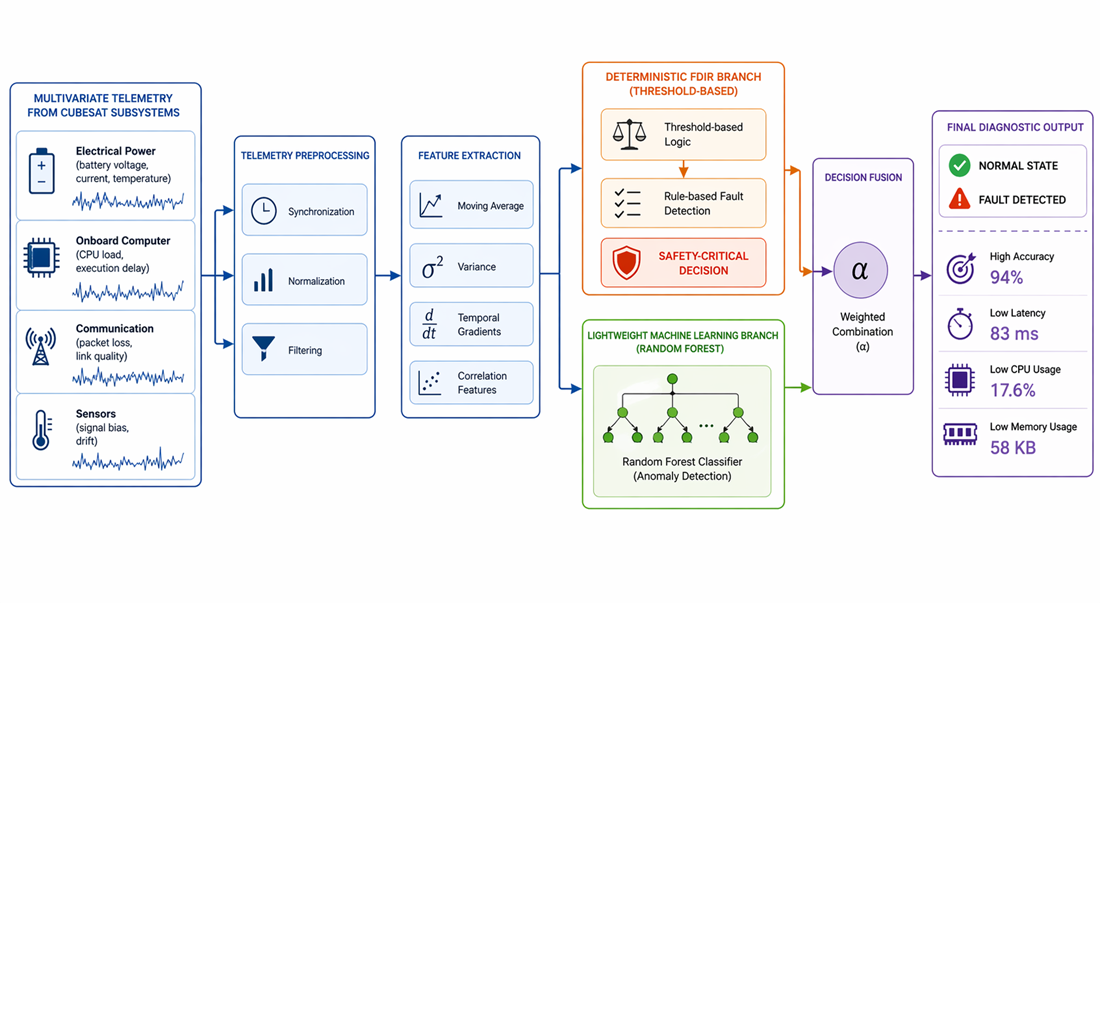
The object of the study is the onboard diagnostic process in CubeSat nanosatellite systems, with particular emphasis on fault detection based on real-time analysis of multivariate telemetry data under real-time embedded operating conditions. The problem statement is the gap between the relatively low computational expenses and predictability of classical FDIR approaches and their limited ability to detect complex anomalies, and, conversely, the greater anomaly sensitivity and lower embedded performance of machine-learning models. A hybrid onboard diagnostic architecture that integrates telemetry acquisition, telemetry preprocessing, statistical feature extraction, a deterministic FDIR branch, a lightweight machine-learning branch, and decision fusion into one onboard diagnostics session has been elaborated. The proposed hybrid onboard diagnostic architecture has been evaluated based on hardware-in-the-loop testing using representative telemetry and fault cases for CubeSat systems. The evaluation metrics were the fault-detection accuracy, the detection latency, the CPU consumption, the memory consumption, and the resistance to telemetry noise. The hybrid onboard diagnostic architecture was compared to the conventional threshold-based FDIR system and standalone machine learning algorithms under the same HIL conditions. In the reported experiment setup, the proposed hybrid onboard diagnostic architecture demonstrated the fault-detection accuracy of 94%, while the classical FDIR method provided 71%, and the standalone machine-learning approach provided 88%. The average detection latency was decreased to 83 ms, in contrast to 120 ms and 95 ms, respectively. The embedded solution requires only 17.6% CPU and 58 KB of memory. Under the highest telemetry-noise level, the fault-detection accuracy of the proposed hybrid onboard diagnostic architecture decreases to 80%, whereas the standalone machine-learning and the classical FDIR baselines provide only 65% and 43% fault-detection accuracy, respectively.
References
- Isermann, R. (2006). Fault-Diagnosis Systems. Springer Berlin Heidelberg. https://doi.org/10.1007/3-540-30368-5
- Patton, R. J., Frank, P. M., Clark, R. N. (Eds.) (2000). Issues of Fault Diagnosis for Dynamic Systems. Springer London. https://doi.org/10.1007/978-1-4471-3644-6
- Venkatasubramanian, V., Rengaswamy, R., Kavuri, S. N., Yin, K. (2003). A review of process fault detection and diagnosis. Computers & Chemical Engineering, 27 (3), 327–346. https://doi.org/10.1016/s0098-1354(02)00162-x
- Oche, P. A., Ewa, G. A., Ibekwe, N. (2024). Applications and Challenges of Artificial Intelligence in Space Missions. IEEE Access, 12, 44481–44509. https://doi.org/10.1109/access.2021.3132500
- Cratere, A., Gagliardi, L., Sanca, G. A., Golmar, F., Dell’Olio, F. (2024). On-Board Computer for CubeSats: State-of-the-Art and Future Trends. IEEE Access, 12, 99537–99569. https://doi.org/10.1109/access.2024.3428388
- Obied, M. A., Ghaleb, F. F. M., Hassanien, A. E., Abdelfattah, A. M. H., Zakaria, W. (2023). Deep Clustering-Based Anomaly Detection and Health Monitoring for Satellite Telemetry. Big Data and Cognitive Computing, 7 (1), 39. https://doi.org/10.3390/bdcc7010039
- Li, Z., Zhang, Y., Ai, J., Zhao, Y., Yu, Y., Dong, Y. (2023). A Lightweight and Explainable Data-Driven Scheme for Fault Detection of Aerospace Sensors. IEEE Transactions on Aerospace and Electronic Systems, 59 (6), 8392–8410. https://doi.org/10.1109/taes.2023.3303855
- Fejjari, A., Delavault, A., Camilleri, R., Valentino, G. (2025). A Review of Anomaly Detection in Spacecraft Telemetry Data. Applied Sciences, 15 (10), 5653. https://doi.org/10.3390/app15105653
- Xu, Z., Cheng, Z., Guo, B. (2023). A hybrid data-driven framework for satellite telemetry data anomaly detection. Acta Astronautica, 205, 281–294. https://doi.org/10.1016/j.actaastro.2023.02.009
- Nalepa, J., Myller, M., Andrzejewski, J., Benecki, P., Piechaczek, S., Kostrzewa, D. (2022). Evaluating algorithms for anomaly detection in satellite telemetry data. Acta Astronautica, 198, 689–701. https://doi.org/10.1016/j.actaastro.2022.06.026
- Hodge, V., Austin, J. (2004). A Survey of Outlier Detection Methodologies. Artificial Intelligence Review, 22 (2), 85–126. https://doi.org/10.1023/b:aire.0000045502.10941.a9
- Shon, T., Moon, J. (2007). A hybrid machine learning approach to network anomaly detection. Information Sciences, 177 (18), 3799–3821. https://doi.org/10.1016/j.ins.2007.03.025
- He, J., Cheng, Z., Guo, B. (2024). Anomaly detection in telemetry data using a jointly optimal one-class support vector machine with dictionary learning. Reliability Engineering & System Safety, 242, 109717. https://doi.org/10.1016/j.ress.2023.109717
- Hedayati, M., Rahimi, A. (2025). A hybrid framework for real-time satellite fault diagnosis using Markov jump-adjusted models and 1D sliding window Residual Networks. Acta Astronautica, 228, 1066–1087. https://doi.org/10.1016/j.actaastro.2024.12.057
- Crotti, E., Colagrossi, A. (2025). Machine Learning Approaches for Data-Driven Self-Diagnosis and Fault Detection in Spacecraft Systems. Applied Sciences, 15 (14), 7761. https://doi.org/10.3390/app15147761
- Lai, Y., Zhu, Y., Li, L., Lan, Q., Zuo, Y. (2025). STGLR: A Spacecraft Anomaly Detection Method Based on Spatio-Temporal Graph Learning. Sensors, 25 (2), 310. https://doi.org/10.3390/s25020310
- Liang, H., Liu, C., Liu, W., Li, W., Zhang, Y. (2025). Spacecraft Health Status Monitoring Method Based on Multidimensional Data Fusion. Machines, 13 (12), 1136. https://doi.org/10.3390/machines13121136
- Liu, M., Xia, Q., Qiu, S. (2024). A new data-driven framework for progressive anomaly event alerts in spacecraft based on reconstruction discrepancy. Advances in Space Research, 74 (11), 5890–5905. https://doi.org/10.1016/j.asr.2024.08.054
Downloads
Published
How to Cite
Issue
Section
License
Copyright (c) 2026 Ainur Kuttybayeva, Samal Zhamalova, Anargul Boranbayeva, Zhansaya Myrzayeva, Gulnar Imasheva, Zhanat Kaskatayev, Yersain Chinibayev, Nurzhamal Ospanova, Mukhit Abdullayev, Kalmukhamed Tazhen

This work is licensed under a Creative Commons Attribution 4.0 International License.
The consolidation and conditions for the transfer of copyright (identification of authorship) is carried out in the License Agreement. In particular, the authors reserve the right to the authorship of their manuscript and transfer the first publication of this work to the journal under the terms of the Creative Commons CC BY license. At the same time, they have the right to conclude on their own additional agreements concerning the non-exclusive distribution of the work in the form in which it was published by this journal, but provided that the link to the first publication of the article in this journal is preserved.
A license agreement is a document in which the author warrants that he/she owns all copyright for the work (manuscript, article, etc.).
The authors, signing the License Agreement with TECHNOLOGY CENTER PC, have all rights to the further use of their work, provided that they link to our edition in which the work was published.
According to the terms of the License Agreement, the Publisher TECHNOLOGY CENTER PC does not take away your copyrights and receives permission from the authors to use and dissemination of the publication through the world's scientific resources (own electronic resources, scientometric databases, repositories, libraries, etc.).
In the absence of a signed License Agreement or in the absence of this agreement of identifiers allowing to identify the identity of the author, the editors have no right to work with the manuscript.
It is important to remember that there is another type of agreement between authors and publishers – when copyright is transferred from the authors to the publisher. In this case, the authors lose ownership of their work and may not use it in any way.








