Evaluation of a machine learning-assisted interactive evolutionary non-dominated sorting genetic algorithm -II framework for hyperparameter optimization of U-Net in agricultural land segmentation
DOI:
https://doi.org/10.15587/1729-4061.2026.359143Keywords:
hyperparameter optimization, precision agriculture, U-Net segmentation, Pareto rank prediction, surrogate-assisted evolutionAbstract
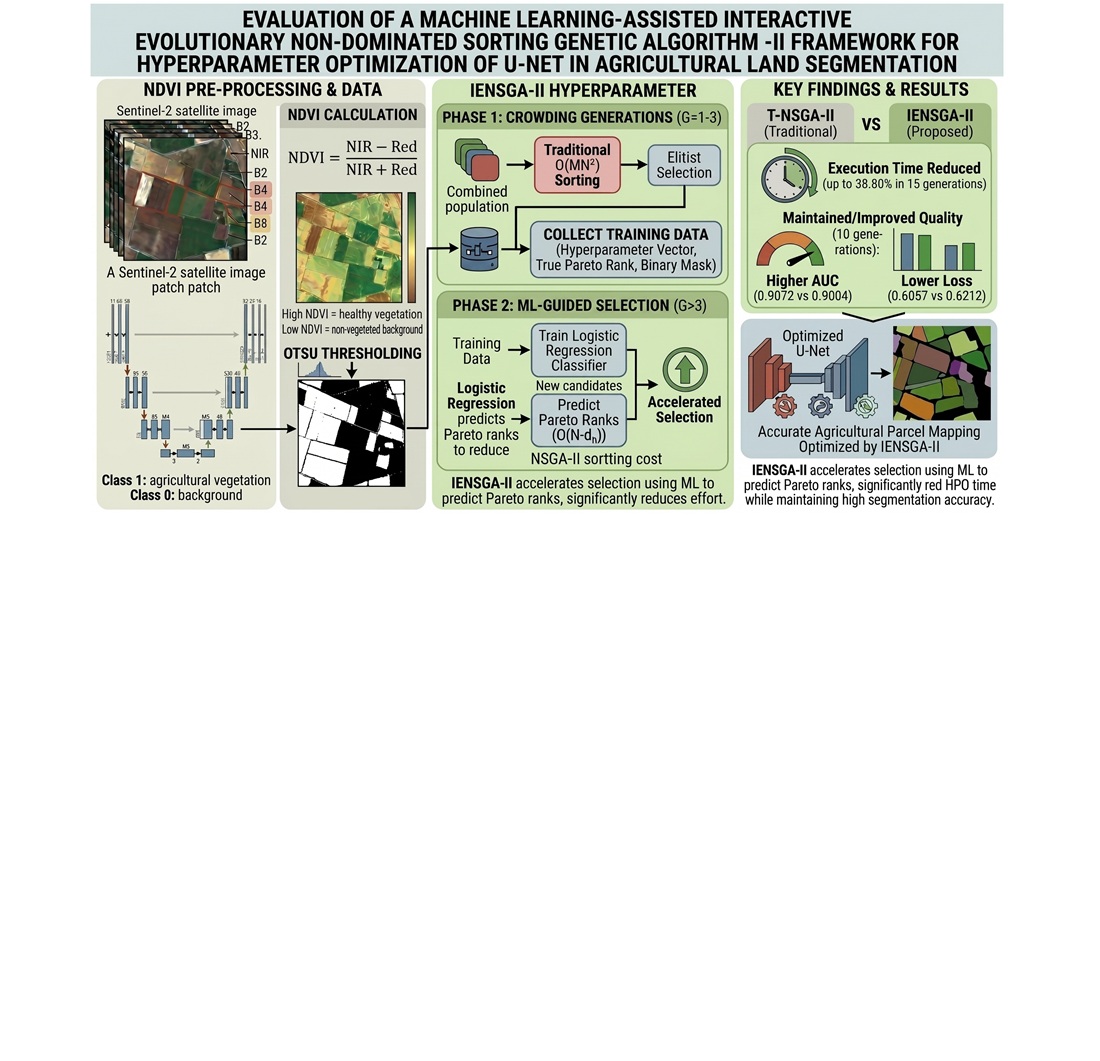
The object of the study is the hyperparameter configuration space of the U-Net architecture for agricultural land segmentation from Sentinel-2 satellite imagery.
The problem being solved is the excessive cost of multi-objective hyperparameter optimization, because non-dominated sorting in the non-dominated sorting genetic algorithm II (NSGA-II), with complexity O(MN2), becomes a bottleneck for deep segmentation models. To address this problem, an interactive evolutionary non-dominated sorting genetic algorithm II (IENSGA-II) framework is evaluated, in which a logistic regression classifier is trained on hyperparameter vectors and Pareto ranks from initial NSGA-II generations, then used to predict ranks in subsequent generations instead of full sorting. Unlike existing surrogate-assisted approaches, this work predicts Pareto ranks without additional model evaluations. On the panoptic agricultural satellite time series (PASTIS) benchmark, the framework reduced execution time by 20.07%, 16.39%, and 38.80% for 5, 10, and 15 generations, and in the 10-generation setting improved validation criteria, reaching an area under the receiver operating characteristic curve (AUC) of 0.9072 versus 0.9004 and validation loss of 0.6057 versus 0.6212. These results were achieved because the method accelerates selection rather than replacing model evaluation, while AUC-based tie-breaking preserves preference for more accurate solutions among candidates with same predicted rank. Effectiveness stems from a regular relationship between hyperparameters and Pareto ranks in early evolutionary data. In practice, the method is used in resource-constrained multi-objective learning when initial generations provide representative data for rank prediction
References
- Zhu, X. X., Tuia, D., Mou, L., Xia, G.-S., Zhang, L., Xu, F., Fraundorfer, F. (2017). Deep Learning in Remote Sensing: A Comprehensive Review and List of Resources. IEEE Geoscience and Remote Sensing Magazine, 5 (4), 8–36. https://doi.org/10.1109/mgrs.2017.2762307
- Ronneberger, O., Fischer, P., Brox, T. (2015). U-Net: Convolutional Networks for Biomedical Image Segmentation. Medical Image Computing and Computer-Assisted Intervention – MICCAI 2015, 234–241. https://doi.org/10.1007/978-3-319-24574-4_28
- Bischl, B., Binder, M., Lang, M., Pielok, T., Richter, J., Coors, S., Thomas, J. et al. (2023). Hyperparameter optimization: Foundations, algorithms, best practices, and open challenges. WIREs Data Mining and Knowledge Discovery, 13 (2). https://doi.org/10.1002/widm.1484
- Deb, K., Pratap, A., Agarwal, S., Meyarivan, T. (2002). A fast and elitist multiobjective genetic algorithm: NSGA-II. IEEE Transactions on Evolutionary Computation, 6 (2), 182–197. https://doi.org/10.1109/4235.996017
- Goldberg, D. E. (1989). Genetic algorithms in search, optimization and machine learning. Addison-Wesley. Available at: https://dl.acm.org/doi/10.5555/534133
- Emmerich, M. T. M., Giannakoglou, K. C., Naujoks, B. (2006). Single- and multiobjective evolutionary optimization assisted by Gaussian random field metamodels. IEEE Transactions on Evolutionary Computation, 10 (4), 421–439. https://doi.org/10.1109/tevc.2005.859463
- Knowles, J. D., Corne, D. W. (2000). Approximating the Nondominated Front Using the Pareto Archived Evolution Strategy. Evolutionary Computation, 8 (2), 149–172. https://doi.org/10.1162/106365600568167
- Li, L., Jamieson, K., DeSalvo, G., Rostamizadeh, A., Talwalkar, A. (2017). Hyperband: a novel bandit-based approach to hyperparameter optimization. Journal of Machine Learning Research, 18. Available at: https://jmlr.org/papers/v18/16-558.html
- Gayibov, A., Gasimov, V. (2025). Interactive Evolutionary NSGA-II with Machine Learning for Efficient Hyperparameter Optimization of Convolutional Neural Networks. 2025 6th International Conference on Problems of Cybernetics and Informatics (PCI), 1–5. https://doi.org/10.1109/pci66488.2025.11219755
- Fare Garnot, V. S., Landrieu, L. (2021). Panoptic Segmentation of Satellite Image Time Series with Convolutional Temporal Attention Networks. 2021 IEEE/CVF International Conference on Computer Vision (ICCV), 4852–4861. https://doi.org/10.1109/iccv48922.2021.00483
- Pedregosa, F., Varoquaux, G., Gramfort, A. et al. (2011). Scikit-learn: machine learning in Python. Journal of Machine Learning Research, 12, 2825–2830. Available at: https://jmlr.org/papers/volume12/pedregosa11a/pedregosa11a.pdf
- Gayibov, A. (2025). Development of a zero-shot classification method for cross-regional crop mapping demonstrating domain transferability in Sentinel-2 imagery. Eastern-European Journal of Enterprise Technologies, 4 (2 (136)), 93–101. https://doi.org/10.15587/1729-4061.2025.338000
- Abadi, M., Barham, P., Chen, J., Chen, Z., Davis, A., Dean, J. et al. (2016). TensorFlow: a system for large-scale machine learning. In Proceedings of the 12th USENIX Symposium on Operating Systems Design and Implementation (OSDI). Available at: https://www.usenix.org/system/files/conference/osdi16/osdi16-abadi.pdf
- Gayibov, A., Gasimov, V. (2026). Extending spectral indices from multispectral satellite data using U-Net segmentation. Radioelectronic and Computer Systems, 1, 207–223. https://doi.org/10.32620/reks.2026.1.14
- Chen, X., Dong, X., Hsieh, C.-J., Huang, D., Le, Q. V., Liang, C. et al. (2023). Symbolic Discovery of Optimization Algorithms. Advances in Neural Information Processing Systems 36, 49205–49233. https://doi.org/10.52202/075280-2140
- O'Malley, T., Bursztein, E., Long, J., Chollet, F., Jin, H., Invernizzi, L. et al. (2019). KerasTuner. Available at: https://github.com/keras-team/keras-tuner
- Srinivas, N., Deb, K. (1994). Muiltiobjective Optimization Using Nondominated Sorting in Genetic Algorithms. Evolutionary Computation, 2 (3), 221–248. https://doi.org/10.1162/evco.1994.2.3.221
- Zitzler, E., Laumanns, M., Thiele, L. (2001). SPEA2: Improving the strength Pareto evolutionary algorithm. TIK-Report, 103. ETH Zurich. Available at: https://sop.tik.ee.ethz.ch/publicationListFiles/zlt2001a.pdf
- Hao, J., Yang, X., Wang, C., Tu, R., Zhang, T. (2022). An Improved NSGA-II Algorithm Based on Adaptive Weighting and Searching Strategy. Applied Sciences, 12 (22), 11573. https://doi.org/10.3390/app122211573
Downloads
Published
How to Cite
Issue
Section
License
Copyright (c) 2026 Artughrul Gayibov, Vagif Gasimov, Esmira Mustafayeva, Kamala Aliyeva, Dilara Guluzada

This work is licensed under a Creative Commons Attribution 4.0 International License.
The consolidation and conditions for the transfer of copyright (identification of authorship) is carried out in the License Agreement. In particular, the authors reserve the right to the authorship of their manuscript and transfer the first publication of this work to the journal under the terms of the Creative Commons CC BY license. At the same time, they have the right to conclude on their own additional agreements concerning the non-exclusive distribution of the work in the form in which it was published by this journal, but provided that the link to the first publication of the article in this journal is preserved.
A license agreement is a document in which the author warrants that he/she owns all copyright for the work (manuscript, article, etc.).
The authors, signing the License Agreement with TECHNOLOGY CENTER PC, have all rights to the further use of their work, provided that they link to our edition in which the work was published.
According to the terms of the License Agreement, the Publisher TECHNOLOGY CENTER PC does not take away your copyrights and receives permission from the authors to use and dissemination of the publication through the world's scientific resources (own electronic resources, scientometric databases, repositories, libraries, etc.).
In the absence of a signed License Agreement or in the absence of this agreement of identifiers allowing to identify the identity of the author, the editors have no right to work with the manuscript.
It is important to remember that there is another type of agreement between authors and publishers – when copyright is transferred from the authors to the publisher. In this case, the authors lose ownership of their work and may not use it in any way.