Удосконалення концептуальних підходів до забезпечення економічної безпеки держави в умовах цифровізації
DOI:
https://doi.org/10.15587/1729-4061.2025.319256Ключові слова:
економічна безпека, цифровий розвиток, інформаційна безпека, безпекоорієнтоване інформаційне середовищеАнотація
Дослідження зосереджено на удосконаленні концептуальних підходів щодо забезпечення економічної безпеки держави з урахуванням тригерних точок впливу інформаційної складової в умовах прискореного цифрового розвитку. Проблема, на вирішення якої спрямовано дослідження, полягає у необхідності забезпечення інформаційної захищеності національної економіки, її стійкості та адаптивності до цифрових ризиків і загроз.
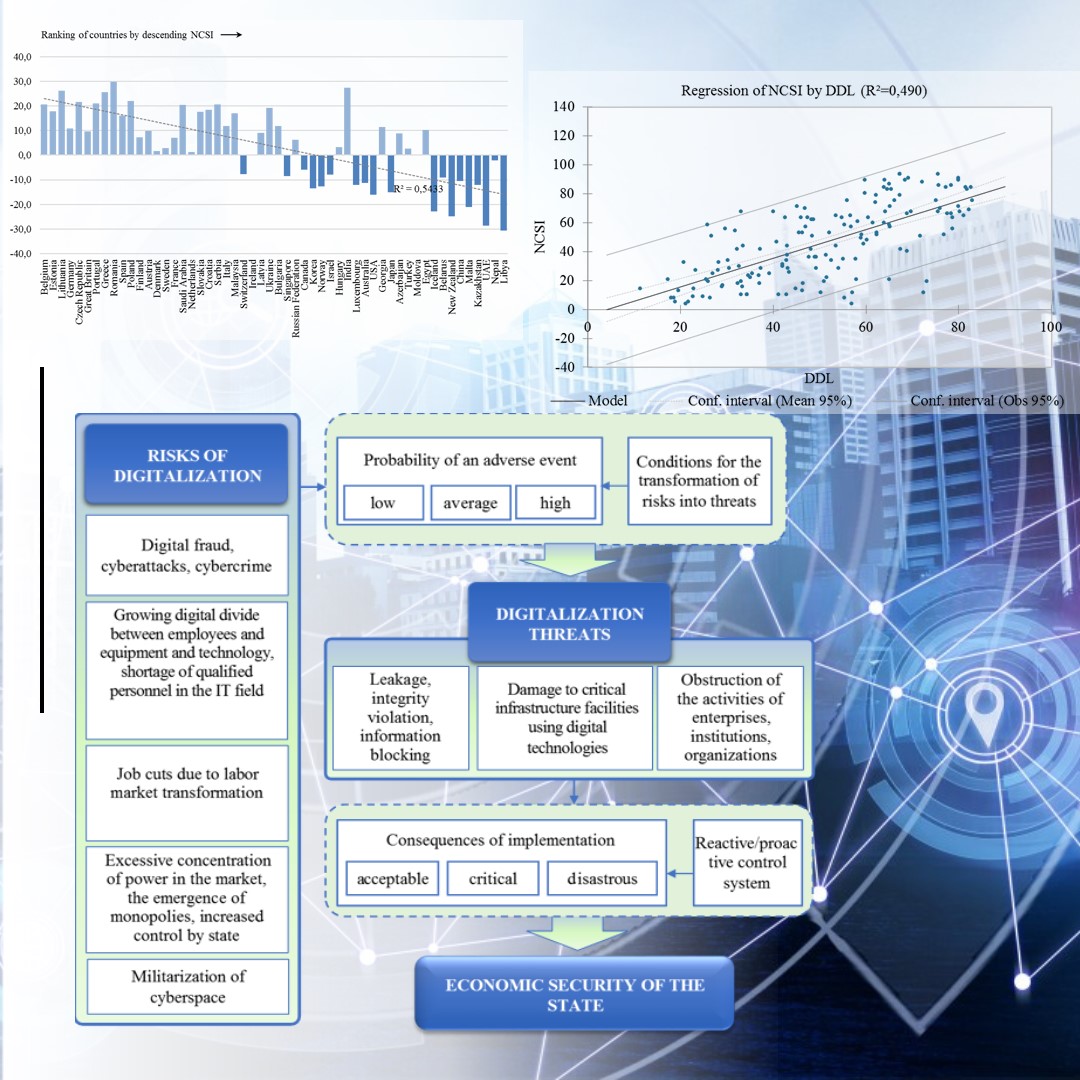
Результати дослідження свідчать про те, що ризики й загрози в інформаційному просторі завдають значних збитків національним економічним системам (більше 4 мільярдів доларів на рік). З урахуванням цього обґрунтовано необхідність двоступеневого проактивного забезпечення економічної безпеки на національному рівні з акцентом на кібербезпеку. Отримані результати демонструють тісний прямий кореляційний зв’язок між рівнем цифровізації економіки та рівнем кібербезпеки – приблизно 49.1 % варіації в рівні кібербезпеки країн можна пояснити варіацією у рівні цифрового розвитку. Виявлено, що деякі країни ставлять в пріоритет кібербезпеку навіть на початкових етапах цифровізації, тоді як інші спочатку розвивають цифрові технології, а вже потім зосереджуються на їх захисті. Визначено тригерні точки впливу інформаційної безпеки на економічну безпеку держави й доведено, що інтеграція безпекових аспектів економічних та інформаційних процесів вимагає формування безпекоорієнтованого інформаційного середовища національної економіки для проактивного забезпечення економічної безпеки держави.
Практична цінність результатів дослідження полягає у можливості їх застосування для реформування державної економічної політики в умовах цифровізації та забезпечення економічної безпеки на всіх рівнях суспільної ієрархії (держава, бізнес, особа, суспільство)
Посилання
- Heath, B. J. (2020). The new national security challenge to the economic order. The Yale Law Journal, 129 (4), 1020–1098. Available at: https://www.yalelawjournal.org/pdf/HeathArticle_jx8mdn4b.pdf
- Onyshchenko, S., Yanko, A., Hlushko, A., Maslii, O. (2023). Economic cybersecurity of business in Ukraine: strategic directions and implementation mechanism. Economic and Cyber Security, 30–58. https://doi.org/10.15587/978-617-7319-98-5.ch2
- Anand, S. C., Teixeira, A. M. H., Ahlén, A. (2024). Risk Assessment of Stealthy Attacks on Uncertain Control Systems. IEEE Transactions on Automatic Control, 69 (5), 3214–3221. https://doi.org/10.1109/tac.2023.3318194
- Yusif, S., Hafeez-Baig, A. (2021). A Conceptual Model for Cybersecurity Governance. Journal of Applied Security Research, 16 (4), 490–513. https://doi.org/10.1080/19361610.2021.1918995
- Edelman, R. D. (2024). Rethinking Cyber Warfare. Oxford University Press. https://doi.org/10.1093/9780197509715.001.0001
- Lysenko, S., Marukhovskyi, O., Krap, A., Illiuschenko, S., Pochapska, O. (2023). The Analysis of World Information Warfare and Information Security in the Context of the Russian-Ukrainian War. Studies in Media and Communication, 11 (7), 150. https://doi.org/10.11114/smc.v11i7.6414
- Agrafiotis, I., Nurse, J. R. C., Goldsmith, M., Creese, S., Upton, D. (2018). A taxonomy of cyber-harms: Defining the impacts of cyber-attacks and understanding how they propagate. Journal of Cybersecurity, 4 (1). https://doi.org/10.1093/cybsec/tyy006
- Global Cyber Security Index. European Union.
- National Cyber Security Index. E-Governance Academy. Available at: https://ncsi.ega.ee/ncsi-index/
- Teece, D. J. (2018). Profiting from innovation in the digital economy: Enabling technologies, standards, and licensing models in the wireless world. Research Policy, 47 (8), 1367–1387. https://doi.org/10.1016/j.respol.2017.01.015
- Digital Progress and Trends Report 2023 (2024). World Bank. https://doi.org/10.1596/978-1-4648-2049-6
- Onyshchenko, V., Yehorycheva, S., Maslii, O., Yurkiv, N. (2021). Impact of Innovation and Digital Technologies on the Financial Security of the State. Proceedings of the 3rd International Conference on Building Innovations, 749–759. https://doi.org/10.1007/978-3-030-85043-2_69
- Onyshchenko, V., Onyshchenko, S., Maslii, O., Maksymenko, A. (2023). Systematization of Threats to Financial Security of Individual, Society, Business and the State in Terms of the Pandemic. Proceedings of the 4th International Conference on Building Innovations, 749–760. https://doi.org/10.1007/978-3-031-17385-1_63
- Bencsik, A. (2020). Challenges of Management in the Digital Economy. International Journal of Technology, 11 (6), 1275. https://doi.org/10.14716/ijtech.v11i6.4461
- Global Risks Report 2024. World Economic Forum. Available at: https://www.weforum.org/publications/global-risks-report-2024/
- Dovhan, O. (Ed.) (2023). Kiberbezpeka vinformatsiynomu suspilstvi. Informatsiyno-analitychnyi daidzhest. Kyiv. Available at: https://ippi.org.ua/sites/default/files/2023-7.pdf
- Onyshchenko, S. V., Masliy, O. A., Buriak, A. A. (2023). Threats and Risks of Ecological and Economic Security of Ukraine in the Conditions of War. 17th International Conference Monitoring of Geological Processes and Ecological Condition of the Environment, 1–5. https://doi.org/10.3997/2214-4609.2023520072
- Lynn, S. (2024). Countries With The Highest Cyber Threat Risk And Ones With The Lowest: Report. Available at: https://www.mescomputing.com/news/4208968/countries-cyber-threat-risk-ones-lowest-report
- Global cybersecurity ranking 2024: Which countries are most at risk? (2024). SecurityDive. Available at: https://securitydive.in/2024/05/14/global-cybersecurity-ranking-2024-which-countries-are-most-at-risk/
- Onyshchenko, S., Yanko, A., Hlushko, A., Maslii, O., Cherviak, A. (2023). Cybersecurity and improvement of the information security system. Journal of the Balkan Tribological Association, 29 (5), 818–835.
- Rong, K. (2022). Research agenda for the digital economy. Journal of Digital Economy, 1 (1), 20–31. https://doi.org/10.1016/j.jdec.2022.08.004
- Onyshchenko, S., Maslii, O., Kivshyk, O., Cherviak, A. (2023). The impact of the insurance market on the financial security of Ukraine. Financial and Credit Activity Problems of Theory and Practice, 1 (48), 268–281. https://doi.org/10.55643/fcaptp.1.48.2023.3976
- Financial watchdog fines Equifax Ltd £11 million for role in one of the largest cyber security breaches in history. Financial Conduct Authority. Available at: https://www.fca.org.uk/news/press-releases/equifax-ltd-fine-cyber-security-breach
- Onyshchenko, S., Yanko, A., Hlushko, A., Maslii, O., Skryl, V. (2023). The Mechanism of Information Security of the National Economy in Cyberspace. Proceedings of the 4th International Conference on Building Innovations, 791–803. https://doi.org/10.1007/978-3-031-17385-1_67
- Krasnobayev, V., Yanko, A., Hlushko, A. (2023). Information Security of the National Economy Based on an Effective Data Control Method. Journal of International Commerce, Economics and Policy, 14 (03). https://doi.org/10.1142/s1793993323500217
- Regulation (EU) 2016/679 of the European Parliament and of the Council of 27 April 2016 on the protection of natural persons with regard to the processing of personal data and on the free movement of such data, and repealing Directive 95/46/EC (General Data Protection Regulation) (Text with EEA relevance). Official Journal of the European Union, L119. Available at: http://data.europa.eu/eli/reg/2016/679/oj
- HM Government. Government Cyber Security Strategy: 2022 to 2030. Available at: https://www.gov.uk/government/publications/government-cyber-security-strategy-2022-to-2030/government-cyber-security-strategy-2022-to-2030-html
- Cybersecurity and Infrastructure Security Agency (CISA). U.S. Department of Homeland Security.
- The European Union Agency for Cybersecurity. Available at: https://www.enisa.europa.eu/
- Onishchenko, S., Matkovskyi, A., Puhach, O. (2014). Analysis of threats to economic security of Ukraine in conditions of innovative economic development. Economic Annals-XXI, 1-2 (2), 8–11. Available at: https://ea21journal.world/index.php/ea-v138-02/
- Onyshchenko, S., Yehorycheva, S., Furmanchuk, O., Maslii, O. (2020). Ukraine Construction Complex Innovation-Oriented Development Management. Proceedings of the 2nd International Conference on Building Innovations, 687–700. https://doi.org/10.1007/978-3-030-42939-3_68
- Svistun, L., Glushko, А., Shtepenko, K. (2018). Organizational Aspects of Development Projects Implementation at the Real Estate Market in Ukraine. International Journal of Engineering & Technology, 7 (3.2), 447. https://doi.org/10.14419/ijet.v7i3.2.14569
- InfraGard. Available at: https://www.infragard.org/
- CyberCorps. Available at: https://www.cybercorps.org/
##submission.downloads##
Опубліковано
Як цитувати
Номер
Розділ
Ліцензія
Авторське право (c) 2025 Oleksandra Maslii, Alona Buriak, Alina Chaikina, Anna Cherviak

Ця робота ліцензується відповідно до Creative Commons Attribution 4.0 International License.
Закріплення та умови передачі авторських прав (ідентифікація авторства) здійснюється у Ліцензійному договорі. Зокрема, автори залишають за собою право на авторство свого рукопису та передають журналу право першої публікації цієї роботи на умовах ліцензії Creative Commons CC BY. При цьому вони мають право укладати самостійно додаткові угоди, що стосуються неексклюзивного поширення роботи у тому вигляді, в якому вона була опублікована цим журналом, але за умови збереження посилання на першу публікацію статті в цьому журналі.
Ліцензійний договір – це документ, в якому автор гарантує, що володіє усіма авторськими правами на твір (рукопис, статтю, тощо).
Автори, підписуючи Ліцензійний договір з ПП «ТЕХНОЛОГІЧНИЙ ЦЕНТР», мають усі права на подальше використання свого твору за умови посилання на наше видання, в якому твір опублікований. Відповідно до умов Ліцензійного договору, Видавець ПП «ТЕХНОЛОГІЧНИЙ ЦЕНТР» не забирає ваші авторські права та отримує від авторів дозвіл на використання та розповсюдження публікації через світові наукові ресурси (власні електронні ресурси, наукометричні бази даних, репозитарії, бібліотеки тощо).
За відсутності підписаного Ліцензійного договору або за відсутністю вказаних в цьому договорі ідентифікаторів, що дають змогу ідентифікувати особу автора, редакція не має права працювати з рукописом.
Важливо пам’ятати, що існує і інший тип угоди між авторами та видавцями – коли авторські права передаються від авторів до видавця. В такому разі автори втрачають права власності на свій твір та не можуть його використовувати в будь-який спосіб.