Розробка моделі аналізу витрат на непередбачені випадки в будівельному проекті з інтеграцією ризиків витрат, часу та якості
DOI:
https://doi.org/10.15587/1729-4061.2025.330351Ключові слова:
будівельний проект, інтеграція ризиків, співвідношення витрат-час-якість, непередбачені витрати, ОГВАнотація
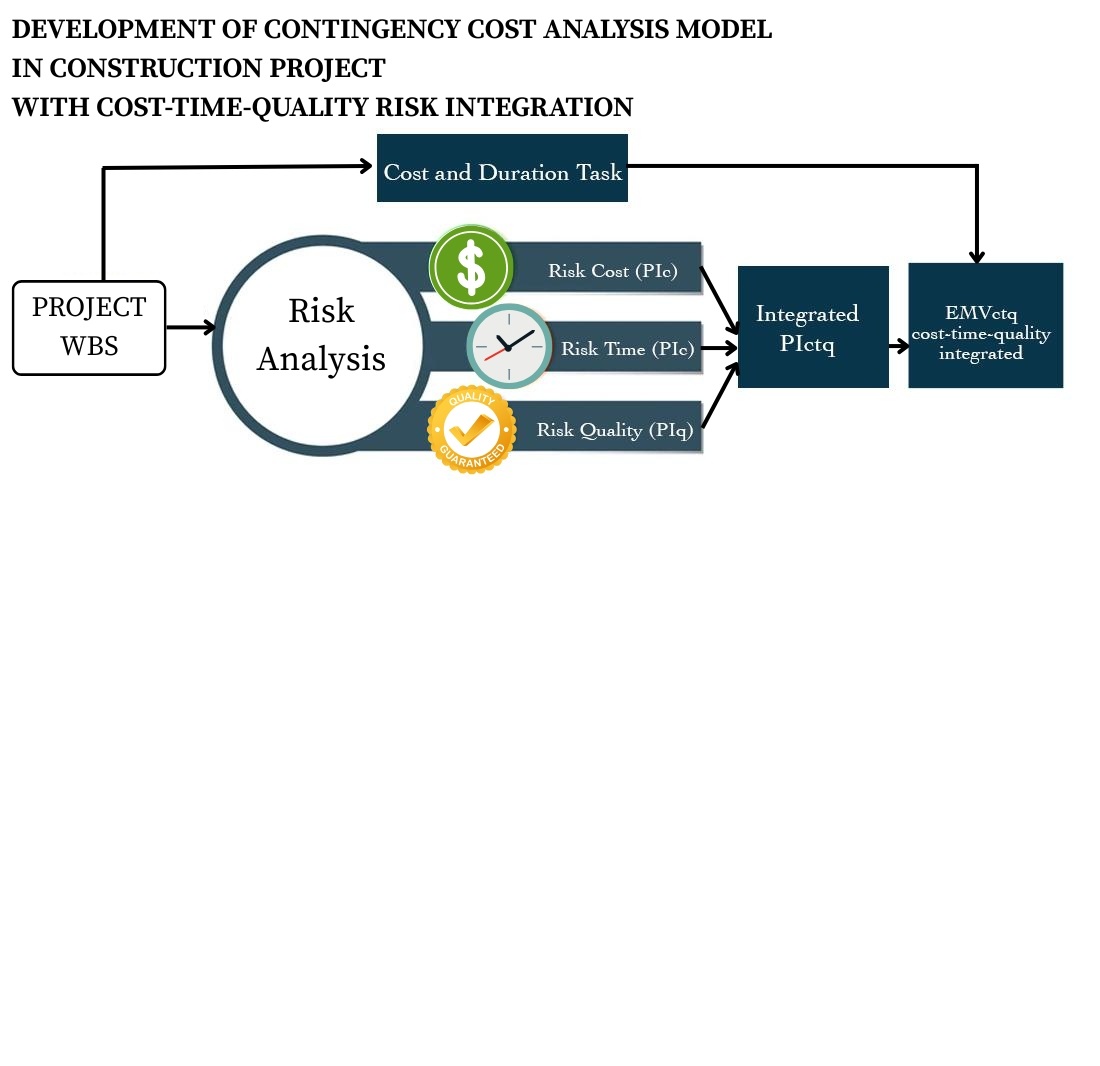
Об’єктом цього дослідження є вартість непередбачених витрат під час реалізації будівельних проектів. Проблема, яку необхідно вирішити, полягає в розробці моделі вартості непередбачених витрат під час реалізації будівельних проектів шляхом інтеграції ризиків, пов’язаних з вартістю, якістю та часом. Раніше використовувані моделі окремо включали ризики вартості, якості та часу. Досі рідко можна знайти аналіз виконання будівельних проектів, який враховує ці три ризики в модель вартості непередбачених витрат. Формулювання цієї інтеграції має вирішальне значення, оскільки кожен проект унікальний і несе різний ступінь ризику. Були досліджені та зібрані дані з проекту покращення доріг провінції Балі, і було застосовано описовий стратегічний аналіз. Використовуючи підхід ймовірності (P) за впливом (I), який є множенням (P) на (I) за шкалою Лайкерта 5, ризики трьох обмежень включені до аналізу очікуваної грошової вартості (ОГВ). Крім того, грошові одиниці використовуються для розробки шкали впливу I, в якій щоденні штрафи та якість з витратами на переробку застосовуються з використанням підходу грошових одиниць з урахуванням часового ефекту. Одночасна сума PI від питань часу, вартості та якості є формулюванням вартості непередбачених витрат ОГВ для інтеграції цих ризиків.
У дослідженні було виявлено, що була створена модель непередбачених витрат, яка враховує фактори ризику вартості, часу та якості. Значення непередбачених витрат цієї моделі становило 9,61% від загальної вартості, коли її застосували до тематичного дослідження. Зокрема, цей висновок знаходиться в межах від 5% до 10%, що є адекватним та узгоджується з емпіричним підходом. Ця модель непередбачених витрат вважається більш раціональною, оскільки вона враховує ризики проекту, включаючи ймовірність потенційних ризиків, а також їх наслідки. Команда проекту може використовувати цей підхід для оцінки непередбачених витрат
Посилання
- Barraza, G. A., Bueno, R. A. (2007). Cost Contingency Management. Journal of Management in Engineering, 23 (3), 140–146. https://doi.org/10.1061/(asce)0742-597x(2007)23:3(140)
- Matějková, J. (2024). Assessing Public Works Procurement in the Czech Republic´s over-limit Regime: Survey Results and Recommendations for Contracting Authorities. Civil and Environmental Engineering Reports, 34 (2), 84–99. https://doi.org/10.59440/ceer/189313
- Leśniak, A. (2023). Delays In Execution Of Building Projects And Their Financial Consequences For Contractors - Polish View. Civil and Environmental Engineering Reports, 33 (1), 99–108. https://doi.org/10.59440/ceer-2023-0007
- Turskis, Z., Zavadskas, E. K., Antucheviciene, J., Kosareva, N. (2015). A Hybrid Model Based on Fuzzy AHP and Fuzzy WASPAS for Construction Site Selection. International Journal of Computers Communications & Control, 10 (6), 113. https://doi.org/10.15837/ijccc.2015.6.2078
- Vaghela, V. N. (2020). Risk management in the construction industry. International Research Journal of Engineering and Technology (IRJET), 7, 584–588. Available at: https://www.irjet.net/archives/V7/i6/IRJET-V7I6107.pdf
- Ziegel, E. R., Vose, D. (1999). Quantitative Risk Analysis. Technometrics, 41 (4), 381. https://doi.org/10.2307/1271374
- Marco, A., Thaheem, M., Grimaldi, S., Rafele, C. (2014). A Framework Methodology for Selection of Risk Analysis Techniques in Construction Projects. Conference: Proceeedings of the Creative Construction Conference 2012. Available at: https://www.researchgate.net/publication/258506573_A_Framework_Methodology_for_Selection_of_Risk_Analysis_Techniques_in_Construction_Projects
- Walke, R., Topkar, V., Kabiraj, S. (2010). Risk Quantification Using EMV Analysis - A Strategic Case of Ready Mix Concrete Plants. International Journal of Computer, 7 (5), 399–408. Available at: https://www.researchgate.net/publication/266214429_Risk_Quantification_Using_EMV_Analysis_-_A_Strategic_Case_of_Ready_Mix_Concrete_Plants
- Purnus, A., Bodea, C.-N. (2014). Correlation between Time and Cost in a Quantitative Risk Analysis of Construction Projects. Procedia Engineering, 85, 436–445. https://doi.org/10.1016/j.proeng.2014.10.570
- Rezaian, A. (2011). Time-Cost-Quality-Risk of Construction and Development Projects or Investment. Middle-East Journal of Scientific Research, 10 (2), 218–223.
- Demir, S. T., Bryde, D. J., Fearon, D. J., Ochieng, E. G. (2014). A tool for integrating time, cost and quality perspectives in Probability Impact (P-I) Tables. International Journal of Project Organisation and Management, 6 (4), 303. https://doi.org/10.1504/ijpom.2014.066410
- Idrus, A., Fadhil Nuruddin, M., Rohman, M. A. (2011). Development of project cost contingency estimation model using risk analysis and fuzzy expert system. Expert Systems with Applications, 38 (3), 1501–1508. https://doi.org/10.1016/j.eswa.2010.07.061
- Jaya, N. M., Sudarsana, D. K. (2023). Development of Contingency Value Analysis Model Using Cost-Time Risk Integration and WBS-Pareto Hybrid in Construction Projects. International Journal on Engineering Applications (IREA), 11 (2), 121. https://doi.org/10.15866/irea.v11i2.23235
- Aloko, M. N. (2018). Risk Assessment Process for Construction Projects in Afghanistan. International Journal of Advanced Engineering Research and Science, 5 (8), 211–217. https://doi.org/10.22161/ijaers.5.8.26
- Simosa, F. (2024). Qualitative Risk Analysis Tools, Definition, Examples. Projectcubicle. Available at: https://www.projectcubicle.com/qualitative-risk-analysis-tools-definition-examples/
- Singam, H. B., Chaudhari, P. S. (2016). Risk Analysis of Construction Project Using Sensitivity Analysis. International Journal of Modern Trends in Engineering and Research, 3(6).
- Hulett, D. T., Nosbisch, M. R. (2018). Integrated Cost / Schedule Risk Analysis Using. Monte Carlo Simulation of CPM Model. Available at: http://www.projectrisk.com/white_papers/Presentation-Hulett-Nosbisch-rev2.pdf
- A guide to the project management body of knowledge (2017). PMI.
- Sudarsana, D. K., Astana, N. Y., Frederika, A., Sanjaya, P. A. (2024). Development of a Quantitative Scale for the Impact of Quality Risk on Construction Project. International Conference on Rehabilitation and Maintenance in Civil Engineering. Available at: https://icrmce06.ft.uns.ac.id/assets/doc/ICRMCE06Guidebook.pdf
- Cooper, D., MacDonald, D., Chapman, C. (1985). Risk analysis of a construction cost estimate. International Journal of Project Management, 3 (3), 141–149. https://doi.org/10.1016/0263-7863(85)90065-1
##submission.downloads##
Опубліковано
Як цитувати
Номер
Розділ
Ліцензія
Авторське право (c) 2025 I Nyoman Yudha Astana, Dewa Ketut Sudarsana, Ariany Frederika, Putu Ari Sanjaya

Ця робота ліцензується відповідно до Creative Commons Attribution 4.0 International License.
Закріплення та умови передачі авторських прав (ідентифікація авторства) здійснюється у Ліцензійному договорі. Зокрема, автори залишають за собою право на авторство свого рукопису та передають журналу право першої публікації цієї роботи на умовах ліцензії Creative Commons CC BY. При цьому вони мають право укладати самостійно додаткові угоди, що стосуються неексклюзивного поширення роботи у тому вигляді, в якому вона була опублікована цим журналом, але за умови збереження посилання на першу публікацію статті в цьому журналі.
Ліцензійний договір – це документ, в якому автор гарантує, що володіє усіма авторськими правами на твір (рукопис, статтю, тощо).
Автори, підписуючи Ліцензійний договір з ПП «ТЕХНОЛОГІЧНИЙ ЦЕНТР», мають усі права на подальше використання свого твору за умови посилання на наше видання, в якому твір опублікований. Відповідно до умов Ліцензійного договору, Видавець ПП «ТЕХНОЛОГІЧНИЙ ЦЕНТР» не забирає ваші авторські права та отримує від авторів дозвіл на використання та розповсюдження публікації через світові наукові ресурси (власні електронні ресурси, наукометричні бази даних, репозитарії, бібліотеки тощо).
За відсутності підписаного Ліцензійного договору або за відсутністю вказаних в цьому договорі ідентифікаторів, що дають змогу ідентифікувати особу автора, редакція не має права працювати з рукописом.
Важливо пам’ятати, що існує і інший тип угоди між авторами та видавцями – коли авторські права передаються від авторів до видавця. В такому разі автори втрачають права власності на свій твір та не можуть його використовувати в будь-який спосіб.