Assessing the state of business energy resilience in the context of crisis management tasks in wartime
DOI:
https://doi.org/10.15587/1729-4061.2025.336529Keywords:
crisis management, environmental uncertainty, business energy resilience, energy resilience assessmentAbstract
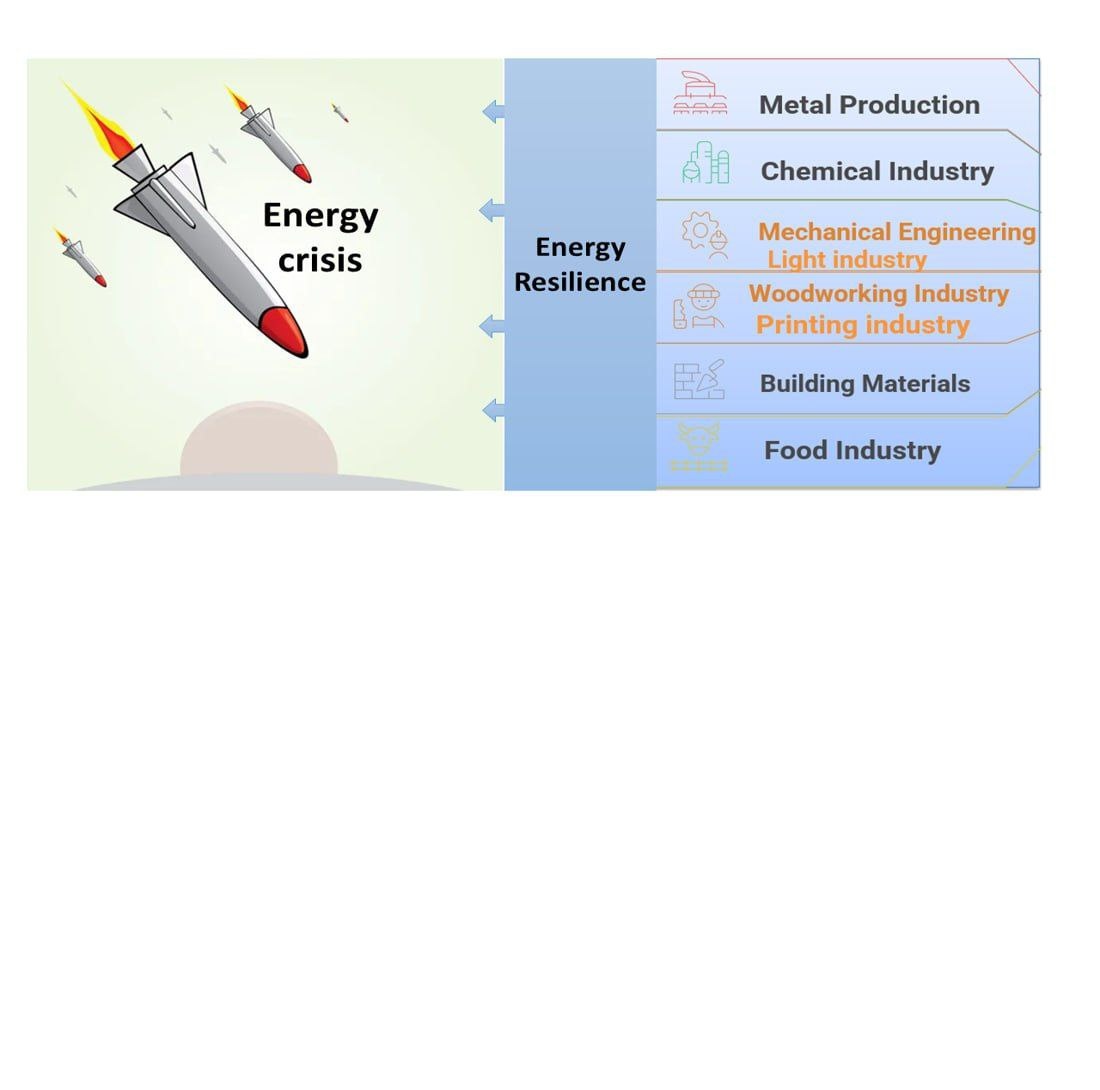
This study's object is the energy resilience of industrial enterprises in Ukraine under martial law. The task considered relates to the insufficient understanding of the consequences of power outages because of the limited availability of reliable empirical data and the lack of tools for comprehensive assessment of business energy resilience. This study is based on the results of monthly surveys of managers from 400–600 enterprises in eight industries, conducted between 2022 and 2024.
A statistically significant relationship between energy problems and a number of business performance indicators has been confirmed. In particular, in 74.4% of cases (35 out of 47), a positive correlation was found, indicating the effective adaptation of most businesses. Negative correlations were found in only 25.5% of cases (12 variables), mainly in mechanical engineering, light industry, and the production of building materials, where power outages had a significant impact on business operations.
Regression models have shown that in most cases (81%), the issue of power supply interruptions is not a critical predictor of decisions to expand business activities. Industrial enterprises are planning to expand their activities despite energy supply problems.
These results are attributed to the implementation of operational anti-crisis measures, corporate strategies, and government support for improving energy security and business continuity during periods of energy instability.
The findings could be used by public authorities to assess sectoral vulnerabilities to energy threats, devise support programs, and design tools for energy crisis planning at regional or industry levels
References
- Widiantoro, D., Shahadan, M. A. (2024). A systematic literature review of crisis management. International Journal of Entrepreneurship and Management Practices, 7 (26), 100–112. https://doi.org/10.35631/ijemp.726008
- Vašíčková, V. (2020). Crisis Management Process - A Literature Review and a Conceptual Integration. Acta Oeconomica Pragensia, 27 (3-4), 61–77. https://doi.org/10.18267/j.aop.628
- Kumar, P. (2020). Twitter, disasters and cultural heritage: A case study of the 2015 Nepal earthquake. Journal of Contingencies and Crisis Management, 28 (4), 453–465. https://doi.org/10.1111/1468-5973.12333
- Wenzel, M., Stanske, S., Lieberman, M. B. (2021). Strategic responses to crisis. Strategic Management Journal, 42 (2), 257–273. https://doi.org/10.1002/smj.3161
- Tyre, M. J., Orlikowski, W. J. (1994). Windows of Opportunity: Temporal Patterns of Technological Adaptation in Organizations. Organization Science, 5 (1), 98–118. https://doi.org/10.1287/orsc.5.1.98
- Duchek, S. (2019). Organizational resilience: a capability-based conceptualization. Business Research, 13 (1), 215–246. https://doi.org/10.1007/s40685-019-0085-7
- Molyneaux, L., Wagner, L., Froome, C., Foster, J. (2012). Resilience and electricity systems: A comparative analysis. Energy Policy, 47, 188–201. https://doi.org/10.1016/j.enpol.2012.04.057
- Melnychuk, N., Dubas, R., Palokha, O. (2022). Energy Independence and Financial Stability of Economic Entities in the Conditions of War. Ekonomika APK, 29 (5), 37–46. https://doi.org/10.32317/2221-1055.202205037
- Sustainable and just economies. Available at: https://www.unescap.org/sites/default/d8files/event-documents/Sustainable%20and%20Just%20Economies.pdf
- Orliuk, M. (2023). Problemy cherez vidkliuchennia svitla vidchuly 87% ukrainskykh pidpryiemstv, – opytuvannia EVA. Censor.Net. Available at: https://biz.censor.net/news/3516429/
- % robochoho chasu pidpryiemstva Kyivshchyny vtratyly cherez vidkliuchennia elektroenerhiyi vnaslidok masovanykh obstriliv enerhostruktury Ukrainy – opytuvannia biznesu (2023). Rupor. Available at: https://rupor.com.ua/news/18-robochoho-chasu-pidpryiemstva-kyivshchyny-vtratyly-cherez-vidkliuchennia-elektroenerhii-vnaslidok-masovanykh-obstriliv-enerhostruktury-ukrainy-opytuvannia-biznesu/
- Yak vidkliuchennia elektroenerhiyi vplyvaie na robotu biznesu? (2022). Debet–Kredyt. Available at: https://news.dtkt.ua/society/economics/80478-iak-vidkliucennia-elektroenergiyi-vplivaje-na-robotu-biznesu
- Bilshist biznesiv v Ukraini mozhe zbankrutuvaty cherez problemy z elektroenerhieiu (2024). Khvylia. Available at: https://help.hvylya.net/uk/294394-bolshinstvo-biznesov-v-ukraine-mozhet-obankrotitsya-iz-za-problem-s-elektroenergiey
- Ukrainska ekonomika za pershe pivrichchia zrosla na 4,1% navit popry nehatyvni faktory (2024). Ministerstvo ekonomiky Ukrainy. Available at: https://me.gov.ua/News/Detail?lang=uk–UA&id=15c2c7e2-4b82-40a6-a638-e15da29bb47f&title=EkonomikaZroslaNa4-1
- Otsinka stiykosti enerhetychnoi infrastruktury Ukrainy. Analitychnyi zvit (2022). DiXi Group. Available at: https://dixigroup.org/wp-content/uploads/2022/05/dixi-energy-resilience-str.pdf
- Su, W., Junge, S. (2023). Unlocking the recipe for organizational resilience: A review and future research directions. European Management Journal, 41 (6), 1086–1105. https://doi.org/10.1016/j.emj.2023.03.002
- Williams, T. A., Gruber, D. A., Sutcliffe, K. M., Shepherd, D. A., Zhao, E. Y. (2017). Organizational Response to Adversity: Fusing Crisis Management and Resilience Research Streams. Academy of Management Annals, 11 (2), 733–769. https://doi.org/10.5465/annals.2015.0134
- Zapłata, S. (2024). Tying Up Loose Ends in Organizational Resilience– Current Status and Future Directions. European Research Studies Journal, XXVII (4), 714–734. http://doi.org/10.35808/ersj/3544
- Annarelli, A., Nonino, F. (2016). Strategic and operational management of organizational resilience: Current state of research and future directions. Omega, 62, 1–18. https://doi.org/10.1016/j.omega.2015.08.004
- Ingram, T., Wieczorek-Kosmala, M., Hlaváček, K. (2023). Organizational Resilience as a Response to the Energy Crisis: Systematic Literature Review. Energies, 16 (2), 702. https://doi.org/10.3390/en16020702
- Marinova-Stoyanova, M. (2024). Evaluation and strategy selection in the anti-crisis management of the energy sector industry. Environment. Technologies. Resources. Proceedings of the International Scientific and Practical Conference, 3, 194–199. https://doi.org/10.17770/etr2024vol3.8158
- Erker, S., Stangl, R., Stoeglehner, G. (2017). Resilience in the light of energy crises – Part I: A framework to conceptualise regional energy resilience. Journal of Cleaner Production, 164, 420–433. https://doi.org/10.1016/j.jclepro.2017.06.163
- Anderson, K., Hotchkiss, E., Myers, L., Stout, S. (2019). Energy Resilience Assessment Methodology. Office of Scientific and Technical Information (OSTI). https://doi.org/10.2172/1573210
- Ludlow, J., Jalil-Vega, F., Schmidt Rivera, X., Garrido, R. A., Hawkes, A., Staffell, I., Balcombe, P. (2021). Organic waste to energy: Resource potential and barriers to uptake in Chile. Sustainable Production and Consumption, 28, 1522–1537. https://doi.org/10.1016/j.spc.2021.08.017
- New Monthly Enterprises Survey. Issue 31. (11.2024) Ukrainian Business in Wartime (2024). The Institute for Economic Research and Policy Consulting. Available at: http://www.ier.com.ua/en/institute/news?pid=7585
- Koefitsient koreliatsii Pirsona (r-Pirsona). Available at: https://www.eztests.xyz/criteria/pearsonr/
- Prezentatsiya rezultativ opytuvannia Amerykanskoi torhovelnoi palaty v Ukraini ta «Deloit» v Ukraini. 19 veresnia 2024 roku. Stiykist biznesu: yak kompaniyi hotuiutsia do zymy 2024–2025. Available at: https://chamber.ua/wp-content/uploads/2024/09/ua_AmCham-Deloitte_Survey.pdf
Downloads
Published
How to Cite
Issue
Section
License
Copyright (c) 2025 Larysa Ligonenko, Vasyl Andriichuk, Nataliia Chukhrayeva, Yana Oliinyk, Andriy Svistun

This work is licensed under a Creative Commons Attribution 4.0 International License.
The consolidation and conditions for the transfer of copyright (identification of authorship) is carried out in the License Agreement. In particular, the authors reserve the right to the authorship of their manuscript and transfer the first publication of this work to the journal under the terms of the Creative Commons CC BY license. At the same time, they have the right to conclude on their own additional agreements concerning the non-exclusive distribution of the work in the form in which it was published by this journal, but provided that the link to the first publication of the article in this journal is preserved.
A license agreement is a document in which the author warrants that he/she owns all copyright for the work (manuscript, article, etc.).
The authors, signing the License Agreement with TECHNOLOGY CENTER PC, have all rights to the further use of their work, provided that they link to our edition in which the work was published.
According to the terms of the License Agreement, the Publisher TECHNOLOGY CENTER PC does not take away your copyrights and receives permission from the authors to use and dissemination of the publication through the world's scientific resources (own electronic resources, scientometric databases, repositories, libraries, etc.).
In the absence of a signed License Agreement or in the absence of this agreement of identifiers allowing to identify the identity of the author, the editors have no right to work with the manuscript.
It is important to remember that there is another type of agreement between authors and publishers – when copyright is transferred from the authors to the publisher. In this case, the authors lose ownership of their work and may not use it in any way.





