Development of a lead-time-first multi-level planning approach for CTO/ATO mass customization supply chains
DOI:
https://doi.org/10.15587/1729-4061.2026.345253Keywords:
lead-time reduction, multi-level planning, postponement strategy, component readiness, demand variabilityAbstract
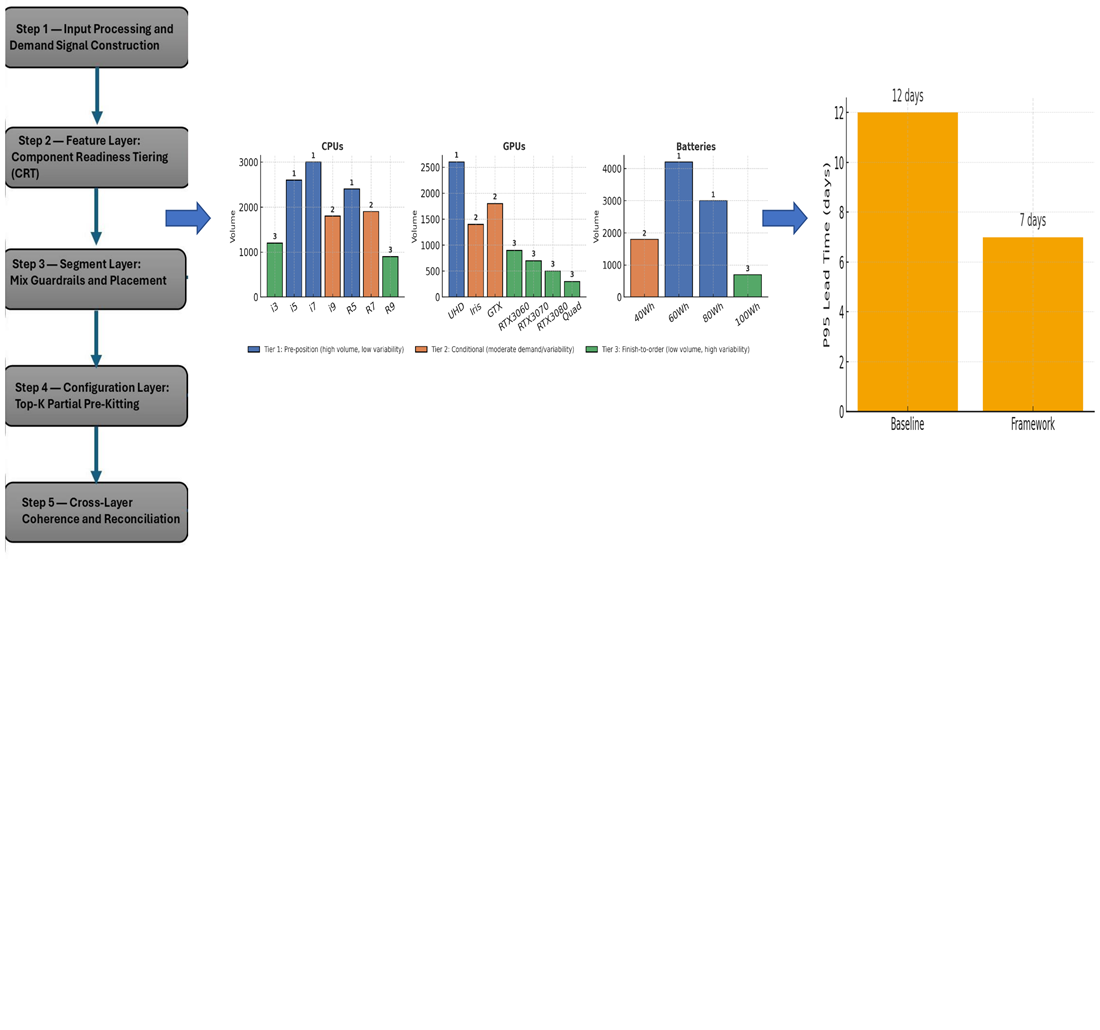
This study examines planning in mass customization contexts that face challenges, due to high product variety, sparse configuration-level demand, and long supplier lead times. Traditional Configure-to-Order and Assemble-to-Order (CTO/ATO) planning approaches often rely on late procurement and full postponement, leading to high and unstable customer lead times. To address this problem, a lead-time-first planning approach is developed to translate historical demand information into executable planning decisions without relying on finished-goods inventory. The approach operates across three levels: feature-level Component Readiness Tiering for upstream component pre-positioning, segment-level Mix Guardrails to control demand heterogeneity, and configuration-level Top-K partial pre-kitting to exploit demand concentration while preserving flexibility through postponement. The approach stands out because it directly links demand variability metrics to operational readiness thresholds. This link enables structured staging and coverage-based configuration selection. The approach is evaluated using a synthetic dataset representing one year of demand for customized laptops. Performance is assessed using lead-time-oriented indicators, including the 95th percentile customer lead time and instant-start rate. Results show improved responsiveness, with the worst-case customer lead time reduced from 12 days to approximately 7 days and immediate production enabled for a significant share of orders. These improvements are explained by early readiness of high-demand components combined with postponed final differentiation. The approach suits modular CTO and ATO environments with clear demand segments, stable high-volume components, and regular planning cycles.
References
- Wang, N. (2021). Retracted on February 24, 2022: Mass Customization Capabilities: Literature Review. The Sixth International Conference on Information Management and Technology, 1–5. https://doi.org/10.1145/3465631.3465728
- Oliveira, J. M., Ramos, P. (2019). Assessing the Performance of Hierarchical Forecasting Methods on the Retail Sector. Entropy, 21 (4), 436. https://doi.org/10.3390/e21040436
- Salvador, F., De Holan, P. M., Salvador, B. Y. F., Holan, P. M. D. E., Piller, F. (2009). Cracking the Code of Mass Customization. MIT Sloan Management Review, 50 (3). Available at: https://www.researchgate.net/publication/265498057_Cracking_the_Code_of_Mass_Customization
- Fogliatto, F. S., da Silveira, G. J. C., Borenstein, D. (2012). The mass customization decade: An updated review of the literature. International Journal of Production Economics, 138 (1), 14–25. https://doi.org/10.1016/j.ijpe.2012.03.002
- Gunasekaran, A. (2007). Build-to-order supply chain management. International Journal of Operations & Production Management, 27 (11). https://doi.org/10.1108/ijopm.2007.02427kaa.001
- Kiefer, D., Grimm, F., Bauer, M., Van, D. (2021). Demand Forecasting Intermittent and Lumpy Time Series: Comparing Statistical, Machine Learning and Deep Learning Methods. Proceedings of the 54th Hawaii International Conference on System Sciences. https://doi.org/10.24251/hicss.2021.172
- Aviv, Y., Federgruen, A. (2001). Design for Postponement: A Comprehensive Characterization of Its Benefits Under Unknown Demand Distributions. Operations Research, 49 (4), 578–598. https://doi.org/10.1287/opre.49.4.578.11229
- El Assad, N., Dachry, A., Fouraiji, H., Dachry, W., Messaoudi, N. (2025). Smart manufacturing paradigms in the context of industry 4.0: Bibliometric analysis. E3S Web of Conferences, 601, 00035. https://doi.org/10.1051/e3sconf/202560100035
- Raza, A., Haouari, L., Pero, M., Absi, N. (2018). Impacts of Industry 4.0 on the Specific Case of Mass Customization Through Modeling and Simulation Approach. Customization 4.0, 217–234. https://doi.org/10.1007/978-3-319-77556-2_14
- Scholz-Reiter, B., Kück, M., Lappe, D. (2014). Prediction of customer demands for production planning – Automated selection and configuration of suitable prediction methods. CIRP Annals, 63 (1), 417–420. https://doi.org/10.1016/j.cirp.2014.03.106
- Vithitsoontorn, C., Chongstitvatana, P. (2022). Demand Forecasting in Production Planning for Dairy Products Using Machine Learning and Statistical Method. 2022 International Electrical Engineering Congress (IEECON), 1–4. https://doi.org/10.1109/ieecon53204.2022.9741683
- van Hoek, R. I. (2001). The rediscovery of postponement a literature review and directions for research. Journal of Operations Management, 19 (2), 161–184. https://doi.org/10.1016/s0272-6963(00)00057-7
- Olhager, J. (2003). Strategic positioning of the order penetration point. International Journal of Production Economics, 85 (3), 319–329. https://doi.org/10.1016/s0925-5273(03)00119-1
- Wikner, J., Rudberg, M. (2005). Integrating production and engineering perspectives on the customer order decoupling point. International Journal of Operations & Production Management, 25 (7), 623–641. https://doi.org/10.1108/01443570510605072
- Yang, B., Burns, N. D., Backhouse, C. J. (2004). Postponement: a review and an integrated framework. International Journal of Operations & Production Management, 24 (5), 468–487. https://doi.org/10.1108/01443570410532542
- Syntetos, A. A., Boylan, J. E. (2005). The accuracy of intermittent demand estimates. International Journal of Forecasting, 21 (2), 303–314. https://doi.org/10.1016/j.ijforecast.2004.10.001
- Nikolopoulos, K. (2021). We need to talk about intermittent demand forecasting. European Journal of Operational Research, 291 (2), 549–559. https://doi.org/10.1016/j.ejor.2019.12.046
- Kourentzes, N., Athanasopoulos, G. (2021). Elucidate structure in intermittent demand series. European Journal of Operational Research, 288 (1), 141–152. https://doi.org/10.1016/j.ejor.2020.05.046
- Teunter, R. H., Syntetos, A. A., Zied Babai, M. (2011). Intermittent demand: Linking forecasting to inventory obsolescence. European Journal of Operational Research, 214 (3), 606–615. https://doi.org/10.1016/j.ejor.2011.05.018
- El Assad, N., Mokhlis, S.-E., Messaoudi, N. (2025). Generation and Validation of a Synthetic Dataset for Demand Modelling in Mass Customization Using Artificial Intelligence Tools. Connected Objects, Artificial Intelligence, Telecommunications and Electronics Engineering, 529–535. https://doi.org/10.1007/978-3-032-01536-5_80
Downloads
Published
How to Cite
Issue
Section
License
Copyright (c) 2026 Nouhaila El Assad, Salah-eddine Mokhlis, Kawtar El Haouti, Najat Messaoudi

This work is licensed under a Creative Commons Attribution 4.0 International License.
The consolidation and conditions for the transfer of copyright (identification of authorship) is carried out in the License Agreement. In particular, the authors reserve the right to the authorship of their manuscript and transfer the first publication of this work to the journal under the terms of the Creative Commons CC BY license. At the same time, they have the right to conclude on their own additional agreements concerning the non-exclusive distribution of the work in the form in which it was published by this journal, but provided that the link to the first publication of the article in this journal is preserved.
A license agreement is a document in which the author warrants that he/she owns all copyright for the work (manuscript, article, etc.).
The authors, signing the License Agreement with TECHNOLOGY CENTER PC, have all rights to the further use of their work, provided that they link to our edition in which the work was published.
According to the terms of the License Agreement, the Publisher TECHNOLOGY CENTER PC does not take away your copyrights and receives permission from the authors to use and dissemination of the publication through the world's scientific resources (own electronic resources, scientometric databases, repositories, libraries, etc.).
In the absence of a signed License Agreement or in the absence of this agreement of identifiers allowing to identify the identity of the author, the editors have no right to work with the manuscript.
It is important to remember that there is another type of agreement between authors and publishers – when copyright is transferred from the authors to the publisher. In this case, the authors lose ownership of their work and may not use it in any way.







