Determining the influence of equipment used in modern cottage cheese production lines on the quantitative and dispersed composition of cheese dust
DOI:
https://doi.org/10.15587/1729-4061.2026.350623Keywords:
cottage cheese production, curd dust contentAbstract
This study investigated a change in the quantitative content and particle size distribution of curd dust during the production of cottage cheese with fat mass fractions of 0.2%, 5%, and 9%.
Modern cottage cheese production lines are characterized by a high level of mechanization of technological processes, which enables high productivity. However, mechanical impact on curd grains leads to their destruction and the formation of curd dust, the particles of which remain in the whey after its separation.
Losses of raw material in the form of curd dust affect the production cost of finished products, complicate further whey processing, and increase its environmental impact.
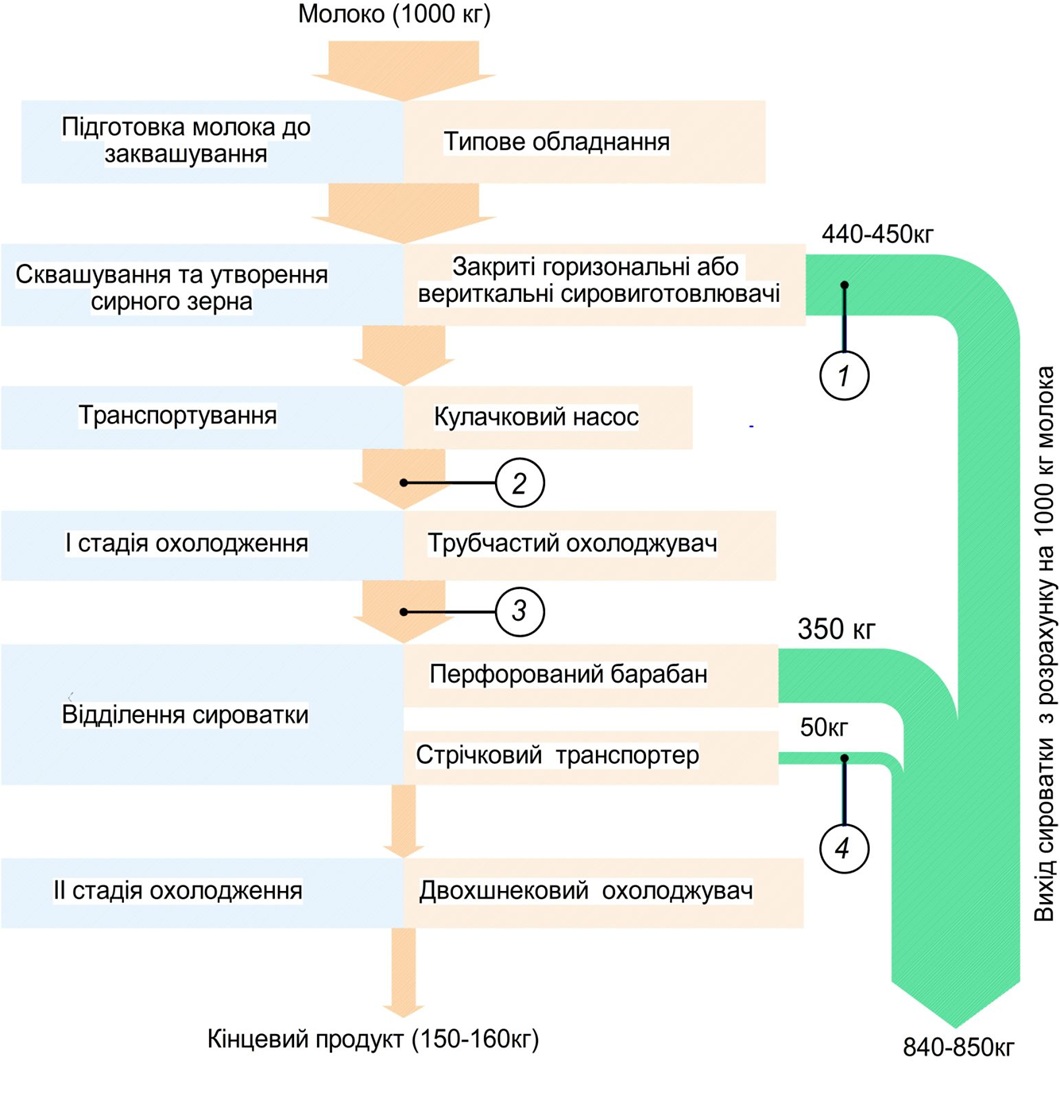
Changes in the curd dust content and its particle size distribution in whey have been investigated at different stages of production, from cutting and stirring the curd coagulum in the curd-making vat to whey separation on a belt conveyor.
The final average content of curd dust in the whey obtained during cottage cheese production was determined to be 4.78 kg/m3.
It was established that, on average, 25% of curd dust is formed in the curd-making vat. The maximum amount of curd dust (62%) is formed during the transportation of curd grains from the curd-making vat to the heat exchanger. In the heat exchanger, 13% of curd dust is formed. The formation of curd dust in the rotary lobe pump is explained by the significant mechanical impact on curd grains in this equipment.
To reduce the level of curd dust formation, heat exchangers with minimal hydraulic resistance should be used for cooling the curd grains. This allows the use of pumps with gentler operating characteristics (compared to rotary lobe pumps) for transporting curd grains from the curd-making vat to the heat exchanger. These measures could be applied in practice to reduce raw material losses during cottage cheese production on modern mechanized production lines
References
- Mirzakulova, A., Sarsembaeva, T., Suleimenova, Z., Kowalski, Ł., Gajdzik, B., Wolniak, R., Bembenek, M. (2025). Whey: Composition, Processing, Application, and Prospects in Functional and Nutritional Beverages – A Review. Foods, 14 (18), 3245. https://doi.org/10.3390/foods14183245
- Souli, I., Fernandes, A., Lopes, A., Gomes, I., Afonso, A., Labiadh, L., Ammar, S. (2025). Treatment of cheese whey wastewater by electrochemical oxidation using BDD, Ti/RuO2-TiO2, and Ti/RuO2-IrO2-Pt anodes: ecotoxicological and energetic evaluation. Environmental Science and Pollution Research, 32 (11), 7058–7069. https://doi.org/10.1007/s11356-025-36174-0
- Bilyi, V., Merzlov, S., Narizhnyy, S., Mashkin, Y., Merzlova, G. (2022). Amino Acid Composition of Whey and Cottage Cheese Under Various Rennet Enzymes. Scientific Horizons, 24 (9), 19–25. https://doi.org/10.48077/scihor.24(9).2021.19-25
- Pires, A. F., Marnotes, N. G., Rubio, O. D., Garcia, A. C., Pereira, C. D. (2021). Dairy By-Products: A Review on the Valorization of Whey and Second Cheese Whey. Foods, 10 (5), 1067. https://doi.org/10.3390/foods10051067
- Moatsou, G., Moschopoulou, E. (2021). CHEESE and WHEY: The Outcome of Milk Curdling. Foods, 10 (5), 1008. https://doi.org/10.3390/foods10051008
- Kravets, O. I., Shynkaryk, M. M. (2011). Viddilennia syrnoi pyliuky vid syrovatky yak shliakh ekonomiyi syrovyny i pidvyshchennia ekolohichnoi bezpeky. Zbirnyk naukovykh prats Vinnytskoho natsionalnoho ahrarnoho universytetu, 8, 13–16. Available at: https://socrates.vsau.edu.ua/repository/card.php?lang=uk&id=3568
- Shynkaryk, M. M., Kravets, O. I. (2011). Analiz hranulometrychnoho skladu syrnoi pyliuky. Naukovi pratsi Odeskoi natsionalnoi akademiyi kharchovykh tekhnolohiy, 2 (40), 266–269. Available at: http://nbuv.gov.ua/UJRN/Np_2011_40%282%29__70
- Aldalur, A., Bustamante, M. Á., Salmerón, J., Barron, L. J. R. (2021). Relationships between cheese-processing conditions and curd and cheese properties to improve the yield of Idiazabal cheese made in small artisan dairies: A multivariate approach. Journal of Dairy Science, 104 (1), 253–269. https://doi.org/10.3168/jds.2020-18926
- Franceschi, P., Malacarne, M., Formaggioni, P., Cipolat-Gotet, C., Stocco, G., Summer, A. (2019). Effect of Season and Factory on Cheese-Making Efficiency in Parmigiano Reggiano Manufacture. Foods, 8 (8), 315. https://doi.org/10.3390/foods8080315
- Everard, C. D., O’Callaghan, D. J., Mateo, M. J., O’Donnell, C. P., Castillo, M., Payne, F. A. (2008). Effects of Cutting Intensity and Stirring Speed on Syneresis and Curd Losses During Cheese Manufacture. Journal of Dairy Science, 91 (7), 2575–2582. https://doi.org/10.3168/jds.2007-0628
- Fagan, C. C., Castillo, M., Payne, F. A., O’Donnell, C. P., O’Callaghan, D. J. (2007). Effect of Cutting Time, Temperature, and Calcium on Curd Moisture, Whey Fat Losses, and Curd Yield by Response Surface Methodology. Journal of Dairy Science, 90 (10), 4499–4512. https://doi.org/10.3168/jds.2007-0329
- Kravets, O., Shynkaryk, M., Kravets, V. (2024). Improvement of environmental sustainability of milk processing enterprises. Scientific Journal of the Ternopil National Technical University, 114 (2), 111–118. https://doi.org/10.33108/visnyk_tntu2024.02.111
Downloads
Published
How to Cite
Issue
Section
License
Copyright (c) 2026 Mariia Shynkaryk, Oleh Kravets, Roman Papernyak, Borys Lukiyanchuk

This work is licensed under a Creative Commons Attribution 4.0 International License.
The consolidation and conditions for the transfer of copyright (identification of authorship) is carried out in the License Agreement. In particular, the authors reserve the right to the authorship of their manuscript and transfer the first publication of this work to the journal under the terms of the Creative Commons CC BY license. At the same time, they have the right to conclude on their own additional agreements concerning the non-exclusive distribution of the work in the form in which it was published by this journal, but provided that the link to the first publication of the article in this journal is preserved.
A license agreement is a document in which the author warrants that he/she owns all copyright for the work (manuscript, article, etc.).
The authors, signing the License Agreement with TECHNOLOGY CENTER PC, have all rights to the further use of their work, provided that they link to our edition in which the work was published.
According to the terms of the License Agreement, the Publisher TECHNOLOGY CENTER PC does not take away your copyrights and receives permission from the authors to use and dissemination of the publication through the world's scientific resources (own electronic resources, scientometric databases, repositories, libraries, etc.).
In the absence of a signed License Agreement or in the absence of this agreement of identifiers allowing to identify the identity of the author, the editors have no right to work with the manuscript.
It is important to remember that there is another type of agreement between authors and publishers – when copyright is transferred from the authors to the publisher. In this case, the authors lose ownership of their work and may not use it in any way.







