Detecting cadmium bioaccumulation in soil and its translocation into agricultural produce
DOI:
https://doi.org/10.15587/1729-4061.2026.351507Keywords:
cadmium contamination, trophic transfer factor, transition coefficient, military operations, milk safetyAbstract
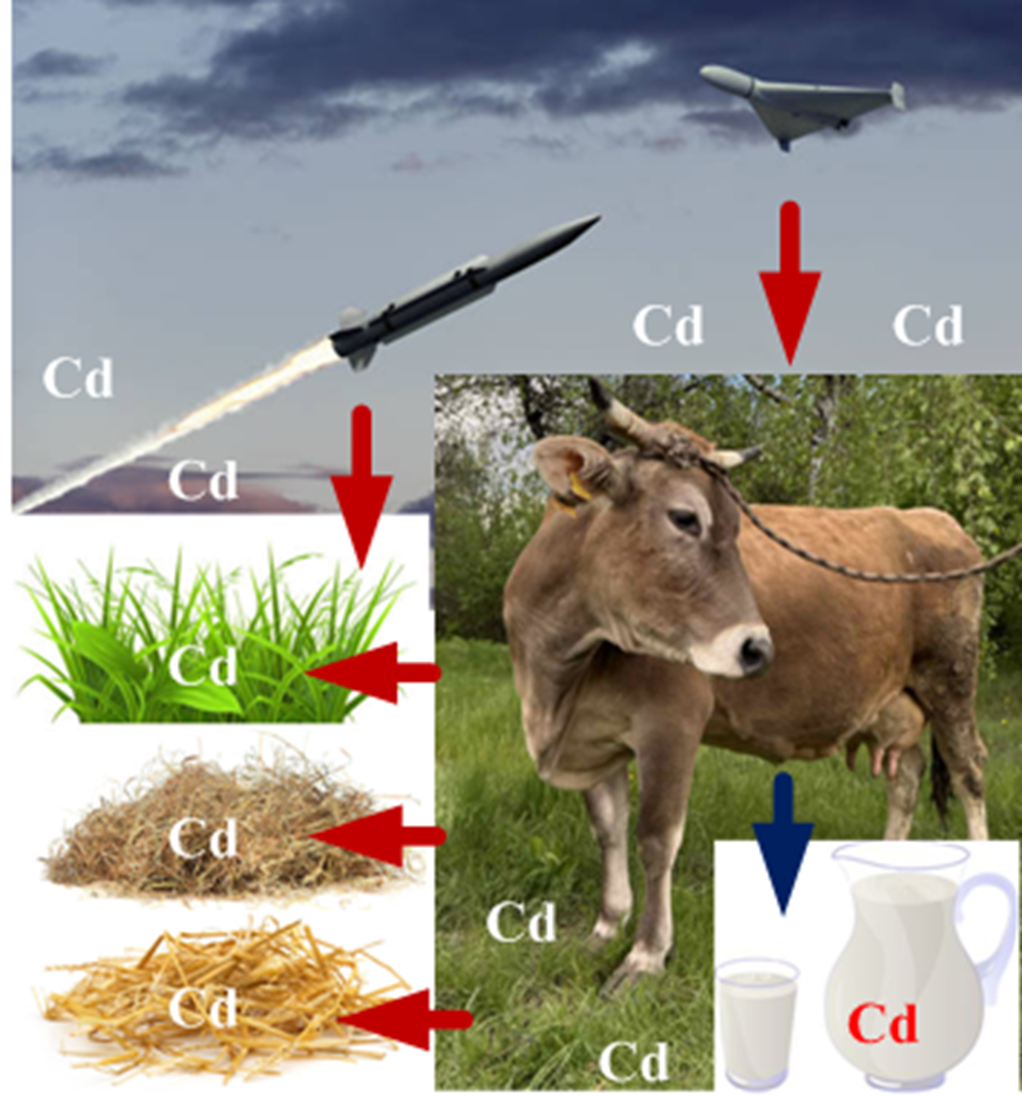
This paper quantifies transition factors (TFs) of Cd from soil to feed for dairy cattle (pasture grass, hay, straw) and to cow's milk.
The study area is a transit area for the movement of military air objects and is likely to be contaminated with heavy metals. Analysis of soil and agricultural produce could make it possible to establish the level of their safety.
Field studies were conducted in July and October 2025 in the village of Sulske (Ukraine), located within 50 km of the combat zone. The concentration of Cd, TFs, and the trophic factor of its transfer from feed to milk (TTF) were determined using generally accepted methods. The concentration of Cd in the soil ranged from 16.49 to 16.82 mg/kg, with the highest value in the soil of agricultural land. Bioaccumulation of Cd in straw (0.036 mg/kg) dominated in October, in grass (0.06 mg/kg) and hay (0.09 mg/kg) in July. Cd levels in grass ranged from 0.034 to 0.06 mg/kg, exceeding the permissible concentration recommended by the World Health Organization (WHO) by three times. Despite this, the TF value in all samples does not exceed 1, which indicates a slight diffusion of heavy metals from chernozems. The Cd concentration in milk was practically the same, exceeding the norm established in Ukraine (0.01 mg/kg) and was 3.8–4.6 times higher than the WHO recommended value. The highest trophic factor of Cd transfer from feed to milk (0.6) is possible when cows are fed straw in July. In October, this indicator is the same for all types of feed (0.3).
The study showed that Cd bioaccumulation occurs in soils, plants, and milk in the territories within a 50-kilometer zone of military operations. The results could be used for subsequent analysis while further monitoring the safety of agricultural produce in this area
References
- Chen, M., Ding, S., Li, C., Tang, Y., Fan, X., Xu, H. et al. (2021). High cadmium pollution from sediments in a eutrophic lake caused by dissolved organic matter complexation and reduction of manganese oxide. Water Research, 190, 116711. https://doi.org/10.1016/j.watres.2020.116711
- Chețan, F., Moraru, P. I., Rusu, T., Șimon, A., Dinca, L., Murariu, G. (2025). From Contamination to Mitigation: Addressing Cadmium Pollution in Agricultural Soils. Agriculture, 15 (20), 2179. https://doi.org/10.3390/agriculture15202179
- Shang, E., Long, A., Yang, J., Ma, Y., Yao, W., Zhang, S. (2025). Dynamics of Cadmium Pollution Risk in Agricultural Land Soil of Tropical Islands in China from 2000 to 2024: A Case Study of Hainan Island. Applied Sciences, 15 (7), 3817. https://doi.org/10.3390/app15073817
- Friberg, L., Kjellström, T., Elinder, C.-G., Nordberg, G. F. (2019). Cadmium and Health: A Toxicological and Epidemiological Appraisal. CRC Press. https://doi.org/10.1201/9780429260605
- Jia, S., Zhao, X., Huang, J., Yao, X., Xie, F. (2025). Phosphorus Alleviates Cadmium Damage by Reducing Cadmium Accumulation and Enhancing Antioxidant Enzymes at the Vegetative Phase in Soybean. Agronomy, 15 (3), 637. https://doi.org/10.3390/agronomy15030637
- Angon, P. B., Islam, Md. S., KC, S., Das, A., Anjum, N., Poudel, A., Suchi, S. A. (2024). RETRACTED: Sources, effects and present perspectives of heavy metals contamination: Soil, plants and human food chain. Heliyon, 10 (7), e28357. https://doi.org/10.1016/j.heliyon.2024.e28357
- Islam, M. N., Nguyen, X. P., Jung, H.-Y., Park, J.-H. (2015). Chemical Speciation and Quantitative Evaluation of Heavy Metal Pollution Hazards in Two Army Shooting Range Backstop Soils. Bulletin of Environmental Contamination and Toxicology, 96 (2), 179–185. https://doi.org/10.1007/s00128-015-1689-z
- Kicińska, A., Pomykała, R., Izquierdo‐Diaz, M. (2021). Changes in soil pH and mobility of heavy metals in contaminated soils. European Journal of Soil Science, 73 (1). https://doi.org/10.1111/ejss.13203
- Altahaan, Z., Dobslaw, D. (2024). The Impact of War on Heavy Metal Concentrations and the Seasonal Variation of Pollutants in Soils of the Conflict Zone and Adjacent Areas in Mosul City. Environments, 11 (11), 247. https://doi.org/10.3390/environments11110247
- Suciu, N. A., De Vivo, R., Rizzati, N., Capri, E. (2022). Cd content in phosphate fertilizer: Which potential risk for the environment and human health? Current Opinion in Environmental Science & Health, 30, 100392. https://doi.org/10.1016/j.coesh.2022.100392
- Ben Ameur, W., Annabi, A., Rania, K., Marini, M. (2025). Assessment of Heavy Metal Contamination and Human Health Risk in Parapenaeus longirostris from Coastal Tunisian Aquatic Ecosystems. Pollutants, 5 (3), 23. https://doi.org/10.3390/pollutants5030023
- Ali, H., Khan, E. (2018). Trophic transfer, bioaccumulation, and biomagnification of non-essential hazardous heavy metals and metalloids in food chains/webs – Concepts and implications for wildlife and human health. Human and Ecological Risk Assessment: An International Journal, 25 (6), 1353–1376. https://doi.org/10.1080/10807039.2018.1469398
- Boudebbouz, A., Boudalia, S., Bousbia, A., Habila, S., Boussadia, M. I., Gueroui, Y. (2021). Heavy metals levels in raw cow milk and health risk assessment across the globe: A systematic review. Science of The Total Environment, 751, 141830. https://doi.org/10.1016/j.scitotenv.2020.141830
- Samilyk, M., Bokovets, S., Kovalenko, O., Ryzhkova, T., Hnoievyi, I., Hrinchenko, D. et al. (2025). Revealing the impact of military activities on the safety of agricultural produce. Eastern-European Journal of Enterprise Technologies, 6 (11 (138)), 47–53. https://doi.org/10.15587/1729-4061.2025.343273
- Samilyk, M., Synenko, T., Bolgova, N., Lukhanin, B., Borozenets, N. (2025). Assessment of the risk of pollution of the ecosystem and agricultural products in the zone of military conflict. Technology Audit and Production Reserves, 5 (3 (85)), 23–28. https://doi.org/10.15587/2706-5448.2025.341902
- Samilyk, M. (2025). Assessment of the state of lead contamination of soil and agricultural products in the territory near the combat zone. EUREKA: Life Sciences, 4, 30–38. https://doi.org/10.21303/2504-5695.2025.004071
- Guo, J., Wei, Z., Zhang, C., Li, C., Dai, L., Lu, X. et al. (2022). Characteristics and DGT Based Bioavailability of Cadmium in the Soil–Crop Systems from the East Edge of the Dongting Lake, China. International Journal of Environmental Research and Public Health, 20 (1), 30. https://doi.org/10.3390/ijerph20010030
- Yashchenko, L., Androshchuk, O., Vasylenko, L., Chornoivan, Y. (2025). Environmental risks of heavy metal pollution in war-affected soils in Ukraine. European Journal of Environmental Sciences, 15 (1), 18–27. https://doi.org/10.14712/23361964.2025.3
- Genchi, G., Sinicropi, M. S., Lauria, G., Carocci, A., Catalano, A. (2020). The Effects of Cadmium Toxicity. International Journal of Environmental Research and Public Health, 17 (11), 3782. https://doi.org/10.3390/ijerph17113782
- Ghoochani, M., Rastkari, N., Yunesian, M., Nabizadeh Nodehi, R., Mesdaghinia, A. et al. (2017). What do we know about exposure of Iranians to cadmium? Findings from a systematic review. Environmental Science and Pollution Research, 25 (2), 1–11. https://doi.org/10.1007/s11356-017-0863-8
- Adamczyk-Szabela, D., Wolf, W. M. (2022). The Impact of Soil pH on Heavy Metals Uptake and Photosynthesis Efficiency in Melissa officinalis, Taraxacum officinalis, Ocimum basilicum. Molecules, 27 (15), 4671. https://doi.org/10.3390/molecules27154671
- Nascimento, S. S., Silva, E. B., Alleoni, L. R. F., Grazziotti, P. H., Fonseca, F. G., Nardis, B. O. (2014). Availability and accumulation of lead for forage grasses in contaminated soil. Journal of Soil Science and Plant Nutrition, ahead. https://doi.org/10.4067/s0718-95162014005000063
Downloads
Published
How to Cite
Issue
Section
License
Copyright (c) 2026 Maryna Samilyk, Serhii Bokovets, Oleh Bakhmat, Ulyana Nedilska, Taisia Ryzhkova, Ihor Hnoievyі, Dmytro Hrinchenko, Alla Petrenko, Anna Hotvianska, Yevhen Yevtushenko

This work is licensed under a Creative Commons Attribution 4.0 International License.
The consolidation and conditions for the transfer of copyright (identification of authorship) is carried out in the License Agreement. In particular, the authors reserve the right to the authorship of their manuscript and transfer the first publication of this work to the journal under the terms of the Creative Commons CC BY license. At the same time, they have the right to conclude on their own additional agreements concerning the non-exclusive distribution of the work in the form in which it was published by this journal, but provided that the link to the first publication of the article in this journal is preserved.
A license agreement is a document in which the author warrants that he/she owns all copyright for the work (manuscript, article, etc.).
The authors, signing the License Agreement with TECHNOLOGY CENTER PC, have all rights to the further use of their work, provided that they link to our edition in which the work was published.
According to the terms of the License Agreement, the Publisher TECHNOLOGY CENTER PC does not take away your copyrights and receives permission from the authors to use and dissemination of the publication through the world's scientific resources (own electronic resources, scientometric databases, repositories, libraries, etc.).
In the absence of a signed License Agreement or in the absence of this agreement of identifiers allowing to identify the identity of the author, the editors have no right to work with the manuscript.
It is important to remember that there is another type of agreement between authors and publishers – when copyright is transferred from the authors to the publisher. In this case, the authors lose ownership of their work and may not use it in any way.







