Devising an approach to prototyping a worn or deformed aviation part based on reverse engineering
DOI:
https://doi.org/10.15587/1729-4061.2026.351776Keywords:
reverse engineering, 3D scanning, geometry reconstruction, geometry accuracy, reconstruction algorithm, digital model, surface controlAbstract
This study estimates the geometric accuracy of an aviation part's digital model constructed from a portrait. The task addressed is to reproduce the geometry of an aviation part based on its original dimensions.
A procedure is proposed for reconstructing the geometry of aviation parts that have wear or deformation (changes in size and shape from the rated ones) and assessing the accuracy of a digital 3D model using RE methods. An approach to digitizing test parts using RE is suggested in the form of a general algorithm for generating data on a digital 3D model of a test part. The algorithm includes 3D scanning, point cloud processing, polygonal model construction, analysis of “shadow zones”, and additional iterations with a change in the position of the part. The latter allowed for high-precision identification of the geometry of the original test part for building a digital 3D model.
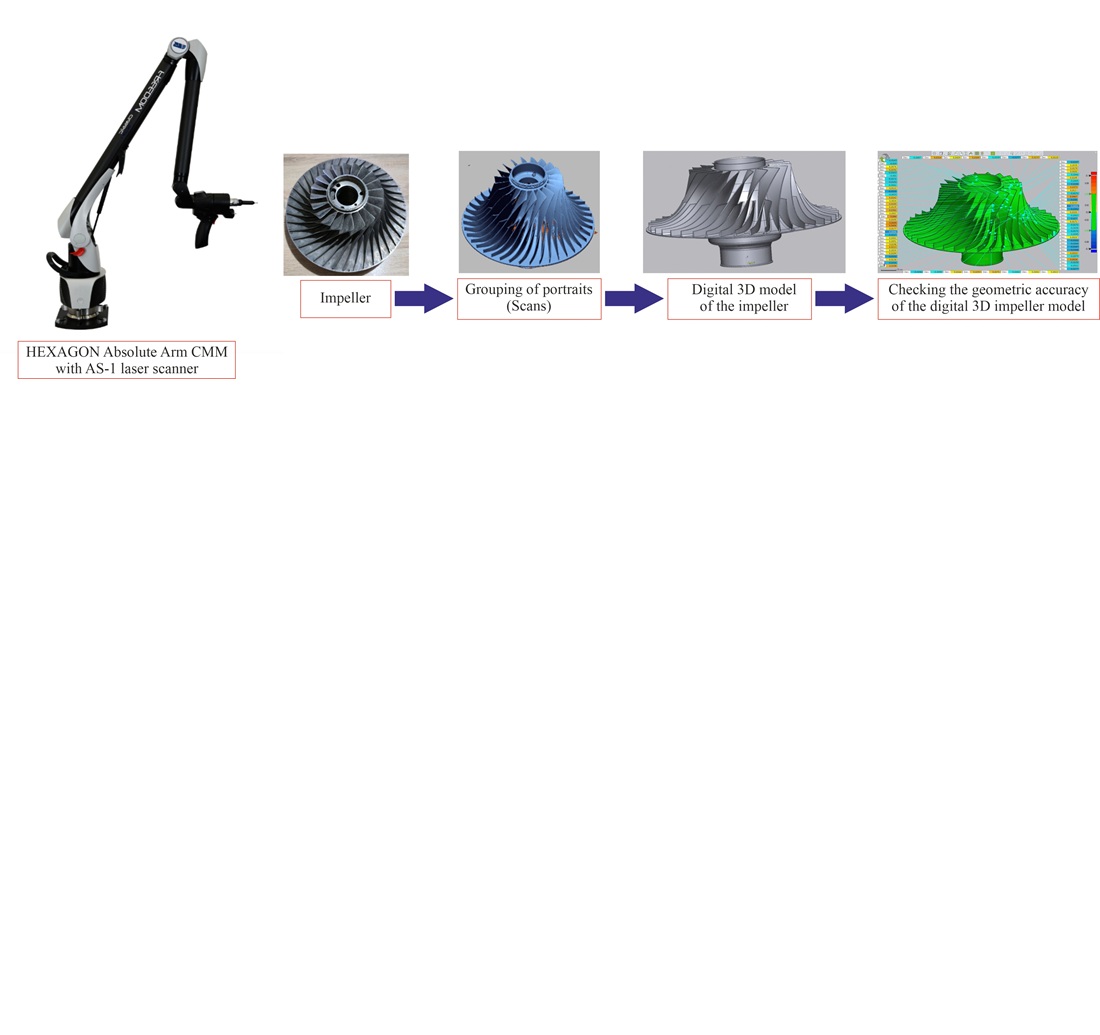
The approach was tested on the example of an impeller using a HEXAGON Absolute Arm coordinate measuring machine with an AS-1 laser scanner, which provided a scanning accuracy of ±0.05 mm and a point density of up to 0.026 mm. Current geometry control and correction of deviations using a color map were carried out at each stage of the algorithm implementation. That has made it possible to minimize errors, eliminate “shadow zones”, and restore the lost geometry of the original impeller when building a digital 3D model. The final control of the constructed model showed robustness of the results within the range of ±0.05 mm.
The results could make it possible to prototype test parts with signs of wear or damage with a reproduced high-precision geometry within the tolerance for the manufactured size.
References
- Zong, Y., Liang, J., Pai, W., Ye, M., Ren, M., Zhao, J. et al. (2022). A high-efficiency and high-precision automatic 3D scanning system for industrial parts based on a scanning path planning algorithm. Optics and Lasers in Engineering, 158, 107176. https://doi.org/10.1016/j.optlaseng.2022.107176
- Pliuhin, V., Zaklinskyy, S., Plankovsky,y S., Tsegelnyk, Y. (2023). A digital twin design of induction motor with squirrel-cage rotor for insulation condition prediction. International Journal of Mechatronics and Applied Mechanics, I (14). https://doi.org/10.17683/ijomam/issue14.22
- Montlahuc, J., Ali Shah, G., Polette, A., Pernot, J.-P. (2019). As-scanned Point Clouds Generation for Virtual Reverse Engineer-ing of CAD Assembly Models. Computer-Aided Design and Applications, 16 (6), 1171–1182. https://doi.org/10.14733/cadaps.2019.1171-1182
- Stojkic, Z., Culjak, E., Saravanja, L. (2020). 3D Measurement - Comparison of CMM and 3D Scanner. Proceedings of the 31st International DAAAM Symposium 2020, 0780–0787. https://doi.org/10.2507/31st.daaam.proceedings.108
- Sikulskyi, V., Maiorova, K., Shypul, O., Nikichanov, V., Tryfonov, O., Voronko, I., Kapinus, O. (2024). Algorithm for Selecting the Optimal Technology for Rapid Manufacturing and/or Repair of Parts. Integrated Computer Technologies in Mechanical Engineering - 2023, 25–39. https://doi.org/10.1007/978-3-031-61415-6_3
- Tretiak, O., Kritskiy, D., Kobzar, I., Arefieva, M., Selevko, V., Brega, D. et al. (2023). Stress-Strained State of the Thrust Bearing Disc of Hydrogenerator-Motor. Computation, 11 (3), 60. https://doi.org/10.3390/computation11030060
- Tretiak, O., Kritskiy, D., Kobzar, I., Arefieva, M., Nazarenko, V. (2022). The Methods of Three-Dimensional Modeling of the Hydrogenerator Thrust Bearing. Computation, 10 (9), 152. https://doi.org/10.3390/computation10090152
- Bauer, F., Schrapp, M., Szijarto, J. (2019). Accuracy analysis of a piece-to-piece reverse engineering workflow for a turbine foil based on multi-modal computed tomography and additive manufacturing. Precision Engineering, 60, 63–75. https://doi.org/10.1016/j.precisioneng.2019.07.008
- Raj, G. B., Reddy, Dr. G. S., Kumar, Dr. L. M. A. (2019). Reverse Engineering on Jet Engine Turbine Disk. International Journal of Innovative Technology and Exploring Engineering, 8 (12), 5118–5122. https://doi.org/10.35940/ijitee.l2757.1081219
- Gupta, D., Trivedi, S., Pandya, J. (2024). Design and Analysis of Pump Simulation Approach through Reverse Engineering. 2024 Parul International Conference on Engineering and Technology (PICET), 1–6. https://doi.org/10.1109/picet60765.2024.10716139
- Fortini, A., Suman, A., Merlin, M., Garagnani, G. L. (2015). Morphing blades with embedded SMA strips: An experimental investigation. Materials & Design, 85, 785–795. https://doi.org/10.1016/j.matdes.2015.07.175
- Subeshan, B., Abdulaziz, A., Khan, Z., Uddin, Md. N., Rahman, M. M., Asmatulu, E. (2022). Reverse Engineering of Aerospace Components Utilizing Additive Manufacturing Technology. TMS 2022 151st Annual Meeting & Exhibition Supplemental Proceedings, 238–246. https://doi.org/10.1007/978-3-030-92381-5_21
- Kaiser, J., Dědič, M. (2024). Influence of Material on the Density of a Point Cloud Created Using a Structured-Light 3D Scanner. Applied Sciences, 14 (4), 1476. https://doi.org/10.3390/app14041476
- Turek, P., Bezłada, W., Cierpisz, K., Dubiel, K., Frydrych, A., Misiura, J. (2024). Analysis of the Accuracy of CAD Modeling in Engineering and Medical Industries Based on Measurement Data Using Reverse Engineering Methods. Designs, 8 (3), 50. https://doi.org/10.3390/designs8030050
- Peter R.N. (2019). Mechanical Design Engineering Handbook. Butterworth-Heinemann, 982. https://doi.org/10.1016/c2016-0-05252-x
- Maiorova, K., Lysochenko, I., Skyba, O., Suslov, A., Antonyuk, V. (2025). Analysis of Modern Approaches to Approbation of Aircraft Parts Geometric Data Digitization by Reverse Engineering. Smart Innovations in Energy and Mechanical Systems, 264–273. https://doi.org/10.1007/978-3-031-95191-6_25
- Where can I find the User Manual for my Hexagon Romer Absolute Arm? Available at: https://support.hexagonmi.com/s/article/Where-can-I-find-the-User-Manual-for-my-Hexagon-Romer-Absolute-Arm
- Stark, R. (2022). Major Technology 6: Digital Mock-Up – DMU. Virtual Product Creation in Industry, 273–304. https://doi.org/10.1007/978-3-662-64301-3_12
- Rukhovich, D., Dupont, E., Mallis, D., Cherenkova, K., Kacem, A., Aouada, D. (2024). CAD-Recode: Reverse Engineering CAD Code from Point Clouds. arXiv. https://doi.org/10.48550/arXiv.2412.14042
- Pajerová, N., Koptiš, M. (2024). Shape functions to scanner comparison. The International Journal of Advanced Manufacturing Technology, 132 (7-8), 3889–3902. https://doi.org/10.1007/s00170-024-13520-z
- Products Overview. Available at: https://www.polyworks.com/en-us/products/products-overview
- Geomagic Design X. Available at: https://hexagon.com/products/geomagic-design-x
Downloads
Published
How to Cite
Issue
Section
License
Copyright (c) 2026 Kateryna Maiorova, Sergiy Zaklinskyy, Oleksandra Kapinus, Artem Suslov, Oleksandr Skyba

This work is licensed under a Creative Commons Attribution 4.0 International License.
The consolidation and conditions for the transfer of copyright (identification of authorship) is carried out in the License Agreement. In particular, the authors reserve the right to the authorship of their manuscript and transfer the first publication of this work to the journal under the terms of the Creative Commons CC BY license. At the same time, they have the right to conclude on their own additional agreements concerning the non-exclusive distribution of the work in the form in which it was published by this journal, but provided that the link to the first publication of the article in this journal is preserved.
A license agreement is a document in which the author warrants that he/she owns all copyright for the work (manuscript, article, etc.).
The authors, signing the License Agreement with TECHNOLOGY CENTER PC, have all rights to the further use of their work, provided that they link to our edition in which the work was published.
According to the terms of the License Agreement, the Publisher TECHNOLOGY CENTER PC does not take away your copyrights and receives permission from the authors to use and dissemination of the publication through the world's scientific resources (own electronic resources, scientometric databases, repositories, libraries, etc.).
In the absence of a signed License Agreement or in the absence of this agreement of identifiers allowing to identify the identity of the author, the editors have no right to work with the manuscript.
It is important to remember that there is another type of agreement between authors and publishers – when copyright is transferred from the authors to the publisher. In this case, the authors lose ownership of their work and may not use it in any way.







