Determining design parameters of disk working bodies for overcompacted soils
DOI:
https://doi.org/10.15587/1729-4061.2026.352033Keywords:
disk working elements, traction resistance, overcompacted soil, specific disk loadAbstract
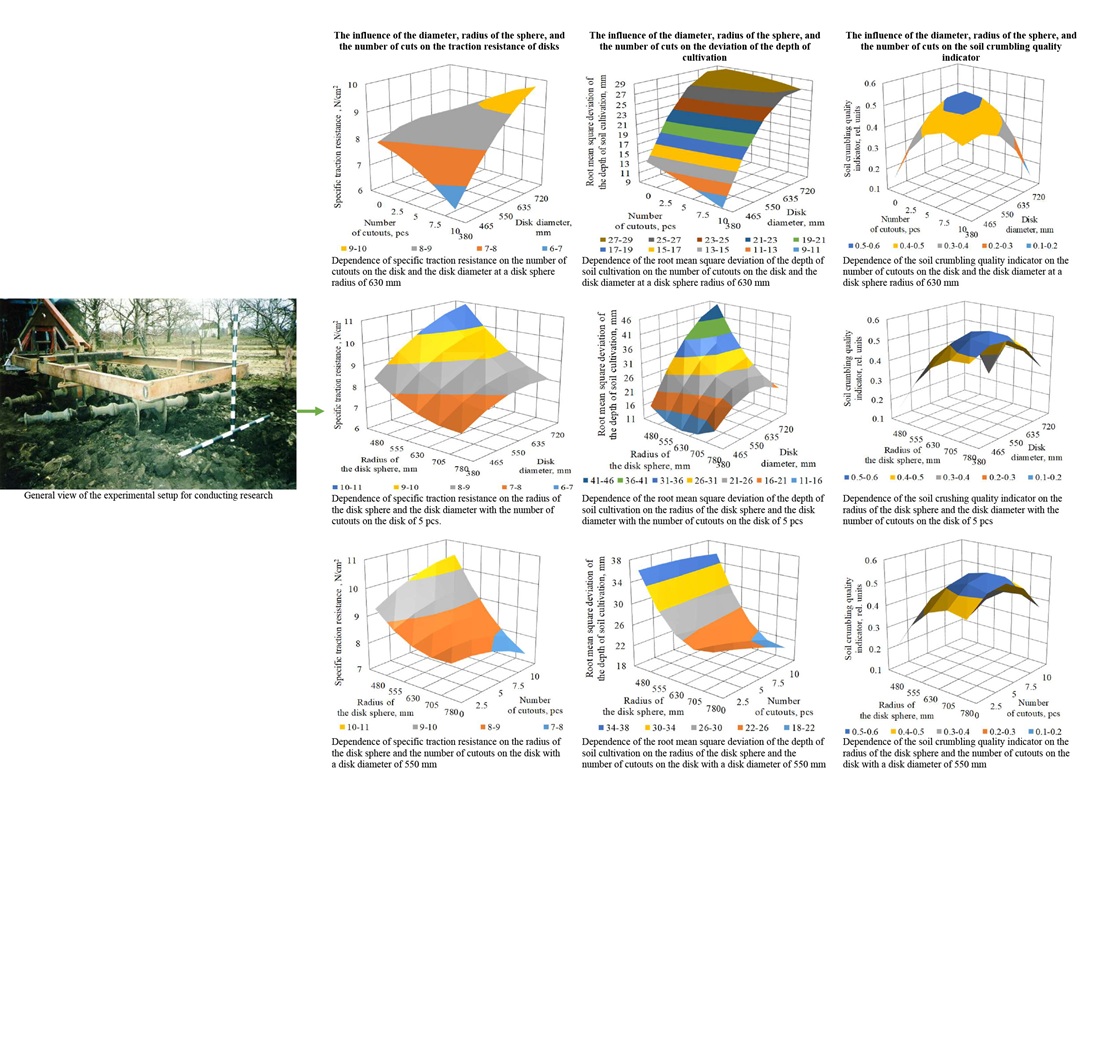
This study investigates the process of interaction between spherical disk working bodies and the soil environment. The task addressed is to establish a relationship between the generalized indicators and structural parameters of the disk working bodies (disk diameter, sphere radius, number of cutouts on the disk) at an angle of attack of the disk section of 20° and a speed of movement of 7–8 km/h.
The generalized parameters include the specific load on the disk, the stability of the movement of the working bodies according to the depth of cultivation, and the indicator of soil crumbling quality. The minimum specific traction resistance of the disks can be obtained with a disk diameter of 380 mm, a disk sphere radius of 682 mm, and a number of cutouts on the disk of 10 pcs.
Stabilization of the disk movement according to the depth of cultivation without an additional increase in the specific load on it leads to a significant improvement in both energy and quality indicators of the operation of the disk working bodies. The minimum root mean square deviation of the soil cultivation depth is achieved with a disk diameter of 380 mm, a disk sphere radius of 626 mm, and a number of cutouts on the disk of 10 pcs.
The indicator of soil loosening quality is determined by the stability of the disk movement along the cultivation depth. In this case, the disk is held at the technological cultivation depth, and most of its spherical surface, which is immersed in the soil environment, takes part in soil loosening. That is, stable disk movement along the set cultivation depth provides maximum soil loosening, which can be obtained with a disk diameter of 524 mm, a disk sphere radius of 710 mm, and a number of cutouts on the disk of 10 pcs.
The practical significance of the results is that they could be used to design disks for specific operating conditions. In this case, the ratio of the disk radius to its diameter (R/D) determines the disk's ability to work under specific soil conditions
References
- Mier, G., Vélez, S., Valente, J., de Bruin, S. (2025). Soil2Cover: Coverage path planning minimizing soil compaction for sustainable agriculture. Precision Agriculture, 26 (4). https://doi.org/10.1007/s11119-025-10250-4
- Mbah, J. T., Pentoś, K., Pieczarka, K. S., Wojciechowski, T. (2025). Estimating Energy Consumption During Soil Cultivation Using Geophysical Scanning and Machine Learning Methods. Agriculture, 15 (12), 1263. https://doi.org/10.3390/agriculture15121263
- Ucgul, M. (2023). Simulating Soil–Disc Plough Interaction Using Discrete Element Method–Multi-Body Dynamic Coupling. Agriculture, 13 (2), 305. https://doi.org/10.3390/agriculture13020305
- Sadek, M. A., Chen, Y., Zeng, Z. (2021). Draft force prediction for a high-speed disc implement using discrete element modelling. Biosystems Engineering, 202, 133–141. https://doi.org/10.1016/j.biosystemseng.2020.12.009
- Oduma, O., Ugwu, E. C., Ehiomogue, P., Igwe, J. E., Ntunde, D. I., Agu, C. S. (2023). Modelling of the effects of working width, tillage depth and operational speed on draft and power requirements of disc plough in sandy-clay soil in South-East Nigeria. Scientific African, 21, e01815. https://doi.org/10.1016/j.sciaf.2023.e01815
- Oduma, O., Ehiomogue, P., Okeke, C. G., Orji, N. F., Ugwu, E. C., Umunna, M. F., Nwosu-Obieogu, K. (2022). Modeling and optimization of energy requirements of disc plough operation on loamy-sand soil in South-East Nigeria using response surface methodology. Scientific African, 17, e01325. https://doi.org/10.1016/j.sciaf.2022.e01325
- Capozza, R., Hanley, K. J. (2024). Wear at an incipient ploughing–cutting transition. Wear, 546-547, 205354. https://doi.org/10.1016/j.wear.2024.205354
- Okoko, P., Ajav, E. A. (2020). Determination of Draft Force for a 3-bottom Disc Plough Under Sandy Loam Soil Conditions. American Journal of Agricultural and Biological Sciences, 15 (1), 60–67. https://doi.org/10.3844/ajabssp.2020.60.67
- Ahmadi, I. (2016). Development and assessment of a draft force calculator for disk plow using the laws of classical mechanics. Soil and Tillage Research, 163, 32–40. https://doi.org/10.1016/j.still.2016.04.013
- Storozhuk, T., Klasner, G., Kremyansky, V., Zhigailov, F. (2023). Substantiation of the disk soil-cultivating tool parameters for all forms of farming. E3S Web of Conferences, 390, 06012. https://doi.org/10.1051/e3sconf/202339006012
- Shmulevich, I., Asaf, Z., Rubinstein, D. (2007). Interaction between soil and a wide cutting blade using the discrete element method. Soil and Tillage Research, 97 (1), 37–50. https://doi.org/10.1016/j.still.2007.08.009
- Li, S., Diao, P., Zhang, Y., Li, X., Zhao, Y., Zhao, H. (2025). Design and performance evaluation of notched type discs for application in no-till seeding process using discrete element method and field trials. Biosystems Engineering, 257, 104222. https://doi.org/10.1016/j.biosystemseng.2025.104222
- McKyes, E., Ali, O. S. (1977). The cutting of soil by narrow blades. Journal of Terramechanics, 14 (2), 43–58. https://doi.org/10.1016/0022-4898(77)90001-5
- Hrushetskyі S., Bodnaruk, B. (2024). Model of analytical study of the interaction of the disc working body with the soil. International Science Journal of Engineering & Agriculture, 3 (5), 30–43. https://doi.org/10.46299/j.isjea.20240305.04
- Damanauskas, V., Velykis, A., Satkus, A. (2019). Efficiency of disc harrow adjustment for stubble tillage quality and fuel consumption. Soil and Tillage Research, 194, 104311. https://doi.org/10.1016/j.still.2019.104311
- Zeng, Z., Chen, Y. (2018). Performance evaluation of fluted coulters and rippled discs for vertical tillage. Soil and Tillage Research, 183, 93–99. https://doi.org/10.1016/j.still.2018.06.003
- Xu, G., Xie, Y., Peng, S., Liang, L., Ding, Q. (2023). Performance Evaluation of Vertical Discs and Disc Coulters for Conservation Tillage in an Intensive Rice–Wheat Rotation System. Agronomy, 13 (5), 1336. https://doi.org/10.3390/agronomy13051336
- Nalavade, P. P., Salokhe, V. M., Niyamapa, T., Soni, P. (2010). Performance of Free Rolling and Powered Tillage Discs. Soil and Tillage Research, 109 (2), 87–93. https://doi.org/10.1016/j.still.2010.05.004
- Ahmad, F., Weimin, D., Qishuo, D., Hussain, M., Jabran, K. (2015). Forces and Straw Cutting Performance of Double Disc Furrow Opener in No-Till Paddy Soil. PLOS ONE, 10 (3), e0119648. https://doi.org/10.1371/journal.pone.0119648
- Ahmad, F., Weimin, D., Qishou, D., Rehim, A., Jabran, K. (2017). Comparative Performance of Various Disc-Type Furrow Openers in No-Till Paddy Field Conditions. Sustainability, 9 (7), 1143. https://doi.org/10.3390/su9071143
- Zeng, Z., Thoms, D., Chen, Y., Ma, X. (2021). Comparison of soil and corn residue cutting performance of different discs used for vertical tillage. Scientific Reports, 11 (1). https://doi.org/10.1038/s41598-021-82270-9
- Gill, W. R., Vanden Berg, G. E. (1967). Soil Dynamics in Tillage and Traction: Agriculture Handbook No. 316. Washington, D.C.: Agricultural Research Service, U.S. Department of Agriculture, 511. Available at: https://www.scribd.com/document/555588379/PDF?utm_source
- Shevchenko, I. A., Oleksandrenko, V. P., Martynyuk, A., Medvedchuk, N. K., Luts, P. M. (2025). Mechanical-mathematical model of the interaction of a spherical disc with the soil environment. Bulletin of Sumy National Agrarian University. The Series: Mechanization and Automation of Production Processes, 3, 134–141. https://doi.org/10.32782/msnau.2025.3.19
- Golub, G., Chuba, V., Yarosh, Y., Solarov, O., Tsyvenkova, N. (2021). Experimental studies of the interaction of tractor drive wheels with the soil in the plowed field. INMATEH Agricultural Engineering, 65 (3), 430–440. https://doi.org/10.35633/inmateh-65-45
- Shevchenko, I., Golub, G., Tsyvenkova, N., Shevchenko, I., Shubenko, V., Medvedskyi, O. et al. (2023). Improving the quality of processing the soil environment by determining the rational structural and technological parameters for the rolling working bodies. Eastern-European Journal of Enterprise Technologies, 5 (1 (125)), 54–63. https://doi.org/10.15587/1729-4061.2023.289238
Downloads
Published
How to Cite
Issue
Section
License
Copyright (c) 2026 Ihor Shevchenko, Gennadii Golub, Nataliya Tsyvenkova, Andriy Martynyuk, Ivan Rogovskii, Oleksandr Medvedskyi, Volodymyr Kulykivskyi, Maksym Zayets, Victor Biletskii

This work is licensed under a Creative Commons Attribution 4.0 International License.
The consolidation and conditions for the transfer of copyright (identification of authorship) is carried out in the License Agreement. In particular, the authors reserve the right to the authorship of their manuscript and transfer the first publication of this work to the journal under the terms of the Creative Commons CC BY license. At the same time, they have the right to conclude on their own additional agreements concerning the non-exclusive distribution of the work in the form in which it was published by this journal, but provided that the link to the first publication of the article in this journal is preserved.
A license agreement is a document in which the author warrants that he/she owns all copyright for the work (manuscript, article, etc.).
The authors, signing the License Agreement with TECHNOLOGY CENTER PC, have all rights to the further use of their work, provided that they link to our edition in which the work was published.
According to the terms of the License Agreement, the Publisher TECHNOLOGY CENTER PC does not take away your copyrights and receives permission from the authors to use and dissemination of the publication through the world's scientific resources (own electronic resources, scientometric databases, repositories, libraries, etc.).
In the absence of a signed License Agreement or in the absence of this agreement of identifiers allowing to identify the identity of the author, the editors have no right to work with the manuscript.
It is important to remember that there is another type of agreement between authors and publishers – when copyright is transferred from the authors to the publisher. In this case, the authors lose ownership of their work and may not use it in any way.







