Design of a system for load forecasting and optimal control over enterprise energy sources under unstable power supply
DOI:
https://doi.org/10.15587/1729-4061.2026.352199Keywords:
enterprise energy consumption optimization, generator control, machine learning, LightGBM regressionAbstract
This study investigates the process underlying the autonomy of industrial enterprises that face critical instability of centralized power supply and dynamic market tariffs.
Given the significant losses of generating capacities and frequent interruptions in the supply of electricity, enterprises often use autonomous power sources. Optimal utilization of such sources requires economic substantiation and construction of appropriate models. The task of these models is to improve the economic efficiency and energy independence of an enterprise by automating optimal control over energy sources.
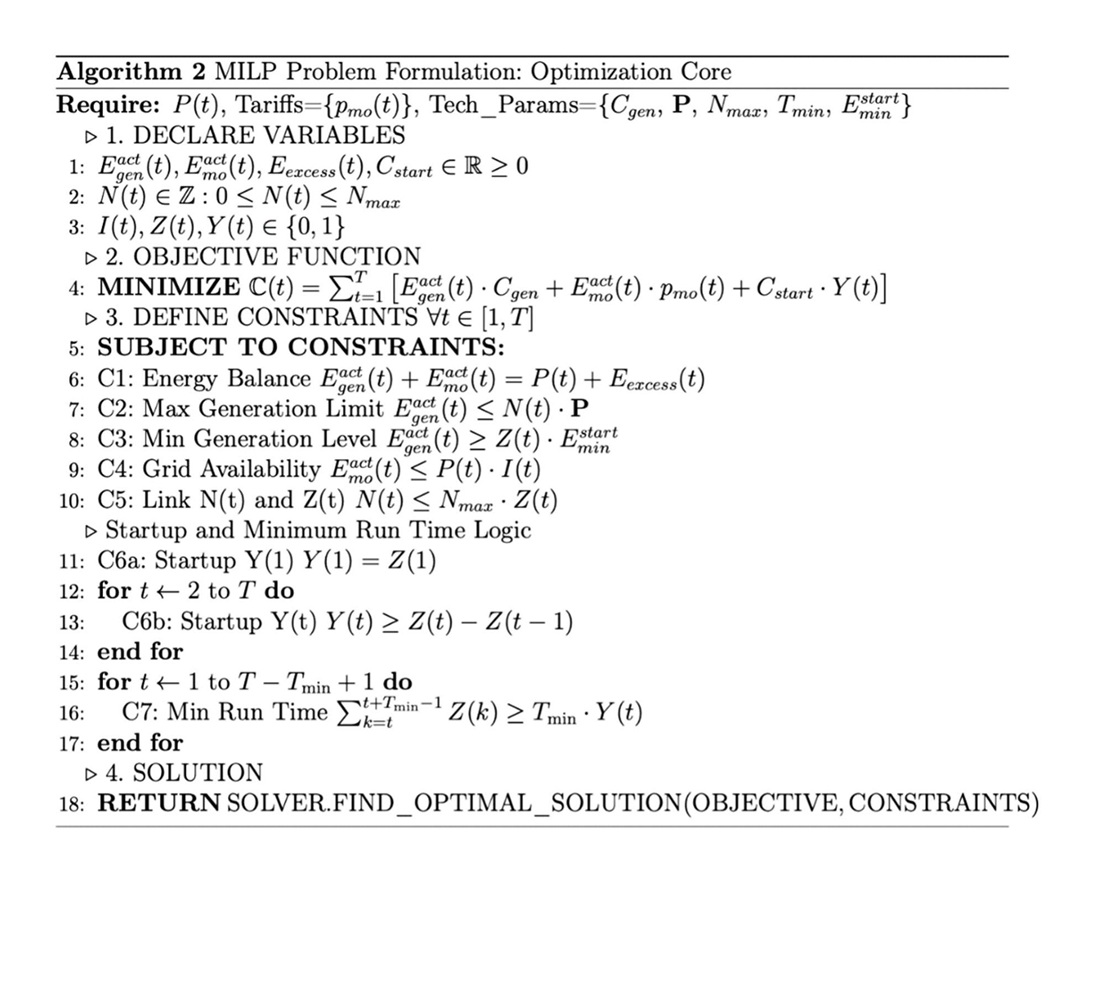
This work proposes a two-level system. The first level is responsible for forecasting energy consumption. The second one is a deterministic optimization algorithm for automatic selection of a power source and economically justified control over the operational schedule of autonomous power sources.
When forecasting energy consumption, two models built on the basis of Random Forest and LightGBM were compared. The models yielded average absolute errors, as a percentage of the average, of 5–7% and 8–10%, which indicates their applicability for further decision-making.
Analysis of the optimization algorithm on real data revealed overall energy cost savings of 9–12% compared to unoptimized use of electricity from the grid. These results were achieved through timely switching between central and alternative power sources. Switching occurs when the use of the source becomes more economically advantageous, subject to technical constraints.
The resulting system could be used by enterprises that require uninterrupted power supply and exploit generators as alternative power sources.
References
- DiXi Group calculated mass attacks on the energy system of Ukraine (2024). Ukrainian Energy. Available at: https://ua-energy.org/en/posts/03-10-2024-0c9b86dc-4300-49c0-afb3-307d43ca6d1d
- Bytva za svitlo. Zvit pro diyalnist (2024). DTEK. Available at: https://dtek.com/content/upload/report/DTEK%202024%20Action%20Report%20Ukrainian%20250221.pdf
- Otsinka priamykh zbytkiv ta nepriamykh vtrat enerhetychnoho sektoru Ukrainy vnaslidok povnomasshtabnoho vtorhnennia rosii (2024). Kyivska shkola ekonomiky. Available at: https://kse.ua/wp-content/uploads/2024/06/KSE_Vpliv-vii--ni-na-energetiku_UA-1.pdf
- A Rebirth in Flame: Ukraine’s Beleaguered Energy System (2025). CEPA. Available at: https://cepa.org/article/a-rebirth-in-flame-ukraines-beleaguered-energy-system
- Kumar, M., Pal, N. (2023). Machine Learning-based Electric Load Forecasting for Peak Demand Control in Smart Grid. Computers, Materials & Continua, 74 (3), 4785–4799. https://doi.org/10.32604/cmc.2022.032971
- Halimuzzaman, M. (2025). AI-driven optimization of hybrid renewable energy systems: A review of techniques, challenges, and future direction. Pacific Journal of Advanced Engineering Innovations, 2 (1), 22–32. https://doi.org/10.70818/pjaei.v02i01.093
- Kong, W., Dong, Z. Y., Jia, Y., Hill, D. J., Xu, Y., Zhang, Y. (2019). Short-Term Residential Load Forecasting Based on LSTM Recurrent Neural Network. IEEE Transactions on Smart Grid, 10 (1), 841–851. https://doi.org/10.1109/tsg.2017.2753802
- Fayyazbakhsh, A., Kienberger, T., Vopava-Wrienz, J. (2025). Comparative Analysis of Load Profile Forecasting: LSTM, SVR, and Ensemble Approaches for Singular and Cumulative Load Categories. Smart Cities, 8 (2), 65. https://doi.org/10.3390/smartcities8020065
- Ibrar, M., Hassan, M. A., Shaukat, K., Alam, T. M., Khurshid, K. S., Hameed, I. A. et al. (2022). A Machine Learning‐Based Model for Stability Prediction of Decentralized Power Grid Linked with Renewable Energy Resources. Wireless Communications and Mobile Computing, 2022 (1). https://doi.org/10.1155/2022/2697303
- Mudgal, Y., Tiwari, R., Krishnan, N., Téllez, A. A. (2025). Advanced Cluster-Based Load Forecasting and Peak Demand Management for Electric Vehicle Charging Networks. IEEE Access, 13, 105664–105677. https://doi.org/10.1109/access.2025.3578875
- Bahrami, S., Chen, Y. C., Wong, V. W. S. (2021). Deep Reinforcement Learning for Demand Response in Distribution Networks. IEEE Transactions on Smart Grid, 12 (2), 1496–1506. https://doi.org/10.1109/tsg.2020.3037066
- Suanpang, P., Jamjuntr, P., Jermsittiparsert, K., Kaewyong, P. (2022). Autonomous Energy Management by Applying Deep Q-Learning to Enhance Sustainability in Smart Tourism Cities. Energies, 15 (5), 1906. https://doi.org/10.3390/en15051906
- Danylchenko, D. O., Fedorchuk, S. O., Maslak, M. V. et al. (2024). Intelektualni systemy elektropostachannia na osnovi zaluchennia aktyvnykh spozhyvachiv. Kharkiv: NTU "KhPI", 310. Available at: https://repository.kpi.kharkov.ua/entities/publication/1511a424-3c71-467d-a8f6-9ad66d58ae33
- Sirenko, Yu. V., Volvach, T. S., Savoiskyi, O. Yu., Kozin, V. M. (2025). Analysis of the state of ukraine’s energy system and measures to improve the situation. Visnyk of Kherson National Technical University, 1 (2 (93)), 229–237. https://doi.org/10.35546/kntu2078-4481.2025.2.1.30
- Bobrov, O., Yaroshenko, Y. (2024). Analysis of electrical load schedules of UPS of Ukraine. Electrical and Information Systems, 106, 27–34. https://doi.org/10.32782/eis/2024-106-5
- González Grandón, T., Schwenzer, J., Steens, T., Breuing, J. (2024). Electricity demand forecasting with hybrid classical statistical and machine learning algorithms: Case study of Ukraine. Applied Energy, 355, 122249. https://doi.org/10.1016/j.apenergy.2023.122249
- Petko, S. (2024). Application of AI in the Energy Sector of Ukraine in the Conditions of War. Challenges to national defence in contemporary geopolitical situation (CNDCGS’2024). Brno, 22–26. Available at: https://ir.kneu.edu.ua/items/9520f314-cf25-4a12-9369-29155c54d6d4
- Breiman, L. (2001). Random Forests. Machine Learning, 45 (1), 5–32. https://doi.org/10.1023/a:1010933404324
- Cutler, D. R., Edwards, T. C., Beard, K. H., Cutler, A., Hess, K. T., Gibson, J., Lawler, J. J. (2007). Random forests for classification in ecology. Ecology, 88 (11), 2783–2792. https://doi.org/10.1890/07-0539.1
- Liaw, A., Wiener, M. (2002). Classification and regression by randomForest. R News, 2, 18–22. Available at: https://journal.r-project.org/articles/RN-2002-022/RN-2002-022.pdf
- Hastie, T., Tibshirani, R., Friedman, J. (2009). The Elements of Statistical Learning. In Springer Series in Statistics. Springer New York. https://doi.org/10.1007/978-0-387-84858-7
- Ke, G., Meng, Q., Finley, T., Wang, T., Chen, W., Ma, W. et al. (2017). LightGBM: A highly efficient gradient boosting decision tree. NIPS'17: Proceedings of the 31st International Conference on Neural Information Processing Systems. Available at: http://dl.acm.org/doi/10.5555/3294996.3295074
- Bertsimas, D., Tsitsiklis, J. N. (1997). Introduction to linear optimization. Athena Scientific, 587.
- 2-1998 - IEEE Standard for Conceptual Modeling Language - Syntax and Semantics for IDEF1X97 (IDEFobject). Available at: https://ieeexplore.ieee.org/document/8883275
- Yourdon, E. (1989). Modern structured analysis. Englewood Cliffs: Prentice Hall, 688.
Downloads
Published
How to Cite
Issue
Section
License
Copyright (c) 2026 Pavlo Shevchyk, Vitalii Polovyi, Yana Ni

This work is licensed under a Creative Commons Attribution 4.0 International License.
The consolidation and conditions for the transfer of copyright (identification of authorship) is carried out in the License Agreement. In particular, the authors reserve the right to the authorship of their manuscript and transfer the first publication of this work to the journal under the terms of the Creative Commons CC BY license. At the same time, they have the right to conclude on their own additional agreements concerning the non-exclusive distribution of the work in the form in which it was published by this journal, but provided that the link to the first publication of the article in this journal is preserved.
A license agreement is a document in which the author warrants that he/she owns all copyright for the work (manuscript, article, etc.).
The authors, signing the License Agreement with TECHNOLOGY CENTER PC, have all rights to the further use of their work, provided that they link to our edition in which the work was published.
According to the terms of the License Agreement, the Publisher TECHNOLOGY CENTER PC does not take away your copyrights and receives permission from the authors to use and dissemination of the publication through the world's scientific resources (own electronic resources, scientometric databases, repositories, libraries, etc.).
In the absence of a signed License Agreement or in the absence of this agreement of identifiers allowing to identify the identity of the author, the editors have no right to work with the manuscript.
It is important to remember that there is another type of agreement between authors and publishers – when copyright is transferred from the authors to the publisher. In this case, the authors lose ownership of their work and may not use it in any way.







