Improving a method for filtering images acquired from a space-based radar observation system based on the Kuan algorithm
DOI:
https://doi.org/10.15587/1729-4061.2026.352347Keywords:
space radar surveillance system, image filtering, Kuan algorithm, signal-to-noise ratioAbstract
The object of this study is the process of filtering images acquired from a space radar observation system. The task to filter images from a space radar observation system has been solved by applying the Kuan algorithm.
The results reported here include the following:
– the defined basic stages of the method for filtering images acquired from a space radar observation system based on the Kuan algorithm;
– the performed experimental study on filtering images from a space radar observation system based on the Kuan algorithm.
A method for filtering images from a space radar observation system based on the Kuan algorithm has been improved. Special features of the improved method, in contrast to those in established ones, are:
– selection of a local filtering window;
– calculation of local statistical characteristics;
– calculation of variation coefficients;
– calculation of the Kuan weight coefficient;
– sequential filtering of image pixels using the “sliding” window method.
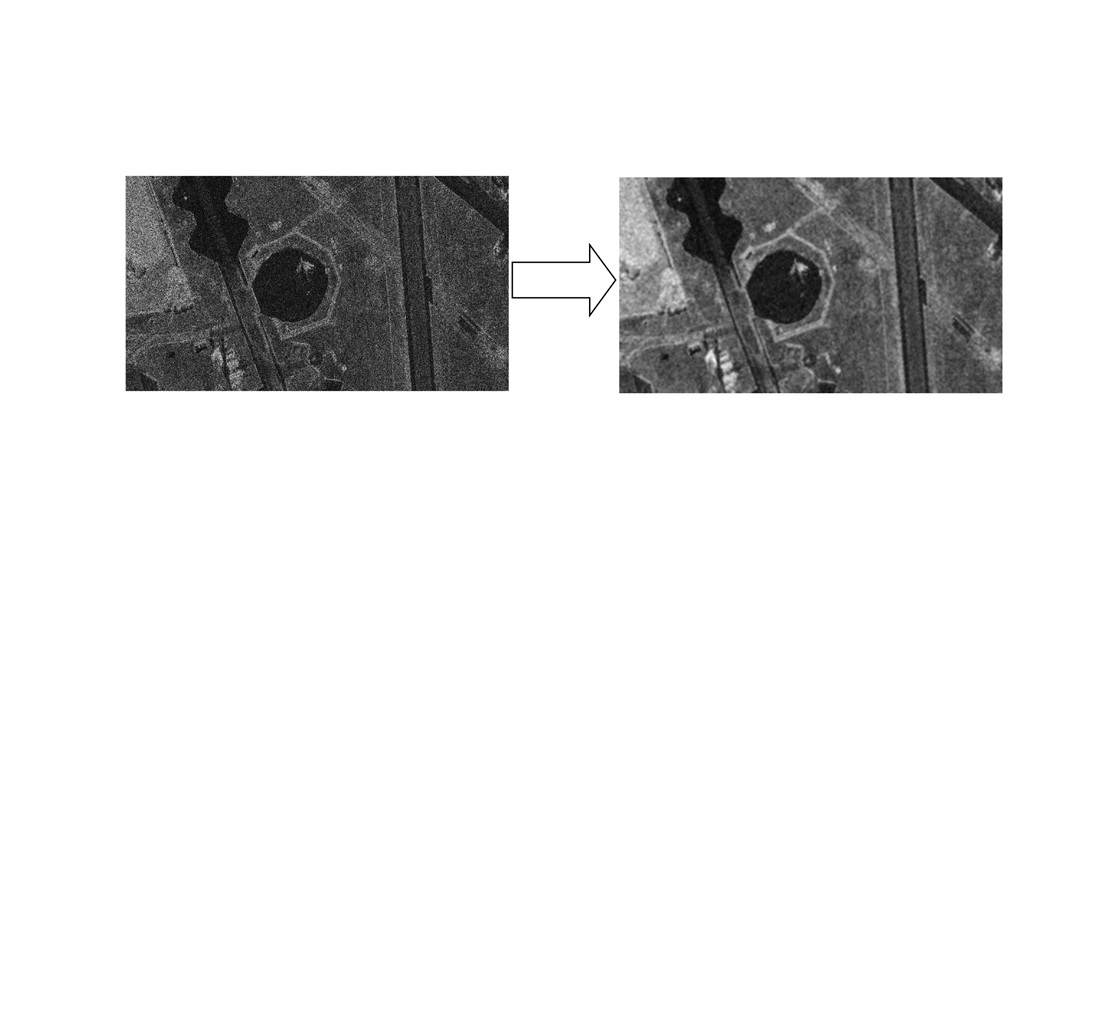
A visual analysis of radar image filtering by an improved method based on the Kuan algorithm and known methods based on the Li algorithm and Frost algorithm were carried out. The use of the improved method when filtering an image acquired from a space radar surveillance system made it possible to increase the signal-to-noise ratio. That became possible due to the use of the Kuan algorithm. The choice of the Kuan algorithm has made it possible to achieve a 21% gain in the maximum signal-to-noise ratio in comparison with the known method (based on the Li algorithm).
The scope of the improved method application includes filtering images from space radar surveillance systems. Conditions for practical implementation of the results are specialized software in software-hardware systems for processing radar images
References
- Zhang, M., Ouyang, Y., Yang, M., Guo, J., Li, Y. (2025). ORPSD: Outer Rectangular Projection-Based Representation for Oriented Ship Detection in SAR Images. Remote Sensing, 17 (9), 1511. https://doi.org/10.3390/rs17091511
- Amitrano, D., Di Martino, G., Di Simone, A., Imperatore, P. (2024). Flood Detection with SAR: A Review of Techniques and Datasets. Remote Sensing, 16 (4), 656. https://doi.org/10.3390/rs16040656
- Hrushko, O., Zhytar, D., Ilkiv, E., Hrynishak, M., Kukhtar, D. (2025). Geospatial Analysis of War-Affected Areas in Ukraine Based on SAR and GIS Technologies. 18th International Conference Monitoring of Geological Processes and Ecological Condition of the Environment, 1–5. https://doi.org/10.3997/2214-4609.2025510159
- Pavlikov, V., Zhyla, S., Pozdniakov, P., Kolesnikov, D., Cherepnin, H., Shmatko, O. et al. (2024). Foundations of radar synthesis theory of phantom objects formation in SAR images. Radioelectronic and Computer Systems, 2024 (4), 123–140. https://doi.org/10.32620/reks.2024.4.11
- Kostenko, P. Yu., Slobodyanuk, V. V., Plahotenko, O. V. (2016). Method of image filtering using singular decomposition and the surrogate data technology. Radioelectronics and Communications Systems, 59 (9), 409–416. https://doi.org/10.3103/s0735272716090041
- Kostenko, P. Yu., Slobodyanuk, V. V., Kostenko, I. L. (2019). Method of Image Denoising in Generalized Phase Space with Improved Indicator of Spatial Resolution. Radioelectronics and Communications Systems, 62 (7), 368–375. https://doi.org/10.3103/s0735272719070045
- Kryvenko, S., Lukin, V., Vozel, B. (2024). Lossy Compression of Single-channel Noisy Images by Modern Coders. Remote Sensing, 16 (12), 2093. https://doi.org/10.3390/rs16122093
- Kryvenko, S., Rebrov, V., Lukin, V., Golovko, V., Sachenko, A., Shelestov, A., Vozel, B. (2025). Post-Filtering of Noisy Images Compressed by HEIF. Applied Sciences, 15 (6), 2939. https://doi.org/10.3390/app15062939
- Al-Bayati, M., El-Zaart, A. (2013). Automatic Thresholding Techniques for SAR Images. Computer Science & Information Technology (CS&IT), 4 (3), 75–84. https://doi.org/10.5121/csit.2013.3308
- Tan, J., Tang, Y., Liu, B., Zhao, G., Mu, Y., Sun, M., Wang, B. (2023). A Self-Adaptive Thresholding Approach for Automatic Water Extraction Using Sentinel-1 SAR Imagery Based on OTSU Algorithm and Distance Block. Remote Sensing, 15 (10), 2690. https://doi.org/10.3390/rs15102690
- Hillebrand, F. L., Prieto, J. D., Mendes Júnior, C. W., Arigony-Neto, J., Simões, J. C. (2024). Gray Level Co-occurrence Matrix textural analysis for temporal mapping of sea ice in Sentinel-1A SAR images. Anais Da Academia Brasileira de Ciências, 96 (2). https://doi.org/10.1590/0001-3765202420240554
- Zhai, Y., Liu, K., Piuri, V., Ying, Z., Xu, Y. (2016). SAR automatic target recognition based on K-means and data augmentation. Proceedings of the 2016 International Conference on Intelligent Information Processing, 1–6. https://doi.org/10.1145/3028842.3028894
- Chen, Z., Cong, B., Hua, Z., Cengiz, K., Shabaz, M. (2021). Application of clustering algorithm in complex landscape farmland synthetic aperture radar image segmentation. Journal of Intelligent Systems, 30 (1), 1014–1025. https://doi.org/10.1515/jisys-2021-0096
- Salehi, H., Vahidi, J., Abdeljawad, T., Khan, A., Rad, S. Y. B. (2020). A SAR Image Despeckling Method Based on an Extended Adaptive Wiener Filter and Extended Guided Filter. Remote Sensing, 12 (15), 2371. https://doi.org/10.3390/rs12152371
- Rubel, O., Lukin, V., Rubel, A., Egiazarian, K. (2021). Selection of Lee Filter Window Size Based on Despeckling Efficiency Prediction for Sentinel SAR Images. Remote Sensing, 13 (10), 1887. https://doi.org/10.3390/rs13101887
- Ruban, I., Khudov, H., Makoveichuk, O., Khudov, V., Kalimulin, T., Glukhov, S. et al. (2022). Methods of UAVs images segmentation based on k-means and a genetic algorithm. Eastern-European Journal of Enterprise Technologies, 4 (9 (118)), 30–40. https://doi.org/10.15587/1729-4061.2022.263387
- Khudov, H., Makoveichuk, O., Khizhnyak, I., Shamrai, B., Glukhov, S., Lunov, O. et al. (2022). The Method for Determining Informative Zones on Images from On-Board Surveillance Systems. International Journal of Emerging Technology and Advanced Engineering, 12 (8), 61–69. https://doi.org/10.46338/ijetae0822_08
- Kanakaraj, S., Nair, M. S., Kalady, S. (2019). Adaptive Importance Sampling Unscented Kalman Filter based SAR image super resolution. Computers & Geosciences, 133, 104310. https://doi.org/10.1016/j.cageo.2019.104310
- Rubel, O. S., Rubel, A. S., Lukin, V., Egiazarian, K. (2022). Optimal parameters selection of the Frost filter based on despeckling efficiency prediction for Sentinel SAR images. Electronic Imaging, 34 (10), 193-1-193–196. https://doi.org/10.2352/ei.2022.34.10.ipas-193
- Ruban, I., Khudov, H., Khudov, V., Makoveichuk, O., Khizhnyak, I., Shamrai, N. et al. (2025). Development of an image segmentation method from unmanned aerial vehicles based on the ant colony algorithm under the influence of speckle noise. Technology Audit and Production Reserves, 4 (2 (84)), 80–86. https://doi.org/10.15587/2706-5448.2025.334993
- Benes, R., Riha, K. (2012). Medical Image Denoising by Improved Kuan Filter. Advances in Electrical and Electronic Engineering, 10 (1), 43–49. https://doi.org/10.15598/aeee.v10i1.529
- Tripathi, A., Bhateja, V., Sharma, A.; Mandal, J., Satapathy, S., Sanyal, M., Bhateja, V. (Eds.) (2016). Kuan Modified Anisotropic Diffusion Approach for Speckle Filtering. Proceedings of the First International Conference on Intelligent Computing and Communication. Singapore: Springer, 537–545. https://doi.org/10.1007/978-981-10-2035-3_55
- Sentinel-1. European Space Agency. Available at: https://sentinels.copernicus.eu/copernicus/sentinel-1
- Sun, Z., Zhang, Z., Chen, Y., Liu, S., Song, Y. (2020). Frost Filtering Algorithm of SAR Images With Adaptive Windowing and Adaptive Tuning Factor. IEEE Geoscience and Remote Sensing Letters, 17 (6), 1097–1101. https://doi.org/10.1109/lgrs.2019.2939208
Downloads
Published
How to Cite
Issue
Section
License
Copyright (c) 2026 Hennadii Khudov, Oleksandr Makoveichuk, Serhii Tokarev, Artem Andriushchenko, Oleksandr Pukhovyi, Оlexandr Rohulia, Oleh Bilous, Mykola Verovok, Valeriy Samoylenko, Vladyslav Khudov

This work is licensed under a Creative Commons Attribution 4.0 International License.
The consolidation and conditions for the transfer of copyright (identification of authorship) is carried out in the License Agreement. In particular, the authors reserve the right to the authorship of their manuscript and transfer the first publication of this work to the journal under the terms of the Creative Commons CC BY license. At the same time, they have the right to conclude on their own additional agreements concerning the non-exclusive distribution of the work in the form in which it was published by this journal, but provided that the link to the first publication of the article in this journal is preserved.
A license agreement is a document in which the author warrants that he/she owns all copyright for the work (manuscript, article, etc.).
The authors, signing the License Agreement with TECHNOLOGY CENTER PC, have all rights to the further use of their work, provided that they link to our edition in which the work was published.
According to the terms of the License Agreement, the Publisher TECHNOLOGY CENTER PC does not take away your copyrights and receives permission from the authors to use and dissemination of the publication through the world's scientific resources (own electronic resources, scientometric databases, repositories, libraries, etc.).
In the absence of a signed License Agreement or in the absence of this agreement of identifiers allowing to identify the identity of the author, the editors have no right to work with the manuscript.
It is important to remember that there is another type of agreement between authors and publishers – when copyright is transferred from the authors to the publisher. In this case, the authors lose ownership of their work and may not use it in any way.







