Development of a method for diagnosing and forecasting power supply systems for mining enterprises
DOI:
https://doi.org/10.15587/1729-4061.2026.352513Keywords:
power supply, diagnostics, failure prediction, reliability, mining enterprise, regression analysisAbstract
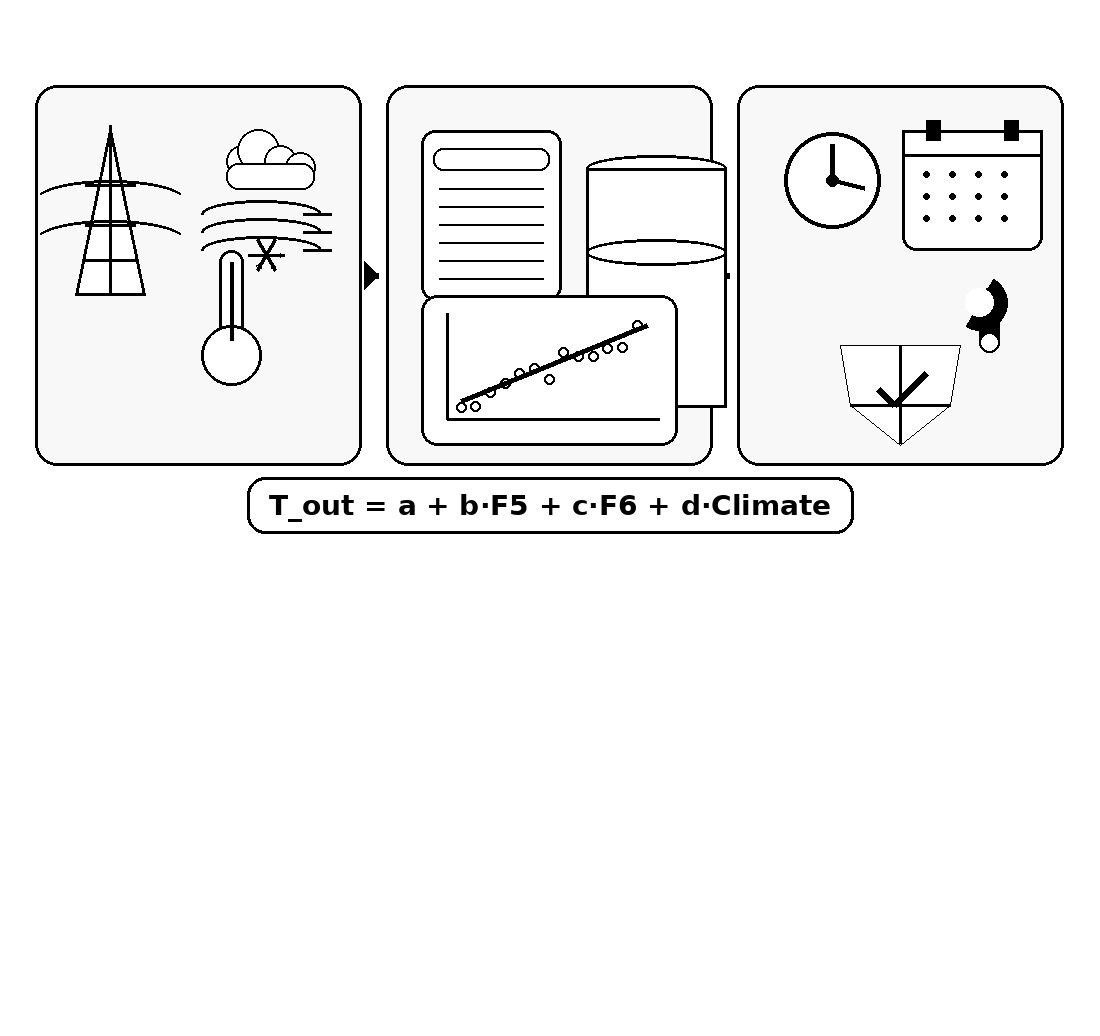
The object of the study is the power supply system of the mining enterprise Nova-Zinc LLP, located in Central region of Republic of Kazakhstan, which specializes in the extraction and enrichment of lead-zinc ores. Reliable power supply in mining is challenged by heavy mechanical loads, vibration, and severe weather; this case study is used only as an example of conditions common in many mining regions worldwide. This study proposes a diagnostic-and-forecasting method for distribution power systems based on routinely available operational records and climatic indicators. The method was tested using outage data from 2020–2024. Using least squares, a multivariate regression model was obtained for feeder emergency outage duration as a function of cable damage (F5), transformer failure (F6), and the climatic factor (Climate). The model is significant overall (F-test p < 0.01) and explains 68.7% of downtime variation (R2 = 0.687); residual diagnostics indicate normality and no autocorrelation. The average marginal effects are 7.561 h for cable failures, 3.314 h for transformer failures, and 2.418 h for climatic impacts, highlighting cables as the dominant driver of prolonged outages. To assess energy performance, a separate model was built for the loss share in the power system as a function of outage duration, phase clashing (F3), and Climate. This loss model has low explanatory power (R2 = 0.2013) and non-significant factor coefficients (p > 0.05). Finally, bivariate regressions show that Climate strongly affects phase clashing (F3) (R2 = 0.793) and moderately affects ground faults (F1) and insulator chipping (F2) (R2 = 0.533 each). The proposed method supports maintenance prioritization, climate-mitigation measures, and continuous updating as new outage records are added, strengthening decision-making and system robustness
References
- Government of the Republic of Kazakhstan. Resolution No. 264 of March 28, 2023: On the approval of the Concept for the development of energy saving and energy efficiency in the Republic of Kazakhstan for 2023–2029. Available at: https://adilet.zan.kz/rus/docs/P2300000264?utm_source=chatgpt.com
- Khan, M. A. M. (2025). AI and machine learning in transformer fault diagnosis: a systematic review. American Journal of Advanced Technology and Engineering Solutions, 1 (01), 290–318. https://doi.org/10.63125/sxb17553
- Betti, A., Lo Trovato, M. L., Leonardi, F. S., Leotta, G., Ruffini, F., Lanzetta, C. (2019). Predictive Maintenance in Photovoltaic Plants with a Big Data Approach. arXiv. https://doi.org/10.48550/arXiv.1901.10855
- Ding, F., Ma, Y., Li, X., Huang, J. (2025). Research on digital twin diagnosis model for the thermal-electric field of high-voltage switchgears. https://doi.org/10.21203/rs.3.rs-6651594/v1
- Baker, E., Nese, S. V., Dursun, E. (2023). Hybrid Condition Monitoring System for Power Transformer Fault Diagnosis. Energies, 16 (3), 1151. https://doi.org/10.3390/en16031151
- Rojas, L., Peña, Á., Garcia, J. (2025). AI-Driven Predictive Maintenance in Mining: A Systematic Literature Review on Fault Detection, Digital Twins, and Intelligent Asset Management. Applied Sciences, 15 (6), 3337. https://doi.org/10.3390/app15063337
- Kim, H., Kim, J.-K., Song, J., Lee, J., Han, K., Shin, J. et al. (2019). Smart and Green Substation: Shaping the Electric Power Grid of Korea. IEEE Power and Energy Magazine, 17 (4), 24–34. https://doi.org/10.1109/mpe.2019.2909792
- Maican, C. A., Pană, C. F., Pătrașcu-Pană, D. M., Rădulescu, V. M. (2025). Review of Fault Detection and Diagnosis Methods in Power Plants: Algorithms, Architectures, and Trends. Applied Sciences, 15 (11), 6334. https://doi.org/10.3390/app15116334
- Hasan, A., Salvo Rossi, P. (2025). A unified sensor and actuator fault diagnosis in digital twins for remote operations. Mechanical Systems and Signal Processing, 222, 111778. https://doi.org/10.1016/j.ymssp.2024.111778
- Porawagamage, G., Dharmapala, K., Chaves, J. S., Villegas, D., Rajapakse, A. (2024). A review of machine learning applications in power system protection and emergency control: opportunities, challenges, and future directions. Frontiers in Smart Grids, 3. https://doi.org/10.3389/frsgr.2024.1371153
- Liu, W., Han, B., Zheng, A., Zheng, Z., Chen, S., Jia, S. (2024). Fault diagnosis of reducers based on digital twins and deep learning. Scientific Reports, 14 (1). https://doi.org/10.1038/s41598-024-75112-x
- Abilzhanova, F., Bulatbaev, F., Kuanyshtaeva, A. (2025). Development of a method for reliability assessment of distribution power networks up to 110 kV. Eastern-European Journal of Enterprise Technologies, 1 (8 (133)), 15–23. https://doi.org/10.15587/1729-4061.2025.322920
- Nova Zinc LLP. Available at: http://novazinc.kz/
- Nova Zinc LLP. Kazakhstan Mining Group. Available at: https://kazmininggroup.kz/company/partners/zn-pb/
- Telbayeva, S., Nurmaganbetova, G., Avdeyev, L., Kaverin, V., Issenov, S., Janiszewski, D. et al. (2024). Development of mathematical models of power consumption at coal plants. Eastern-European Journal of Enterprise Technologies, 5 (8 (131)), 22–32. https://doi.org/10.15587/1729-4061.2024.313932
- Breido, I. V., Sichkarenko, A. V., Kotov, E. S. (2013). Emergency control of technological environment and electric machinery activity in coal mines. Journal of Mining Science, 49 (2), 338–342. https://doi.org/10.1134/s1062739149020172
Downloads
Published
How to Cite
Issue
Section
License
Copyright (c) 2026 Aizada Kuanyshtaeva, Yevgeniy Kotov, Karshiga Smagulova, Fariza Abilzhanova

This work is licensed under a Creative Commons Attribution 4.0 International License.
The consolidation and conditions for the transfer of copyright (identification of authorship) is carried out in the License Agreement. In particular, the authors reserve the right to the authorship of their manuscript and transfer the first publication of this work to the journal under the terms of the Creative Commons CC BY license. At the same time, they have the right to conclude on their own additional agreements concerning the non-exclusive distribution of the work in the form in which it was published by this journal, but provided that the link to the first publication of the article in this journal is preserved.
A license agreement is a document in which the author warrants that he/she owns all copyright for the work (manuscript, article, etc.).
The authors, signing the License Agreement with TECHNOLOGY CENTER PC, have all rights to the further use of their work, provided that they link to our edition in which the work was published.
According to the terms of the License Agreement, the Publisher TECHNOLOGY CENTER PC does not take away your copyrights and receives permission from the authors to use and dissemination of the publication through the world's scientific resources (own electronic resources, scientometric databases, repositories, libraries, etc.).
In the absence of a signed License Agreement or in the absence of this agreement of identifiers allowing to identify the identity of the author, the editors have no right to work with the manuscript.
It is important to remember that there is another type of agreement between authors and publishers – when copyright is transferred from the authors to the publisher. In this case, the authors lose ownership of their work and may not use it in any way.







