Development of a concept of gravity energy storage systems based on discontinued wells
DOI:
https://doi.org/10.15587/1729-4061.2026.352876Keywords:
gravity energy storage, wells, renewable energy sources, load-storage unitAbstract
The object of the study is the well gravity energy storage system (WellGES) implemented in a vertical oil and gas well. The system consists of a heavy load suspended on steel cables that moves along the shaft of a discontinued well to convert potential energy into electrical energy via generators. The inherent instability of renewable energy sources requires the implementation of grid balancing technologies and peak load coverage.
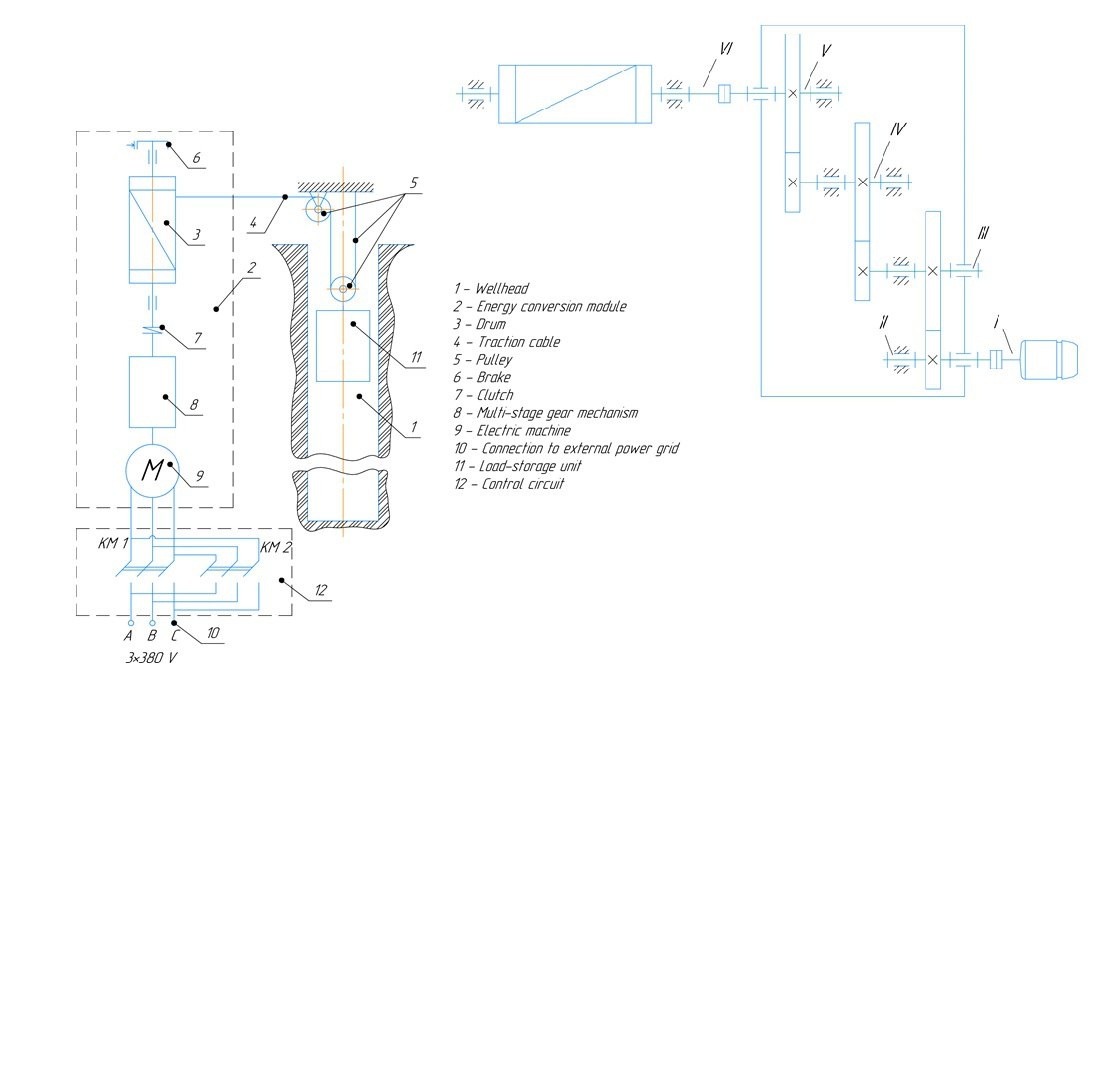
A concept is proposed that involves using the great depth of decommissioned oil and gas wells for gravity energy storage, as well as the feasibility of using such technology for large-scale energy storage.
The well gravity energy storage system converts excess electrical energy into potential mechanical energy. This conversion is carried out by lifting a load-storage unit that moves freely along the wellbore using a cable and a drum with an electric machine operating in engine mode. When the load is lowered, the electric machine switches to regenerative braking mode, returning the stored energy to the power grid.
The advantages of the well gravity energy storage system over existing similar systems have been identified. In particular, the use of a significant height difference (deep wells), lower capital investments due to the use of ready-made objects, environmental safety, and independence from atmospheric conditions. Kinematic and power calculations of the system are carried out, including determining energy consumption, calculation of the hoist, selection of an electric machine and gear ratio of a multi-stage mechanism. Using the example of well No. 64 – Dolyna (depth 2000 m, load 4000 kg), it was calculated that the battery capacity is 22 kWh, which confirms the possibility of implementing the system
References
- Cai, K., Han, Y., Xia, R., Wu, J., Wang, J., Lund, P. D. (2024). Gravity Energy Storage: A Review on System Types, Techno‐Economic Assessment and Integration With Renewable Energy. WIREs Energy and Environment, 13 (6). https://doi.org/10.1002/wene.543
- Tong, W., Lu, Z., Chen, W., Han, M., Zhao, G., Wang, X., Deng, Z. (2022). Solid gravity energy storage: A review. Journal of Energy Storage, 53, 105226. https://doi.org/10.1016/j.est.2022.105226
- Wang, R., Zhang, L., Shi, C., Zhao, C. (2025). A Review of Gravity Energy Storage. Energies, 18 (7), 1812. https://doi.org/10.3390/en18071812
- Hunt, J. D., Zakeri, B., Falchetta, G., Nascimento, A., Wada, Y., Riahi, K. (2020). Mountain Gravity Energy Storage: A new solution for closing the gap between existing short- and long-term storage technologies. Energy, 190, 116419. https://doi.org/10.1016/j.energy.2019.116419
- Berrada, A., Emrani, A., Ameur, A. (2021). Life-cycle assessment of gravity energy storage systems for large-scale application. Journal of Energy Storage, 40, 102825. https://doi.org/10.1016/j.est.2021.102825
- Berrada, A. (2022). Financial and economic modeling of large-scale gravity energy storage system. Renewable Energy, 192, 405–419. https://doi.org/10.1016/j.renene.2022.04.086
- Berrada, A., Loudiyi, K., Zorkani, I. (2017). System design and economic performance of gravity energy storage. Journal of Cleaner Production, 156, 317–326. https://doi.org/10.1016/j.jclepro.2017.04.043
- Botha, C. D., Kamper, M. J. (2019). Capability study of dry gravity energy storage. Journal of Energy Storage, 23, 159–174. https://doi.org/10.1016/j.est.2019.03.015
- Bowoto, O. K., Emenuvwe, O. P., Azadani, M. N. (2021). Gravitricity based on solar and gravity energy storage for residential applications. International Journal of Energy and Environmental Engineering, 12 (3), 503–516. https://doi.org/10.1007/s40095-021-00393-1
- Emrani, A., Berrada, A., Arechkik, A., Bakhouya, M. (2022). Improved techno-economic optimization of an off-grid hybrid solar/wind/gravity energy storage system based on performance indicators. Journal of Energy Storage, 49, 104163. https://doi.org/10.1016/j.est.2022.104163
- Tong, W., Lu, Z., Zhao, H., Han, M., Zhao, G., Hunt, J. D. (2023). The structure and control strategies of hybrid solid gravity energy storage system. Journal of Energy Storage, 67, 107570. https://doi.org/10.1016/j.est.2023.107570
- Hunt, J. D., Nascimento, A., Zakeri, B., Jurasz, J., Dąbek, P. B., Barbosa, P. S. F. et al. (2022). Lift Energy Storage Technology: A solution for decentralized urban energy storage. Energy, 254, 124102. https://doi.org/10.1016/j.energy.2022.124102
- Zakeri, B., Syri, S. (2015). Electrical energy storage systems: A comparative life cycle cost analysis. Renewable and Sustainable Energy Reviews, 42, 569–596. https://doi.org/10.1016/j.rser.2014.10.011
- Break Through with G-VAULT™ - Gravity Energy Storage. Energy Vault. Available at: https://www.energyvault.com/products/g-vault-gravity-energy-storage
Downloads
Published
How to Cite
Issue
Section
License
Copyright (c) 2026 Oleg Vytyaz, Ruslan Rachkevych, Ivan Petryk, Eduard Velikanov

This work is licensed under a Creative Commons Attribution 4.0 International License.
The consolidation and conditions for the transfer of copyright (identification of authorship) is carried out in the License Agreement. In particular, the authors reserve the right to the authorship of their manuscript and transfer the first publication of this work to the journal under the terms of the Creative Commons CC BY license. At the same time, they have the right to conclude on their own additional agreements concerning the non-exclusive distribution of the work in the form in which it was published by this journal, but provided that the link to the first publication of the article in this journal is preserved.
A license agreement is a document in which the author warrants that he/she owns all copyright for the work (manuscript, article, etc.).
The authors, signing the License Agreement with TECHNOLOGY CENTER PC, have all rights to the further use of their work, provided that they link to our edition in which the work was published.
According to the terms of the License Agreement, the Publisher TECHNOLOGY CENTER PC does not take away your copyrights and receives permission from the authors to use and dissemination of the publication through the world's scientific resources (own electronic resources, scientometric databases, repositories, libraries, etc.).
In the absence of a signed License Agreement or in the absence of this agreement of identifiers allowing to identify the identity of the author, the editors have no right to work with the manuscript.
It is important to remember that there is another type of agreement between authors and publishers – when copyright is transferred from the authors to the publisher. In this case, the authors lose ownership of their work and may not use it in any way.







